10th Budget of Yogi Adityanath: How the BJP rebuilt UP’s education, health, infrastructure and jobs after the misrule of Akhilesh Yadav
Over the past ten years, Uttar Pradesh’s budget story has seen a dramatic shift. A comparison between the 2016-17 budget presented by Akhilesh Yadav and the 2026-27 budget, which is the 10th budget of Yogi Adityanath, shows how the state’s political and economic thinking has shifted. A budget is not just about numbers. It shows what a government wants to prioritise and how it plans to shape the future. Looking at the figures and schemes from both periods makes it clear that the approach has changed from limited expansion and subsidy-based support to large investments and system-building. Budget size in 10 years In 2016-17, the final budget of the Akhilesh Yadav government stood at around ₹3,46,935 crore. At that time, it was called the biggest budget in the state’s history. The government highlighted expressways, laptop distribution and rural schemes as its development model. However, a large part of the spending went into revenue expenditure and planned announcements. In 2026-27, the Yogi Adityanath government presented a budget of about ₹9.13 lakh crore, nearly two and a half times more than a decade ago. The rise is linked not just to inflation but to big spending on roads, expressways, industrial corridors, energy and major infrastructure projects. Capital expenditure alone is pegged at ₹2.52 lakh crore, which is around 22% of the total budget. The focus now is on building long-term assets rather than only announcing schemes. Infrastructure: From rural roads to expressway network In 2016-17, the Public Works Department (PWD) received ₹14,721 crore. This included ₹1,923 crore for rural road connectivity, ₹1,111 crore under the Pradhan Mantri Gram Sadak Yojana (PMGSY), and ₹1,180 crore for rural bridges. Projects like the Bijnor-Meerut four-lane road and the Ganga Bridge were highlighted. The emphasis was largely on rural roads and basic connectivity. In 2026-27, the allocation for PWD has jumped to ₹34,468 crore, while total capital outlay for roads and bridges stands at ₹38,343 crore, about 2.3 times more than in 2016-17. ₹1,050 crore has been set aside for four expressways: Ganga Expressway, Vindhya Expressway, Bundelkhand-Rewa Link Expressway and the Agra-Lucknow Expressway Extension. ₹3,000 crore has been kept for bridge maintenance and ₹200 crore for the Chief Minister’s Village Road Repair Scheme. The Global Investors Summit is targeting ₹36 lakh crore in MoUs, with infrastructure as the biggest attraction. Other infrastructure differences are also visible. In 2016-17, the Lucknow Metro was launched, plans for a bullet train were discussed, 40,000 solar streetlights were installed, and rural tanks and canals were constructed. In 2026-27, ₹50 crore has been provided for the Lucknow Metro extension, the bullet train project has seen updates, and ₹25,400 crore has been allocated for urban development, including ₹400 crore for smart cities and ₹800 crore for green roads. Health: From basic care to medical expansion In 2016-17, the Medical Health and Family Welfare Department received about ₹8,500 crore, which was around 2.5% of the total budget. ₹100 crore was set aside for mobile medical units in remote areas. Over ₹3,000 crore was allocated for rural health services under the NRHM. ₹500 crore was for repair and equipment in district hospitals, ₹200 crore for reducing infant mortality, and ₹300 crore for a malnutrition-free Uttar Pradesh. The state had 36 medical colleges at that time. In 2026-27, the health budget has reached ₹37,956 crore, nearly 4.5 times higher and around 6% of the total budget. ₹1,023 crore has been allocated for 14 new medical colleges. ₹315 crore has been set aside for the Lucknow Cancer Institute and ₹130 crore for free treatment of serious diseases. The NRHM allocation has increased to ₹8,641 crore. ₹2,000 crore has been kept for Ayushman Bharat and the Chief Minister’s Jan Arogya Yojana, expected to benefit 49.22 lakh families. Medical education has expanded sharply. MBBS seats have increased from 4,540 to 12,800, PG seats from 1,221 to 4,995, and medical colleges from 36 to 81, of which 45 are government-run. Institutional deliveries have gone up from 3.474 million to 4.1 million. Mental health programmes are running in 75 districts, and disease tracking has been digitised through a surveillance portal. Education and jobs In 2016-17, education received around ₹28,000 crore, about 8% of the budget. More than ₹12,000 crore went to basic education. ₹5,000 crore was for secondary education, including 100 new Kasturba Gandhi Vidyalayas. ₹2,500 crore was for higher education. Around 1.5 million students received laptops. ₹300 crore was for the Chief Minister’s Meritorious Student Scheme and scholarships for 25 lakh students. ₹100 crore was set aside for Sanskrit schools. In 2026-27, education’s share has risen to 12.4%, with an allocation of about ₹1.13 lakh crore, nearly four times higher. 57 new Chief Minister Mode
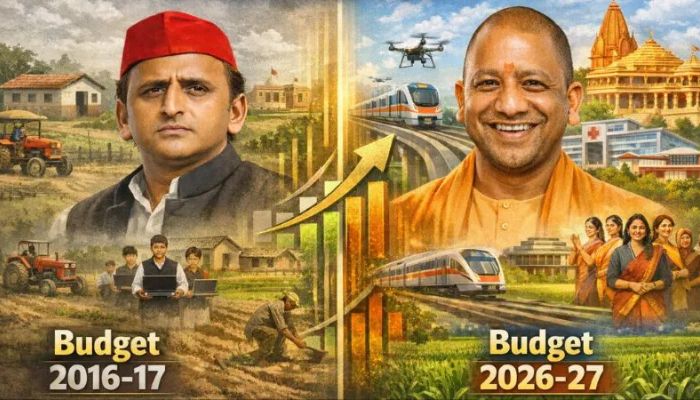

Over the past ten years, Uttar Pradesh’s budget story has seen a dramatic shift. A comparison between the 2016-17 budget presented by Akhilesh Yadav and the 2026-27 budget, which is the 10th budget of Yogi Adityanath, shows how the state’s political and economic thinking has shifted.
A budget is not just about numbers. It shows what a government wants to prioritise and how it plans to shape the future. Looking at the figures and schemes from both periods makes it clear that the approach has changed from limited expansion and subsidy-based support to large investments and system-building.
Budget size in 10 years
In 2016-17, the final budget of the Akhilesh Yadav government stood at around ₹3,46,935 crore. At that time, it was called the biggest budget in the state’s history. The government highlighted expressways, laptop distribution and rural schemes as its development model. However, a large part of the spending went into revenue expenditure and planned announcements.
In 2026-27, the Yogi Adityanath government presented a budget of about ₹9.13 lakh crore, nearly two and a half times more than a decade ago. The rise is linked not just to inflation but to big spending on roads, expressways, industrial corridors, energy and major infrastructure projects.
Capital expenditure alone is pegged at ₹2.52 lakh crore, which is around 22% of the total budget. The focus now is on building long-term assets rather than only announcing schemes.
Infrastructure: From rural roads to expressway network
In 2016-17, the Public Works Department (PWD) received ₹14,721 crore. This included ₹1,923 crore for rural road connectivity, ₹1,111 crore under the Pradhan Mantri Gram Sadak Yojana (PMGSY), and ₹1,180 crore for rural bridges. Projects like the Bijnor-Meerut four-lane road and the Ganga Bridge were highlighted. The emphasis was largely on rural roads and basic connectivity.
In 2026-27, the allocation for PWD has jumped to ₹34,468 crore, while total capital outlay for roads and bridges stands at ₹38,343 crore, about 2.3 times more than in 2016-17.
₹1,050 crore has been set aside for four expressways: Ganga Expressway, Vindhya Expressway, Bundelkhand-Rewa Link Expressway and the Agra-Lucknow Expressway Extension. ₹3,000 crore has been kept for bridge maintenance and ₹200 crore for the Chief Minister’s Village Road Repair Scheme.
The Global Investors Summit is targeting ₹36 lakh crore in MoUs, with infrastructure as the biggest attraction.
Other infrastructure differences are also visible. In 2016-17, the Lucknow Metro was launched, plans for a bullet train were discussed, 40,000 solar streetlights were installed, and rural tanks and canals were constructed. In 2026-27, ₹50 crore has been provided for the Lucknow Metro extension, the bullet train project has seen updates, and ₹25,400 crore has been allocated for urban development, including ₹400 crore for smart cities and ₹800 crore for green roads.
Health: From basic care to medical expansion
In 2016-17, the Medical Health and Family Welfare Department received about ₹8,500 crore, which was around 2.5% of the total budget. ₹100 crore was set aside for mobile medical units in remote areas. Over ₹3,000 crore was allocated for rural health services under the NRHM. ₹500 crore was for repair and equipment in district hospitals, ₹200 crore for reducing infant mortality, and ₹300 crore for a malnutrition-free Uttar Pradesh. The state had 36 medical colleges at that time.
In 2026-27, the health budget has reached ₹37,956 crore, nearly 4.5 times higher and around 6% of the total budget.
₹1,023 crore has been allocated for 14 new medical colleges. ₹315 crore has been set aside for the Lucknow Cancer Institute and ₹130 crore for free treatment of serious diseases. The NRHM allocation has increased to ₹8,641 crore. ₹2,000 crore has been kept for Ayushman Bharat and the Chief Minister’s Jan Arogya Yojana, expected to benefit 49.22 lakh families.
Medical education has expanded sharply. MBBS seats have increased from 4,540 to 12,800, PG seats from 1,221 to 4,995, and medical colleges from 36 to 81, of which 45 are government-run.
Institutional deliveries have gone up from 3.474 million to 4.1 million. Mental health programmes are running in 75 districts, and disease tracking has been digitised through a surveillance portal.
Education and jobs
In 2016-17, education received around ₹28,000 crore, about 8% of the budget. More than ₹12,000 crore went to basic education. ₹5,000 crore was for secondary education, including 100 new Kasturba Gandhi Vidyalayas. ₹2,500 crore was for higher education. Around 1.5 million students received laptops. ₹300 crore was for the Chief Minister’s Meritorious Student Scheme and scholarships for 25 lakh students. ₹100 crore was set aside for Sanskrit schools.
In 2026-27, education’s share has risen to 12.4%, with an allocation of about ₹1.13 lakh crore, nearly four times higher.
57 new Chief Minister Model Composite Schools are being built, each with ₹25 crore for construction and ₹5 crore for equipment. ₹2,000 crore has been allocated for basic education infrastructure, ₹666 crore for Samagra Shiksha Abhiyan, ₹479 crore for government higher secondary school buildings, and ₹454 crore for digital libraries in villages.
₹300 crore has been kept for the PM Shri scheme and ₹10 crore for smart classes in polytechnics. Higher education includes ₹600 crore under the Prime Minister’s Higher Education Mission, a scooty scheme for girls, ₹25 crore each for Sainik Schools in Gorakhpur and Lucknow, and ₹20 crore for Sanskrit scholarships.
On employment, 2016-17 had ₹4,500 crore under MNREGA and a target to train 5 lakh youth. ₹1,000 crore was provided as a loan guarantee for MSMEs.
In 2026-27, the Tech Yuva Samarth Yuva Yojana aims to create 10 lakh jobs. The ₹36 lakh crore MoUs from the Global Investors Summit aim to generate 20 lakh jobs. ₹1,000 crore has been allocated for a startup fund and ₹2,500 crore for skill development, targeting the training of 1 crore youth. IT parks and electronics hubs are being promoted, along with unemployment allowance schemes.
Agriculture: From subsidy support to modern farming
In 2016-17, agriculture got around ₹12,500 crore, about 3.6% of the budget. ₹1,200 crore went for irrigation pump subsidies, ₹800 crore for seeds and fertilisers, ₹2,500 crore for MSP procurement, ₹100 crore for Farmers Accident Insurance, ₹200 crore for rural cow shelters and ₹150 crore for the Chief Minister’s Farmer Accident Welfare Scheme.
In 2026-27, agriculture received nearly ₹1 lakh crore, around 11% of the total budget.
₹2,000 crore has been allocated for PM Kisan Samman Nidhi to benefit 2.5 crore farmers. ₹5,000 crore has been kept for Mukhyamantri Krishak Samriddhi Yojana. ₹3,200 crore is for crop diversification and horticulture. ₹500 crore has been set aside under the Drone Didi Yojana to provide 10,000 drones. ₹1,000 crore is for organic farming clusters in 50 districts.
₹2,500 crore is for cold chains and warehouses. ₹10,000 crore has been earmarked for MSP procurement to benefit 50 lakh wheat and paddy farmers. ₹4,000 crore has been allocated for animal husbandry and ₹800 crore for fisheries. Agricultural investment worth ₹10 lakh crore is being discussed through the Global Investors Summit.
Tourism: From limited promotion to global branding
In 2016-17, tourism received ₹800-1,000 crore, about 0.3% of the budget. ₹307 crore was for development of historical and religious sites. The Lucknow-Agra Expressway was linked to tourism growth. The Kumbh Mela and Sangam region were also developed. Tourist numbers were around 23 crore annually.
₹1,500 crore has been earmarked for Ayodhya and the Ram Temple development. ₹800 crore is for the Kumbh Mela and related infrastructure in Prayagraj. ₹200 crore has been set aside for helicopter tours and cruise tourism. ₹500 crore is for branding in 75 districts under ODOP 2.0. Tourism investment of ₹5 lakh crore has been announced through the Global Investors Summit.
Women: From assistance to wide coverage
In 2016-17, around ₹2,000 crore was allocated for women’s welfare, about 0.6% of the budget. ₹200 crore went to Kanya Vivah Sahayata Yojana. ₹300 crore was for nutrition schemes. ₹400 crore supported self-help groups. Around 10 lakh girls were targeted.
In 2026-27, more than ₹15,000 crore has been allocated for women and girls, about 1.6% of the total budget.
₹700 crore has been set aside for the Chief Minister Kanya Sumangala Yojana, targeting 25 lakh beneficiaries. ₹550 crore is for the Chief Minister’s Mass Marriage Scheme. ₹150 crore is for marriage grants for poor daughters of SC, ST and general categories, and ₹200 crore for backward class daughters.
₹971 crore has been allocated for Anganwadi workers’ honorarium. ₹170 crore is for working women’s hostels in seven cities. Scholarships include ₹968 crore for SC students, ₹900 crore for the general category, ₹365 crore for minorities and ₹2,825 crore for backward classes. Computer training and a free scooty scheme are also included.
A bigger economic vision
The biggest change between the two budgets is scale and ambition. The 2016-17 budget focused more on limited schemes and support. The 2026-27 budget talks about expressways, 81 medical colleges, higher capital spending, a ₹36 lakh crore MoU target, and the idea of building a trillion-dollar economy.
The message from the current budget is that spending is being linked to long-term assets and growth. Whether this shift fully delivers on its promises will depend on implementation, but the numbers clearly show that Uttar Pradesh’s budget thinking has moved from small steps to a much larger economic framework.