Ambedkar backed Somnath Temple reconstruction: Viral letter to KM Munshi reveals a forgotten chapter of history
It has been 1000 years since Mahmud Ghaznavi attacked the Somnath Temple, India’s pride, standing proudly on the seashore in Gujarat. The state of Gujarat is set to celebrate the Somnath Swabhiman Parv on 8th January. Ahead of the big day, the history of the Somnath Temple has piqued the interest of many. A letter written by Dr Bhimrao Ambedkar to Kanhaiyalal Maniklal Munshi, or simply KM Munshi, regarding the temple is going viral on social media. Back in November 1947, Sardar Patel had promised the public that he would rebuild the Somnath Temple. After his death in December 1950, Munshi, the then Food Minister, took on this responsibility and oversaw the Somnath temple’s reconstruction. Ambedkar wrote to Munshi in March 1951, before the consecration of the Jyotirlinga in the new temple by then-President Dr Rajendra Prasad in May 1951. It is no secret that India’s first Prime Minister, Jawaharlal Nehru, was disturbed by the temple’s reconstruction. Nehru even opposed the proposal to rebuild the Somnath Temple, calling it “Hindu revivalism .” Ambedkar’s letter, meanwhile, makes it clear that he not only supported the temple’s reconstruction but also offered his suggestions. What Ambedkar wrote in the letter to KM Munshi? A section of people today portrays Ambedkar as anti-Hindu, but this letter offers a new perspective. Anuj Dhar, author of popular books like “Conundrum ” and “Your Prime Minister is Dead, ” shared this letter on X. “I find that the date for the installation of the Idol of Somnath is fixed on the 11th of May. I would very much like you to invite my friend Mr Anirudhachary to the ceremony. He is the Head of the Matha in Chandoda in Baroda District. I know personally and do not doubt that he is worthy of an invitation. I am /attaching herewith his name and full address,” Nehru wrote. Dr B R Ambedkar's letter to KM Munshi concerning the Somnath Temple consecration ceremony. #SomnathTemple pic.twitter.com/PkFfct9qbI— Anuj Dhar (@anujdhar) January 5, 2026 Grok said Ambedkar’s letter to KM Munshi is fake. Is Grok wrong? After Anuj Dhar shared the post, many xAI users began claiming the letter was fake and created by AI. Several users tagged Musk’s company xAI’s chatbot, GROK, and asked questions about the letter, which the chatbot later confirmed as AI-created. “The letter does not appear in Ambedkar’s official writings or historical archives. No prior mentions found in searches before 2026. The name “Antrudhachary” lacks matching historical records for 1951. It appears likely fabricated, possibly AI-generated,” the chatbot wrote in Post X. Subsequently, there was a flood of people claiming that it was created by AI. We spoke to Anuj Dhar himself about this letter. He clearly stated, “The source of all these records is the National Archives. Anyone who thinks these are fake should consult KM Munshi’s papers in the archives.” He also shared other letters related to this letter. This means that relying solely on AI chatbots for information could be problematic. Chatbots can’t read archives because a large portion of historical records don’t even exist in digital form. Archives around the world, not just in India, hold millions of documents on paper, including old government files, private letters, handwritten diaries, reports, and registers. These documents are often neither scanned nor available online. Chatbots can only access content that is already digitised and publicly available. This also presents several challenges, as even the archives that have been digitised are mostly scanned images, not neat text files. They contain ink stains, torn pages, blurred letters, and old scripts. Reading such material requires not only linguistic knowledge but also experience in palaeography and reading historical documents, which is simply not possible for a chatbot. Other letters exchanged between Ambedkar and Munshi about the Somnath idol installation ceremony Anuj Dhar has also shared two other letters related to this letter from Ambedkar: one containing Munshi’s reply to Ambedkar and the other an invitation to Swami Aniruddhacharya. On March 30, 1951, Munshi wrote to Dr Ambedkar, “Thank you for your letter dated 27th March 1951. I shall be very pleased to invite Shri Anirudhachary for the ceremony. I would request you to make it convenient to attend the installation ceremony.” Meanwhile, on 30th March 1951, KM Munshi wrote to Swami Anirudhachary, inviting him to the Somnath idol installation ceremony. “You are perhaps aware that the installation of the Somnath Lingam has been scheduled to be held at Prabhas Patan on the 11th May 1951. At the same time All India Sanskrit Parishad will also be held. We are inviting the heads of all religious institutions and it will be a great pleasure if you will make it convenient to grace the occasion by your presence. You can come a couple of days in advance,” Munshi wrote. After reading these two, in addition to Amb

It has been 1000 years since Mahmud Ghaznavi attacked the Somnath Temple, India’s pride, standing proudly on the seashore in Gujarat. The state of Gujarat is set to celebrate the Somnath Swabhiman Parv on 8th January. Ahead of the big day, the history of the Somnath Temple has piqued the interest of many. A letter written by Dr Bhimrao Ambedkar to Kanhaiyalal Maniklal Munshi, or simply KM Munshi, regarding the temple is going viral on social media.
Back in November 1947, Sardar Patel had promised the public that he would rebuild the Somnath Temple. After his death in December 1950, Munshi, the then Food Minister, took on this responsibility and oversaw the Somnath temple’s reconstruction. Ambedkar wrote to Munshi in March 1951, before the consecration of the Jyotirlinga in the new temple by then-President Dr Rajendra Prasad in May 1951.
It is no secret that India’s first Prime Minister, Jawaharlal Nehru, was disturbed by the temple’s reconstruction. Nehru even opposed the proposal to rebuild the Somnath Temple, calling it “Hindu revivalism .” Ambedkar’s letter, meanwhile, makes it clear that he not only supported the temple’s reconstruction but also offered his suggestions.
What Ambedkar wrote in the letter to KM Munshi?
A section of people today portrays Ambedkar as anti-Hindu, but this letter offers a new perspective. Anuj Dhar, author of popular books like “Conundrum ” and “Your Prime Minister is Dead, ” shared this letter on X.
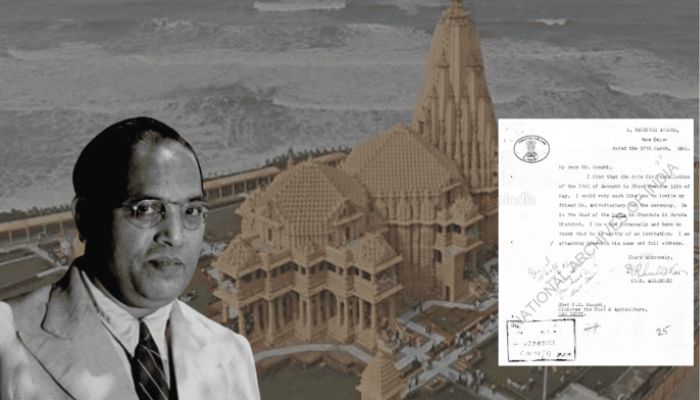
“I find that the date for the installation of the Idol of Somnath is fixed on the 11th of May. I would very much like you to invite my friend Mr Anirudhachary to the ceremony. He is the Head of the Matha in Chandoda in Baroda District. I know personally and do not doubt that he is worthy of an invitation. I am /attaching herewith his name and full address,” Nehru wrote.
Dr B R Ambedkar's letter to KM Munshi concerning the Somnath Temple consecration ceremony. #SomnathTemple pic.twitter.com/PkFfct9qbI
— Anuj Dhar (@anujdhar) January 5, 2026
Grok said Ambedkar’s letter to KM Munshi is fake. Is Grok wrong?
After Anuj Dhar shared the post, many xAI users began claiming the letter was fake and created by AI. Several users tagged Musk’s company xAI’s chatbot, GROK, and asked questions about the letter, which the chatbot later confirmed as AI-created.
“The letter does not appear in Ambedkar’s official writings or historical archives. No prior mentions found in searches before 2026. The name “Antrudhachary” lacks matching historical records for 1951. It appears likely fabricated, possibly AI-generated,” the chatbot wrote in Post X.
Subsequently, there was a flood of people claiming that it was created by AI. We spoke to Anuj Dhar himself about this letter. He clearly stated, “The source of all these records is the National Archives. Anyone who thinks these are fake should consult KM Munshi’s papers in the archives.” He also shared other letters related to this letter.
This means that relying solely on AI chatbots for information could be problematic. Chatbots can’t read archives because a large portion of historical records don’t even exist in digital form. Archives around the world, not just in India, hold millions of documents on paper, including old government files, private letters, handwritten diaries, reports, and registers. These documents are often neither scanned nor available online. Chatbots can only access content that is already digitised and publicly available.
This also presents several challenges, as even the archives that have been digitised are mostly scanned images, not neat text files. They contain ink stains, torn pages, blurred letters, and old scripts. Reading such material requires not only linguistic knowledge but also experience in palaeography and reading historical documents, which is simply not possible for a chatbot.
Other letters exchanged between Ambedkar and Munshi about the Somnath idol installation ceremony
Anuj Dhar has also shared two other letters related to this letter from Ambedkar: one containing Munshi’s reply to Ambedkar and the other an invitation to Swami Aniruddhacharya. On March 30, 1951, Munshi wrote to Dr Ambedkar, “Thank you for your letter dated 27th March 1951. I shall be very pleased to invite Shri Anirudhachary for the ceremony. I would request you to make it convenient to attend the installation ceremony.”
Meanwhile, on 30th March 1951, KM Munshi wrote to Swami Anirudhachary, inviting him to the Somnath idol installation ceremony. “You are perhaps aware that the installation of the Somnath Lingam has been scheduled to be held at Prabhas Patan on the 11th May 1951. At the same time All India Sanskrit Parishad will also be held. We are inviting the heads of all religious institutions and it will be a great pleasure if you will make it convenient to grace the occasion by your presence. You can come a couple of days in advance,” Munshi wrote.

After reading these two, in addition to Ambedkar’s letter, Anuj Dhar’s claim that this letter is not a single one created by AI, but rather a series of letters, is borne out. This also exposes those who seek to portray Ambedkar as anti-Hindu.