Argentina vs England match will be more than just football, because Messi’s team sings ‘Por Malvinas’
Wednesday at Atlanta’s Mercedes‑Benz Stadium will be packed, and something old will stir along with it. Lionel Messi, thirty nine and still chasing a fourth star for that shirt, will walk out for what might be his last World Cup semi‑final. Opposite him are England, carried by Jude Bellingham’s boots and Harry Kane’s early goals, three points from a final they’ve already begun planning for. What England’s FA will carefully leave out of the match programme is this. After they beat Switzerland, and after that ridiculous comeback against Egypt, the Argentina players did what they always do now when they win, they sang. Not the national anthem but they belted out La Cuarta Estrella, the song written specially for this World Cup, the one that reaches straight back to Maradona and forward to Messi and never once forgets to name the islands Argentina still calls the Malvinas (Falkland Islands). The dressing room line is pure and blunt, ‘Por Malvinas, por el Diego, por la última de Leo’ FIFA, the same body that had just confiscated England flags for ‘political imagery,’ watched the whole thing and said nothing. Funny how the rules work when it suits them. So no, this is not just a football match. It never was. Letra completa. “Por Malvinas, por el Diego”Soy hincha de la SelecciónLa aliento con el corazónGanamos la tercera con LionelQueremos ser campeones otra vezY 32 años despuésLa Scaloneta va a vengarLa Copa que le robaron al diezLa que no nos dejaron levantarQuiero ver la…— Ochoita (@OchoitaSoy) July 8, 2026 1833: The year England stole a doorstep Let’s finally set the record straight, because Britain has spent the better part of two centuries polishing a comfortable fiction. These islands belonged to Spain. When Argentina declared independence in 1816 it inherited Spanish territory the same way every new republic in the Americas did, under the legal principle that international lawyers still recognise today, uti possidetis juris. Uti possidetis juris is simply the rule of customary international law that when a colony becomes a country, it keeps the borders it already had under the colonial power on the day of independence. It was invented for one reason: to stop the European empires from slicing up the Americas the moment Spain fell apart, and it is still the basis for nearly every border drawn across Latin America. Buenos Aires formally claimed the islands in 1820. From 1826 a settler named Luis Vernet, with the explicit backing of the Argentine government, built a real, functioning colony there. Then, on 3 January 1833, a Royal Navy sloop called HMS Clio dropped anchor in Port Louis. Its captain simply told the Argentine commander, José María Pinedo, to haul down his flag and leave. Pinedo had only a handful of men, several of them British born, and no realistic chance of resistance. He lodged a formal written protest and sailed away two days later. That is the entire story of how Britain ‘acquired’ the Falklands. No treaty, no purchase, just a warship and an order to get out. Argentina never accepted it. Not for a single year, not for a century, and not now. Falklands war, image via Nat Geo Fast forward to 1982. The military junta in Buenos Aires invaded on 2 April, gambling that Britain would never fight for a wind-swept rock eight thousand miles from home. They miscalculated badly. Margaret Thatcher summoned her chiefs of staff. When First Sea Lord Henry Leach told her a task force could be ready within days, she gave the order on the spot. On 5 April, just three days after the invasion, HMS Hermes and HMS Invincible sailed from Portsmouth. They were eventually joined by more than a hundred ships, including the requisitioned ocean liners Queen Elizabeth 2 and Canberra. Even Washington, deep in the Cold War, spent the first crucial days trying to mediate rather than automatically siding with Britain, proof that American support was never as automatic as the later mythology claims. Seventy-four days later, 649 Argentine servicemen, 255 British, and three islanders were dead, and Britain held the islands again, by force, exactly the same way it had taken them in 1833. International Law already ruled, England just won’t read it Here’s the legal case, clean and without the usual British varnish. Argentina inherited the islands from Spain in 1816 under uti possidetis juris, the exact same doctrine that fixed almost every border in Latin America, and recognized as a general principle by the International Court of Justice. Britain seized them by force in 1833. Force has never been a source of legal title, not in the nineteenth century and not now. Argentina has kept the claim alive ever since, bilaterally and at the United Nations, for nearly two hundred years. That is not a country that walked away. That is a country that has never stopped knocking. The United Nations itself still treats this as an open dispute, not a closed book. General Assembly Resolution 2065 of 19
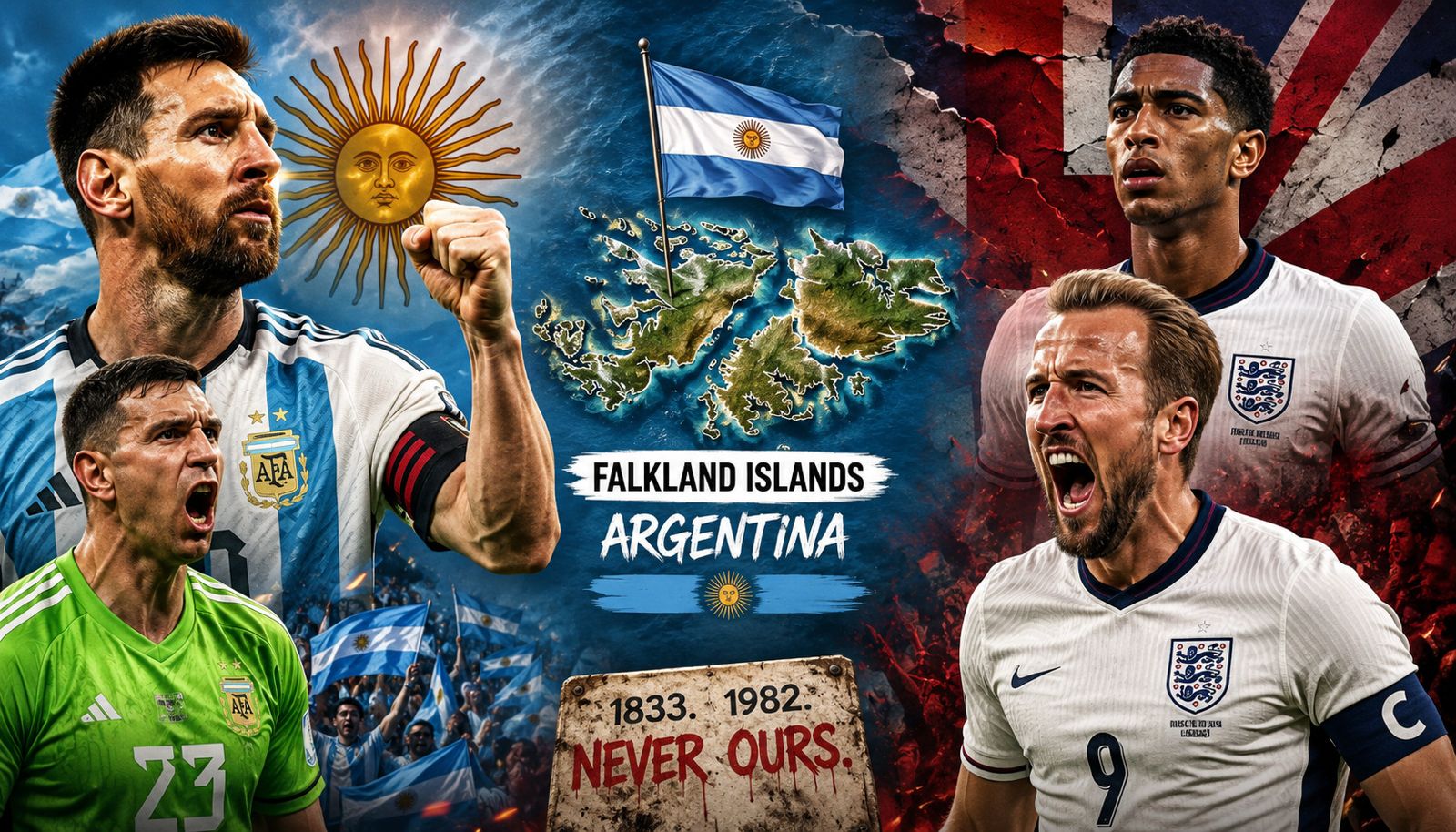
Wednesday at Atlanta’s Mercedes‑Benz Stadium will be packed, and something old will stir along with it. Lionel Messi, thirty nine and still chasing a fourth star for that shirt, will walk out for what might be his last World Cup semi‑final. Opposite him are England, carried by Jude Bellingham’s boots and Harry Kane’s early goals, three points from a final they’ve already begun planning for.
What England’s FA will carefully leave out of the match programme is this. After they beat Switzerland, and after that ridiculous comeback against Egypt, the Argentina players did what they always do now when they win, they sang. Not the national anthem but they belted out La Cuarta Estrella, the song written specially for this World Cup, the one that reaches straight back to Maradona and forward to Messi and never once forgets to name the islands Argentina still calls the Malvinas (Falkland Islands). The dressing room line is pure and blunt, ‘Por Malvinas, por el Diego, por la última de Leo’ FIFA, the same body that had just confiscated England flags for ‘political imagery,’ watched the whole thing and said nothing. Funny how the rules work when it suits them. So no, this is not just a football match. It never was.
Letra completa. “Por Malvinas, por el Diego”Soy hincha de la SelecciónLa aliento con el corazónGanamos la tercera con LionelQueremos ser campeones otra vezY 32 años despuésLa Scaloneta va a vengarLa Copa que le robaron al diezLa que no nos dejaron levantarQuiero ver la…— Ochoita (@OchoitaSoy) July 8, 2026
1833: The year England stole a doorstep
Let’s finally set the record straight, because Britain has spent the better part of two centuries polishing a comfortable fiction.
These islands belonged to Spain. When Argentina declared independence in 1816 it inherited Spanish territory the same way every new republic in the Americas did, under the legal principle that international lawyers still recognise today, uti possidetis juris. Uti possidetis juris is simply the rule of customary international law that when a colony becomes a country, it keeps the borders it already had under the colonial power on the day of independence. It was invented for one reason: to stop the European empires from slicing up the Americas the moment Spain fell apart, and it is still the basis for nearly every border drawn across Latin America.
Buenos Aires formally claimed the islands in 1820. From 1826 a settler named Luis Vernet, with the explicit backing of the Argentine government, built a real, functioning colony there.
Then, on 3 January 1833, a Royal Navy sloop called HMS Clio dropped anchor in Port Louis. Its captain simply told the Argentine commander, José María Pinedo, to haul down his flag and leave. Pinedo had only a handful of men, several of them British born, and no realistic chance of resistance. He lodged a formal written protest and sailed away two days later. That is the entire story of how Britain ‘acquired’ the Falklands. No treaty, no purchase, just a warship and an order to get out.
Argentina never accepted it. Not for a single year, not for a century, and not now.
Falklands war, image via Nat Geo
Fast forward to 1982. The military junta in Buenos Aires invaded on 2 April, gambling that Britain would never fight for a wind-swept rock eight thousand miles from home. They miscalculated badly. Margaret Thatcher summoned her chiefs of staff. When First Sea Lord Henry Leach told her a task force could be ready within days, she gave the order on the spot. On 5 April, just three days after the invasion, HMS Hermes and HMS Invincible sailed from Portsmouth. They were eventually joined by more than a hundred ships, including the requisitioned ocean liners Queen Elizabeth 2 and Canberra. Even Washington, deep in the Cold War, spent the first crucial days trying to mediate rather than automatically siding with Britain, proof that American support was never as automatic as the later mythology claims. Seventy-four days later, 649 Argentine servicemen, 255 British, and three islanders were dead, and Britain held the islands again, by force, exactly the same way it had taken them in 1833.
International Law already ruled, England just won’t read it
Here’s the legal case, clean and without the usual British varnish.
Argentina inherited the islands from Spain in 1816 under uti possidetis juris, the exact same doctrine that fixed almost every border in Latin America, and recognized as a general principle by the International Court of Justice. Britain seized them by force in 1833. Force has never been a source of legal title, not in the nineteenth century and not now. Argentina has kept the claim alive ever since, bilaterally and at the United Nations, for nearly two hundred years. That is not a country that walked away. That is a country that has never stopped knocking.
The United Nations itself still treats this as an open dispute, not a closed book. General Assembly Resolution 2065 of 1965 does not invite Britain to carry on as if nothing happened. It tells both sides to sit down and negotiate a settlement. That call has never been withdrawn. Every year since 1983 the UN Special Committee on Decolonization has passed a fresh version of the same resolution, most recently with not a single vote against it, still describing the islands as an unresolved colonial situation.
Britain’s answer is self determination, the islanders should simply decide. Fair enough, the numbers are clear. In the 2013 referendum 1,513 out of 1,517 voters chose to remain British. No serious person disputes what the current population wants.
But that vote cannot do what Britain needs it to do. The UN’s own decolonization committee has said it in plain language, you cannot use self determination to whitewash an illegal occupation. These people are not an indigenous population freely choosing their destiny. They are the descendants of the settlers Britain brought in after it expelled Argentina’s colony at gunpoint. Ask anyone from the Chagos Islands how that particular defence has aged. Self determination was invented to dismantle colonialism, not to put a notary stamp on it.
An empire that now begs Washington for scraps
They used to say the sun never set on the British Empire. These days it can barely find the light switch. In April a Pentagon mail leaked, reportedly shaped with input from senior adviser Elbridge Colby, that floated the idea of reviewing American support for Britain’s claim to the Falklands. The reason was pure punishment. Britain hadn’t fully lined up behind Washington’s war with Iran, hadn’t handed over the airbases and overflight rights the Pentagon wanted, so its 190-year-old colonial leftover suddenly became a bargaining chip. The Pentagon’s press office didn’t deny the memo existed; it simply refused to discuss ‘internal deliberations.’ British politicians slammed the ranks shut at once, calling the idea nonsense and non-negotiable. One Washington think tanker went further and labelled it disgusting. Imagine having to use that word about your closest ally. The timing made it even uglier. The leak dropped right before King Charles’s state visit to Washington, and palace aides spent days trying to keep the whole trip as far from the subject as possible.
This is a country that once decided, alone, where every line on the map went. Now it needs Washington’s permission just to hang on to the colonies it still has left.
And that is before you look at the economy. The Atlantic ran a long piece this year on how Britain, the nation that built the railways, the factories and half the modern world’s legal system, now produces less per person than Mississippi, America’s poorest state. Take London out of the picture, and the gap gets worse. Junior doctors have walked out repeatedly over starting salaries around £38,800. A high-speed rail line has tripled in cost and still doesn’t reach half the cities it was supposed to serve. The IMF warned this year that Britain faces the sharpest economic shock of any G7 country as the Iran war rattles energy prices. An empire that once coloured a quarter of the map pink can’t currently outearn a state its own comedians use as a punchline.
Keep the islands? Britain can barely keep the lights on.
Football between Argentina and England isn’t just football
In 1972, Bobby Fischer sat across a chessboard from Boris Spassky in Reykjavik, and nobody with half a brain thought it was really about chess. Henry Kissinger personally rang Fischer and told him to play, not for the money, but for his country. The Soviets had held the world title for twenty-four straight years. Losing it to an American wasn’t two hobbyists having a scrap. It was the Cold War reduced to sixty-four squares, and every single person watching understood exactly what was happening.
Nobody was confused about that match. So let’s not suddenly pretend to be confused about this one.
Football between Argentina and England hasn’t been just football since 1982, and it certainly hasn’t been since Diego Maradona stuck his fist in the net four years after the guns went silent and called it justice. Every time the two sides meet, it carries the same freight, flags, memory, a war that never really finished, only paused. Wednesday’s semi-final is the same fixture it’s always been, just wearing a new year’s shirt. Sport doesn’t get to sit politics out. It never has. It’s been a battlefield with better lighting since the day countries first decided to keep score.
Conclusion
So here’s the point, and it isn’t complicated. Argentina should walk out on Wednesday and play like the islands are on the line, because in every way that matters, they are. Beat England. Beat them badly. Give Messi the ending he deserves, let that stadium in Atlanta belt out every verse of the song FIFA is still too nervous to touch, and send England home to add up its shrinking GDP and its borrowed American goodwill. The scoreline is only one thing. The islands are the bigger prize, and international law has been saying so for sixty years. Argentina doesn’t need to ask nicely any more. It’s waited long enough. The Malvinas are Argentina’s. Time really is up.