As India and New Zealand finalise a Free Trade Agreement, read how it will benefit Indian farmers, labour-intensive industries and students
India and New Zealand have announced the conclusion of negotiations on a $1.3 billion Free Trade Agreement (FTA) on Monday (22nd December). The trade deal, aimed at doubling bilateral trade between the two countries over the next five years, is expected to take effect early in 2026. Jointly announced by Indian Prime Minister Modi and New Zealand Prime Minister Christopher Luxon, the agreement was finalised after nine months of negotiations that commenced in March 2025. However, the implementation of the agreement, which has been given a go-ahead by the Indian cabinet, can take another 6 months after it is passed in the New Zealand Parliament. Describing the FTA with New Zealand, PM Modi said that the deal was a “historic milestone” aimed at deepening economic ties between the two countries. “An important moment for India-New Zealand relations, with a strong push to bilateral trade and investment! My friend, PM Christopher Luxon and I had a very good conversation a short while ago following the conclusion of the landmark India-New Zealand Free Trade Agreement. Concluded in just nine months, this historic milestone reflects a strong political will and shared ambition to deepen economic ties between our two countries. This FTA ensures: Enhanced market access, deeper investment flows, numerous opportunities for innovators, entrepreneurs, farmers, MSMEs, students, and youth,” PM Modi wrote on X on Monday. An important moment for India-New Zealand relations, with a strong push to bilateral trade and investment!My friend PM Christopher Luxon and I had a very good conversation a short while ago following the conclusion of the landmark India-New Zealand Free Trade Agreement.…— Narendra Modi (@narendramodi) December 22, 2025 New Zealand PM hailed the trade deal with India as being founded on a strong friendship between the two countries. “I’ve just spoken with India’s Prime Minister Narendra Modi following the conclusion of the NZ-India Free Trade Agreement. The FTA reduces or removes tariffs on 95% of our exports to India. It’s forecast that NZ exports to India could increase from $1.1B to $1.3B per year over the coming two decades. Boosting trade means more Kiwi jobs, higher wages, and more opportunities for hard-working New Zealanders. The agreement builds on the strong friendship between our two countries. India is one of the fastest-growing economies in the world, and this gives Kiwi businesses access to 1.4 billion Indian consumers,” PM Luxon wrote in a post on X on Monday. I’ve just spoken with India’s Prime Minister Narendra Modi following the conclusion of the NZ-India Free Trade Agreement.The FTA reduces or removes tariffs on 95% of our exports to India. It’s forecast that NZ exports to India could increase $1.1B to $1.3B per year over the… pic.twitter.com/FEat7BQWOI— Christopher Luxon (@chrisluxonmp) December 22, 2025 The FTA is the third major trade agreement concluded by India in 2025, following agreements with the UK and Oman. All three trade deals have been made by India with developed economies having higher per-capita incomes, underscoring how India’s trade negotiating capabilities have increased significantly. In recent years, this is the seventh Free Trade Agreement concluded by India, after agreements with the United Arab Emirates, Australia, Mauritius and the European Free Trade Association (EFTA). A key highlight of the entire trade negotiations is that it was India’s first women-led Free Trade Agreement. The Indian negotiating team was almost entirely comprised of women, including the chief negotiator, deputy chief negotiator, leads for goods, services, investment, and the Indian ambassador to New Zealand. Indian labour-intensive sectors to get a boost The trade pact is expected significantly boost the two global economies. The key focus of the deal is job creation for both countries. Under the deal, New Zealand would provide zero-duty access to 100% Indian exports. This stipulation will boost the labour-intensive sectors of India, including textiles, apparel, footwear, marine products, gems and jewellery, handicrafts, and engineering goods. As a result, Indian workers, artisans, women entrepreneurs, youth, and MSMEs engaged in these sectors will benefit from it. Employment opportunities for Indian students and skilled professionals Indian students studying in New Zealand are set to gain significantly under the FTA. The agreement removes numerical caps on Indian students and guarantees at least 20 hours of work a week for the duration of their study. It also provides extended post-study work opportunities up to three years for STEM (Science, Technology, Engineering, and Mathematics) graduates and post-graduates. Additionally, the trade deal offers post-study work opportunities up to four years for Doctorate holders, paving the way for skills development and global careers. “For the first time with any country, New Zealand has created a dedicated pathway for
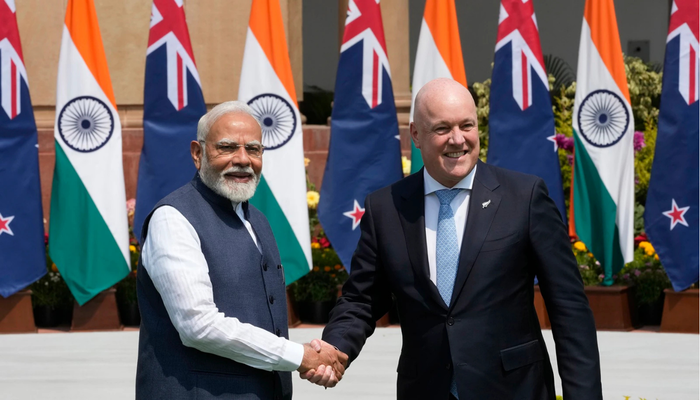

India and New Zealand have announced the conclusion of negotiations on a $1.3 billion Free Trade Agreement (FTA) on Monday (22nd December). The trade deal, aimed at doubling bilateral trade between the two countries over the next five years, is expected to take effect early in 2026. Jointly announced by Indian Prime Minister Modi and New Zealand Prime Minister Christopher Luxon, the agreement was finalised after nine months of negotiations that commenced in March 2025.
However, the implementation of the agreement, which has been given a go-ahead by the Indian cabinet, can take another 6 months after it is passed in the New Zealand Parliament.
Describing the FTA with New Zealand, PM Modi said that the deal was a “historic milestone” aimed at deepening economic ties between the two countries. “An important moment for India-New Zealand relations, with a strong push to bilateral trade and investment! My friend, PM Christopher Luxon and I had a very good conversation a short while ago following the conclusion of the landmark India-New Zealand Free Trade Agreement. Concluded in just nine months, this historic milestone reflects a strong political will and shared ambition to deepen economic ties between our two countries. This FTA ensures: Enhanced market access, deeper investment flows, numerous opportunities for innovators, entrepreneurs, farmers, MSMEs, students, and youth,” PM Modi wrote on X on Monday.
An important moment for India-New Zealand relations, with a strong push to bilateral trade and investment!
— Narendra Modi (@narendramodi) December 22, 2025
My friend PM Christopher Luxon and I had a very good conversation a short while ago following the conclusion of the landmark India-New Zealand Free Trade Agreement.…
New Zealand PM hailed the trade deal with India as being founded on a strong friendship between the two countries. “I’ve just spoken with India’s Prime Minister Narendra Modi following the conclusion of the NZ-India Free Trade Agreement. The FTA reduces or removes tariffs on 95% of our exports to India. It’s forecast that NZ exports to India could increase from $1.1B to $1.3B per year over the coming two decades. Boosting trade means more Kiwi jobs, higher wages, and more opportunities for hard-working New Zealanders. The agreement builds on the strong friendship between our two countries. India is one of the fastest-growing economies in the world, and this gives Kiwi businesses access to 1.4 billion Indian consumers,” PM Luxon wrote in a post on X on Monday.
I’ve just spoken with India’s Prime Minister Narendra Modi following the conclusion of the NZ-India Free Trade Agreement.
— Christopher Luxon (@chrisluxonmp) December 22, 2025
The FTA reduces or removes tariffs on 95% of our exports to India. It’s forecast that NZ exports to India could increase $1.1B to $1.3B per year over the… pic.twitter.com/FEat7BQWOI
The FTA is the third major trade agreement concluded by India in 2025, following agreements with the UK and Oman. All three trade deals have been made by India with developed economies having higher per-capita incomes, underscoring how India’s trade negotiating capabilities have increased significantly. In recent years, this is the seventh Free Trade Agreement concluded by India, after agreements with the United Arab Emirates, Australia, Mauritius and the European Free Trade Association (EFTA).
A key highlight of the entire trade negotiations is that it was India’s first women-led Free Trade Agreement. The Indian negotiating team was almost entirely comprised of women, including the chief negotiator, deputy chief negotiator, leads for goods, services, investment, and the Indian ambassador to New Zealand.
Indian labour-intensive sectors to get a boost
The trade pact is expected significantly boost the two global economies. The key focus of the deal is job creation for both countries. Under the deal, New Zealand would provide zero-duty access to 100% Indian exports. This stipulation will boost the labour-intensive sectors of India, including textiles, apparel, footwear, marine products, gems and jewellery, handicrafts, and engineering goods. As a result, Indian workers, artisans, women entrepreneurs, youth, and MSMEs engaged in these sectors will benefit from it.
Employment opportunities for Indian students and skilled professionals
Indian students studying in New Zealand are set to gain significantly under the FTA. The agreement removes numerical caps on Indian students and guarantees at least 20 hours of work a week for the duration of their study. It also provides extended post-study work opportunities up to three years for STEM (Science, Technology, Engineering, and Mathematics) graduates and post-graduates. Additionally, the trade deal offers post-study work opportunities up to four years for Doctorate holders, paving the way for skills development and global careers. “For the first time with any country, New Zealand has created a dedicated pathway for student mobility and post-study work visas with India,” the Indian Commerce and Industry Ministry said. The trade deal is expected to open up employment avenues for Indian professionals as India has secured access to 118 services sectors, including telecommunications, construction, IT, financial services, travel, and tourism.
The FTA envisages a fixed quota of work visas for Indian professionals, for which it establishes a new Temporary Employment Entry (TEE) Visa pathway. The TEE provides a quota of 5000 visas for a given period and a stay of up to three years. This covers professions like AYUSH practitioners, yoga instructors, chefs, and music teachers, along with high-demand sectors including IT, engineering, healthcare, education, and construction, strengthening skilled workforce mobility and services trade.
Indian farmers’ interests protected under the trade deal
Indian farmers’ interests have also been ensured under the trade deal through an Agricultural Productivity Partnership. The partnership will cover products like apples, kiwi, and honey to enhance domestic productivity and increase farmer incomes. Moreover, New Zealand has committed to granting GI-level protection for Basmati rice, which will benefit Indian rice farmers. To safeguard the interests of Indian farmers, India has ensured that sectors such as rice, dairy, wheat, soya, and other key agricultural products remain fully protected, with no market opening that could harm domestic livelihoods.
New Zealand increases investment in India
New Zealand has agreed to invest $20 billion into India over the next 15 years in exchange for receiving market access in a fast-growing Indian consumer market. This is a significant leap from the $6.43 billion investment made by New Zealand in India during the last 25 years. During the last 25 years, New Zealand has invested about $6.43 billion in India.
India has recently emerged as a strong trade negotiator and has struck mutually beneficial trade deals with several world economies. The country has been multiplying as well as diversifying its trade ties as it paces towards realising its Viksit Bharat Vision 2047.