As the BJP sweeps Bengal, pro-TMC newspaper The Telegraph takes an abrupt pivot: Understanding why it’s opportunism and not an ideological shift
There is an adage: “All worship the rising sun”. As the sun of the Bharatiya Janata Party dawned in West Bengal, turncoats emerged not in political but in media circles as well. A Kolkata-based English daily, The Telegraph, has flipped from historically portraying the BJP as a ‘communal force’ and eulogising the TMC to flirting with the victorious saffron party. From villainising the BJP as ‘communal’ and TMC as ‘inclusive’ to simping over the saffron party: The Telegraph and its flip-flop The front page of the Calcutta edition of the newspaper published on 5th May dominated BJP’s Bengal victory, with a large front in saffron colour “BJP’s Bengal” with an illustration of the iconic Howrah Bridge worked into the lettering. Below it is the headline “Saffron tsunami sets aside TMC”. The newspaper’s lead story opens with “A tectonic shift has reshaped Bengal’s political landscape… a blinding saffron storm swept away the green gulal that had coloured the state since 2011, clearing the path for Bengal’s first BJP chief minister.” The lead piece carried an image of Prime Minister Narendra Modi arriving at the BJP headquarters in traditional Bengali attire after his party registered its maiden victory in West Bengal. Moreover, the newspaper carried two more Bengal election-related stories. One of which headlined, “PM pledge on jobs, women’s safety”, covered PM Modi’s speech from the BJP HQ, where he announced the ‘change’ in West Bengal and said, “Banglay poriborton hopechhe”. The other story was about Mamata Banerjee’s ‘election rigging’ bogey. This blatant change in tone of The Telegraph, which has been notorious for its anti-BJP propaganda, is also reflected in the front page of the newspaper’s 6th May publication. The top headline of the newspaper particularly stands out as it directly targets former Chief Minister Mamata Banerjee. “Madam, this is what rejection looks like”. Not only this, The Telegraph, once criticised as an unofficial TMC mouthpiece, also published an editorial hailing the Bharatiya Janata Party for sweeping the “elusive final frontier for the BJP merit examination.” The Telegraph historically remained sympathetic to TMC’s ‘poribortan’, ‘welfare’ and ‘secular’ narratives; however, the editorial says that Bengal’s economy is in shambles and the BJP has a “herculean task” of bringing an economic resurgence. The editorial’s concluding remark is particularly interesting as it reads, “Bengal has been disappointed — deceived before when it comes to meaningful transition. The BJP will break its pledge at its own peril.” After staying silent over the TMC’s ‘syndicate raj’ in West Bengal, The Telegraph has also remembered the now-ousted Mamata regime’s opprobrious mess. The newspaper published an op-ed headlined, “Even Netaji was not spared: Bengal home owners, builders recall extortion mafia of TMC era.” The article described TMC’s control over the building syndicate as “a defining feature of Mamata Banerjee’s 15 years in power.” Now let’s take a look at The Telegraph’s reportage from 2021, when the Trinamool Congress won the state assembly elections with a massive 215 seats while the BJP had to be content with just 77. On the 3rd of May 2021, right after the TMC’s victory, The Telegraph’s front page carried a dominant headline “GOOD MORNING” in massive bold letters with “ALL” in the Indian tricolours. The lead story carried a celebratory subheading which read, “An inclusive vote against communalism.” Over the years, OpIndia has documented The Telegraph’s pro-TMC bias and anti-BJP fake news. Back in July 2022, the English-language paper from the ABP group maintained strategic silence on the enormous amount of cash recovered from the house of TMC leader Partha Chatterjee’s close aide, Arpita Mukherjee, despite it being unignorably the biggest news of that time. Instead of highlighting how TMC leaders and their aides were involved in corruption, The Telegraph did not even initially cover the news. Rather, The Telegraph chose to publish an ‘interview’ with Alt News’ Mohammed Zubair, whose online trolling and dog-whistling against ex-BJP spokesperson Nupur Sharma led to incidents of violence and at least three killings of Hindus by Islamists. During the 15 years of TMC rule, The Telegraph always remained meek and pliable. In October 2020, when the TMC goons joined hands with the West Bengal Police and unleashed violence, brutally thrashing people on the streets of Kolkata, the self-declared ‘unputdownable’ media, ‘Telegraph’, chose to remain a mute spectator against the atrocities perpetrated by the Mamata regime. In fact, the newspaper came in the TMC and West Bengal police’s defence to discredit the BJP. In one of its reports back then, The Telegraph resorted to hailing West Bengal police under Mamata Banerjee for showing restraint on the protesters. In Telegraph’s self-imagined reality, Mamata’s cops showed exemplary restraint
There is an adage: “All worship the rising sun”. As the sun of the Bharatiya Janata Party dawned in West Bengal, turncoats emerged not in political but in media circles as well. A Kolkata-based English daily, The Telegraph, has flipped from historically portraying the BJP as a ‘communal force’ and eulogising the TMC to flirting with the victorious saffron party.
From villainising the BJP as ‘communal’ and TMC as ‘inclusive’ to simping over the saffron party: The Telegraph and its flip-flop
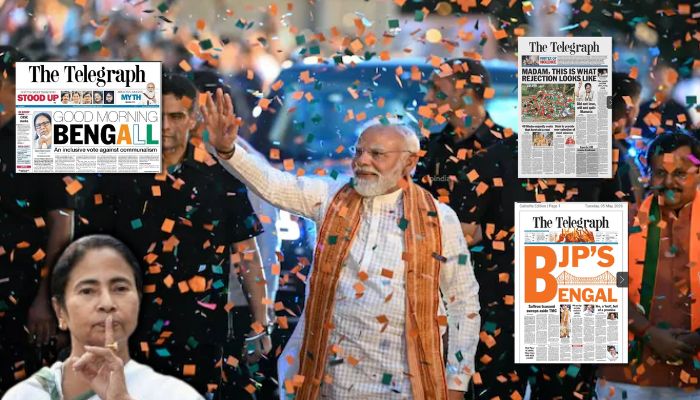
The front page of the Calcutta edition of the newspaper published on 5th May dominated BJP’s Bengal victory, with a large front in saffron colour “BJP’s Bengal” with an illustration of the iconic Howrah Bridge worked into the lettering. Below it is the headline “Saffron tsunami sets aside TMC”.
The newspaper’s lead story opens with “A tectonic shift has reshaped Bengal’s political landscape… a blinding saffron storm swept away the green gulal that had coloured the state since 2011, clearing the path for Bengal’s first BJP chief minister.”
The lead piece carried an image of Prime Minister Narendra Modi arriving at the BJP headquarters in traditional Bengali attire after his party registered its maiden victory in West Bengal.
Moreover, the newspaper carried two more Bengal election-related stories. One of which headlined, “PM pledge on jobs, women’s safety”, covered PM Modi’s speech from the BJP HQ, where he announced the ‘change’ in West Bengal and said, “Banglay poriborton hopechhe”. The other story was about Mamata Banerjee’s ‘election rigging’ bogey.
This blatant change in tone of The Telegraph, which has been notorious for its anti-BJP propaganda, is also reflected in the front page of the newspaper’s 6th May publication.
The top headline of the newspaper particularly stands out as it directly targets former Chief Minister Mamata Banerjee. “Madam, this is what rejection looks like”.
Not only this, The Telegraph, once criticised as an unofficial TMC mouthpiece, also published an editorial hailing the Bharatiya Janata Party for sweeping the “elusive final frontier for the BJP merit examination.”
The Telegraph historically remained sympathetic to TMC’s ‘poribortan’, ‘welfare’ and ‘secular’ narratives; however, the editorial says that Bengal’s economy is in shambles and the BJP has a “herculean task” of bringing an economic resurgence.
The editorial’s concluding remark is particularly interesting as it reads, “Bengal has been disappointed — deceived before when it comes to meaningful transition. The BJP will break its pledge at its own peril.”
After staying silent over the TMC’s ‘syndicate raj’ in West Bengal, The Telegraph has also remembered the now-ousted Mamata regime’s opprobrious mess. The newspaper published an op-ed headlined, “Even Netaji was not spared: Bengal home owners, builders recall extortion mafia of TMC era.” The article described TMC’s control over the building syndicate as “a defining feature of Mamata Banerjee’s 15 years in power.”
Now let’s take a look at The Telegraph’s reportage from 2021, when the Trinamool Congress won the state assembly elections with a massive 215 seats while the BJP had to be content with just 77.
On the 3rd of May 2021, right after the TMC’s victory, The Telegraph’s front page carried a dominant headline “GOOD MORNING” in massive bold letters with “ALL” in the Indian tricolours. The lead story carried a celebratory subheading which read, “An inclusive vote against communalism.”
Over the years, OpIndia has documented The Telegraph’s pro-TMC bias and anti-BJP fake news. Back in July 2022, the English-language paper from the ABP group maintained strategic silence on the enormous amount of cash recovered from the house of TMC leader Partha Chatterjee’s close aide, Arpita Mukherjee, despite it being unignorably the biggest news of that time.
Instead of highlighting how TMC leaders and their aides were involved in corruption, The Telegraph did not even initially cover the news. Rather, The Telegraph chose to publish an ‘interview’ with Alt News’ Mohammed Zubair, whose online trolling and dog-whistling against ex-BJP spokesperson Nupur Sharma led to incidents of violence and at least three killings of Hindus by Islamists.
During the 15 years of TMC rule, The Telegraph always remained meek and pliable. In October 2020, when the TMC goons joined hands with the West Bengal Police and unleashed violence, brutally thrashing people on the streets of Kolkata, the self-declared ‘unputdownable’ media, ‘Telegraph’, chose to remain a mute spectator against the atrocities perpetrated by the Mamata regime.
In fact, the newspaper came in the TMC and West Bengal police’s defence to discredit the BJP. In one of its reports back then, The Telegraph resorted to hailing West Bengal police under Mamata Banerjee for showing restraint on the protesters. In Telegraph’s self-imagined reality, Mamata’s cops showed exemplary restraint against the BJP workers even as bombs and stones were hurled during the protest.
During the 2019 general elections, its editor had claimed in an article that removing Narendra Modi from power was the only hope for India’s redemption. The Bengal-based media house The Telegraph was called out by netizens for a headline that insulted the Dalit community as it compared the President of India, Ramnath Kovind, who is a Dalit leader himself, to ‘Covid-19’. The meltdown came after President Kovind nominated ex-CJI Ranjan Gogoi to the Rajya Sabha.“Kovind, not Covid, did it”, the headline read.
One of the BJP and its supporter base’s core concerns has been the forced and deceptive conversion of Hindus to Islam and Christianity by Islamists and Christian missionaries, respectively. The Telegraph, which is now turning soft on the same BJP, had previously used the ‘spread of classical music in Kolkata’ to glorify conversion and evangelical work that marred Bengal.
There have been many other incidents wherein The Telegraph demonstrated that, contrary to its projected image of a ‘witty’ and ‘neutral’ news outlet, it is a far-left rag. However, such has been the turn of political winds in West Bengal that even such spiteful and devoid of journalistic ethics media organisations are changing tone.
From 2021’s defensive and celebratory tone in Mamata Banerjee’s favour to dramatic, overzealous and affirmative of the BJP mandate using ‘tectonic shift’ and ‘saffron tsunami’ type language, The Telegraph changed colours faster than a chameleon.
This opportunistic U-turn, however, should not be mistaken for an ideological change of heart. It is a classic case of commercial pragmatism. Beyond the tall claims of speaking truth to power, media outlets are commercial entities. In India, the media, especially print media, depends heavily on government advertising revenue. Holding a consistently hostile stance against the ruling dispensation may dry up ad releases, directly affecting revenues. Apparently, this performative tonal shift is driven by the imperative to secure monetary interests rather than any genuine admiration or appreciation for the BJP.