Assam Elections 2026: The arithmetic of power and the psychology of victory as BJP-led NDA appears set for a comfortable hat-trick
Assam goes to the polls on April 9, and conventionally, a journalist’s task is to observe, interpret, and analyse, not to predict. Electoral democracy, after all, is famously unpredictable. Yet, there are moments when patterns become so visible, when structural shifts align so clearly with political momentum, that refraining from a forecast feels like an evasion rather than restraint. This is one such moment. Based on more than two decades of closely following Assam’s politics and extensive ground observations over the past few months, the conclusion is difficult to avoid: when results are declared on May 4, the National Democratic Alliance (NDA), led by the Bharatiya Janata Party, is poised to return to power with a comfortable majority. This is not clairvoyance. It is the outcome of examining a confluence of factors structural, organisational, psychological, and political that together tilt the balance decisively in favour of the ruling alliance. A Fragmented Battlefield: Alliances and Contradictions At the outset, the electoral map presents a familiar yet deeply fractured contest. The NDA comprises the BJP, Asom Gana Parishad (AGP), and Bodoland People’s Front (BPF), collectively contesting nearly all of Assam’s 126 seats. The BJP itself fields candidates in the lion’s share, underscoring its dominance within the alliance. Himanta Biswa Sarma with AGP chief Atul Bora and BPF chief Hagrama Mohilary Yet beneath this apparent cohesion lies a story of transactional politics. The BJP’s relationship with the BPF and its rival, the United People’s Party Liberal (UPPL), illustrates the fluidity of alliances in Assam. From backing the BPF in 2016 to supporting the UPPL in the 2020 Bodoland Territorial Council elections, and then returning to the BPF after its resurgence in 2025, the BJP has demonstrated a pragmatic, almost clinical approach to coalition-building. On the opposing side stands a Congress-led alliance featuring the Indian National Congress, the Raijor Dal (RD), the Asom Jatiya Parishad (AJP), and several Left and regional outfits. On paper, this coalition appears broad-based. In practice, it is an untested amalgamation with weak organisational coherence and uncertain vote transferability. Crucially, the Congress has chosen not to ally with the All India United Democratic Front (AIUDF), a decision that may prove decisive. In 2021, their alliance delivered a combined 45 seats. Today, their separation risks splitting a consolidated minority vote a development that structurally benefits the NDA. Delimitation: Redrawing the Political Geometry The most consequential shift in Assam’s electoral landscape is the 2023 delimitation exercise. Constituencies have been redrawn, new seats created, and demographic balances recalibrated. While such exercises are ostensibly administrative, their political consequences are profound. The number of constituencies where Muslim voters can decisively influence outcomes has dropped significantly from around 35 to approximately 24. Given that Muslim voters have historically consolidated behind the Congress and AIUDF, this contraction directly weakens the opposition’s electoral efficiency. Assam’s Muslim population, estimated to exceed 40 percent today, remains a critical voting bloc. However, its geographic concentration now translates into diminishing returns in terms of seats. The Congress, which secured nearly 30 percent of the vote in 2021 but only 29 seats, faces the prospect of an even worse vote-to-seat conversion ratio in 2026. Without an alliance between the Congress and AIUDF, this vote base is further fragmented. Multi-cornered contests in minority-dominated constituencies introduce unpredictability but not necessarily an opportunity for the opposition. Instead, they create openings for the NDA to either win marginally or benefit indirectly from divided adversaries. Leadership and Governance: The Sarma Factor If delimitation provides the structural foundation for the NDA’s advantage, leadership supplies its emotional and political energy. Chief Minister Himanta Biswa Sarma has emerged as one of the most formidable political figures in contemporary India. Sarma’s appeal transcends conventional party lines. His governance model, marked by visible infrastructure development, aggressive welfare delivery, and an assertive administrative style, has resonated with a broad cross-section of voters. Roads, bridges, healthcare facilities, and digitised service delivery have created a perception of efficiency and progress. Equally important is Sarma’s political communication. Through extensive outreach campaigns such as the Aashirvad Yatra, he has cultivated a direct connection with voters. These are not merely political rallies; they are carefully choreographed demonstrations of mass appeal that reinforce his image as a leader who delivers. In contrast, the Congress leadership in Assam, led by Gaurav Gogoi, struggles to
Assam goes to the polls on April 9, and conventionally, a journalist’s task is to observe, interpret, and analyse, not to predict. Electoral democracy, after all, is famously unpredictable. Yet, there are moments when patterns become so visible, when structural shifts align so clearly with political momentum, that refraining from a forecast feels like an evasion rather than restraint. This is one such moment. Based on more than two decades of closely following Assam’s politics and extensive ground observations over the past few months, the conclusion is difficult to avoid: when results are declared on May 4, the National Democratic Alliance (NDA), led by the Bharatiya Janata Party, is poised to return to power with a comfortable majority.
This is not clairvoyance. It is the outcome of examining a confluence of factors structural, organisational, psychological, and political that together tilt the balance decisively in favour of the ruling alliance.
A Fragmented Battlefield: Alliances and Contradictions
At the outset, the electoral map presents a familiar yet deeply fractured contest. The NDA comprises the BJP, Asom Gana Parishad (AGP), and Bodoland People’s Front (BPF), collectively contesting nearly all of Assam’s 126 seats. The BJP itself fields candidates in the lion’s share, underscoring its dominance within the alliance.
Himanta Biswa Sarma with AGP chief Atul Bora and BPF chief Hagrama Mohilary
Yet beneath this apparent cohesion lies a story of transactional politics. The BJP’s relationship with the BPF and its rival, the United People’s Party Liberal (UPPL), illustrates the fluidity of alliances in Assam. From backing the BPF in 2016 to supporting the UPPL in the 2020 Bodoland Territorial Council elections, and then returning to the BPF after its resurgence in 2025, the BJP has demonstrated a pragmatic, almost clinical approach to coalition-building.
On the opposing side stands a Congress-led alliance featuring the Indian National Congress, the Raijor Dal (RD), the Asom Jatiya Parishad (AJP), and several Left and regional outfits. On paper, this coalition appears broad-based. In practice, it is an untested amalgamation with weak organisational coherence and uncertain vote transferability.
Crucially, the Congress has chosen not to ally with the All India United Democratic Front (AIUDF), a decision that may prove decisive. In 2021, their alliance delivered a combined 45 seats. Today, their separation risks splitting a consolidated minority vote a development that structurally benefits the NDA.
Delimitation: Redrawing the Political Geometry
The most consequential shift in Assam’s electoral landscape is the 2023 delimitation exercise. Constituencies have been redrawn, new seats created, and demographic balances recalibrated. While such exercises are ostensibly administrative, their political consequences are profound.
The number of constituencies where Muslim voters can decisively influence outcomes has dropped significantly from around 35 to approximately 24. Given that Muslim voters have historically consolidated behind the Congress and AIUDF, this contraction directly weakens the opposition’s electoral efficiency.
Assam’s Muslim population, estimated to exceed 40 percent today, remains a critical voting bloc. However, its geographic concentration now translates into diminishing returns in terms of seats. The Congress, which secured nearly 30 percent of the vote in 2021 but only 29 seats, faces the prospect of an even worse vote-to-seat conversion ratio in 2026.
Without an alliance between the Congress and AIUDF, this vote base is further fragmented. Multi-cornered contests in minority-dominated constituencies introduce unpredictability but not necessarily an opportunity for the opposition. Instead, they create openings for the NDA to either win marginally or benefit indirectly from divided adversaries.
Leadership and Governance: The Sarma Factor
If delimitation provides the structural foundation for the NDA’s advantage, leadership supplies its emotional and political energy. Chief Minister Himanta Biswa Sarma has emerged as one of the most formidable political figures in contemporary India.
Sarma’s appeal transcends conventional party lines. His governance model, marked by visible infrastructure development, aggressive welfare delivery, and an assertive administrative style, has resonated with a broad cross-section of voters. Roads, bridges, healthcare facilities, and digitised service delivery have created a perception of efficiency and progress.
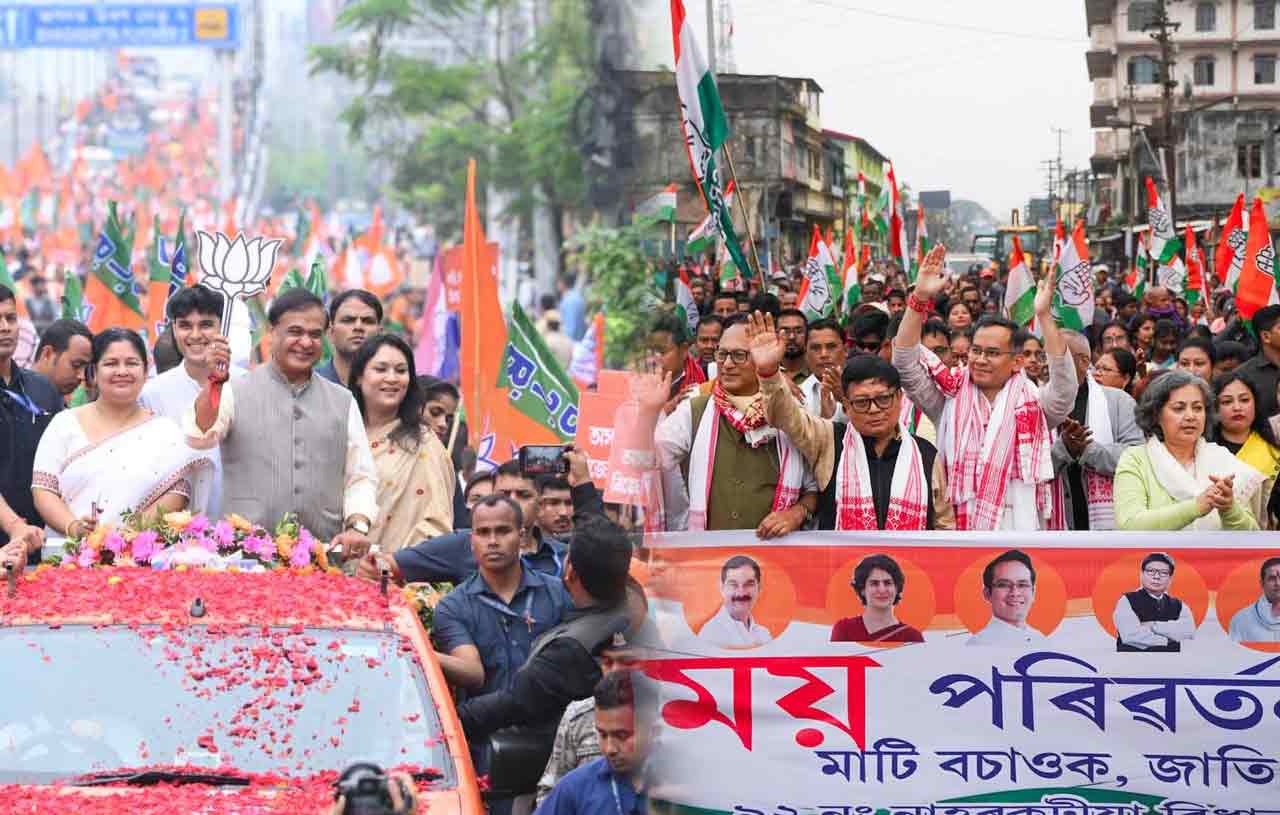
Equally important is Sarma’s political communication. Through extensive outreach campaigns such as the Aashirvad Yatra, he has cultivated a direct connection with voters. These are not merely political rallies; they are carefully choreographed demonstrations of mass appeal that reinforce his image as a leader who delivers.
In contrast, the Congress leadership in Assam, led by Gaurav Gogoi, struggles to project a comparable narrative. Organisational weaknesses at the booth level further compound this disadvantage. Elections in India are increasingly won not just through messaging but through meticulous ground-level mobilisation a domain where the BJP and its ideological ecosystem, including the Rashtriya Swayamsevak Sangh (RSS), maintain a decisive edge.
Polarisation and Identity: The Enduring Faultline
No analysis of Assam’s politics is complete without addressing the issue of illegal immigration from Bangladesh. It remains one of the most emotionally charged and politically potent issues in the state.
The BJP has consistently leveraged this concern to consolidate indigenous voters. Sarma’s rhetoric around demographic change and cultural preservation taps into deeply held anxieties. While critics describe this as polarisation, its electoral effectiveness is undeniable.
In previous elections, the BJP found a convenient adversary in AIUDF chief Badruddin Ajmal, whose image was used to symbolise the threat of demographic imbalance. With the AIUDF no longer allied with the Congress and its influence diminished, the BJP has recalibrated its narrative.
Figures like Rakibul Hussain have been positioned as new focal points of political attack, particularly after internal dissent within the Congress exposed factional tensions. The BJP has effectively weaponised these divisions, portraying the Congress as a party unable to reconcile competing interests.
Ironically, Congress often amplifies this narrative through its own missteps. The presence of controversial figures during key campaign moments and public disagreements over candidate selection provide the BJP with ready-made talking points.
The Optics of Defection: Perception as Reality
Elections are as much about perception as they are about numbers. In this regard, recent defections from the Congress to the BJP have had an outsized impact.
Leaders such as Bhupen Kumar Borah and Pradyut Bordoloi may not individually alter electoral arithmetic. Yet their departure reinforces a narrative of instability within the Congress.
The optics have been particularly damaging. Public attempts by Congress leaders to persuade defectors to stay, often after decisions had already been finalised, project an image of desperation. In contrast, the BJP appears confident, even dominant, further strengthening its psychological advantage.
Sarma has skilfully deepened this perception by claiming to have insider influence within the Congress, suggesting that he can anticipate or even orchestrate defections. Whether exaggerated or not, such claims sow distrust within opposition ranks and erode voter confidence.
An Unsteady Opposition: Arithmetic Without Chemistry
The Congress-led alliance faces a fundamental problem: it exists more convincingly on paper than on the ground. While it brings together multiple parties, their combined strength remains limited.
The RD and AJP, led by figures like Akhil Gogoi and Lurinjyoti Gogoi, respectively, have pockets of influence but lack statewide organisational depth. Many of the constituencies they are contesting are either newly delimited or structurally unfavourable. In the current house, the two parties have a grand total of one seat, as only Akhil Gogoi is an MLA. He is expected to retain his Sivasagar seat despite anti-incumbency due to his non-stop drama, but Lurin’s win in the election remains a doubt.
The overhyped 3G alliance: Gaurav Gogoi, Akhil Gogoi and Lurinjyoti Gogoi
Even where arithmetic suggests competitiveness, the absence of proven vote transferability undermines the alliance’s prospects. Elections require not just shared objectives but seamless coordination at the grassroots, a capability the alliance has yet to demonstrate.
There is hope among sections of voters that a consolidation of Ahom support behind leaders like Gaurav Gogoi, Akhil Gogoi, and Lurinjyoti Gogoi could challenge the BJP in upper Assam. However, delimitation has diluted the electoral impact of such community-based swings, further reducing the opposition’s leverage.
Emotion vs Electoral Behaviour: The Zubeen Factor
The death of cultural icon Zubeen Garg has deeply affected Assam’s public consciousness. Few figures have commanded such widespread affection across communities.
Yet history suggests that emotional issues do not always translate into electoral outcomes. The protests against the Citizenship Amendment Act in 2019–20 were intense and widespread, yet they did not prevent the BJP from returning to power in 2021.
Zubeen Garg’s legacy, like the anti-CAA sentiment, reflects cultural and emotional currents that shape public discourse. But voting behaviour often aligns more closely with considerations of governance, identity, and political momentum.
The BJP’s Hidden Vulnerability
Despite its many advantages, the BJP is not without weaknesses. One notable concern is its increasing reliance on “imported” candidates leaders drawn from the Congress, AGP, and other parties.
Out of its declared candidates, a significant proportion are newcomers. This has created murmurs of discontent among long-time party workers who feel sidelined. Internal dissent, if not managed effectively, could lead to localised disruptions.
However, the BJP’s track record suggests a high degree of organisational discipline. Under leaders like Sarma and Sarbananda Sonowal, the party has consistently managed internal contradictions without allowing them to escalate into electoral liabilities.
Conclusion: A Convergence of Advantage
In the final analysis, the NDA’s expected victory in Assam is not the result of a single factor but of a convergence of advantages. Delimitation has altered the electoral map in its favour. The opposition remains fragmented and organisationally weak. Leadership, governance, and political communication provide the BJP with a compelling narrative. Polarisation continues to shape voter behaviour. And the psychological momentum rests firmly with the ruling alliance.
Elections, of course, can still surprise. Local factors, candidate-specific dynamics, and last-minute shifts in voter sentiment always carry the potential to disrupt forecasts. But barring an unforeseen upheaval, the trajectory appears clear.
When Assam’s voters deliver their verdict on May 4, it is likely to reaffirm not just a government but a political order, one defined by the BJP’s ability to combine structural advantage with strategic execution.