Christian missionary organisation The Timothy Initiative routed 95 crores through foreign debit cards? Read how conversion activities were going on in Naxal-affected areas of Chhattisgarh
On 18th and 19th April, the Enforcement Directorate conducted raids at several locations linked to an organisation named The Timothy Initiative, TTI. In a press release, the ED said that it is investigating how TTI channelled over Rs 95 crore into India using foreign bank issued debit cards while completely skipping FCRA regulations. ED, Headquarters Office, New Delhi has conducted search operations on 18th and 19th April, 2026 at six locations in multiple states in connection with suspected withdrawal and utilisation of funds by using foreign bank debit cards, bypassing regulatory channels. The investigation… pic.twitter.com/gloGiWyDvQ— ED (@dir_ed) April 24, 2026 Notably, TTI is not registered under the Foreign Contribution Regulation Act, FCRA, which means any programme run by the organisation in India cannot be funded by foreign donations. However, the ED stated that crores of funds were withdrawn using foreign bank debit cards between November 2025 and April 2026. The ED has stated that TTI followed a specific method. Foreign bank debit cards linked to Truist Bank in the United States were brought into India and used for repeated cash withdrawals from ATMs across multiple states. The money was then used for meeting expenses connected to the conversion activities of TTI’s India chapter. The searches were conducted at six locations in multiple states in connection with the suspected withdrawal and utilisation of funds. The agency said 25 foreign bank debit cards, Rs 40 lakh in cash, various incriminating digital evidence, devices and documents were seized during the searches. Furthermore, 24 foreign debit cards were found in the possession of one Micah Mark, who was intercepted by the Bureau of Immigration at Bengaluru International Airport against a Look Out Circular issued by the ED while he was bringing the cards into India. The ED stated that the investigation revealed that there had been unusual and suspicious cash withdrawals using these cards in Left Wing Extremism, Naxal affected regions, including Dhamtari and Bastar in Chhattisgarh. According to the ED, around Rs 6.5 crore had been withdrawn in these areas in the past few years. The ED further stated that these cards were being used to withdraw large amounts of cash in a planned manner, which indicated the possibility of organised networks. The agency further said that the emergence of a parallel cash based economy in Naxalite affected areas poses a serious threat to the security and financial integrity of India, as it can facilitate the movement of illicit funds for unlawful activities. Furthermore, TTI was using a billing and accounting online platform for maintaining records of such cash withdrawals from ATMs and their utilisation. The platform, according to the ED, was purportedly controlled by foreign entities, which indicates that the withdrawals were not random or isolated. What is The Timothy Initiative According to The Timothy Initiative’s website, which is geo blocked in India, it is a global Christian movement that makes and multiplies disciples, churches and leaders. Its own material accessed by OpIndia states that it is committed to getting a church in every village, everywhere. Its published material, history page and promotional content show that church planting is its central measurable objective. According to its “Kingdom Impact” material, it has planted over 2,68,750 churches since 2007 across 50 countries, including India. It claims that 23,92,427 people have been converted to Christianity, including 2,01,954 widows and orphans, making it a serious issue. Source: TTI TTI claims that the disciple count is an estimated number based on historical averages of new believers per church planted. It means the number of disciples could be much higher compared to what it claims on the website. The ministry model of TTI is based on the Biblical verse 2 Timothy 2:2, hence the name. The verse refers to entrusting teachings to reliable people who will also be qualified to teach others. In simple terms, this is a replication model. One person trains another set of people, those people train others, and the network continues to grow through successive layers of trainees, leaders, pastors, church planters and disciples. It can also be seen as a Multi Level Marketing, MLM, project, and the only difference is that people do not buy products but convert to Christianity. Source: TTI Just like MLM, one person trains another set of people, those people train others, and the network continues to grow through successive layers of trainees, leaders, pastors, church planters and disciples. In one of its promotional explanation videos, TTI stated that everything it does, directly or indirectly, goes towards planting churches around the world. This is an important statement as it means even expenses that may look administrative, logistical or welfare oriented are ultimately tied by TTI itself to the objec
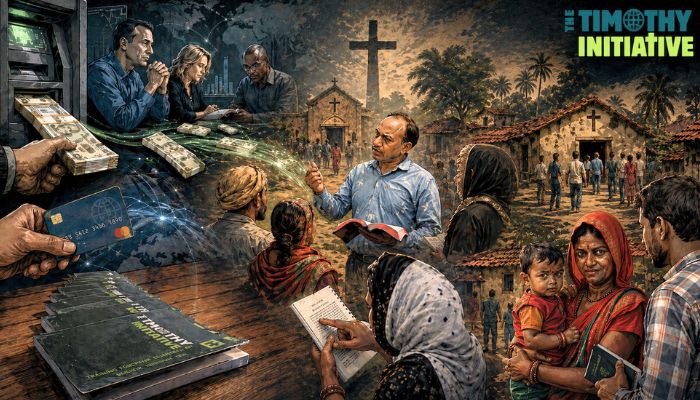
On 18th and 19th April, the Enforcement Directorate conducted raids at several locations linked to an organisation named The Timothy Initiative, TTI. In a press release, the ED said that it is investigating how TTI channelled over Rs 95 crore into India using foreign bank issued debit cards while completely skipping FCRA regulations.
ED, Headquarters Office, New Delhi has conducted search operations on 18th and 19th April, 2026 at six locations in multiple states in connection with suspected withdrawal and utilisation of funds by using foreign bank debit cards, bypassing regulatory channels. The investigation… pic.twitter.com/gloGiWyDvQ— ED (@dir_ed) April 24, 2026
Notably, TTI is not registered under the Foreign Contribution Regulation Act, FCRA, which means any programme run by the organisation in India cannot be funded by foreign donations. However, the ED stated that crores of funds were withdrawn using foreign bank debit cards between November 2025 and April 2026.
The ED has stated that TTI followed a specific method. Foreign bank debit cards linked to Truist Bank in the United States were brought into India and used for repeated cash withdrawals from ATMs across multiple states. The money was then used for meeting expenses connected to the conversion activities of TTI’s India chapter.
The searches were conducted at six locations in multiple states in connection with the suspected withdrawal and utilisation of funds. The agency said 25 foreign bank debit cards, Rs 40 lakh in cash, various incriminating digital evidence, devices and documents were seized during the searches.
Furthermore, 24 foreign debit cards were found in the possession of one Micah Mark, who was intercepted by the Bureau of Immigration at Bengaluru International Airport against a Look Out Circular issued by the ED while he was bringing the cards into India. The ED stated that the investigation revealed that there had been unusual and suspicious cash withdrawals using these cards in Left Wing Extremism, Naxal affected regions, including Dhamtari and Bastar in Chhattisgarh. According to the ED, around Rs 6.5 crore had been withdrawn in these areas in the past few years.
The ED further stated that these cards were being used to withdraw large amounts of cash in a planned manner, which indicated the possibility of organised networks. The agency further said that the emergence of a parallel cash based economy in Naxalite affected areas poses a serious threat to the security and financial integrity of India, as it can facilitate the movement of illicit funds for unlawful activities.
Furthermore, TTI was using a billing and accounting online platform for maintaining records of such cash withdrawals from ATMs and their utilisation. The platform, according to the ED, was purportedly controlled by foreign entities, which indicates that the withdrawals were not random or isolated.
What is The Timothy Initiative
According to The Timothy Initiative’s website, which is geo blocked in India, it is a global Christian movement that makes and multiplies disciples, churches and leaders. Its own material accessed by OpIndia states that it is committed to getting a church in every village, everywhere. Its published material, history page and promotional content show that church planting is its central measurable objective.
According to its “Kingdom Impact” material, it has planted over 2,68,750 churches since 2007 across 50 countries, including India. It claims that 23,92,427 people have been converted to Christianity, including 2,01,954 widows and orphans, making it a serious issue.
Source: TTI
TTI claims that the disciple count is an estimated number based on historical averages of new believers per church planted. It means the number of disciples could be much higher compared to what it claims on the website.
The ministry model of TTI is based on the Biblical verse 2 Timothy 2:2, hence the name. The verse refers to entrusting teachings to reliable people who will also be qualified to teach others. In simple terms, this is a replication model. One person trains another set of people, those people train others, and the network continues to grow through successive layers of trainees, leaders, pastors, church planters and disciples. It can also be seen as a Multi Level Marketing, MLM, project, and the only difference is that people do not buy products but convert to Christianity.
Source: TTI
Just like MLM, one person trains another set of people, those people train others, and the network continues to grow through successive layers of trainees, leaders, pastors, church planters and disciples.
In one of its promotional explanation videos, TTI stated that everything it does, directly or indirectly, goes towards planting churches around the world. This is an important statement as it means even expenses that may look administrative, logistical or welfare oriented are ultimately tied by TTI itself to the objective of church planting and converting people to Christianity. Notably, majority of the visuals in one of its main videos are from India.
Screenshot of India-centric visuals in one of TTI’s videos. Source: TTI
According to TTI, it has five levels of leadership, each with its own funding needs. In the information shared on its website and in the video, it mentions Titus, Timothy, Pauls, master trainers and movement leaders. It is very similar to MLMs, where there are Gold, Silver, Diamond and Platinum members based on the number of members under them.
Titus level workers are trained through two books. Timothy level workers are trained through 12 books, with thousands of pages of material that need translation. Pauls receive a master trainers manual, eight quarterly trainings and travel stipends.
The organisation further says master trainers and movement leaders receive funds for food, travel and accommodation while leading trainings. It also says they receive a small monthly stipend to help with the cost of living. This is important because the model is not simply voluntary preaching by individuals. The organisation’s own material says funds are used to support certain categories of leaders and trainers who are part of the church planting chain.
The same promotional material says donor funds also pay for vision castings to mobilise more labourers. In simpler terms, these are events or meetings used to inspire and recruit more people into the mission. It also says TTI field representatives visit the field to verify that churches and fellowships actually exist. This shows that TTI has not only a training model, but also a reporting and verification system.
The organisation says funds are also used for expansion into new countries. It mentions buying flights, funding offices and translating material into new languages. Beyond this, the promotional material lists a wide range of expenses, including village mapping software, launches, reporting, leadership development, mentoring, continental offices, printers, new training material, Jesus films, benevolence, videos, audio Bibles, book printing, metrics, staff salaries, leadership filtering, regional leadership meetings, local fundraisers, partnerships, graphic design, editing books, ministry statistics, church planter graduations, ministry pictures, national offices, computers and coalition meetings.
In simple language, TTI’s model appears to work like a large religious expansion machine. Donor money funds training material, translations, travel, meetings, stipends, office infrastructure, digital systems, local leaders, verification and reporting. These resources are then used to train people who are expected to create more disciples and plant more churches.
TTI’s own history also supports this reading. In 2010, the organisation says it developed its 10 book core training material with the expectation that each disciple would plant one church by the end of training. In 2013, it implemented a multiplication model called Disciples Making Disciples, DMD. By 2020, it was talking about mapping 700,000 villages. By 2021, it was speaking of mapping 5 million villages through the Coalition of the Willing.
TTI may not be a commercial MLM, but its church planting system follows a multi level replication model. It creates layers of leadership, trains people through standardised material, funds movement leaders and trainers, tracks expansion, verifies field output and measures success through the multiplication of churches and disciples.
Foreign churches, India focus and Hindu majority regions
The material shared by TTI linked partners shows that the India connection is not limited to the ED investigation in Chhattisgarh. Social media posts indicate TTI associated activity in other Indian regions, including Rajasthan and northern India.
One post said The Timothy Initiative was active in Rajasthan through a mission focused on equipping pastors and leaders. It described the work as involving intentional training, discipleship and support. It also said the initiative was made possible through a partnership involving Faculdade Batista Pioneira and the Baptist Churches of New England Multiplication Center. This shows that foreign or international church networks were linked to training activity in Rajasthan.
Source: instagram
Another post by Kensington Church described TTI as a worldwide movement that makes and multiplies disciples, churches and leaders. It stated that the church’s partnership with TTI had allowed the start of over 3,000 house churches in northern India, a region it described as predominantly Hindu. The same post said a group of eight churches, including Kensington, had committed to raising $1 million to bring the message of Jesus to that region.
Source: Instagram
The ED press release mentions alleged withdrawals in Left Wing Extremism affected regions such as Dhamtari and Bastar in Chhattisgarh. But TTI linked partner material points to a broader India focused church planting network, including Rajasthan and northern India. It also specifically refers to work in a predominantly Hindu region.
According to a Bhaskar report, Chhattisgarh adds further context to the ED findings. The report claimed that in tribal villages across Jashpur, Ambikapur, Raigarh, Bastar and Surguja, Hindus have become a minority while Christians are now the majority. It said villages without a single temple but with three or four churches have become common, and traditional cremation has been replaced by burials with crosses on graves in several places.
The report also suggested that poor, sick and socially neglected families were being targeted by two or three salaried pastors active in several villages. It further said 146 NGOs are FCRA registered in Chhattisgarh, including 50 missionary organisations, out of which 30 work in Jashpur, Ambikapur, Raigarh and Bastar, the same districts where conversions are said to be highest. These NGOs are also registered with Chhattisgarh Firm and Society, but the society does not audit them and the NGOs submit their own audit reports. The report said the state government has no concrete information on their foreign funding.
TTI’s timeline shows how church planting became a measurable expansion project
According to TTI’s history section, the movement began in 2007 after founder David Nelms visited Asia. The organisation says he saw countless temples and mosques and asked, “Where are the churches?” The reply, according to TTI’s own account, was, “There are none.” TTI presents this moment as the “spiritual beginning of the movement” to target Hindus in India.
Source: TTI
In 2008, TTI says David Nelms and local leaders Joshua Vijayakumar and Harsha Kumar started a church planting training programme. The organisation also says that this was the launch of TTI’s first 3,075 church planters. This is a significant number for the initial stage of a religious movement. It shows that the organisation’s early model was not merely personal evangelism or small scale fellowship work, but structured training of church planters.
In 2010, TTI says its 10 book core training material was developed. The stated expectation was that each disciple would plant one church by the end of their training. This is perhaps one of the clearest admissions of the model. The disciple is not just expected to learn. The disciple is expected to produce a church. In other words, training and church creation are directly linked.
In 2013, TTI says it implemented a new multiplication model for training called Disciples Making Disciples, or DMD. It also says TTI became active in 30 countries. The phrase itself explains the model. A disciple is trained not merely to remain a disciple, but to create more disciples. This is where the structure begins to look like a replication chain. Each trained person becomes a possible node for further expansion.
Source: TTI
In 2014, TTI claimed that it had crossed 25,000 churches planted. In just a few years, the organisation was already presenting church planting numbers as an achievement marker. This also shows that TTI measured its work not only through welfare or community service but through the number of churches planted.
In 2016, TTI says it began focusing on helping reach Unreached People Groups, or UPGs. These are communities where Christian presence is limited or absent. This again underlines the target based nature of the movement. The goal is not simply to serve wherever help is needed, but to reach communities identified as unreached from a Christian missionary perspective.
In 2020, TTI launched ACHIEVE, described as “A Church in Every Village, Everywhere”. The organisation says two Asian countries began surveying and mapping 700,000 villages so each could have a church. It also claimed that a new church was being planted through TTI every 40 minutes. This is a very important stage in the timeline because it shows the use of mapping, surveying and village level targeting for church planting.
Source: TTI
In 2021, TTI moved into what it calls Pursuit. It says that in pursuit of ACHIEVE, TTI knew the goal could happen only in partnership. This is when COTW, the Coalition of the Willing, was born. TTI says ministries worked together to map 5 million villages. The organisation claimed at this stage that a new church was being planted through TTI every 20 minutes.
In its “today” section, TTI describes the phase as acceleration. It claims that it has surpassed 260,000 churches planted, has 2.3 million new disciples and is expanding towards 50 countries. It also claims that a new church is planted through TTI every 11 minutes.
Current leadership and the role of Dr Jared Nelms
TTI’s website names Dr Jared Nelms as its President and CEO. His profile says he is passionate about serving, equipping and partnering with indigenous leaders across the globe with the overarching aim of getting the Gospel to every people and place.
Source: TTI
Conclusion
While the ED’s investigation has put focus on TTI’s activities in Naxal hit areas of Chhattisgarh, the larger play of the organisation is not limited to one state but the whole of North India. The MLM style working and “passionate” members who are running pillar to post to install churches and convert Hindus to Christianity are serious concerns that need deeper investigation.