Congress treating Karnataka as a cash cow? National Herald run by Gandhi family paid 69% of state’s ad spending despite negligible circulation
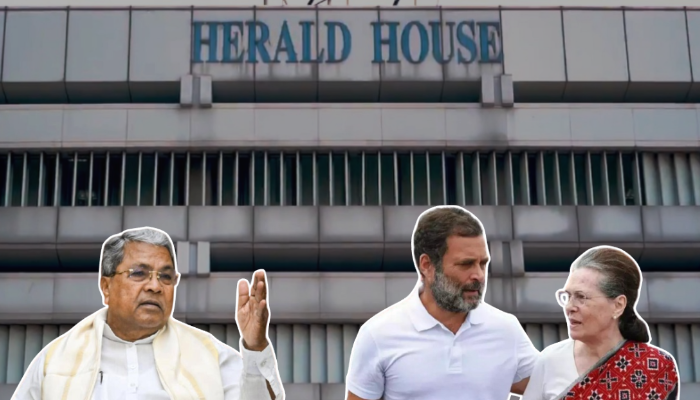
The Karnataka government reportedly gave more money to the controversial newspaper National Herald for advertisements than any other national daily, raising concerns over the use of public funds. The official documents revealed that the National Herald received crores of rupees from the government’s advertising budget despite its lack of distribution and negligible readership in the state. The data unveiled that National Herald was awarded Rs 1.90 crore in 2023–2024 and approximately Rs 1 crore (Rs 99 lakh) in 2024–2025, while reputable national newspapers were given significantly less, with some even securing less than half of the amount allocated to Herald. The government spent Rs 1.42 crore on advertisements in national publications in 2024–2025, and roughly 69% of this was paid to the National Herald alone. On the other hand, prominent national dailies remained empty-handed during the same time frame. The government has devoted more than Rs 4.31 crore on advertisements for the National Herald over the past three years, the most of any national media expenditure. The government has already released Rs 99 lakh for the year 2025–2026. Interestingly, Chief Minister Siddaramaiah is in charge of the Information Department. The National Herald has turned out to be the largest recipient of Karnataka’s advertising budget among national newspapers for the past two fiscal years, despite the dismal number of readers. Open loot, daylight robbery: BJP lashes out as Congress defends the spending The details sparked a political uproar in the state as the opposition slammed the decision, while the ruling party audaciously justified the same. Dr CN Ashwath Narayan, a senior Bharatiya Janata Party leader and former deputy chief minister, described the development as “open loot of the money of taxpayers.” He added that the National Herald is already under inquiry by the Enforcement Directorate. Narayan outlined, “Why should public money be given to a newspaper that has no circulation in Karnataka or anywhere else? Why associate government funds with an entity already facing serious financial investigations?” Union Minister Prahlad Joshi launched a similar attack and expressed that National Herald has “more advertising revenue than any established newspaper, which in itself is a scam. The so‑called owners Sonia Gandhi and Rahul Gandhi in the scam are under scrutiny, and are currently on bail.” #WATCH | Bengaluru, Karnataka: On National Herald Case, Union Minister Pralhad Joshi says, "… They have more advertising revenue than any established newspaper, which in itself is a scam. The so‑called owners Sonia Gandhi and Rahul Gandhi in the scam are under scrutiny, and are… pic.twitter.com/w9Cm5L0biP— ANI (@ANI) January 8, 2026 However, Karnataka Minister Eshwar Khandre referred to the enquiries as “anti-national” and claimed, “What is wrong in giving advertisements to National Herald,” charging politicisation of the matter by the saffron party. His comments provoked further backlash as with opposition leaders accusing Congress of trying to stifle criticism by labelling valid concerns as unpatriotic. Likewise, another minister and Congress chief Mallikarjun Kharge’s son Priyank Kharge dragged the Rashtriya Swayamsevak Sangh to create a false equivalence and asked the BJP to furnish the financial details about “Organiser” magazine. “BJP should bother about the funding of the RSS magazine organiser, not the National Herald. They say that they do not have bank accounts and are not registered. Here it’s clear. There is a legal entity called National Herald and government and corporate entities are giving advertisements. Is there a law against it? If there is a law, let them inform us which law we are violating.” Deputy chief minister DK Shivakumar also advocated for the government’s actions amidst the intensifying criticism. “Any government can give advertisements to any media outlet it feels is doing its work. We have seen many other states giving ads to Kannada newspapers. What are they doing? Can we question that? There is nothing wrong with it,” he insisted. VIDEO | On BJP’s allegations that the state government spent crores on ads in the National Herald, Karnataka Deputy CM DK Shivakumar said, “Any government can give advertisements to any media outlet it feels is doing its work. We have seen many other states giving ads to Kannada… pic.twitter.com/FbLX0fwLqb— Press Trust of India (@PTI_News) January 8, 2026 Leader of the Opposition of the state’s Legislative Assembly countered that Shivakumar was granted bail in the National Herald case, however, this did not stop Siddaramaiah from funnelling money to a Congress organisation from the government coffers. He argued, “The Karnataka government’s advertisement revenue constitutes 69% of the total revenue of the National Herald, while the contribution to this paper from all other sources constitutes only 31%. This is daylight robbery.”

The Karnataka government reportedly gave more money to the controversial newspaper National Herald for advertisements than any other national daily, raising concerns over the use of public funds. The official documents revealed that the National Herald received crores of rupees from the government’s advertising budget despite its lack of distribution and negligible readership in the state.
The data unveiled that National Herald was awarded Rs 1.90 crore in 2023–2024 and approximately Rs 1 crore (Rs 99 lakh) in 2024–2025, while reputable national newspapers were given significantly less, with some even securing less than half of the amount allocated to Herald.
The government spent Rs 1.42 crore on advertisements in national publications in 2024–2025, and roughly 69% of this was paid to the National Herald alone. On the other hand, prominent national dailies remained empty-handed during the same time frame. The government has devoted more than Rs 4.31 crore on advertisements for the National Herald over the past three years, the most of any national media expenditure.
The government has already released Rs 99 lakh for the year 2025–2026. Interestingly, Chief Minister Siddaramaiah is in charge of the Information Department. The National Herald has turned out to be the largest recipient of Karnataka’s advertising budget among national newspapers for the past two fiscal years, despite the dismal number of readers.
Open loot, daylight robbery: BJP lashes out as Congress defends the spending
The details sparked a political uproar in the state as the opposition slammed the decision, while the ruling party audaciously justified the same. Dr CN Ashwath Narayan, a senior Bharatiya Janata Party leader and former deputy chief minister, described the development as “open loot of the money of taxpayers.” He added that the National Herald is already under inquiry by the Enforcement Directorate.
Narayan outlined, “Why should public money be given to a newspaper that has no circulation in Karnataka or anywhere else? Why associate government funds with an entity already facing serious financial investigations?”
Union Minister Prahlad Joshi launched a similar attack and expressed that National Herald has “more advertising revenue than any established newspaper, which in itself is a scam. The so‑called owners Sonia Gandhi and Rahul Gandhi in the scam are under scrutiny, and are currently on bail.”
#WATCH | Bengaluru, Karnataka: On National Herald Case, Union Minister Pralhad Joshi says, "… They have more advertising revenue than any established newspaper, which in itself is a scam. The so‑called owners Sonia Gandhi and Rahul Gandhi in the scam are under scrutiny, and are… pic.twitter.com/w9Cm5L0biP
— ANI (@ANI) January 8, 2026
However, Karnataka Minister Eshwar Khandre referred to the enquiries as “anti-national” and claimed, “What is wrong in giving advertisements to National Herald,” charging politicisation of the matter by the saffron party. His comments provoked further backlash as with opposition leaders accusing Congress of trying to stifle criticism by labelling valid concerns as unpatriotic.
Likewise, another minister and Congress chief Mallikarjun Kharge’s son Priyank Kharge dragged the Rashtriya Swayamsevak Sangh to create a false equivalence and asked the BJP to furnish the financial details about “Organiser” magazine.
“BJP should bother about the funding of the RSS magazine organiser, not the National Herald. They say that they do not have bank accounts and are not registered. Here it’s clear. There is a legal entity called National Herald and government and corporate entities are giving advertisements. Is there a law against it? If there is a law, let them inform us which law we are violating.”
Deputy chief minister DK Shivakumar also advocated for the government’s actions amidst the intensifying criticism. “Any government can give advertisements to any media outlet it feels is doing its work. We have seen many other states giving ads to Kannada newspapers. What are they doing? Can we question that? There is nothing wrong with it,” he insisted.
VIDEO | On BJP’s allegations that the state government spent crores on ads in the National Herald, Karnataka Deputy CM DK Shivakumar said, “Any government can give advertisements to any media outlet it feels is doing its work. We have seen many other states giving ads to Kannada… pic.twitter.com/FbLX0fwLqb
— Press Trust of India (@PTI_News) January 8, 2026
Leader of the Opposition of the state’s Legislative Assembly countered that Shivakumar was granted bail in the National Herald case, however, this did not stop Siddaramaiah from funnelling money to a Congress organisation from the government coffers. He argued, “The Karnataka government’s advertisement revenue constitutes 69% of the total revenue of the National Herald, while the contribution to this paper from all other sources constitutes only 31%. This is daylight robbery.”
Shivakumar had acknowledged last year that he had given Rs 25 lakh to the National Herald, claiming it was a party-run publication. The response followed the inclusion of his brother DK Suresh and Telangana Chief Minister Revanth Reddy in the ED’s chargesheet.
The BJP at present has asked the Siddaramaiah-led government to answer for its actions and to provide a thorough explanation of the standards by which advertising monies are distributed.
Meanwhile, Congress veteran who also heads the party’s media and publicity department, Pawan Khera declared, “National Herald is a national heritage since Independence. What problem does the media have if funds are given to the media itself,” in a CNN-NEWS18 interview and even contended that it was appropriate to support legacy institutions.
National Herald’s history and the origin of a scam
The National Herald has been at the centre of an ongoing high-profile matter related to the Enforcement Directorate’s money-laundering probe involving the newspaper’s parent company, Associated Journals Limited (AJL). Sonia Gandhi and her son Rahul Gandhi have been named as accused in the case alongside other Congress leaders.
Pandit Jawaharlal Nehru and other freedom fighters founded the National Herald in 1938, which shifted into the Congress party’s mouthpiece when India gained its independence. The National Herald newspaper was published by Associated Journals Limited (AJL). It owed the Congress an amount of Rs 90.26 crores by April 2008. The party occasionally approved loans to AJL at zero per cent interest to keep it operational, but it shut down in 2008 due to unsustainability.
Afterwards, another business was established under the name Young Indian Private Limited (YIL) in 2010. Sonia Gandhi, Rahul Gandhi, and prominent Congressmen Motilal Vora, as well as Oscar Fernandes, were its owners at the time of incorporation. The party transferred recovery rights for its Rs 90 crore debt to the fresh firm in exchange for Rs 50 lakh, allowing it to acquire majority ownership of AJL.
AJL was unable to pay off its debt, and Young Indian bought most of its shares and eventually the entire company. As a result, all of its assets were taken over by the Gandhi-controlled organisation. This comprised real estate holdings in upscale areas of Mumbai, New Delhi, Lucknow, Bhopal, Indore, Patna, and others, valued at more than Rs 2000 crores.
Young Indian then announced that publishing newspapers was not its goal, however, the non-profit began to republish three newspapers, including the National Herald, in digital format in 2016. A massive row transpired after Subramanian Swamy in 2011 conveyed that the Gandhi family founded YIL to purchase AJL’s real estate properties.
He took the issue to the trial court and charged Rahul Gandhi and Sonia Gandhi of defrauding their party. He pointed out that YIL was able to wipe off debt totalling Rs 90.26 crores for Rs 50 lakh. According to Swamy, the party’s choice to lend money to AJL for commercial reasons was unlawful.
Investigation spanning several years
Sonia Gandhi, Rahul Gandhi, and others were called by a magistrate’s court in 2014. It was observed that YI seemed to be a “sham structure” that moved public assets for private use. Furthermore, both the ED and the Income Tax Department launched independent preliminary inquiries the same year. The Gandhi family’s appeal was denied by the Delhi High Court, which maintained the summons. Sonia and Rahul had to show up in court and were given bail.
A few years later, the Income Tax Department’s findings and Swamy’s complaint served as the premises for the ED’s 2018 formal submission of a case under the Prevention of Money Laundering Act (PMLA).
The investigation grew more intense in 2022 when Sonia was questioned in several sessions in July and Rahul was also grilled for more than 50 hours over the course of five days in June. Additionally, premises connected to Young Indian and AJL were searched. The agency initiated a new case under the PMLA’s criminal provisions in 2022 after a trial judge took notice of an Income Tax Department probe against Young Indian on Swamy’s 2013 complaint.
AJL properties in Delhi, Mumbai, and Lucknow were provisionally confiscated by the ED in 2023. They had an estimated worth of more than Rs 750 crore. Congress office-bearers and former AJL employees were subjected to more interrogation sessions in 2024 as another PMLA complaint was initiated by the agency.
Last year, the ED filed a PMLA chargesheet with the Special MP/MLA court in Delhi with Sonia and Rahul as the principal accused. The Economic Offences Wing (EOW) of Delhi Police also received a letter from the ED requesting the registration of a new First Information Report owing to its findings.
Afterwards, the official complaint was lodged which featured the names of Sonia and Rahul along with Congress leaders Suman Dubey and Sam Pitroda as well as unidentified individuals. However, a Delhi court dismissed the money laundering charges because it was on the basis of Swamy’s private complaint.
It was pronounced that the Delhi Police’s Economic Offences Wing (EOW) presented a formal complaint in the case, and the judge did not consider it appropriate to review the ED’s arguments on the veracity of the claim. Nonetheless, the court stated that the central agency may carry out its inquiry because the Delhi Police had filed a formal complaint.
It is important to note that criminal conspiracy, misuse of party finances, money laundering, tax evasion, and commercial misuse of publicly leased land are the grave charges in the National Herald case, which also include fraudulent takeover and land grab.
Karnataka: A cash cow for Congress
Congress has not only depleted Karnataka’s resources to finance its giveaway politics aimed at securing power, but it has also exploited the state’s assets to support a corrupt entity like National Herald. This has come to symbolise yet another dubious step by the government to take advantage of the vulnerable exchequer for selfish interests.
The publication, labelled as a “legacy institution” by Congress, might have qualified as such had it not been for the corrupt practices of Congress. However, it is now far removed from that due to the severe allegations that are associated with it. The devious activities within the National Herald were even emphasised by Sardar Vallabhbhai Patel, only to be predictably rejected by Nehru. The grand old party has illustrated, “The more things change, the more they stay the same,” in this regard as well.
Furthermore, the Congress leaders stood by the move and even tried to involve the RSS, conveniently overlooking the fact that the outfit’s publication, “Organiser,” is neither implicated in corruption nor facing any such allegations.
The expectation of objectivity and honesty from Congress is akin to the quest for a unicorn. However, the possibility of locating the mythical creature is greater than that of finding the former. Furthermore, these actions are not surprising, considering the corruption-laden track record of Congress.
The party that once ruled with an iron fist was ousted from power in 2014 due to the incredible scale of its scams and has since been restricted to a few pockets of the country. Currently, it is making do with what it can and employing the states where it is in power to perpetuate its corrupt legacy.