Dancing girl of Mohenjo-Daro: Read why the tiny bronze figure has been one of the most iconic artefacts of India’s ancient heritage
A fresh row erupted after National Council of Educational Research and Training (NCERT) textbook featured a modified version of the iconic “Dancing Girl” of Mohenjo-daro, which is among the most prominently recognised artefacts of the Indus Valley Civilisation. The picture appeared in the first chapter titled “History of Arts” of Madhurima, a recently released arts education textbook for Class 9. The bare torso of the figurine had been covered. It was shaded from the shoulders downwards and seemed to be ‘clothed’. The anatomical characteristics observed in photographs of the original object are no longer evident. The sculpture is widely acknowledged in its authentic form and frequently appears in history and archaeology books globally. As a result, the incident attracted both attention and criticism. The edited form (right) of the original statuette (left). (Source: Deccan Herald) After widespread condemnation and criticism, NCERT responded swiftly and decided to restore the primary portrait of the bronze artwork. The revision is going to be executed on the digital edition on the website alongside copies that have not yet been printed. “From next year, it will be reflected in the hard copy too,” an official was quoted by The Indian Express. On 15th June (Monday), the autonomous organisation has been asked to produce an explanation by the Ministry of Education. “If the photo is already there in a Class 6 Social Science textbook, it doesn’t make any sense why the image was retouched for the Class 9 textbook,” another source expressed. NCERT textbooks have included the “Dancing Girl” for at least 25 years. The defining symbol of Harappan civilisation The 4500-year-old bronze statuette of a nude young woman, which is about 4.1 inches or 10.5 centimetres tall was recovered at the Hargreaves Area (HR) of Mohenjo-daro, a significant prehistoric city from the Indus Valley civilisation or Harappan civilisation (3300 BCE to 1300 BCE). It was noted for its large-scale architecture, well-planned cities, and one of the world’s first urban sanitation systems. The figure dates around 2500 BCE. She is wearing bangles, a bracelet and a necklace with 3 pendants. Her hair is styled and coiled s on her shoulder, and her one arm is propped up at her waist as the other dangles by her side, in a strikingly confident pose. It was named the “Dancing Girl” by the British archaeologist Ernest Mackay, who made the discovery in 1926 in the Sindh province of Pakistan. He believed that the female resembled dancing Nautch girls, who were female dancers who frequently performed in salons and at royal courts, particularly in colonial India. Her slim body displays disproportionate proportions, including long limbs, a high brow, huge eyes, a broad nose along with full cheeks and lips. She is donning 4 bangles on her right arm and 24 to 25 on her left while she leans slightly on her right leg with her head tilted slightly backwards. Her right arm is bent, and her palm is clenched into a fist at the rear of her hip, and she looks to be holding a vessel in her left arm. Her weight is distributed unevenly. “There is her little Baluchi-style face with pouting lips and insolent look in the eye. She’s about 15-years-old I should think, not more, but she stands there with bangles all the way up her arm and nothing else on. A girl perfectly, for the moment, perfectly confident of herself and the world. There’s nothing like her, I think, in the world,” stated British archaeologist Mortimer Wheeler. The refined subtleties of the artwork The sculpture offered a window into the technological advancements and global perspective of the civilisation. The majority of the objects in the Indus Valley, whether they represent men, women, or animals, were made of terracotta. Bronze sculptures similar to the “Dancing Girl” are extremely exceptional. Furthermore, the terracotta figurines of women unearthed in the Indus Valley usually possess a belt or a short skirt concealing their lower body. However, the “Dancing Girl” stands out due to her complete frontal nudity. The metal composition proves that the civilisation created metal alloys and other superior metallurgical techniques. The legendary piece is composed of bronze, an alloy created by the metalsmiths by combining copper and tin. Many Indus Valley copper and copper alloy articles also include arsenic, suggesting that the metallurgists might have realised that putting arsenic to copper produced a stronger and more durable material. The proportion of tin added varies from 8% to 26%. The archaeological findings pointed out that copper and bronze were employed to create tools, weapons, jewellery, household goods and sacred objects, including intricately crafted bronze sculptures such as the “Dancing Girl” which was made via a lost-wax casting technique. The 6,000-year-old procedure is very complex in which a wax model is made and coated with clay, allo
A fresh row erupted after National Council of Educational Research and Training (NCERT) textbook featured a modified version of the iconic “Dancing Girl” of Mohenjo-daro, which is among the most prominently recognised artefacts of the Indus Valley Civilisation. The picture appeared in the first chapter titled “History of Arts” of Madhurima, a recently released arts education textbook for Class 9. The bare torso of the figurine had been covered.
It was shaded from the shoulders downwards and seemed to be ‘clothed’. The anatomical characteristics observed in photographs of the original object are no longer evident. The sculpture is widely acknowledged in its authentic form and frequently appears in history and archaeology books globally. As a result, the incident attracted both attention and criticism.
The edited form (right) of the original statuette (left). (Source: Deccan Herald)
After widespread condemnation and criticism, NCERT responded swiftly and decided to restore the primary portrait of the bronze artwork. The revision is going to be executed on the digital edition on the website alongside copies that have not yet been printed. “From next year, it will be reflected in the hard copy too,” an official was quoted by The Indian Express.
On 15th June (Monday), the autonomous organisation has been asked to produce an explanation by the Ministry of Education. “If the photo is already there in a Class 6 Social Science textbook, it doesn’t make any sense why the image was retouched for the Class 9 textbook,” another source expressed. NCERT textbooks have included the “Dancing Girl” for at least 25 years.
The defining symbol of Harappan civilisation
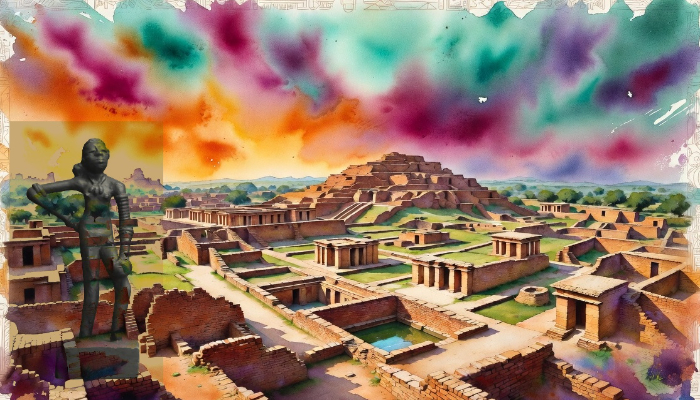
The 4500-year-old bronze statuette of a nude young woman, which is about 4.1 inches or 10.5 centimetres tall was recovered at the Hargreaves Area (HR) of Mohenjo-daro, a significant prehistoric city from the Indus Valley civilisation or Harappan civilisation (3300 BCE to 1300 BCE). It was noted for its large-scale architecture, well-planned cities, and one of the world’s first urban sanitation systems.
The figure dates around 2500 BCE. She is wearing bangles, a bracelet and a necklace with 3 pendants. Her hair is styled and coiled s on her shoulder, and her one arm is propped up at her waist as the other dangles by her side, in a strikingly confident pose. It was named the “Dancing Girl” by the British archaeologist Ernest Mackay, who made the discovery in 1926 in the Sindh province of Pakistan.
He believed that the female resembled dancing Nautch girls, who were female dancers who frequently performed in salons and at royal courts, particularly in colonial India. Her slim body displays disproportionate proportions, including long limbs, a high brow, huge eyes, a broad nose along with full cheeks and lips.
She is donning 4 bangles on her right arm and 24 to 25 on her left while she leans slightly on her right leg with her head tilted slightly backwards. Her right arm is bent, and her palm is clenched into a fist at the rear of her hip, and she looks to be holding a vessel in her left arm. Her weight is distributed unevenly.
“There is her little Baluchi-style face with pouting lips and insolent look in the eye. She’s about 15-years-old I should think, not more, but she stands there with bangles all the way up her arm and nothing else on. A girl perfectly, for the moment, perfectly confident of herself and the world. There’s nothing like her, I think, in the world,” stated British archaeologist Mortimer Wheeler.
The refined subtleties of the artwork
The sculpture offered a window into the technological advancements and global perspective of the civilisation. The majority of the objects in the Indus Valley, whether they represent men, women, or animals, were made of terracotta. Bronze sculptures similar to the “Dancing Girl” are extremely exceptional.
Furthermore, the terracotta figurines of women unearthed in the Indus Valley usually possess a belt or a short skirt concealing their lower body. However, the “Dancing Girl” stands out due to her complete frontal nudity. The metal composition proves that the civilisation created metal alloys and other superior metallurgical techniques.
The legendary piece is composed of bronze, an alloy created by the metalsmiths by combining copper and tin. Many Indus Valley copper and copper alloy articles also include arsenic, suggesting that the metallurgists might have realised that putting arsenic to copper produced a stronger and more durable material. The proportion of tin added varies from 8% to 26%.
The archaeological findings pointed out that copper and bronze were employed to create tools, weapons, jewellery, household goods and sacred objects, including intricately crafted bronze sculptures such as the “Dancing Girl” which was made via a lost-wax casting technique. The 6,000-year-old procedure is very complex in which a wax model is made and coated with clay, allowing tiny gaps for air to pass through.
Melted wax is removed from these moulds by heating them in a furnace, leaving just the outer layer of clay that serves as the vessel for pouring molten bronze. The metal solidifies after cooling, the clay layer chips off, and the artist can introduce final details.
“The statue is suggestive of two major breakthroughs. One, that the Indus artists knew metal blending and casting and perhaps other technical aspects of metallurgy, and two, that a well-developed society Indus people had innovated dance and other performing arts as modes of entertainment,” reads National Museum of India.
A carrier of civilisational heritage
The “Dancing Girl” is one of the most prominent representations of the Harappan civilisation attributed the exquisite craftsmanship. The figurine has long been seen by archaeologists as proof of the high metallurgical understanding of the Indus Valley people. It is a testament to their expertise in metal blending, casting and other sophisticated methods. The jewellery also highlights the outstanding progress in artistry and design as well as the attention to detail. Another interesting aspect is the existence of jewellery making as an industry, so many centuries ago in Harappa.
The girl statue was found inside a house in Mohenjo-daro, as per reports, indicating that she was not a sculpture carved for worship, but a personal or household item. It provides evidence of artistic expression, possible social status symbols shown in the abundant jewellery she wore, and the portrayal of human figures with realism and individuality instead of overt sexualisation and idealisation, another indication of how uniquely advanced that society was.
Thousands of jewellery pieces, manufacturing waste, tools, and unfinished items have been excavated from Indus Valley sites, showing that the jewellery was not just household craft but a professional industry supporting urban life. The style of bangles stacked from shoulder to wrist is still practised today in some areas of North-west India, further suggesting how some styles have continued through millennia in the same geography.
Interestingly, Pakistan desired both the “Dancing Girl” and “Priest King,” another extraordinary artefact belonging to this civilisation. However, India was only prepared to give up one of the two.
“The Pakistani officials chose the priest king to avoid any backlash at home that a figure of a naked teenager could have invoked from religious quarters. Here the ‘nudity’ of a teenager girl impacted the decision of the Pakistani officials, who considered its sexuality as a threat to their moral beliefs,” wrote Panjab University historian Ashish Kumar.
The relic is proudly housed in the National Museum in New Delhi as a national cultural monument, exhibiting the excellent craftsmanship, vibrant fashion and creative genius of the ancient Indus Valley Civilisation.