Explained: How counterfeit refrigerant gases, illegal refilling practices and import dependence could be contributing to a rise in deadly AC fire incidents across India
The blazing Indian summer has arrived, sending people in search of relief under fans, coolers and air conditioners. While many try to stay behind closed doors to escape the scorching heat, another threat rears its head, putting lives at risk during this time of the year. The reliance on ACs to fight the rising temperatures has grown to become a necessity for people. However, this comfort is coupled with underlying safety issues that are causing multiple mishaps. On 28th May (Thursday), Dhanendra Kumar, an 80-year-old retired IAS officer and the first chairman of the Competition Commission of India (CCI), perished in a fire, following a suspected AC burst at his house in Delhi’s Hauz Khas. The event is the most recent in a string of similar incidents involving air conditioners that have been reported in the National Capital Region this season. According to reports, a split AC blew and started a fire on the 15th story of a residential tower in Indirapuram, Ghaziabad. Last month, 9 people lost their lives in a fire in a residential complex in Shahdara of East Delhi. The preliminary findings suggested that an AC blast might have been responsible for it. The possibility of such accidents is escalating as the demand and supply of AC surges annually due to the extreme heat. The application of potentially dangerous refrigerant gases, like R-152a or combinations including R-152a, in the secondary refiller market amplifies the danger opposed to the usage of safe and non-flammable refrigerant R-22 or modern and effective substitutes like R-32 and R-410A. In February 2024, a devastating instance took place in Delhi, resulting in the death of an 83-year-old grandmother as she tried to escape her burning flat alongside her granddaughter. The Fire Department stated that the cause was a gas leak originating from the AC compressor. It emphasised potential hazards connected to specious refrigerant gases. A cold storage owner and his driver were killed in 2023 after the refrigerant gas cylinder at their Telangana cold store detonated as they were attempting to replace it. According to the police inquiry, the explosion happened as they were changing an outdoor unit’s refrigerant cylinder. It highlighted how dangerous it is to handle a combination of refrigerant gases without the right expertise. Moreover, there have been numerous instances of these disasters occurring while replenishing or servicing air conditioning appliances. What are refrigerant gases and how do they work A chemical utilised in cooling system for mechanical devices including walk-in freezers, air conditioners and refrigerators is known as a refrigerant gas. The majority of refrigeration equipment rely on its chemical interactions to remove heat from enclosed spaces. Many gases are employed as refrigerants. These act as a heat-transfer medium rather than cold air. The refrigerant helps the air conditioner maintain acceptable interior temperatures for extended periods of time by absorbing heat from the room and transporting it outside rather than directly spitting chilled air. The system effectively controls temperature and pressure because refrigerant alternates between liquid and gas states. The gas used in air conditioners is crucial to cooling performance during hot summer days because of these frequent phase transitions that assist in the transfer of heat outdoors. The refrigerant flows through the unit’s expansion unit as a high-pressure liquid before decreasing to a low-pressure liquid caused by a pressure drop. Afterwards, it passes through air conditioner’s evaporator coils, which takes heat and converts it into a low-pressure gas. After circulating through compressor and developing into a high-pressure gas, this refrigerant passes through condenser coils before cooling down into a high-pressure liquid that starts a new loop. Mechanism of cooling (Source: Figaro) The refrigerant industry uses a variety of gases, including R-22, R-152a and modern R-32 and R-410A. These gases are unique to the appliance and cannot be substituted. R-22 has long been employed in older air conditioners due to its dependability and safety. It is a traditional refrigerant gas with a faintly sweet odour and no colour. It is chemically stable and non-flammable but operates at higher pressures. However, R-22 was to be phased out by January 2025 in Original Equipment Manufacturers (OEMs) under the international convention dubbed as the Montreal Protocol, because there are safer and better alternatives on the market to replace it in a number of refrigeration and air conditioning (RAC) sectors. In many regions of the world, R-152a is often put as an aerosol propellant in deodorants and hair sprays. It presents a safety issue when used as refrigerant alone or in combinations in air conditioners owing to its flammable qualities. It is not suitable as a refrigerant for ACs because it produces harmful gases including carbon monoxid
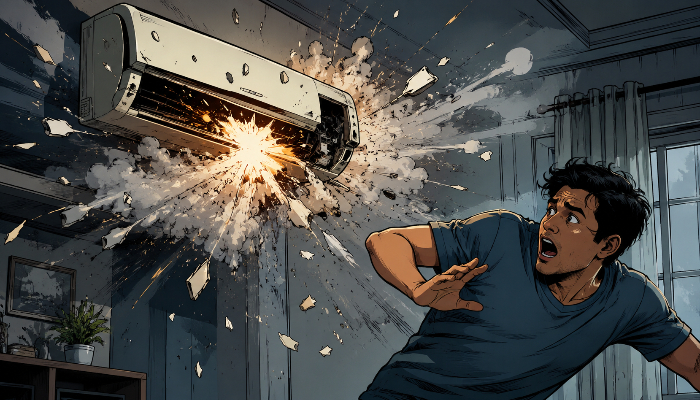
The blazing Indian summer has arrived, sending people in search of relief under fans, coolers and air conditioners. While many try to stay behind closed doors to escape the scorching heat, another threat rears its head, putting lives at risk during this time of the year. The reliance on ACs to fight the rising temperatures has grown to become a necessity for people. However, this comfort is coupled with underlying safety issues that are causing multiple mishaps.
On 28th May (Thursday), Dhanendra Kumar, an 80-year-old retired IAS officer and the first chairman of the Competition Commission of India (CCI), perished in a fire, following a suspected AC burst at his house in Delhi’s Hauz Khas. The event is the most recent in a string of similar incidents involving air conditioners that have been reported in the National Capital Region this season. According to reports, a split AC blew and started a fire on the 15th story of a residential tower in Indirapuram, Ghaziabad.
Last month, 9 people lost their lives in a fire in a residential complex in Shahdara of East Delhi. The preliminary findings suggested that an AC blast might have been responsible for it. The possibility of such accidents is escalating as the demand and supply of AC surges annually due to the extreme heat.
The application of potentially dangerous refrigerant gases, like R-152a or combinations including R-152a, in the secondary refiller market amplifies the danger opposed to the usage of safe and non-flammable refrigerant R-22 or modern and effective substitutes like R-32 and R-410A.
In February 2024, a devastating instance took place in Delhi, resulting in the death of an 83-year-old grandmother as she tried to escape her burning flat alongside her granddaughter. The Fire Department stated that the cause was a gas leak originating from the AC compressor. It emphasised potential hazards connected to specious refrigerant gases.
A cold storage owner and his driver were killed in 2023 after the refrigerant gas cylinder at their Telangana cold store detonated as they were attempting to replace it. According to the police inquiry, the explosion happened as they were changing an outdoor unit’s refrigerant cylinder.
It highlighted how dangerous it is to handle a combination of refrigerant gases without the right expertise. Moreover, there have been numerous instances of these disasters occurring while replenishing or servicing air conditioning appliances.
What are refrigerant gases and how do they work
A chemical utilised in cooling system for mechanical devices including walk-in freezers, air conditioners and refrigerators is known as a refrigerant gas. The majority of refrigeration equipment rely on its chemical interactions to remove heat from enclosed spaces. Many gases are employed as refrigerants.
These act as a heat-transfer medium rather than cold air. The refrigerant helps the air conditioner maintain acceptable interior temperatures for extended periods of time by absorbing heat from the room and transporting it outside rather than directly spitting chilled air. The system effectively controls temperature and pressure because refrigerant alternates between liquid and gas states.
The gas used in air conditioners is crucial to cooling performance during hot summer days because of these frequent phase transitions that assist in the transfer of heat outdoors. The refrigerant flows through the unit’s expansion unit as a high-pressure liquid before decreasing to a low-pressure liquid caused by a pressure drop.
Afterwards, it passes through air conditioner’s evaporator coils, which takes heat and converts it into a low-pressure gas. After circulating through compressor and developing into a high-pressure gas, this refrigerant passes through condenser coils before cooling down into a high-pressure liquid that starts a new loop.
Mechanism of cooling (Source: Figaro)
The refrigerant industry uses a variety of gases, including R-22, R-152a and modern R-32 and R-410A. These gases are unique to the appliance and cannot be substituted. R-22 has long been employed in older air conditioners due to its dependability and safety. It is a traditional refrigerant gas with a faintly sweet odour and no colour. It is chemically stable and non-flammable but operates at higher pressures.
However, R-22 was to be phased out by January 2025 in Original Equipment Manufacturers (OEMs) under the international convention dubbed as the Montreal Protocol, because there are safer and better alternatives on the market to replace it in a number of refrigeration and air conditioning (RAC) sectors.
In many regions of the world, R-152a is often put as an aerosol propellant in deodorants and hair sprays. It presents a safety issue when used as refrigerant alone or in combinations in air conditioners owing to its flammable qualities. It is not suitable as a refrigerant for ACs because it produces harmful gases including carbon monoxide and hydrogen fluoride upon combustion.
The switch has been executed towards newer and improved options, R-32, R-410A and R-290, which facilitate superior cooling properties while being more environmentally friendly than R-22. R32 enables effective cooling with better compressor performance and reduced charge volume. It is used in many inverter air conditioners to improve power efficiency and temperature stability. It is mildly flammable and non-toxic.
R410A offers stronger cooling output, balanced pressure and smoother heat transfer. This refrigerant is used by several mid-generation split air conditioners to offer consistent performance. Propane or R290, is marketed as a non-toxic, eco-friendly and viable replacement for other refrigerant gases.
Compared to gases like R32, it has a lower Global Warming Potential (GWP) index. It is an excellent natural refrigerant with remarkable thermodynamic efficiency that has minimum effect on the environment. However, R290 has to be handled carefully because of its high flammability.
The threat imposed by R-152a gas
A major issue is the infiltration of spurious gases, primarily R-152a, which have been taking the place of authentic gases in refrigeration and air conditioning (RAC) equipment in the secondary refiller market. The prevalent use of air conditioners in homes and businesses birth grave fears of public safety if they contain the gas or its blends.
The expected demand for genuine R-152a end-uses in India is 1000. However, data mentioned that an alarming amount of R-152a, roughly 5000 tonnes, was entering the nation even after the product fell within the category of prohibited imports.
The reservations arise from the inherent perils associated with employing R-152a as a refrigerant in air conditioners when it is not appropriate. It requires different handling and safety standards, such as physical and chemical qualities. It is also extremely flammable. Anyone operating an air conditioner without being certain of the refrigerant gas inside is exposed to danger due to the lack of information about it. A gas swap involving R-152a could possibly endanger his life.
Oblivious users, consumers or technicians in charge of the equipment’s maintenance could be critically harmed, stressing the pressing need to address this impending threat.
Massive imports of refrigerant gases from China
It is noteworthy that Beijing is the primary supplier of AC components and refrigerant gases to New Delhi. Interestingly, a 2016 post titled “The Fraud in Chinese Air-Conditioners” relating to an experience around procurement of these devices for Saudi Arabia highlighted, “China is not an origin for high quality refrigerant gasses and there is no way to proof what the factory put in there. A low-quality refrigerant will sooner or later blow up your compressor.” It asserted, “So far my conclusion is that it is impossible to buy high quality and performance verified air conditioners from a factory out of China.”
The post charged that the “Chinese have mastered the art of gaming the system” as there is no practical method for the certification body to quality test every single unit that comes off the production line. Hence, the approvals are based on samples, and the manufacturers exploit the situation. It mentioned that “all quality certifications are self-policing means the manufacturer makes a voluntary commitment to abide by them. The certification agency has no mechanism to enforce this compliance.”
Similarly, American heating, ventilation, and air conditioning (HVAC) contractors were firmly cautioned against illegally imported R-22 knockoffs from China or other countries. It was warned, “While there are plenty of genuine, viable alternatives to R-22, counterfeit products can be flammable, explosive, and even deadly.”
Moreover, 5 illicit production facilities, 11 storage warehouses, 2 sales offices and 18 members of 4 criminal gangs were apprehended in China in 2015. 20 tonnes of raw materials and more than 28,000 canisters of counterfeit R-134a and other refrigerants were seized. There was between 15% and 30% added methyl chloride in the bogus R22 and using it could prompt serious corrosion alongside compressor failure.
The aforementioned illustrated how counterfeit and dangerous refrigerant gases in compressors manufactured in China have been posing a great risk to the safety and lives of consumers.
How to confront the issue
The centre must take action to stop the excessive importation of R-152a into India. Stringent import regulation and enforcement must be put in place in line with the actual end-user demand. The unlawful practice of creating a cocktail of fake gases for a quick profit has to end. Thus, enforcement agencies should take strong action against vendors and refillers of these fake gases on the secondary market to ensure adherence to safety norms.
It is necessary to educate consumers about the severity of the problem by creating awareness of the hazards that accompany the use of R-152a and other such gases. The government, of course, needs active support of the public as well. In fact, both must join forces to deal with this menace successfully. A decisive and attentive strategy is needed along with proper comprehension of the challenge. No purchase should be made without adequate inquiry and understanding of the product.
The fight against contaminated gases calls for coordinated action for public safety, maintain market fairness and guarantee the proper use of refrigerant gases in India. This can also provide a suitable opportunity for the government to advance its “Make in India” initiative and lessen foreign dependency.
Imports of R134a refrigerant from China were subject to anti-dumping levies last year by the government. The Directorate General of Trade Remedies (DGTR) of India conducted investigations and discovered that R134a was acquired at a discount, resulting in dumping that did major damage to the domestic industry through price undercutting.
Several estimates suggested that the focus on the “Atmanirbhar Bharat Abhiyan” program contributed to a decline in reliance on air conditioner imports. The nation reportedly recorded a 65% decrease in imports of split air conditioners or air conditioners between October and November of 2020.
India has to get rid of its ongoing reliance on China for enhanced control over quality and the introduction of better standards to counter the threat posed by the adulterated gases in ACs. It is a feasible goal that can be accomplished through public backing and strong implementation of a well-defined policy.