‘Fact-Checker’ Alt News publishes misleading report: Claims that Election Commission portal features applicable pan India are barriers for West Bengal voter lists
Alt News published an article on 3 April 2026 titled “Bengal SIR: The wall ECI built around electoral data and how we broke through it” claiming that the Election Commission of India (ECI) has deliberately made the voter lists in West Bengal inaccessible. The article focuses on the publication of Special Intensive Revision (SIR) draft electoral rolls for West Bengal in 2025–26. It alleges deliberate barriers specifically for the state, like downloads limited to ten polling booths per attempt, CAPTCHA protection on every download, and rolls provided only as “scanned PDF images” that are non-searchable and cannot be meaningfully analysed. These measures, Alt News claims, create a “barrier” and a “wall” around public data. Alt News claims that this format is “not a technological limitation” and contrasts it with systems like Aadhaar or UPI, arguing that providing text files would be “trivial.” Alt News implied that these barriers are specific to West Bengal, creating nm impression that such measures are not applicable for voter lists of other states. The article said that while attempting to work with the SIR Final Rolls 2026 for two Kolkata constituencies, they faced these obstacles. The organisation claimed to have digitised two Kolkata constituencies (Bhabanipur and Ballygunge) at a reported cost of approximately ₹11,800. These claims by Alt News are completely false and misleading. The access restrictions and file formats described as ‘obstacles for West Bengal’ are actually standard ECI policy applied uniformly across all States and Union Territories, not a Bengal-specific design. The ECI has long mandated image-based non-editable PDFs with CAPTCHA gating precisely to safeguard the integrity of electoral rolls. Voter lists are generated digitally from the central ERONET system and exported in a secure, non-manipulable format. What Alt News claims to be faults are actually by design, and there are valid reasons behind them. Below is a point-by-point examination of the facts. The 10-area limit per attempt and CAPTCHA requirement are default nationwide behaviours The ECI’s Voters’ Services Portal and the websites of all Chief Electoral Officers (CEOs) operate with identical technical safeguards. Users can download electoral rolls, including SIR drafts, only in limited batches, typically ten polling stations at a time. Moreover, each attempt is protected by a CAPTCHA challenge containing letters, numerals, and special characters. This is explicitly required by ECI instructions to all CEOs. This can be easily verified by going to the Voters’ Services portal and selecting any state under the Download Elector Roll option. These controls exist for every State/UT, not just West Bengal, as Alt News is claiming. Moreover, this is not a new feature; it is part of the ECI portal for a long time. For example, this Livemint article published in August 2025 describing how to check names in voter list after SIR in Bihar says in step 4: “Enter your district, Assembly constituency, Select language, ‘Roll Type [SIR draft roll] and ‘Part No and Part Name’; finally, enter captcha and proceed.” These measures have been implemented to prevent automated bulk scraping that could overload ECI servers, enable distributed denial-of-service-style attacks, or facilitate unauthorised mass harvesting of personal data. Alt News falsely presents the restrictions as evidence of intent aimed solely at Bengal. Electoral rolls published as “image PDFs” across India for security and integrity reasons, upheld by the Supreme Court Alt News claims that voter lists are provided as non-text image files is another barrier, and that publishing text files like CSV files should be easy. While it is true that the commission can easily export text voter data from its data, they have not done this on purpose. Had Alt News performed research on this before publishing the article, they would have known that the ECI instructions specifically say that “only image PDF (non-editable) of electoral rolls, with only details and without photograph of electors, shall be hosted on the CEOs’ website” and “Access to view such image PDF to be strictly provided through CAPTCHA.” ECI has a clear policy of not publishing machine-readable voter lists, and this ‘barrier’ is by design. Soft copies supplied to recognised political parties also follow the same image-PDF-only rule. The ECI has repeatedly explained why text-based or machine-readable formats such as searchable PDFs or CSVs are not provided for public download. Text files are easily editable, which could allow malicious actors to insert, delete, or alter entries and then circulate “evidence” of manipulation, undermining public confidence in the rolls. PDFs with text can be easily edited by software such as Adobe Acrobat and other similar programs, making them vulnerable for malicious changes to create controversies. On the other hand, image-PDF files can be edited on
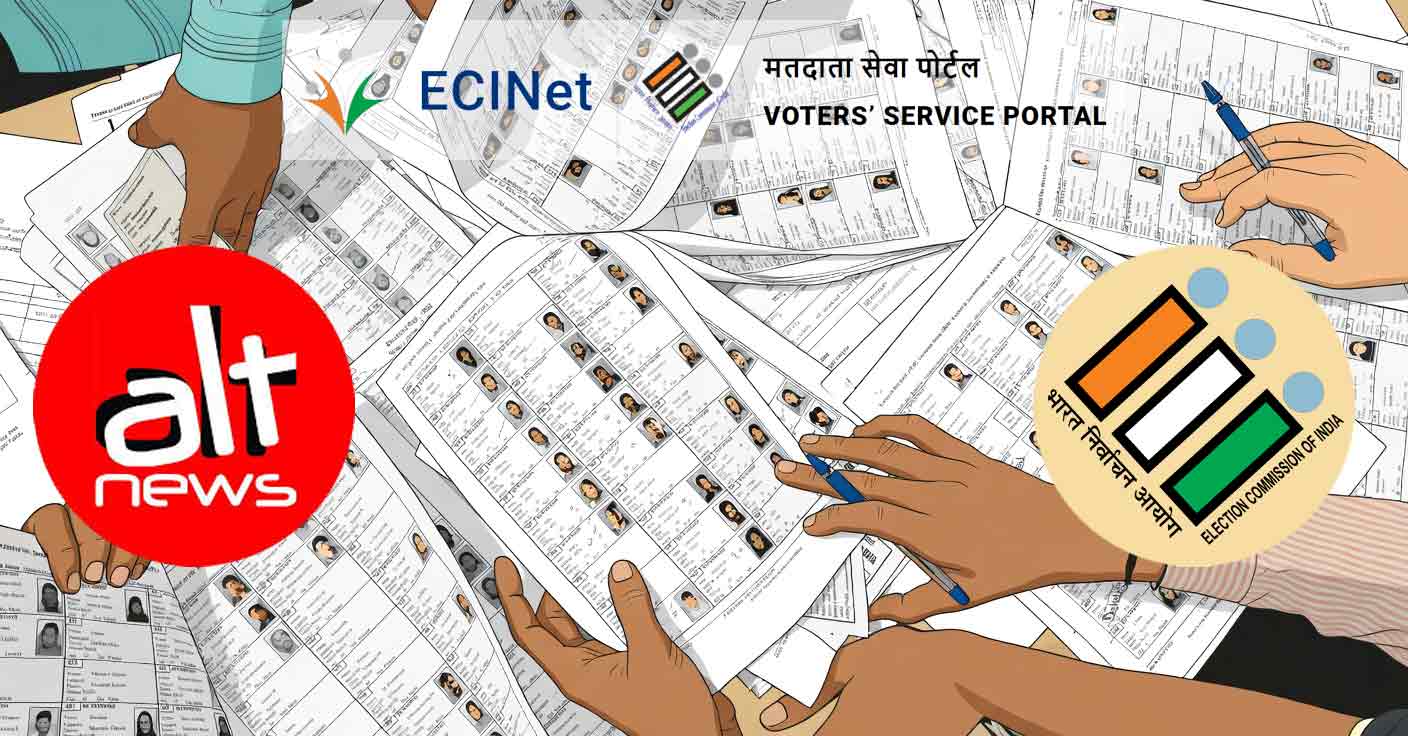
Alt News published an article on 3 April 2026 titled “Bengal SIR: The wall ECI built around electoral data and how we broke through it” claiming that the Election Commission of India (ECI) has deliberately made the voter lists in West Bengal inaccessible. The article focuses on the publication of Special Intensive Revision (SIR) draft electoral rolls for West Bengal in 2025–26. It alleges deliberate barriers specifically for the state, like downloads limited to ten polling booths per attempt, CAPTCHA protection on every download, and rolls provided only as “scanned PDF images” that are non-searchable and cannot be meaningfully analysed.
These measures, Alt News claims, create a “barrier” and a “wall” around public data. Alt News claims that this format is “not a technological limitation” and contrasts it with systems like Aadhaar or UPI, arguing that providing text files would be “trivial.” Alt News implied that these barriers are specific to West Bengal, creating nm impression that such measures are not applicable for voter lists of other states.
The article said that while attempting to work with the SIR Final Rolls 2026 for two Kolkata constituencies, they faced these obstacles. The organisation claimed to have digitised two Kolkata constituencies (Bhabanipur and Ballygunge) at a reported cost of approximately ₹11,800.
These claims by Alt News are completely false and misleading. The access restrictions and file formats described as ‘obstacles for West Bengal’ are actually standard ECI policy applied uniformly across all States and Union Territories, not a Bengal-specific design. The ECI has long mandated image-based non-editable PDFs with CAPTCHA gating precisely to safeguard the integrity of electoral rolls. Voter lists are generated digitally from the central ERONET system and exported in a secure, non-manipulable format. What Alt News claims to be faults are actually by design, and there are valid reasons behind them.
Below is a point-by-point examination of the facts.
The 10-area limit per attempt and CAPTCHA requirement are default nationwide behaviours
The ECI’s Voters’ Services Portal and the websites of all Chief Electoral Officers (CEOs) operate with identical technical safeguards. Users can download electoral rolls, including SIR drafts, only in limited batches, typically ten polling stations at a time. Moreover, each attempt is protected by a CAPTCHA challenge containing letters, numerals, and special characters. This is explicitly required by ECI instructions to all CEOs.
This can be easily verified by going to the Voters’ Services portal and selecting any state under the Download Elector Roll option. These controls exist for every State/UT, not just West Bengal, as Alt News is claiming. Moreover, this is not a new feature; it is part of the ECI portal for a long time. For example, this Livemint article published in August 2025 describing how to check names in voter list after SIR in Bihar says in step 4: “Enter your district, Assembly constituency, Select language, ‘Roll Type [SIR draft roll] and ‘Part No and Part Name’; finally, enter captcha and proceed.”
These measures have been implemented to prevent automated bulk scraping that could overload ECI servers, enable distributed denial-of-service-style attacks, or facilitate unauthorised mass harvesting of personal data. Alt News falsely presents the restrictions as evidence of intent aimed solely at Bengal.
Electoral rolls published as “image PDFs” across India for security and integrity reasons, upheld by the Supreme Court
Alt News claims that voter lists are provided as non-text image files is another barrier, and that publishing text files like CSV files should be easy. While it is true that the commission can easily export text voter data from its data, they have not done this on purpose. Had Alt News performed research on this before publishing the article, they would have known that the ECI instructions specifically say that “only image PDF (non-editable) of electoral rolls, with only details and without photograph of electors, shall be hosted on the CEOs’ website” and “Access to view such image PDF to be strictly provided through CAPTCHA.”
ECI has a clear policy of not publishing machine-readable voter lists, and this ‘barrier’ is by design. Soft copies supplied to recognised political parties also follow the same image-PDF-only rule.
The ECI has repeatedly explained why text-based or machine-readable formats such as searchable PDFs or CSVs are not provided for public download. Text files are easily editable, which could allow malicious actors to insert, delete, or alter entries and then circulate “evidence” of manipulation, undermining public confidence in the rolls.
PDFs with text can be easily edited by software such as Adobe Acrobat and other similar programs, making them vulnerable for malicious changes to create controversies. On the other hand, image-PDF files can be edited only with graphics software like Adobe Photoshop, and even in such attempts, it is hard to match the font, colour, texture, etc., which makes any manipulation very hard.
In 2018, Congress leader Kamal Nath had moved the Supreme Court seeking direction to the ECI to publish voter lists in text format like MS-Word files. The former Madhya Pradesh CM, along with other Congress leaders, had also approached ECI with this demand, claiming that text-based voter lists will enable easy identification of duplicate, repeat, multiple, illegal, invalid and false entries in electoral rolls.
However, ECI had rejected this demand, saying that its instructions were to publish only image-only files, in view of the safety and privacy concerns. The poll commission told the apex court that if the voter list is supplied in text form, it will enable data mining in large scale, potentially creating risks for the integrity of the database.
The Supreme Court, in its judgment, upheld the ECI’s prerogative to decide the format, rejecting demands for searchable versions on the grounds that the Commission must balance transparency with the prevention of misuse. The court said that ECI has given valid reasons for not publishing text files.
Last year CEC Gyanesh Kumar reiterated that the voter list cannot be published in machine-readable format as it can be edited and can lead to its misuse.
The Supreme Court had made it clear that the Election Commission is not required to provide text files, and told the petitioner that if he wants, he can get the image-PDF files converted to text data on his own efforts.
Therefore, the claim of Alt News that they spent money to convert such voter lists from Kolkata is as per the Supreme Court order.
The PDFs are not “scanned” photographs of printed pages, they are digitally generated
Alt News repeatedly claimed in the article that the voter list files are “scanned PDF images — effectively photographs of printed pages,” but that is incorrect. The rolls are produced centrally through the ECI’s ERONET application. ERONET is the national, standardised system that processes all forms, manages elector data, generates unique EPIC numbers, and produces the final electoral rolls.
The PDFs are created programmatically from this database, commonly using libraries such as iText Core, and exported directly in a rasterised image-based format. It can be easily verified by opening the PDF file in Adobe Reader and checking the Description tab under Document Properties. This ensures the files are non-editable and tamper-proof without any physical printing and scanning.
For example, given below is the properties screen of the voter list PDF for one of the booths in Bhabanipur constituency in West Bengal, cited by the Alt News article. It clearly states that the file was created by iText Core 8.0.1, which means this PDF file was created directly from the database, it was not scanned, even though it only contains images.
The larger file sizes noted by Alt News, approximately 228 times bigger than a plain-text equivalent, are a direct consequence of this deliberate design choice, each page is rendered as an image layer to prevent text extraction or editing.
Watermarks hide names
Alt News said that a large number of voter entries carry a diagonal “UNDER DJUDICATION” watermark, and that it hinders automated data extraction using OCR software, and sometimes even manual reading becomes difficult.
It should be noted that watermarks such as “UNDER ADJUDICATION” and “DELETED” are also system-generated overlays applied where relevant during the process, they are not physical ink stamps. These are standard features of ERONET output, visible in rolls published by CEOs in every State.
The claim of using the stamps to hide the names in West Bengal is false and misleading, such stamps appear in voter lists of all states. While the “UNDER ADJUDICATION” stamp is specific to SIR, other stamps like “DELETED” appear in all voter lists of all states and UTs, they are not aimed at hiding any name.
While third parties and software may not recognise some names due to such stamps, respective voters, families and neighbours are easily able to read such names. Moreover, the list also contains the voter ID number for any further validation.
Therefore, the ‘stamp hiding name’ affects only third parties and tools attempting mass data analysis or data harvesting from voter lists, which is not the intended purpose of the published lists. Actual intended users of the voter lists, the voters, are not impacted by these stamps.
Voter lists exist for voters, not as free raw data for third-party automation
The ECI’s official position, reiterated in multiple roll-revision cycles, is that voter lists are public records meant for individual citizens to verify their own entries, not bulk datasets for third parties to subject to automated analysis. Recognised political parties already receive free soft copies for scrutiny, and booth-level party workers are supposed to work with the voter lists of only one or a few booths under their jurisdiction.
Voter lists are maintained under the Representation of the People Act, 1950, primarily to enable citizens to verify their own electoral status and to allow recognised political parties to scrutinise the rolls under controlled conditions. The ECI has explicitly argued in court and in the media that unrestricted machine-readable formats would facilitate large-scale data mining and misuse, which is why image-based PDFs with access controls remain the norm. As explained by the ECI in the Kamal Nath case, such restrictions help prevent bulk exploitation of voter data while preserving transparency for legitimate purposes.
The portal is not intended as a free API or data dump for NGOs, political consultancy firms or media organisations to run large-scale automated scripts. The electoral rolls are for voters, not for third parties or other organisations to run demographic analysis to customise their political strategies. If such organisations want to run automated analysis on voter lists, they must get the data converted to machine readable format themselves, as suggested by the Supreme Court.
The ECI provides multiple avenues for legitimate scrutiny, including individual search on the National Voters’ Service Portal (NVSP) using voter ID number, download of polling station-wise voter lists from the portal, free hard and soft copies supplied to recognised political parties, and physical inspection at Electoral Registration Officers’ offices. Before elections, political parties print such lists and distribute them among their booth-level workers to mobilise voters and inform voters about their polling station, serial number, etc.
Bulk automated extraction by any entity is deliberately restricted by design to protect server stability and the integrity of the official record. The ECI has consistently argued that unrestricted machine-readable data could be weaponised to create duplicate or fake voter claims, eroding trust in the electoral process.
Conclusion
Alt News’s report frames routine, nationwide ECI technical and procedural safeguards as a politically motivated “wall” erected specifically around West Bengal’s electoral data. In reality, the 10-area download limit, CAPTCHA protection, and image-PDF-only format are uniform ECI policy documented in official instructions to all Chief Electoral Officers and upheld by the Supreme Court. These measures exist to prevent server overload by bots, stop easy manipulation of voter data, and ensure that the rolls remain authoritative public records rather than editable datasets open to misuse.
While these restrictions can undoubtedly be frustrating for researchers, journalists, and analysts seeking large-scale or automated access, they are by design and the ECI has valid reasons for implementing them. In effect, they are features, not bugs.
The ECI’s approach reflects a deliberate balance between transparency and the security of one of India’s most critical democratic instruments. Voter lists are not intended as free, machine-readable fodder for third-party analysis, they are tools for citizens to confirm their own electoral status.
The Alt News article actually mentions ECI’s argument against text voter lists, and accepts that image files only withhold usability, not information. That is what the Election Commission is also saying.
By omitting the fact that these rules apply to all the states and UTs and implying that they are implemented only in West Bengal’s voter lists, so called fact checker ended up spreading fake news. It is clear that Alt News has presented a selective and inaccurate narrative. This is not evidence of any Bengal-specific conspiracy, it is standard electoral administration applied equally across the country.