From festive cheer to ecological cost: How Christmas consumption drives deforestation, waste, and climate damage
Christmas commemorates the birth of Jesus Christ, the central figure of Christianity, and is observed worldwide as a religious and cultural festival. When autumn has given way to winter and snow covers the ground, and lights twinkle from house to house, you know Christmas is coming. Christmas is widely associated with joy, generosity, and cultural celebration. Still, in its current form, it has also grown into one of the world’s biggest annual consumption cycles. It includes Seasonal spikes in shopping, travel, food consumption, and decorative spending, which create measurable environmental consequences. This article examines the environmental impact of Christmas by examining deforestation, waste generation, and agricultural stress. Rather than questioning the celebration itself, the focus here is on how consumption-driven practices linked to Christmas contribute to ecological degradation, as highlighted by global environmental studies and policy research. Christmas and Deforestation Pressure One of the less discussed impacts of Christmas is its indirect contribution to deforestation. With the increasing demand for natural Christmas trees, paper-based products, gift packaging, furniture, and decorative items during the festive season, trees are the ones who suffer the most. Even when trees are sourced from plantations, these operations require land, water, fertilisers, and energy-intensive transport. In addition to trees, the increased demand for cardboard, paper bags, and wrapping material puts pressure on forest resources worldwide. According to the American Farm Bureau, about 25 million natural Christmas trees are cut and sold in the United States each year[i]. Moreover, according to the UK government, about 6-8 million Christmas trees are cut and sold annually.[ii] Across North America and Europe alone, tens of millions of trees are cut each year for Christmas celebrations. The World Wide Fund for Nature (WWF), in its Living Forests Report, identifies rising consumer demand and lifestyle-driven consumption cycles as key drivers of global deforestation and forest degradation, warning that such demand weakens biodiversity and reduces forests’ capacity to regulate climate and store carbon. Waste Generation and Plastic Pollution Christmas is also associated with a sharp rise in solid waste generation. Household and commercial waste increases significantly during the festive period due to disposable decorations, excessive packaging, and wrapping paper. According to environmental audits in the United Kingdom, around 227,000 miles of wrapping paper are used every Christmas, enough to wrap the Earth nearly 9 times, and much of which is non-recyclable[iii]. A large proportion of festive wrapping materials are non-recyclable because they are laminated, dyed, or coated with plastic and glitter. This results in higher landfill use and incineration, both of which contribute to pollution and greenhouse gas emissions. Municipal waste-management systems often struggle to handle these short-term surges, creating long-term environmental costs that extend well beyond the holiday season. The Plastic Problem Christmas gifting has quietly become a major driver of avoidable waste. UK government and waste-management data show that around 30% more waste is generated during the festive period compared to the rest of the year, much of it linked to packaging and short-lived consumer goods.[iv] According to the Department for Environment, Food & Rural Affairs, the UK discards more than £40 million worth of unwanted Christmas presents, many of which end up in landfills just months after being traded.[v] Packaging significantly amplifies this problem. According to WRAP’s data, approximately 114,000 tonnes of recyclable festive packaging are incorrectly disposed of each year due to contamination from plastic coatings, glitter, ribbons, and mixed materials.[vi] According to consumer surveys, workplace and social gifting are particularly inefficient. Gifts received among coworkers and acquaintances are significantly more likely to be disliked, making them a high-volume, low-utility kind of consumption. From an environmental point of view, this represents a poor trade-off, resulting in increased material waste that lingers well beyond the festive season. Seasonal Consumption, Methane Emissions, and Climate Stress Christmas’s environmental impact goes beyond visible waste to climate-critical emissions. One of the most significant impacts comes from organic waste. According to the reports, the UK wastes an estimated 7-8 million real Christmas trees, which are discarded annually, generating approximately 12000 tonnes of green waste.[vii] Methane, a greenhouse gas significantly more potent than carbon dioxide in the short term, is released when decomposing trees are dumped in landfills. It indicates that emissions may reach tens of thousands of tonnes annually. Food waste compounds this problem. Accord
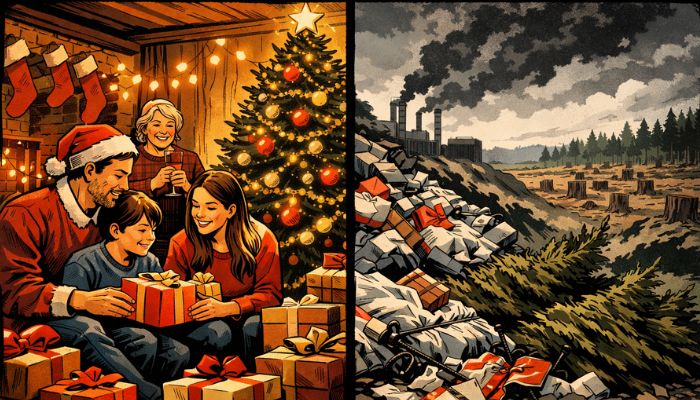

Christmas commemorates the birth of Jesus Christ, the central figure of Christianity, and is observed worldwide as a religious and cultural festival. When autumn has given way to winter and snow covers the ground, and lights twinkle from house to house, you know Christmas is coming. Christmas is widely associated with joy, generosity, and cultural celebration. Still, in its current form, it has also grown into one of the world’s biggest annual consumption cycles.
It includes Seasonal spikes in shopping, travel, food consumption, and decorative spending, which create measurable environmental consequences. This article examines the environmental impact of Christmas by examining deforestation, waste generation, and agricultural stress. Rather than questioning the celebration itself, the focus here is on how consumption-driven practices linked to Christmas contribute to ecological degradation, as highlighted by global environmental studies and policy research.
Christmas and Deforestation Pressure
One of the less discussed impacts of Christmas is its indirect contribution to deforestation. With the increasing demand for natural Christmas trees, paper-based products, gift packaging, furniture, and decorative items during the festive season, trees are the ones who suffer the most. Even when trees are sourced from plantations, these operations require land, water, fertilisers, and energy-intensive transport. In addition to trees, the increased demand for cardboard, paper bags, and wrapping material puts pressure on forest resources worldwide.
According to the American Farm Bureau, about 25 million natural Christmas trees are cut and sold in the United States each year[i]. Moreover, according to the UK government, about 6-8 million Christmas trees are cut and sold annually.[ii] Across North America and Europe alone, tens of millions of trees are cut each year for Christmas celebrations. The World Wide Fund for Nature (WWF), in its Living Forests Report, identifies rising consumer demand and lifestyle-driven consumption cycles as key drivers of global deforestation and forest degradation, warning that such demand weakens biodiversity and reduces forests’ capacity to regulate climate and store carbon.
Waste Generation and Plastic Pollution
Christmas is also associated with a sharp rise in solid waste generation. Household and commercial waste increases significantly during the festive period due to disposable decorations, excessive packaging, and wrapping paper. According to environmental audits in the United Kingdom, around 227,000 miles of wrapping paper are used every Christmas, enough to wrap the Earth nearly 9 times, and much of which is non-recyclable[iii].
A large proportion of festive wrapping materials are non-recyclable because they are laminated, dyed, or coated with plastic and glitter. This results in higher landfill use and incineration, both of which contribute to pollution and greenhouse gas emissions. Municipal waste-management systems often struggle to handle these short-term surges, creating long-term environmental costs that extend well beyond the holiday season.
The Plastic Problem
Christmas gifting has quietly become a major driver of avoidable waste. UK government and waste-management data show that around 30% more waste is generated during the festive period compared to the rest of the year, much of it linked to packaging and short-lived consumer goods.[iv] According to the Department for Environment, Food & Rural Affairs, the UK discards more than £40 million worth of unwanted Christmas presents, many of which end up in landfills just months after being traded.[v] Packaging significantly amplifies this problem.
According to WRAP’s data, approximately 114,000 tonnes of recyclable festive packaging are incorrectly disposed of each year due to contamination from plastic coatings, glitter, ribbons, and mixed materials.[vi] According to consumer surveys, workplace and social gifting are particularly inefficient. Gifts received among coworkers and acquaintances are significantly more likely to be disliked, making them a high-volume, low-utility kind of consumption. From an environmental point of view, this represents a poor trade-off, resulting in increased material waste that lingers well beyond the festive season.
Seasonal Consumption, Methane Emissions, and Climate Stress
Christmas’s environmental impact goes beyond visible waste to climate-critical emissions. One of the most significant impacts comes from organic waste. According to the reports, the UK wastes an estimated 7-8 million real Christmas trees, which are discarded annually, generating approximately 12000 tonnes of green waste.[vii] Methane, a greenhouse gas significantly more potent than carbon dioxide in the short term, is released when decomposing trees are dumped in landfills. It indicates that emissions may reach tens of thousands of tonnes annually.
Food waste compounds this problem. According to the WRAP, it estimates that over 200,000 tonnes of edible food are wasted in the UK during the Christmas period, including hundreds of thousands of turkeys and millions of festive food items.[viii] This waste represents not only lost food but also wasted land, water, energy, and fertilisers used in production. When disposed of in a landfill, food waste further contributes to methane emissions, intensifying climate impact.
From a global standpoint, these seasonal patterns are consistent with broader environmental research. The World Wide Fund for Nature has consistently pointed out that lifestyle-driven consumption spikes, even when temporary, cumulatively contribute to deforestation, biodiversity loss, and climate instability. Christmas exemplifies how repeated annual increases in consumption and waste can affect the long-term environmental and climate goals.
Conclusion – Sustainability, Not Celebration Shaming
The environmental concerns associated with Christmas are not an argument against celebration or cultural tradition. Instead, they highlight the ecological cost of unchecked consumerism that now surrounds many global festivals. Research shows that forests, climate systems, and ecosystems respond to cumulative human behaviour rather than intent. Addressing environmental degradation requires acknowledging and reforming high-impact consumption cycles, including those linked to Christmas. Sustainable celebrations focused on reduced waste, responsible consumption, and environmental awareness offer a way forward that balances cultural practice with ecological responsibility.
References:
[i] Marszalek, J. (2024, November 15). Natural Christmas tree sales reach 25 million annually; tariffs on artificial trees not a boon. WFYI. https://www.wfyi.org/news/articles/natural-christmas-tree-sales-reach-25-million-annually-tariffs-on-artificial-trees-not-a-boon
[ii] UK Government. (2023). Christmas trees and forestry regulations in England. GOV.UK. https://www.gov.uk/government/publications/christmas-trees-and-forestry-regulations-in-england/christmas-trees-and-forestry-regulations
[iii] GWP Group. (2025). Christmas packaging facts. https://www.gwp.co.uk/guides/christmas-packaging-facts/
[iv] MyGreenPod.
(2024). Christmas waste statistics 2024. https://www.mygreenpod.com/articles/christmas-waste-2024/
[v] GWP Group.
(2025). Christmas packaging facts. https://www.gwp.co.uk/guides/christmas-packaging-facts/
[vi] Waste Direct. (2024, December 17). Christmas waste statistics in 2025. WasteDirect.co.uk. https://wastedirect.co.uk/blog/christmas-waste-statistics/
[vii] GWP Group. (2025). Christmas packaging facts. https://www.gwp.co.uk/guides/christmas-packaging-facts/
[viii] Waste & Resources Action Programme. (2023). Festive food and packaging waste in the UK. WRAP. https://wrap.org.uk