Guarding the Dharmic land: How India’s new FCRA Rules finally shut the door on conversion money
The Foreign Contribution (Regulation) Rules, 2011, were amended by a Gazette notification published by the Union Ministry of Home Affairs on June 22, 2026. One point of statutory clarity must be made clear before moving on, the Rules, which are the subordinate, delegated laws formed under the parent Act, are what have been changed. The main FCRA itself, the Foreign Contribution (Regulation) Act, 2010, has not been altered. The operational mechanics, such as who is eligible for FCRA registration, what they must formally declare, how they must account for each rupee of foreign money they have received, and which activities are now specifically prohibited, have been altered by the Home Ministry. This distinction is important since it defines how the change was implemented. Changes to the Rules do not require Parliament’s approval. On June 22, the executive administration, through the Ministry of Home Affairs, exercised its assigned authority to notify them directly. The announcement is transparent, legal, and open to the public through the Official Gazette. On this particular occasion, critics who claim procedural impropriety are just legally incorrect. Nevertheless, it is important to recognise the importance of the changes. These are some of the most significant changes to India’s foreign funding structure in a long time. The long permissive interregnum and how it was exploited The United Progressive Alliance government was in power when the original Foreign Contribution (Regulation) Rules were drafted in 2011. At that time, they allowed organisations registered for broad, flexible purposes, such as ‘religious,’ ‘educational,’ ‘social,’ or ‘cultural’, to accept donations from outside with comparatively little examination of what those purposes actually meant in reality. Basic disclosures were filed, annual returns were required, and registration was necessary. However, there was no clear definition of what constitutes a ‘religious purpose’ in the Rules. The consequences of that silence were significant. In the subsequent years that followed, intelligence reports from central agencies and state governments consistently pointed out a concerning trend. Foreign funds that were supposed to be used for charitable, educational, or religious purposes were instead being used, either entirely or partially, for organised religious conversion and proselytising, especially in rural and tribal areas. Over 20,000 FCRA registrations have been suspended or cancelled since 2014, with conversion activity being one of the reasons given, according to enforcement data from the Ministry of Home Affairs. Four Christian evangelical organisations operating in Jharkhand, Manipur, and Mumbai had their FCRA licenses suspended by the MHA in September 2020 due to intelligence reports about their efforts to convert tribal communities. In the same month, the licenses of thirteen more NGOs were suspended for similar reasons. Prominent organisations like World Vision India, the Church’s Auxiliary for Social Action, and the Evangelical Fellowship of India had their registrations revoked in 2024. The pattern was the same in all of these cases, registration for welfare or religious purposes, but field activities consistently veered into aggressive conversion drives aimed at economically disadvantaged groups, with foreign finance supporting the entire endeavour. However, there was no clear prohibition on this path in the Rules. Case by case, notice by notice, cancellation by cancellation, enforcement continued to be reactive. A systemic, rule-based closure of the loophole itself was what the nation required. Precision where there was permissiveness This vacuum is purposefully filled by the Foreign Contribution (Regulation) Rules, 2026, which go into force immediately following the gazette notification. First and foremost, all organisations wishing to register under the FCRA must now choose their goals from a government-notified Schedule that encompasses five major categories, social, religious, cultural, economic, and educational. Self-defined, unrestricted goals are a thing of the past. You cannot register if your purpose is not specified. Second, the Rules now specifically stipulate that activities must be conducted ‘excluding proselytisation‘ for a number of groups within the religious community. Religious education, documenting of religious traditions, preservation of indigenous beliefs, satsangs, talks, meditation retreats, and, most importantly, the documentation, maintenance, and rejuvenation of indigenous and tribal faith practices are among the categories affected. Particular consideration must be given to this final category. The phrase preserving or reviving indigenous faith was appropriated for decades as a pretext for systematic conversion. The Rules have forged a boundary that is both legally correct and civilisationally sensible by allowing certain activities but expressly prohibiting proselytisati
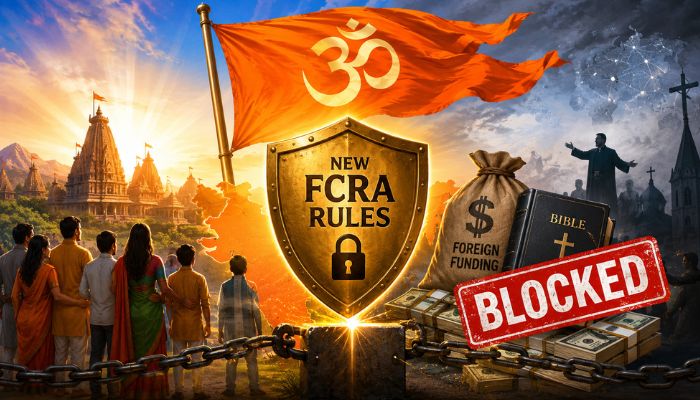
The Foreign Contribution (Regulation) Rules, 2011, were amended by a Gazette notification published by the Union Ministry of Home Affairs on June 22, 2026. One point of statutory clarity must be made clear before moving on, the Rules, which are the subordinate, delegated laws formed under the parent Act, are what have been changed. The main FCRA itself, the Foreign Contribution (Regulation) Act, 2010, has not been altered. The operational mechanics, such as who is eligible for FCRA registration, what they must formally declare, how they must account for each rupee of foreign money they have received, and which activities are now specifically prohibited, have been altered by the Home Ministry.
This distinction is important since it defines how the change was implemented. Changes to the Rules do not require Parliament’s approval. On June 22, the executive administration, through the Ministry of Home Affairs, exercised its assigned authority to notify them directly. The announcement is transparent, legal, and open to the public through the Official Gazette. On this particular occasion, critics who claim procedural impropriety are just legally incorrect.
Nevertheless, it is important to recognise the importance of the changes. These are some of the most significant changes to India’s foreign funding structure in a long time.
The long permissive interregnum and how it was exploited
The United Progressive Alliance government was in power when the original Foreign Contribution (Regulation) Rules were drafted in 2011. At that time, they allowed organisations registered for broad, flexible purposes, such as ‘religious,’ ‘educational,’ ‘social,’ or ‘cultural’, to accept donations from outside with comparatively little examination of what those purposes actually meant in reality. Basic disclosures were filed, annual returns were required, and registration was necessary. However, there was no clear definition of what constitutes a ‘religious purpose’ in the Rules. The consequences of that silence were significant.
In the subsequent years that followed, intelligence reports from central agencies and state governments consistently pointed out a concerning trend. Foreign funds that were supposed to be used for charitable, educational, or religious purposes were instead being used, either entirely or partially, for organised religious conversion and proselytising, especially in rural and tribal areas. Over 20,000 FCRA registrations have been suspended or cancelled since 2014, with conversion activity being one of the reasons given, according to enforcement data from the Ministry of Home Affairs.
Four Christian evangelical organisations operating in Jharkhand, Manipur, and Mumbai had their FCRA licenses suspended by the MHA in September 2020 due to intelligence reports about their efforts to convert tribal communities. In the same month, the licenses of thirteen more NGOs were suspended for similar reasons. Prominent organisations like World Vision India, the Church’s Auxiliary for Social Action, and the Evangelical Fellowship of India had their registrations revoked in 2024. The pattern was the same in all of these cases, registration for welfare or religious purposes, but field activities consistently veered into aggressive conversion drives aimed at economically disadvantaged groups, with foreign finance supporting the entire endeavour.
However, there was no clear prohibition on this path in the Rules. Case by case, notice by notice, cancellation by cancellation, enforcement continued to be reactive. A systemic, rule-based closure of the loophole itself was what the nation required.
Precision where there was permissiveness
This vacuum is purposefully filled by the Foreign Contribution (Regulation) Rules, 2026, which go into force immediately following the gazette notification.
First and foremost, all organisations wishing to register under the FCRA must now choose their goals from a government-notified Schedule that encompasses five major categories, social, religious, cultural, economic, and educational. Self-defined, unrestricted goals are a thing of the past. You cannot register if your purpose is not specified.
Second, the Rules now specifically stipulate that activities must be conducted ‘excluding proselytisation‘ for a number of groups within the religious community. Religious education, documenting of religious traditions, preservation of indigenous beliefs, satsangs, talks, meditation retreats, and, most importantly, the documentation, maintenance, and rejuvenation of indigenous and tribal faith practices are among the categories affected. Particular consideration must be given to this final category. The phrase preserving or reviving indigenous faith was appropriated for decades as a pretext for systematic conversion. The Rules have forged a boundary that is both legally correct and civilisationally sensible by allowing certain activities but expressly prohibiting proselytisation inside them.
Third, any organisation that employs foreign nationals as essential staff, other than those of Indian origin, will no longer ‘ordinarily not be considered’ for registration or prior authorisation. This resolves a long-standing issue with externally driven organisations that effectively serve as tools of foreign cultural or religious agendas by placing foreign nationals at the operational helm.
Fourth, the meaning of ‘key functionary’ has been greatly expanded to include directors of companies, partners in businesses, trustees, the Karta of a Hindu Undivided Family, and anybody with effective management control. This eliminates a popular loophole in which nominal Indian names sat at the top while actual direction came from foreign individuals operating outside of formal scrutiny.
Fifth, transparency at both ends of the money path is tightened by new disclosure regulations. In registration applications, NGOs are required to include details regarding all social media accounts they have. The true donor, or the original source of the donation, must be revealed when contributions come through intermediary vehicles like donor-advised contributions.
Sixth, a minimum of ₹10 lakh in foreign contribution on declared activities over the past two financial years is now required for renewal in order to stop stagnant organisations from accumulating licenses. Subsequent instalments will only be granted to groups receiving funds under Prior Permission if 75% of the last instalment has been used. In other words, licenses that are dormant will expire.
Finally, all current FCRA-registered associations have one year from the date of notification to formally declare their precise purposes and modes of operation under the new Schedule. This transition provision compels a public accounting and is not just administrative. These days, every organization must formally commit to specific and clearly defined goals.
The pending bill: Completing the architecture
There is more to the June 22 Rules change than just this. It is a component of a broader legislative framework that the government is systematically putting together. The Foreign Contribution (Regulation) Amendment Bill, 2026, was presented to the Lok Sabha by the government in March of that year. The Bill, which is presently being considered, proposes amending the parent FCRA Act itself. A Designated Authority, a government appointed individual with the power to take over the management of foreign donations and the assets of organisations whose FCRA registration has been cancelled, given up, or not renewed, serves as its central focus.
At present, when an organisation loses its licence, its owned assets, land, buildings, hospitals, schools, and equipment built over the years with foreign funds often fall into a legal vacuum. The gap in question would be completely closed by the Bill. The Consolidated Fund of India would receive the proceeds from the Designated Authority’s oversight, management, and, if needed, disposal of those assets. This completely changes enforcement instead of causing lengthy court proceedings during which assets remain intact, and operations essentially continue, a cancelled licence would have actual, immediate, and permanent consequences.
A civilisation protecting itself
India’s actions are not motivated by fear. The civilisation that birthed the Guru Granth Sahib, the Tripitaka, the Vedas, and the Upanishads does not fear free religious practice or open theological discussion. It will no longer tolerate the systematic channelling of foreign funds to target its most vulnerable communities, its forest-dwelling peoples and rural poor, as captive fields for conversion projects directed and funded from abroad. Every genuine democracy defends its social and cultural fabric against manipulation by foreign funding. FARA exists in the United States. Foreign religious organisations are subject to strict regulations in France. India’s stricter FCRA framework is a completely normal exercise of social self-determination, not an exception.
The June 22, 2026, notification of the rules is accurate, reasonable, and long overdue. The framework will be complete after Parliament has finished working on the current Amendment Bill. When combined, these amendments provide a straightforward but significant guarantee that anyone who wants to help India’s people can do so without restriction as long as they do so on India’s terms, with clear intentions, stated goals, and no conversion agenda supported by foreign funds. India’s dharmic heart is now carefully guarded.