Haryana govt amends Private Universities Act after Al Falah University link surfaced in Delhi Red Fort terror attack: All you need to know
The November 10 Islamic terror attack in Delhi, which killed over 15 people, brought the Al Falah University in Haryana’s Faridabad under the scanner. The Islamic terror attack near Red Fort was carried out by Al Falah University member, Dr Umar Un Nabi. The varsity established in 2014 by the Al Falah Charitable Trust has been implicated in the white-collar terror module linked to the Pakistan-based Islamic terror group Jaish-e-Mohammad and Ansar Ghazwat-ul-Hind (AGuH). To tighten the noose around the Al Falah University, the Haryana Government has passed the Haryana Private Universities (Amendment) Bill, 2025. The BJP government in the state brought the Haryana Private Universities (Amendment) Bill to make amendments to the various provisions of the Haryana Private Universities Act, 2006. The bill was passed on 22nd December 2025 on the last day of the state assembly’s Winter Session. The amendments have been made to enhance state oversight and lay down procedures for dissolving or taking over private universities and appointing an administrator, and to ensure the government’s prior approval for the introduction of new courses. The changes made in the amended legislation will apply to all 26 private universities in Haryana, including Al Falah University. Fines ranging from Rs 10 lakh to Rs 1 crore will be imposed for maladministration, providing false information, or failing to comply with the prescribed standards. In addition, the government may halt admissions and order phased dissolution in case of universities failing to rectify violations within 30 days. It is not that the 2014 Act did not provide for the imposition of penalties for rule violations or did not make any mention about the dissolution of private universities; however, the process was not clearly laid down. Under new Section 44B, the state government can appoint an administrator or committee to take full control over a private university’s affairs, assets, and operations in cases of national security lapses, threat to public security and national sovereignty, law and order, or other unlawful/anti-national activities. The new rule states that the State-appointed administrator will ensure continuity until the last student batch graduates, following which, assets revert to the sponsoring body. Another change in the rule pertains to operations controls. Now, prior government approval will be required for new courses or intake changes. This is done to address the misuse of Section 34A. In addition, annual academic and administrative audits will be mandatory. The annual audits, both academic and administrative, will ensure that private universities are complying with all the rules and maintaining standards. If found violating the rules, varsities may receive notice and face action from the government, if required. The Haryana Private Universities (Amendment) Bill, 2025, also provides for establishing a new state-run University of Design, Innovation and Technology in Gurugram. Explaining what necessitated the amendment to the Private Universities Act, 2006, state education minister, Mahipal Dhanda, said that during a comprehensive review, it was found that Sections 34A, 34B, 44, 44A and 46 required streamlining. He added that the existing Sections 44 and 44A did not lay down any procedure either for the dissolution of a university or for the appointment of an administrator. “This necessitated amendments to these sections and the insertion of the new Section 44B to clearly lay down the process for phased dissolution and administrative takeover,” Minister Dhanda said. Similarly, the minister said that the provisions of Section 46 were broadened to eliminate ambiguities, shut down loopholes and bolster regulatory oversight over private varsities. “It has been noticed that certain private universities started new courses, enhanced intake capacity and even changed the nomenclature of courses without obtaining prior approval of the state government by misusing sub-section (3) of Section 34A. Therefore, the provision needed modification,” the Haryana Education Minister said. The Haryana Private Universities (Amendment) Bill and the Al Falah University connection The passed Private Universities (Amendment) Bill, 2025, does not explicitly mention Al Falah University. However, its timing and changes made in the existing law make it apparent that the state government is not only enhancing regulatory oversight over private universities but also tightening the noose around Al Falah University. This Islamic terror involvement-accused varsity was established by the Al Falah Charitable Trust and obtained the “university” status in 2014 via an act of the Haryana Assembly. As per the information given on the varsity’s website, the “Al-Falah University was established by the Haryana Legislative Assembly by passing Act 21 of 2014 under the Haryana Private University Act 2006, amended in 2014, and notified on May 2, 2014
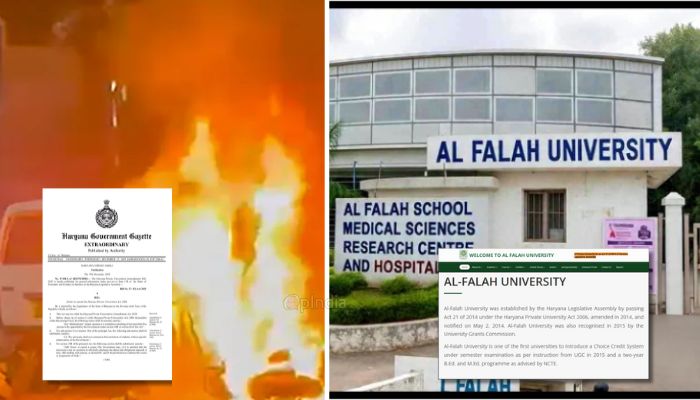

The November 10 Islamic terror attack in Delhi, which killed over 15 people, brought the Al Falah University in Haryana’s Faridabad under the scanner. The Islamic terror attack near Red Fort was carried out by Al Falah University member, Dr Umar Un Nabi. The varsity established in 2014 by the Al Falah Charitable Trust has been implicated in the white-collar terror module linked to the Pakistan-based Islamic terror group Jaish-e-Mohammad and Ansar Ghazwat-ul-Hind (AGuH). To tighten the noose around the Al Falah University, the Haryana Government has passed the Haryana Private Universities (Amendment) Bill, 2025.
The BJP government in the state brought the Haryana Private Universities (Amendment) Bill to make amendments to the various provisions of the Haryana Private Universities Act, 2006. The bill was passed on 22nd December 2025 on the last day of the state assembly’s Winter Session. The amendments have been made to enhance state oversight and lay down procedures for dissolving or taking over private universities and appointing an administrator, and to ensure the government’s prior approval for the introduction of new courses.
The changes made in the amended legislation will apply to all 26 private universities in Haryana, including Al Falah University.
Fines ranging from Rs 10 lakh to Rs 1 crore will be imposed for maladministration, providing false information, or failing to comply with the prescribed standards. In addition, the government may halt admissions and order phased dissolution in case of universities failing to rectify violations within 30 days. It is not that the 2014 Act did not provide for the imposition of penalties for rule violations or did not make any mention about the dissolution of private universities; however, the process was not clearly laid down.
Under new Section 44B, the state government can appoint an administrator or committee to take full control over a private university’s affairs, assets, and operations in cases of national security lapses, threat to public security and national sovereignty, law and order, or other unlawful/anti-national activities. The new rule states that the State-appointed administrator will ensure continuity until the last student batch graduates, following which, assets revert to the sponsoring body.
Another change in the rule pertains to operations controls. Now, prior government approval will be required for new courses or intake changes. This is done to address the misuse of Section 34A. In addition, annual academic and administrative audits will be mandatory.
The annual audits, both academic and administrative, will ensure that private universities are complying with all the rules and maintaining standards. If found violating the rules, varsities may receive notice and face action from the government, if required.
The Haryana Private Universities (Amendment) Bill, 2025, also provides for establishing a new state-run University of Design, Innovation and Technology in Gurugram.
Explaining what necessitated the amendment to the Private Universities Act, 2006, state education minister, Mahipal Dhanda, said that during a comprehensive review, it was found that Sections 34A, 34B, 44, 44A and 46 required streamlining. He added that the existing Sections 44 and 44A did not lay down any procedure either for the dissolution of a university or for the appointment of an administrator.

“This necessitated amendments to these sections and the insertion of the new Section 44B to clearly lay down the process for phased dissolution and administrative takeover,” Minister Dhanda said.
Similarly, the minister said that the provisions of Section 46 were broadened to eliminate ambiguities, shut down loopholes and bolster regulatory oversight over private varsities.
“It has been noticed that certain private universities started new courses, enhanced intake capacity and even changed the nomenclature of courses without obtaining prior approval of the state government by misusing sub-section (3) of Section 34A. Therefore, the provision needed modification,” the Haryana Education Minister said.
The Haryana Private Universities (Amendment) Bill and the Al Falah University connection
The passed Private Universities (Amendment) Bill, 2025, does not explicitly mention Al Falah University. However, its timing and changes made in the existing law make it apparent that the state government is not only enhancing regulatory oversight over private universities but also tightening the noose around Al Falah University. This Islamic terror involvement-accused varsity was established by the Al Falah Charitable Trust and obtained the “university” status in 2014 via an act of the Haryana Assembly.
As per the information given on the varsity’s website, the “Al-Falah University was established by the Haryana Legislative Assembly by passing Act 21 of 2014 under the Haryana Private University Act 2006, amended in 2014, and notified on May 2, 2014. Al-Falah University was also recognised in 2015 by the University Grants Commission.”

The Al Falah University came under the scanner of security agencies after its connection to the Delhi blast case came to light. On one hand, the NIA and local police began questioning suspected terrorists linked to the varsity; on the other, the National Assessment and Accreditation Council (NAAC) handed a show-cause notice to Al Falah University authorities for misleading the public.
The Al Falah University continued to advertise on its website a “Grade A” accreditation even as certifications for its individual colleges had expired in 2016 and 2018. The varsity also falsely claimed that it is eligible for central grants under Section 12(B) of the University Grants Commission Act (UGC Act),
In November, the Enforcement Directorate arrested Al Falah University’s chancellor, Jawad Ahmed Siddiqui, over alleged involvement in money laundering and defrauding students of Rs 415 crore during the years 2018 and 2025. The probe agency’s investigation revealed that Siddiqui allegedly diverted student fees, up to Rs 90 lakh for MBBS courses, for personal use.
The ED told the Delhi court that Al Falah University had made around Rs 415 crore by misleading students and their families through false claims about its accreditation and recognition.
Siddiqui is also accused of acquiring prime Hindu land in south-east Delhi’s Madanpur Khadar using forged documents. The Al Falah University chancellor used his private firm, Tarbia Education Foundation, to purchase multiple land parcels through fake General Power of Attorney (GPA) documents. Officials say some of these GPAs were “executed” decades after the Hindu landowners had passed away.

According to investigators, land in Khasra No. 792, Madanpur Khadar, valued at ₹75 lakh, was among the plots fraudulently transferred. The paperwork is found to be fabricated; having forged signatures, forged thumb impressions and deceased individuals magically authorising land sales in 2004.
Dr Umar Un Nabi, who worked at Al Falah University as an assistant professor, was identified as the Fidayeen Jihadi or suicide bomber who detonated himself in an explosives-laden Hyundai i20 car on 10th November. Two other Al Falah faculty members, Dr Muzammil Ahmed Ghanaie, alias Muzammil Shakeel, and Dr Shaheen Shahid, provided Nabi with logistical support, including stacking about 2,900 kg of explosives. The duo also helped Umar Un Nabi with handling recruitment and distribution for the white-collar Islamic terror module.
A former nursing staff member at the university’s medical college and hospital revealed that every day, about 100 to 150 fake patient files were created there on the orders of accused Muzammil Shakeel. It has also been alleged that Hindu employees at the Muslim-dominated university faced discrimination at multiple levels.
OpIndia reported earlier that while the Delhi blast brought national spotlight on the Al Falah University, it was not the first time that people linked to the varsity indulged in Islamic terror crimes. Mirza Shabad Baiq, the main accused in the 2008 serial bombings in Delhi and Ahmedabad, graduated from Al Falah University in Haryana’s Faridabad. He completed his B.Tech. in Electronics and Instrumentation from the Al Falah Engineering College, Faridabad, Haryana, in 2007. Baig, who is on the run and is believed to be living in Pakistan, headed the Azamgarh module of the terrorist outfit Indian Mujahideen (IM) (formerly known as SIMI – Students Islamic Movement of India).
The Al Falah University received crores of rupees in minority grants, despite not having the UGC Section 12(B) funding status. The university availed substantial benefits from minority-focused Central government schemes. In 2016, over ₹10 crore in MoMA scholarships were disbursed to the students of Al-Falah. Before that, in 2015, ₹6 crore was allotted for around 2,600 minority students. The university also received ₹1.10 crore from AICTE for scholarships to students from Jammu and Kashmir. Similarly, in the year 2014, the year in which it was recognised as a private university, 50 minority students received MoMA scholarships.
In addition, the varsity also received funds from AICTE for laboratories under the MODROB (Modernisation and Removal of Obsolescence) scheme modernisation funds in 2011.
The investigation against the Al Falah University continues, and more revelations regarding the varsity’s alleged illegal, particularly, terror-linked activities might be made in the future. The Haryana Government has started fixing the systemic rot. With the passage of the Private Universities (Amendment) Bill, 2025, the government has eliminated the legal loopholes and strengthened its oversight over not only Al Falah but also other private universities. The amendment to the existing law will also ensure that private universities do not become a haven for terrorists and those involved in various anti-national activities.