India reclaiming its legacy is ‘Hindu majoritarianism’, Pakistan appropriating its pre-Islamic heritage is ‘maturity’: Read how The Wire resorted to mental gymnastics to find ‘Aman ki Asha’
Pakistan has launched an aggressive rebranding campaign aimed at positing the 78-year-old Islamic Republic as a ‘civilisational state’ through a selective embrace of the region’s pre-Islamic history. Pakistan’s sinister pursuits have found a supporter in Islamo-leftist rag The Wire. On the 4th July, The Wire published an opinion piece headlined, “How the Two Partitioned Nations Choose to Remember Their Past”. The article is authored by ‘independent journalist’ Rohinee Singh, who was among the 61 Indian signatories of the joint Aman ki Asha letter signed by Indian and Pakistani ‘concerned citizens’ that sought revival of the pro-Pakistan Musharraf-Manmohan framework on Jammu and Kashmir and PoJK. In her article, Rohinee Singh juxtaposes the renaming exercise of certain places, buildings, roads by the governments in Pakistan and India, and weaves a narrative that somehow, Pakistan’s newfound love for its pre-Islamic and pre-partition past as a sign of ‘maturity’ and ‘correction of history’ while the Modi government’s renaming drive is ‘ideological positioning’, ‘curation of history’, and everything abominable. The article begins with how Lahore’s Laxmi Chowk remained Laxmi Chowk in people’s consciousness despite official renaming as Maulana Zafar Ali Khan Chowk, and Delhi’s GB Road was not forgotten despite official renaming as Swami Shraddhanand Marg. It proceeds towards arguing how governments across the world use maps, monuments, and place names as instruments of power. Roads, cities, railway stations, airports, and public buildings as “political canvases” to “project their preferred version of history. Author Rohinee Singh insinuates that the Modi government renamed the road named after Mughal tyrant Aurangzeb, whose reign witnessed killings of Hindus, demolition of temples and imposition of Jizya, to Dr APJ Abdul Kalam as BJP’s political statement. “After 2014, Aurangzeb Road became Dr. APJ Abdul Kalam Road. Mughalsarai Junction became Pandit Deen Dayal Upadhyaya Junction, and Rajpath became Kartavya Path. The Hall of Nations at Pragati Maidan, an architectural symbol of post-independence India, was demolished in 2017 and eventually replaced by Bharat Mandapam, inaugurated ahead of the G20 summit in 2023,” the article reads. The article quotes a Delhi-based heritage conservationist, Sohail Hashmi, who says that “In this cycle of naming and renaming, people who made major contributions are often replaced by figures who are politically useful in the present.” The Wire contends that while the ‘Hindu nationalist’ Modi government is changing names to erase India’s Muslim and British or pre-partition history, Pakistan is walking an absolutely opposite path. Rohinee Singh claims that Pakistan is ‘restoring’ Hindu-Sikh names of certain places in Lahore. Rohinee Singh, however, did not apply Hashmi’s “politically useful in the present” argument in the context of Pakistan’s sudden embrace of its pre-Islamic and pre-partition history. “Ironically, while India continues to rename roads and institutions associated with its medieval and colonial past, Pakistan’s Punjab province has begun moving in the opposite direction. The provincial cabinet met in May of this year and approved the Lahore Heritage Area Revival Project, aimed at restoring several older place names,” The Wire article that first appeared in Sapan News reads. Singh cites the restoration of the Babri Masjid Road’s name as Jain Mandir Road, or Rahim Gali becoming Ram Gali, to insinuate that Pakistan is pivoting towards embracing pre-partition history and becoming secular and tolerant while India is deviating from secularism by changing names of roads and buildings from those of Mughal tyrants and Islamic fanatics to original Hindu names or after prominent political figures neglected for over six decades of Congress rule due to political-ideological opposition. Rohinee Singh did not mention that Pakistan’s supposed pivot to secularism and embrace of pre-Islamic history is performative and driven by geopolitical interest rather than any genuine realisation that the Two-Nation Theory, rooted in Islamic intolerance of Hindus, is regressive and primitive. Lahore restorations are a part of a tourism boost drive under a specific provincial government. They do not change Pakistan’s Islamic exclusivist nature and state ideology where Hindu and other religious minorities are subjected to brutalities and discrimination of all imaginable kinds just because of their non-Islamic faith. Pakistan has a documented history of demolishing temples, vandalising, encroaching on, and repurposing Hindu heritage sites, in addition to changing names favouring Islamic identity. Interestingly, in its agenda of portraying the Islamic Republic of Pakistan as a mature and tolerant nation in contrast to a ‘secular’ Hindu-majority India, Rohinee Singh did not reveal complete facts about the restoration of pre-partition Hindu names in Lahore.
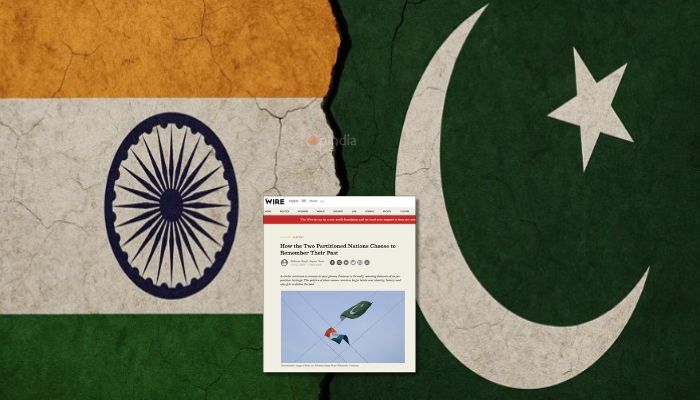
Pakistan has launched an aggressive rebranding campaign aimed at positing the 78-year-old Islamic Republic as a ‘civilisational state’ through a selective embrace of the region’s pre-Islamic history. Pakistan’s sinister pursuits have found a supporter in Islamo-leftist rag The Wire.
On the 4th July, The Wire published an opinion piece headlined, “How the Two Partitioned Nations Choose to Remember Their Past”. The article is authored by ‘independent journalist’ Rohinee Singh, who was among the 61 Indian signatories of the joint Aman ki Asha letter signed by Indian and Pakistani ‘concerned citizens’ that sought revival of the pro-Pakistan Musharraf-Manmohan framework on Jammu and Kashmir and PoJK.
In her article, Rohinee Singh juxtaposes the renaming exercise of certain places, buildings, roads by the governments in Pakistan and India, and weaves a narrative that somehow, Pakistan’s newfound love for its pre-Islamic and pre-partition past as a sign of ‘maturity’ and ‘correction of history’ while the Modi government’s renaming drive is ‘ideological positioning’, ‘curation of history’, and everything abominable.
The article begins with how Lahore’s Laxmi Chowk remained Laxmi Chowk in people’s consciousness despite official renaming as Maulana Zafar Ali Khan Chowk, and Delhi’s GB Road was not forgotten despite official renaming as Swami Shraddhanand Marg.
It proceeds towards arguing how governments across the world use maps, monuments, and place names as instruments of power. Roads, cities, railway stations, airports, and public buildings as “political canvases” to “project their preferred version of history.
Author Rohinee Singh insinuates that the Modi government renamed the road named after Mughal tyrant Aurangzeb, whose reign witnessed killings of Hindus, demolition of temples and imposition of Jizya, to Dr APJ Abdul Kalam as BJP’s political statement.
“After 2014, Aurangzeb Road became Dr. APJ Abdul Kalam Road. Mughalsarai Junction became Pandit Deen Dayal Upadhyaya Junction, and Rajpath became Kartavya Path. The Hall of Nations at Pragati Maidan, an architectural symbol of post-independence India, was demolished in 2017 and eventually replaced by Bharat Mandapam, inaugurated ahead of the G20 summit in 2023,” the article reads.
The article quotes a Delhi-based heritage conservationist, Sohail Hashmi, who says that “In this cycle of naming and renaming, people who made major contributions are often replaced by figures who are politically useful in the present.”
The Wire contends that while the ‘Hindu nationalist’ Modi government is changing names to erase India’s Muslim and British or pre-partition history, Pakistan is walking an absolutely opposite path. Rohinee Singh claims that Pakistan is ‘restoring’ Hindu-Sikh names of certain places in Lahore.
Rohinee Singh, however, did not apply Hashmi’s “politically useful in the present” argument in the context of Pakistan’s sudden embrace of its pre-Islamic and pre-partition history.
“Ironically, while India continues to rename roads and institutions associated with its medieval and colonial past, Pakistan’s Punjab province has begun moving in the opposite direction. The provincial cabinet met in May of this year and approved the Lahore Heritage Area Revival Project, aimed at restoring several older place names,” The Wire article that first appeared in Sapan News reads.
Singh cites the restoration of the Babri Masjid Road’s name as Jain Mandir Road, or Rahim Gali becoming Ram Gali, to insinuate that Pakistan is pivoting towards embracing pre-partition history and becoming secular and tolerant while India is deviating from secularism by changing names of roads and buildings from those of Mughal tyrants and Islamic fanatics to original Hindu names or after prominent political figures neglected for over six decades of Congress rule due to political-ideological opposition.
Rohinee Singh did not mention that Pakistan’s supposed pivot to secularism and embrace of pre-Islamic history is performative and driven by geopolitical interest rather than any genuine realisation that the Two-Nation Theory, rooted in Islamic intolerance of Hindus, is regressive and primitive.
Lahore restorations are a part of a tourism boost drive under a specific provincial government. They do not change Pakistan’s Islamic exclusivist nature and state ideology where Hindu and other religious minorities are subjected to brutalities and discrimination of all imaginable kinds just because of their non-Islamic faith. Pakistan has a documented history of demolishing temples, vandalising, encroaching on, and repurposing Hindu heritage sites, in addition to changing names favouring Islamic identity.
Interestingly, in its agenda of portraying the Islamic Republic of Pakistan as a mature and tolerant nation in contrast to a ‘secular’ Hindu-majority India, Rohinee Singh did not reveal complete facts about the restoration of pre-partition Hindu names in Lahore.
Earlier this year, the Punjab government proposed restoration of pre-partition Hindu/Sikh names in Lahore, making Islampura as Krishan Nagar, Sunnat Nagar to Sant Nagar, Babri Masjid Chowk as Jain Mandir Chowk, etc, under the Lahore Heritage Areas Revival Project.
The Pakistani ruling dispensation and their online supporters widely boasted the move as ‘while India is descending into communalism, Pakistan is shining as a symbol of secularism and tolerance’. However, in the face of the slightest backlash from Islamic extremist groups, the government caved and Lahore Deputy Commissioner Captain (Retired) Muhammad Ali Ijaz publicly stated that no final decision on the name changes had been officially implemented.
The Wire platformed Rohinee Singh to peddle her pro-Pakistan propaganda based on half-truths, because for Islamo-leftists, facts are secondary and ‘narrative’ is the priority.
There is also a fundamental difference between the so-called renaming exercise in India and Pakistan. While Pakistan’s efforts to restore pre-Islamic names of certain roads or cities etc is a part of national rebranding, India is simply ditching the colonial hangover and unwarranted glorification of medieval-era Islamic invaders and tyrants whose supposed architectural contribution to Indian heritage is outweighed by their Jihadist mass killings and conversion of Hindu, Buddhist, Sikh, Jain and other communities following Indic faiths.
It makes no sense that Rohinee Singh is heaping praises on even Pakistan’s failed attempts at restoring specific original Hindu names of roads and places with Islamised names, but paints India as intolerant and bigoted for doing exactly the same.
“In India, recent renaming exercises largely reflect a broader project of cultural and political redefinition. Islamic and colonial references are being replaced with names rooted in Hindu mythology, indigenous traditions, or figures associated with contemporary nationalist narratives,” Singh writes.
Citing ‘experts’, Rohinee Singh claims that Pakistan is trying to reclaim a large South Asian identity and it wants to be seen differently on the international stage.
The 78-year-old Islamic Republic perpetually ignored and even destroyed pre-Islamic history and its archaeological remnants, be it Mohenjo-Daro, destroyed or vandalised heritage sites linked to Sikh king Maharaja Ranjit Singh, disregarded Bhagat Singh, an ‘Indian freedom fighter with no role in Pakistan’s liberation’, and Buddhist heritage as insignificant, and demolished ancient temples.
And yet, based on just one isolated ‘Hindu names restoration’ bid in Lahore, Rohinee Singh whitewashed Pakistan all past anti-Hindu hatred, bigotry and related crimes. One Laxmi Chowk does not erase all the past sins of the nation created on the hateful idea of Muslim exclusivity and superiority.
Pakistan is curating history, India is correcting it: Blinded by Aman ki Asha, Rohinee Singh fails to see the obvious
Either the delusional Aman ki Asha blinds Rohinee Singh, or she is a part of Pakistan’s concerted efforts to reinvent its image as a ‘civilisational state’, to not see that it is Pakistan that is curating history, not India.
From Aurangzeb Road, Mughalsarai Junction, Rajpath, Pragati Maidan’s Hall of Nations, Allahabad, Chhatrapati Sambhajinagar, bust of Edwin Lutyens, Mughal Gardens, Andaman Islands, to Kolkata’s Suhrawardy Avenue, discontinuing colonial-era Navy insignia, etc, all changed for the right reasons. A truly independent nation does not burden itself with the continuation of imposed identities and symbols from the era of its occupation.
Pakistan, on the contrary, has for over seven decades dismissed its pre-Islamic history as an era of ‘Jahilliyah’.
While in rhetoric, Pakistan is promoting Indus Valley Civilisation and Gandharan heritage as ‘ancient Pakistan’, the 78-year-old Islamic Republic has demonstrated historical neglect of the region’s ancient history and its archaeological remnants merely because of their Hindu or Buddhist influence.
From IVC sites like Mohenjo-daro and Harappa to Taxila and Buddhist sites in the Swat Valley area, the Pakistani governments over the decades have failed to prioritise principled conservation of these historical sites. Neither the absolute Hindu-hating Jihadist military dictators nor the military-backed ‘democratic’ governments cared much about the Indus Valley Civilisation, the pre-Islamic historical sites and their conservation.
Last week, the United Nations Educational, Scientific and Cultural Organisation (UNESCO) formally asked Pakistan to reverse recent ‘reconstructions’ and “unnecessary interventions” at Mohra Moradu, a Buddhist monastery and stupa complex from the Kushan era, and Sirkap, the Indo-Greek city layer, in the Taxila/Takshashila archaeological complex.
Such is Pakistan’s sensitivity and seriousness about protecting its ‘ancient’ heritage that Pakistan’s Department of Archaeology and Museums used cement and modern masonry at Mohra Moradu and Sirkap, under its ‘conservation’ work.
However, Rohinee Singh would come up with a counterargument that at least Pakistan has progressed from destroying heritage sites and statues using explosives, to applying cement for preservation.
Rohinee Singh portrayed one Laxmi Chowk and the failed bid to restore Hindu names of some roads in Lahore, as Pakistan’s massive ‘rediscovery and embrace of pre-partition history and culture’.
She, however, conveniently turned a blind eye to the fact that Hindu, Sikh, Christian and other non-Muslim girls continue to be abducted, forcibly converted to Islam and married off their Muslim abductors with courts and governments siding with jihadis, temples continue to rot either in utter neglect, demolished or repurposed for contemporary use by Muslims, and managing to stay alive without undergoing forced conversion and faith-based discrimination is still a luxury for Hindus in Pakistan.
On one hand, Pakistan is rebranding itself as a ‘civilisational state’ and promoting IVC sites as its national pride, labelling Pāṇini, Chanakya, Raja Purushottama and other historical Hindu Sanatani figures as ‘ancient Pakistanis’; on the other, it is destroying or damaging its pre-Islamic history.
Pakistan’s sudden embrace of the pre-Islamic history of the Indian subcontinent is pretentious, agenda-driven, a tactic of retrofitting facts to appropriate the history of ancient India. One or two pre-partition name changes do not change the fact that Pakistan’s foundation is still rooted in the Two-Nation Theory that essentially says that Muslims cannot co-exist with Hindus. Pakistan’s state ideology is tied structurally to Islamic exclusivity and intolerance of non-Muslims.
In February 2026, when the Hindus across the world celebrated Vasant Panchami, a kite-flying festival, Pakistan reintroduced the Hindu festival as Basant. The country’s political leadership marketed it as a return of freedom and tolerance, winning praise from a section of Indian people as well.
However, either driven by fear of Islamist backlash or their own moral indecency, they decoupled the Hindu religiosity and worship of Maa Saraswati from the festival, passing off Vasant or Basant as a ‘cultural’ or ‘regional’ festival just as Islamo-leftists in India de-Hinduise Hindu festivals like Onam, Pongal, and even gods like Murugan as regional or cultural festivals and deities.
OpIndia reported earlier on how Pakistan’s newfound love for Indus Valley Civilisation, pre-Islamic past, and concoction of the farce called ‘ancient Pakistan’, is all tied to the Indus Waters Treaty, and an image makeover from a Terroristan to a ‘civilisational state’.
However, someone like Rohinee Singh, who gleefully signed an ‘Aman ki Asha’ letter to PM Modi and Pakistan PM Shehbaz Sharif, which essentially sought India to relinquish its legitimate claim over PoJK, would not care much about the fact that India has, through civilisational continuity and Sanatan Dharma, preserved its ancient history and roots, while also accommodating other faiths, their rights and dignity. Rohinee Singh exemplifies what Dhimmitude truly means; no wonder she is, as per The Wire, “engaged in India-Pakistan Track II peace initiatives and reconciliation efforts.”