India–Germany set to clear Rs 72,000 crore submarine deal: How Project-75I transforms Indian Navy’s undersea warfare capability and advances Atmanirbharta
India and Germany are set to ratify one of the most consequential defence-industrial agreements in India’s naval history, with German shipbuilder Thyssen Krupp Marine Systems (TKMS) set to partner Mazagon Dock Shipbuilders Limited (MDL) for the construction of six advanced conventional submarines for the Indian Navy. The deal is expected to be finalised during German Chancellor Friedrich Merz’s visit to India on January 12–13, 2026. Valued at around $8 billion (Rs 72,000 crore), the deal marks the decisive conclusion of the long-running Project-75I Tender, a programme that had remained stalled for years due to shifting policy frameworks, technical demands, and India’s insistence on proven and survivable submarine technology. At the centre of the agreement is the Indian Navy’s selection of the German Type-214 Next Generation (214NG)submarine, a 2,500-ton diesel-electric platform equipped with air-independent propulsion (AIP). The German design edged out Spain’s S-80 Plus, offered by Navantia, primarily due to its operationally validated AIP system, superior acoustic stealth, and lower lifecycle risk. For a navy that operates in contested waters and depends on undersea persistence rather than surface visibility, the maturity of the German platform proved decisive. Why AIP and stealth tipped the scales AIP technology has become a baseline requirement for modern conventional submarines. Traditional diesel-electric boats must periodically surface or snorkel to recharge batteries, exposing themselves to detection. AIP-equipped submarines, by contrast, can remain submerged for weeks, allowing them to conduct extended patrols, surveillance, and strike missions with minimal acoustic and electromagnetic signature. The Type-214NG employs a fuel-cell-based AIP system, widely regarded as one of the most reliable and battle-tested solutions in service today. Spain’s bio-ethanol-based AIP, while innovative, has not yet achieved comparable operational validation. In undersea warfare, where failure is not an option, the Indian Navy opted for technology that has already proven itself in real-world naval environments. Karachi 1971: The moment India understood naval power India’s insistence on stealth, endurance, and survivability is rooted in hard historical experience. During the 1971 India-Pakistan war, the Indian Navy executed Operation Trident and Operation Python, devastating Karachi Port, Pakistan’s primary maritime hub. The strikes crippled Pakistan’s naval logistics and fuel infrastructure to such an extent that sustained naval operations became impossible. That attack was not merely tactical; it was strategic. It hastened Pakistan’s defeat and played a critical role in the war’s outcome, culminating in the creation of Bangladesh. For the first time, India’s political and military leadership fully grasped that control of the seas could decisively shape conflicts on land. Yet, despite this lesson, India’s submarine modernisation moved slowly in the decades that followed. Procurement delays, technological dependence, and policy inertia left the Navy with an ageing underwater fleet even as regional threats evolved. Project-75I, therefore, is not just a procurement programme; it is the long-overdue institutional response to lessons learnt in 1971. Operation Sindoor and the return of Karachi as a strategic pressure point The relevance of this lesson resurfaced dramatically during Operation Sindoor in May 2025, when hostilities between India and Pakistan escalated following a major terror provocation. Between May 8 and May 11, the Indian Navy was placed on heightened operational readiness, with credible reports indicating that India was prepared to strike Pakistan’s financial and logistical nerve centre, Karachi Port, once again if escalation continued. Karachi remains the backbone of Pakistan’s economy, handling the overwhelming majority of its maritime trade, energy imports, and financial flows. The very fact that the Indian Navy could credibly threaten a repeat of 1971, this time with far more advanced maritime surveillance, missile platforms, and undersea assets, underscored how naval power functions as strategic leverage even without shots being fired. Operation Sindoor reinforced a hard truth: Pakistan’s greatest vulnerability lies at sea, and India’s ability to exploit that vulnerability depends heavily on undersea dominance. In this context, the India–Germany submarine deal assumes far greater significance. It is not a peacetime modernisation exercise but a capability upgrade shaped by recent, real-world hostilities. Once, the Indian Navy is equipped with new-age submarine, it’s capability to strike Karachi will be further enhanced, reinforcing deterrence through credible, survivable, and persistent undersea strike capability. Make in India at the core of Project-75I A defining feature of the India–Germany agreement is that all six submarines will be built in India, wit
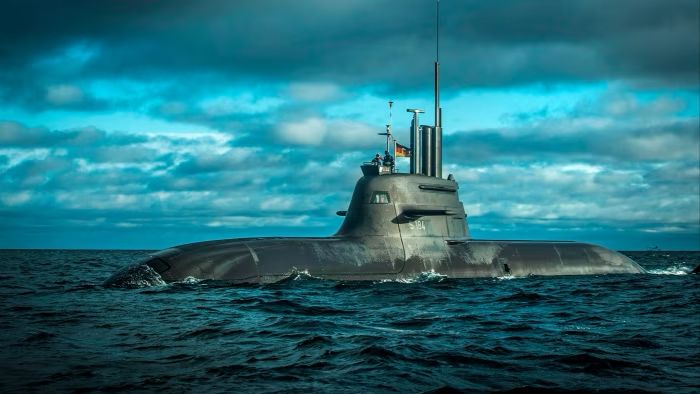

India and Germany are set to ratify one of the most consequential defence-industrial agreements in India’s naval history, with German shipbuilder Thyssen Krupp Marine Systems (TKMS) set to partner Mazagon Dock Shipbuilders Limited (MDL) for the construction of six advanced conventional submarines for the Indian Navy. The deal is expected to be finalised during German Chancellor Friedrich Merz’s visit to India on January 12–13, 2026.
Valued at around $8 billion (Rs 72,000 crore), the deal marks the decisive conclusion of the long-running Project-75I Tender, a programme that had remained stalled for years due to shifting policy frameworks, technical demands, and India’s insistence on proven and survivable submarine technology.
At the centre of the agreement is the Indian Navy’s selection of the German Type-214 Next Generation (214NG)submarine, a 2,500-ton diesel-electric platform equipped with air-independent propulsion (AIP). The German design edged out Spain’s S-80 Plus, offered by Navantia, primarily due to its operationally validated AIP system, superior acoustic stealth, and lower lifecycle risk. For a navy that operates in contested waters and depends on undersea persistence rather than surface visibility, the maturity of the German platform proved decisive.
Why AIP and stealth tipped the scales
AIP technology has become a baseline requirement for modern conventional submarines. Traditional diesel-electric boats must periodically surface or snorkel to recharge batteries, exposing themselves to detection. AIP-equipped submarines, by contrast, can remain submerged for weeks, allowing them to conduct extended patrols, surveillance, and strike missions with minimal acoustic and electromagnetic signature.
The Type-214NG employs a fuel-cell-based AIP system, widely regarded as one of the most reliable and battle-tested solutions in service today. Spain’s bio-ethanol-based AIP, while innovative, has not yet achieved comparable operational validation. In undersea warfare, where failure is not an option, the Indian Navy opted for technology that has already proven itself in real-world naval environments.
Karachi 1971: The moment India understood naval power
India’s insistence on stealth, endurance, and survivability is rooted in hard historical experience. During the 1971 India-Pakistan war, the Indian Navy executed Operation Trident and Operation Python, devastating Karachi Port, Pakistan’s primary maritime hub. The strikes crippled Pakistan’s naval logistics and fuel infrastructure to such an extent that sustained naval operations became impossible.
That attack was not merely tactical; it was strategic. It hastened Pakistan’s defeat and played a critical role in the war’s outcome, culminating in the creation of Bangladesh. For the first time, India’s political and military leadership fully grasped that control of the seas could decisively shape conflicts on land.
Yet, despite this lesson, India’s submarine modernisation moved slowly in the decades that followed. Procurement delays, technological dependence, and policy inertia left the Navy with an ageing underwater fleet even as regional threats evolved. Project-75I, therefore, is not just a procurement programme; it is the long-overdue institutional response to lessons learnt in 1971.
Operation Sindoor and the return of Karachi as a strategic pressure point
The relevance of this lesson resurfaced dramatically during Operation Sindoor in May 2025, when hostilities between India and Pakistan escalated following a major terror provocation. Between May 8 and May 11, the Indian Navy was placed on heightened operational readiness, with credible reports indicating that India was prepared to strike Pakistan’s financial and logistical nerve centre, Karachi Port, once again if escalation continued.
Karachi remains the backbone of Pakistan’s economy, handling the overwhelming majority of its maritime trade, energy imports, and financial flows. The very fact that the Indian Navy could credibly threaten a repeat of 1971, this time with far more advanced maritime surveillance, missile platforms, and undersea assets, underscored how naval power functions as strategic leverage even without shots being fired. Operation Sindoor reinforced a hard truth: Pakistan’s greatest vulnerability lies at sea, and India’s ability to exploit that vulnerability depends heavily on undersea dominance.
In this context, the India–Germany submarine deal assumes far greater significance. It is not a peacetime modernisation exercise but a capability upgrade shaped by recent, real-world hostilities. Once, the Indian Navy is equipped with new-age submarine, it’s capability to strike Karachi will be further enhanced, reinforcing deterrence through credible, survivable, and persistent undersea strike capability.
Make in India at the core of Project-75I
A defining feature of the India–Germany agreement is that all six submarines will be built in India, with MDL acting as the primary construction agency. TKMS will provide design authority, engineering expertise, consultancy, and critical technologies, ensuring that India acquires not just platforms but deep technical competence.
The programme is expected to begin with approximately 45% indigenous content, rising to nearly 60% by the final submarine. This phased indigenisation directly aligns with India’s Atmanirbhar Bharat objectives and addresses a long-standing weakness in defence procurement—dependence on foreign OEMs for upgrades, spares, and lifecycle support.
The framework for this collaboration was established in June last year, when TKMS and MDL signed a memorandum of understanding to jointly pursue Project-75I. MDL’s experience with the Scorpène-class submarines under the earlier Project-75 has positioned it as India’s most capable submarine-building shipyard, making it a natural partner for the programme.
Strategic timing and geopolitical relevance
According to sources familiar with the negotiations, the final contract could be concluded within the next three months, with momentum expected during German Chancellor Friedrich Merz’s visit to India on January 12–13. The timing is geopolitically significant. Germany is seeking a larger strategic footprint in the Indo-Pacific, while India is consciously diversifying its defence partnerships beyond legacy suppliers.
For New Delhi, the deal comes amid growing undersea challenges. China’s rapidly expanding submarine fleet, including nuclear-powered platforms, is increasingly active in the Indian Ocean. Chinese submarines have docked in regional ports and conducted patrols close to Indian waters. Meanwhile, Pakistan, with Chinese assistance, is also upgrading its submarine capabilities.
In this environment, India’s ageing conventional submarines represent a strategic vulnerability. Project-75I addresses that gap by restoring undersea deterrence and enhancing India’s ability to monitor, deter, and if necessary, deny adversaries freedom of movement in critical maritime corridors.
Long-term impact on India’s naval posture
Once inducted, the six Type-214NG submarines will significantly enhance the Indian Navy’s capacity for covert surveillance, sea denial, and precision strike operations. Equipped with advanced sensors, torpedoes, and missile launch capabilities, these platforms will form a critical layer of India’s maritime deterrence architecture.
Equally important is the industrial legacy of the programme. By absorbing advanced submarine design and construction technologies, India positions itself for future indigenous submarine projects and follow-on orders. The programme strengthens MDL’s role as a strategic asset and helps create a specialised supply chain capable of sustaining India’s long-term naval ambitions.
A quiet but decisive milestone
When finalised, the India–Germany Project-75I agreement will rank among the most consequential naval procurement decisions in India’s recent history. It strengthens underwater combat capability, advances genuine indigenisation in one of the most complex domains of warfare, and elevates Germany as a key long-term defence-industrial partner.
From the burning docks of Karachi in 1971 to the silent depths of the Indian Ocean in 2026, India’s naval journey has come full circle. Project-75I signals that the lessons of history have finally been institutionalised—not through rhetoric, but through capability, technology, and strategic foresight.