Johnson & Johnson baby powder causing cancer? What is behind the $5.5 billion settlement
First introduced in 1894, Johnson & Johnson baby powder is one of the most well-known baby-care products globally. However, the company behind it has also found itself at the heart of a global controversy spanning a decade over asbestos (carcinogen) contamination. To settle thousands of prolonged lawsuits alleging that the company’s discontinued talc-based baby powder caused ovarian cancer, Johnson & Johnson has offered $5.5bn. The initial formal lawsuits were brought forth in 2009, which charged that the talc-based baby powder leads to mesothelioma and ovarian cancer. The US Food and Drug Administration’s advisory revealed that Johnson & Johnson recalled a shipment in 2019 after a sample revealed a small level of asbestos. Afterwards, the product was discontinued in the United States in 2020, and in other countries in 2023, but the charges were repeatedly countered. However, the row escalated, marked by tens of thousands of lawsuits and multibillion-dollar settlement offers targeting the baby powder and other products. Johnson & Johnson and Kenvue Inc have agreed to pay $5.5 billion, or ₹52,668 crore, to resolve these cases in the latest landmark development. The announcement was made on 27th July (Monday) by Johnson & Johnson, which is headquartered in New Jersey. Kenvue functioned as its consumer health division and was responsible for the baby powder outside of North America. It later separated in 2022 and started to own famous brands like Band-Aid, Listerine and Calpol. Approximately 76,000 claims, including those consolidated in a federal court in New Jersey and associated proceedings in state court, are addressed by the arrangement, which represents almost all of the remaining pleadings against the pharmaceutical giant. This covers 99.75% of America’s outstanding talc-related cases. The majority of the complaints had similarly been handled by the multinational enterprise, which stopped making and selling its baby powder in the US and international markets, stating, “As part of a worldwide portfolio assessment, we have made the commercial decision to transition to an all cornstarch-based baby powder portfolio,” at the time. Notably, Johnson & Johnson’s production licence for baby powder made at its Mulund facility was revoked by Maharashtra’s Food and Drug Administration in 2022 after samples were deemed “not of standard quality” by a government laboratory. However, the former approached the Bombay High Court, which overturned the order in January 2023 after identifying flaws in the regulatory process. No proof of cancer: Johnson & Johnson refutes charges Johnson & Johnson maintains that the products are neither unsafe nor have asbestos and stressed that there is no proof that talc causes cancer. It also insisted that its current move is only meant to conclude years of expensive litigation and allow it to concentrate on its primary healthcare business. Its vice-president of litigation, Erik Haas, argued that the accusations are “meritless” and remarked that the conglomerate would have succeeded through further legal action “as it has in the vast majority of cases tried to date.” “After decades of litigation and full vetting of the science in an extensive hearing, plaintiffs effectively conceded their inability to prove specific causation by withdrawing their experts on the topic in two bellwether cases. In a watershed moment, the Court thereafter ordered plaintiffs to show why the remaining claims should not be dismissed, confirming what we have maintained for years: that these claims lack scientific merit and were sustained only by unreliable expert opinions that could not survive rigorous judicial review,” Haas said. Excerpt taken from the official statement issued by Johnson & Johnson on 27th July 2026. (Source: jnj.com) He then added that ”this resolution allows the company to put this matter behind it and remain focused on its mission to develop medicines and devices that save lives.” Johnson & Johnson conveyed that it would make an offer of up to $3 billion next year with no subsequent payments required prior to 2028. However, the deal is not going to be finalised unless it is approved by 95% of the claimants in state or federal courts. According to lawyer Chris Seeger, the figure could eventually touch $7 billion or more. He represents roughly 2,500 clients and assisted in negotiating the accord, which does not cap Johnson & Johnson’s ultimate payout, but it assigns certain values to eligible ovarian cancer complaints. “We got a fair settlement, and our clients are going to be happy with it,” he expressed. The fresh pact is limited to existing cases. “The exclusion of future claims made more money available to current plaintiffs than the bankruptcy proposal did, and it also accelerates the payments so that all claims will be paid within 18 months instead of being spread out over more than a decade,” Seeger pointed out. Meanwhile, alm
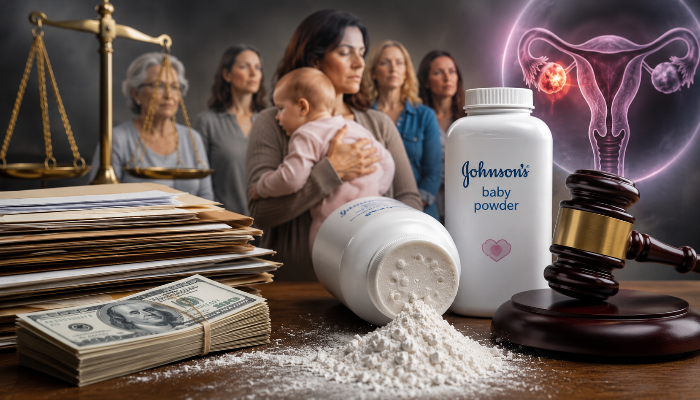
First introduced in 1894, Johnson & Johnson baby powder is one of the most well-known baby-care products globally. However, the company behind it has also found itself at the heart of a global controversy spanning a decade over asbestos (carcinogen) contamination. To settle thousands of prolonged lawsuits alleging that the company’s discontinued talc-based baby powder caused ovarian cancer, Johnson & Johnson has offered $5.5bn.
The initial formal lawsuits were brought forth in 2009, which charged that the talc-based baby powder leads to mesothelioma and ovarian cancer. The US Food and Drug Administration’s advisory revealed that Johnson & Johnson recalled a shipment in 2019 after a sample revealed a small level of asbestos.
Afterwards, the product was discontinued in the United States in 2020, and in other countries in 2023, but the charges were repeatedly countered.
However, the row escalated, marked by tens of thousands of lawsuits and multibillion-dollar settlement offers targeting the baby powder and other products. Johnson & Johnson and Kenvue Inc have agreed to pay $5.5 billion, or ₹52,668 crore, to resolve these cases in the latest landmark development.
The announcement was made on 27th July (Monday) by Johnson & Johnson, which is headquartered in New Jersey.
Kenvue functioned as its consumer health division and was responsible for the baby powder outside of North America. It later separated in 2022 and started to own famous brands like Band-Aid, Listerine and Calpol.
Approximately 76,000 claims, including those consolidated in a federal court in New Jersey and associated proceedings in state court, are addressed by the arrangement, which represents almost all of the remaining pleadings against the pharmaceutical giant. This covers 99.75% of America’s outstanding talc-related cases.
The majority of the complaints had similarly been handled by the multinational enterprise, which stopped making and selling its baby powder in the US and international markets, stating, “As part of a worldwide portfolio assessment, we have made the commercial decision to transition to an all cornstarch-based baby powder portfolio,” at the time.
Notably, Johnson & Johnson’s production licence for baby powder made at its Mulund facility was revoked by Maharashtra’s Food and Drug Administration in 2022 after samples were deemed “not of standard quality” by a government laboratory. However, the former approached the Bombay High Court, which overturned the order in January 2023 after identifying flaws in the regulatory process.
No proof of cancer: Johnson & Johnson refutes charges
Johnson & Johnson maintains that the products are neither unsafe nor have asbestos and stressed that there is no proof that talc causes cancer. It also insisted that its current move is only meant to conclude years of expensive litigation and allow it to concentrate on its primary healthcare business.
Its vice-president of litigation, Erik Haas, argued that the accusations are “meritless” and remarked that the conglomerate would have succeeded through further legal action “as it has in the vast majority of cases tried to date.”
“After decades of litigation and full vetting of the science in an extensive hearing, plaintiffs effectively conceded their inability to prove specific causation by withdrawing their experts on the topic in two bellwether cases. In a watershed moment, the Court thereafter ordered plaintiffs to show why the remaining claims should not be dismissed, confirming what we have maintained for years: that these claims lack scientific merit and were sustained only by unreliable expert opinions that could not survive rigorous judicial review,” Haas said.
Excerpt taken from the official statement issued by Johnson & Johnson on 27th July 2026. (Source: jnj.com)
He then added that ”this resolution allows the company to put this matter behind it and remain focused on its mission to develop medicines and devices that save lives.”
Johnson & Johnson conveyed that it would make an offer of up to $3 billion next year with no subsequent payments required prior to 2028. However, the deal is not going to be finalised unless it is approved by 95% of the claimants in state or federal courts.
According to lawyer Chris Seeger, the figure could eventually touch $7 billion or more. He represents roughly 2,500 clients and assisted in negotiating the accord, which does not cap Johnson & Johnson’s ultimate payout, but it assigns certain values to eligible ovarian cancer complaints. “We got a fair settlement, and our clients are going to be happy with it,” he expressed.
The fresh pact is limited to existing cases. “The exclusion of future claims made more money available to current plaintiffs than the bankruptcy proposal did, and it also accelerates the payments so that all claims will be paid within 18 months instead of being spread out over more than a decade,” Seeger pointed out.
Meanwhile, almost 7,000 potential similar claimants are engaged in the most significant product liability lawsuit in the history of the United Kingdom against Johnson & Johnson.
The alleged bankruptcies
The litigation restarted in March 2025 after more than three years on hold when Johnson & Johnson altered the baby powder’s formula. On the other hand, Johnson & Johnson adopted a tactic known as the “Texas two-step” and lodged three bankruptcies through its shell-company subsidiary to manage the cases; however, it faced rejection each time.
It commenced a corporate reorganisation in October 2021 by forming “LTL Management LLC” to handle the issue. The latter then declared bankruptcy, but the court dismissed this application, finding that sufficient funds were available to proceed with the dispute.
The company then conveyed that its subsidiary would re-file for voluntary Chapter 11 bankruptcy to address the charges, in the securities statement in April 2023. It declared to spend $8.9 billion over 25 years to resolve “all current and future” allegations. However, the offer was turned down due to problems with the method for gaining the permission of claimants.
LTL Management filed for bankruptcy a second time in July 2024 with the intention of reaching a restructuring contract to settle the disagreements. However, the court prohibited this approach because of difficulties in collecting claimant votes and other legal reasons.
Johnson & Johnson filed for bankruptcy for the third time in late September 2024, intending to resolve these outstanding litigations through a comprehensive settlement package. It asserted to have resolved almost all of the cases, thereby removing them from the larger lawsuit, in January 2025.
However, its $8 billion package was disallowed by a judge a few months later in March because of defects in the process for gathering votes from personal injury claimants. The court shut down the bankruptcy strategy for the third time with this ruling.
Johnson & Johnson had a mixed record prior to this strategy with a multibillion-dollar ruling in favour of 22 women who reported that baby powder was the cause of their ovarian cancer. Some trials were secured by the business, and other verdicts were overturned on appeal.
The enduring legal battle
Johnson & Johnson underwent its first major trial in 2013, after which greater judgments in later years were made possible and laid the groundwork for further action. It was ordered by a US jury to pay $72 million, comprising $10 million of actual and $62 million of punitive damages to the family of a woman who passed away from ovarian cancer. The decision was made in 2016.
The family’s counsel had alleged that the company “knew as far back as the 1980s of the risk” but chose to “lie to the public, and lie to the regulatory agencies.”
This was the first such occurrence associated with the application of the mineral in the US. Even though the judgment was overturned a year later, juries all around the country have awarded the plaintiffs in multiple other lawsuits against it.
Substantial rulings were rendered in a variety of jury trials between 2016 and 2018. The enterprise recalled 33,000 bottles of the product after the aforementioned FDA disclosure in 2019 and stated that it would cease to sell the talc-based baby powder in North America that same year. However, it publicly challenged the assertions regarding cancer.
Johnson & Johnson offered a $6.5 billion settlement in May 2024. The proposal was the result of continuous legal conflicts. The company raised the amount to $8 billion in September of that year in a bid to allay the court’s prior worries and win over more people. The court declined this amended plan despite the increase.
A California jury in October directed Johnson & Johnson to cough up $966 million for the family of a woman who highlighted that applying its baby powder for decades had caused her cancer. The amount was the largest verdict in a case involving a single plaintiff.
However, Johnson & Johnson recently tasted a series of victories, including wins in individual trials, successful attempts to disqualify attorneys from the case and decisions against experts that were utilised to support the contentions of plaintiffs.
Last week, a federal judge cast doubt on the ability of 69,000 filings to concretely demonstrate that talc directly caused their ovarian cancer, giving the manufacturer a major triumph in the protracted legal struggle.
Johnson and Johnson was asserted to be aware of the presence of asbestos in its baby powder for decades by Reuters. “From at least 1971 to the early 2000s, the company’s raw talc and finished powders have tested positive for small amounts of asbestos, and the company’s executives, mine managers, scientists and doctors had actively discussed the issue while failing to disclose it to regulators or the public,” highlighted an inquiry that examined documents, depositions and trial statements in 2018.
However, if accepted, the settlement could put a lid on the most extensive and enduring product liability disputes in corporate history.