Maulana Izhar-Ul-Haq, Faraz, Naeem and Shakir arrested: Inside the ATS crackdown on multi-state ‘Lone Wolf’ radicalisation module linked to Pakistan
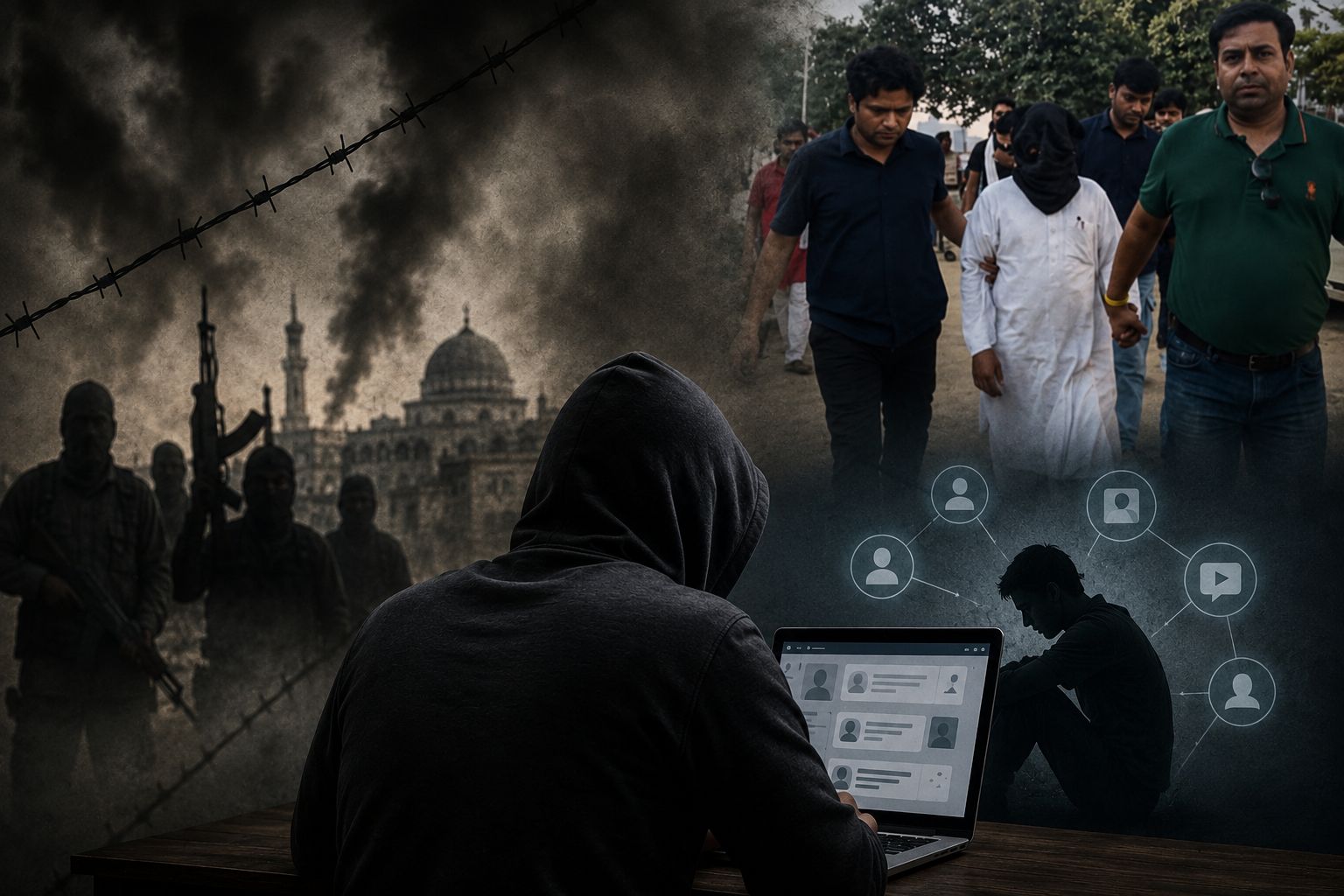
What began with a covert arrest in the congested lanes of Old Bhopal has rapidly expanded into a multi-state counter-terror investigation, leading security agencies from Madhya Pradesh to Uttar Pradesh, Rajasthan and Bihar. Investigators now believe they may have uncovered a radicalisation network that operated largely online, with suspected links to handlers based across the border. The latest breakthrough came on Monday when a joint team of the Madhya Pradesh Anti-Terrorism Squad (ATS) and Bihar ATS arrested Maulana Izhar-Ul-Haq from Bihar’s Madhubani district. The arrest has added a new dimension to the probe, with investigators suspecting that the madrasa teacher may have played a central role in the network. Authorities claim Izhar-Ul-Haq, a resident of Nautol Sarisabpali village under Pandaul police station limits, was more than just another member of the group under investigation. ATS officials suspect he acted as the “Amir”, the ideological guide and coordinator responsible for identifying, mentoring and influencing recruits across multiple states. According to investigators, Izhar maintained communication with overseas handlers and was tasked with expanding the network’s reach, rebuilding dormant cells and facilitating coordination among individuals who were often separated by hundreds of kilometres and, in many cases, had never met in person. The arrest was carried out under tight secrecy. Soon after he was taken into custody, a local court granted ATS teams a 72-hour transit remand, allowing them to shift him to Madhya Pradesh for sustained interrogation. Officials believe his questioning could provide critical insights into how the network functioned. Investigators are particularly keen to understand the methods used to identify vulnerable individuals, the process through which recruits were influenced, and the role played by online platforms in spreading extremist ideology. What triggered the investigation? The investigation first gained momentum on June 12 when the Madhya Pradesh ATS arrested Mohd Faraz, 35, during a covert operation near Nanhe Bee’s Mosque in Bhopal’s Qazi Camp area. Faraz, who worked at a doctor’s clinic, soon emerged as the focal point of the investigation. Officials allege that he had been consuming extremist content disseminated through encrypted digital channels and had become increasingly influenced by radical propaganda. During the examination of his electronic devices, investigators reportedly recovered digital literature and other material that raised security concerns. Agencies also began probing whether Faraz was operating independently or as part of a larger network extending beyond state boundaries. The investigation intensified further after intelligence inputs suggested that Faraz was preparing to travel to Afghanistan for specialised training. Officials also discovered that he had reportedly been undergoing martial arts training, a development investigators considered significant while assessing his activities. Naeem Abdullah Qureshi’s role under scanner The probe soon led investigators to Uttar Pradesh. A day after Faraz’s arrest, ATS teams detained Naeem Abdullah Qureshi, 38, from Nanauta in Saharanpur district. According to investigators, Naeem and Faraz had studied together at a madrasa in Deoband, and officials suspect their association played a role in connecting Faraz to the network. Security agencies are examining information suggesting that Naeem shared photographs and videos of locations in Uttar Pradesh with contacts believed to be operating from Pakistan. The purpose and significance of those exchanges remain under investigation. Officials have also established that Naeem travelled to Bhopal on at least one or two occasions and had personally met Faraz, despite investigators claiming that most members of the network remained connected only through digital platforms. Mohammad Shakir Mev Arrested in Rajasthan The investigation widened further when ATS teams, working alongside Rajasthan Police, arrested Mohammad Shakir Mev, 34, from Alwar district near the Rajasthan-Haryana border. By this stage, investigators had begun viewing the case as a potentially organised module rather than a collection of isolated individuals. The subsequent arrest of Izhar-Ul-Haq has strengthened suspicions that the network may have had a structured leadership hierarchy. Digital evidence becomes key focus Much of the investigation now revolves around digital forensic analysis. Officials claim that mobile phones and electronic devices recovered from the accused contain evidence of encrypted communications, extremist propaganda and interactions with individuals located outside India. Investigators are examining suspected links to phone numbers based in Pakistan and Afghanistan, along with activity across messaging platforms and closed online groups. According to ATS sources, forensic examination of Faraz’s mob
What began with a covert arrest in the congested lanes of Old Bhopal has rapidly expanded into a multi-state counter-terror investigation, leading security agencies from Madhya Pradesh to Uttar Pradesh, Rajasthan and Bihar. Investigators now believe they may have uncovered a radicalisation network that operated largely online, with suspected links to handlers based across the border.
The latest breakthrough came on Monday when a joint team of the Madhya Pradesh Anti-Terrorism Squad (ATS) and Bihar ATS arrested Maulana Izhar-Ul-Haq from Bihar’s Madhubani district. The arrest has added a new dimension to the probe, with investigators suspecting that the madrasa teacher may have played a central role in the network.
Authorities claim Izhar-Ul-Haq, a resident of Nautol Sarisabpali village under Pandaul police station limits, was more than just another member of the group under investigation. ATS officials suspect he acted as the “Amir”, the ideological guide and coordinator responsible for identifying, mentoring and influencing recruits across multiple states.
According to investigators, Izhar maintained communication with overseas handlers and was tasked with expanding the network’s reach, rebuilding dormant cells and facilitating coordination among individuals who were often separated by hundreds of kilometres and, in many cases, had never met in person.
The arrest was carried out under tight secrecy. Soon after he was taken into custody, a local court granted ATS teams a 72-hour transit remand, allowing them to shift him to Madhya Pradesh for sustained interrogation.
Officials believe his questioning could provide critical insights into how the network functioned. Investigators are particularly keen to understand the methods used to identify vulnerable individuals, the process through which recruits were influenced, and the role played by online platforms in spreading extremist ideology.
What triggered the investigation?
The investigation first gained momentum on June 12 when the Madhya Pradesh ATS arrested Mohd Faraz, 35, during a covert operation near Nanhe Bee’s Mosque in Bhopal’s Qazi Camp area.
Faraz, who worked at a doctor’s clinic, soon emerged as the focal point of the investigation. Officials allege that he had been consuming extremist content disseminated through encrypted digital channels and had become increasingly influenced by radical propaganda.
During the examination of his electronic devices, investigators reportedly recovered digital literature and other material that raised security concerns. Agencies also began probing whether Faraz was operating independently or as part of a larger network extending beyond state boundaries.
The investigation intensified further after intelligence inputs suggested that Faraz was preparing to travel to Afghanistan for specialised training. Officials also discovered that he had reportedly been undergoing martial arts training, a development investigators considered significant while assessing his activities.
Naeem Abdullah Qureshi’s role under scanner
The probe soon led investigators to Uttar Pradesh.
A day after Faraz’s arrest, ATS teams detained Naeem Abdullah Qureshi, 38, from Nanauta in Saharanpur district. According to investigators, Naeem and Faraz had studied together at a madrasa in Deoband, and officials suspect their association played a role in connecting Faraz to the network.
Security agencies are examining information suggesting that Naeem shared photographs and videos of locations in Uttar Pradesh with contacts believed to be operating from Pakistan. The purpose and significance of those exchanges remain under investigation.
Officials have also established that Naeem travelled to Bhopal on at least one or two occasions and had personally met Faraz, despite investigators claiming that most members of the network remained connected only through digital platforms.
Mohammad Shakir Mev Arrested in Rajasthan
The investigation widened further when ATS teams, working alongside Rajasthan Police, arrested Mohammad Shakir Mev, 34, from Alwar district near the Rajasthan-Haryana border.
By this stage, investigators had begun viewing the case as a potentially organised module rather than a collection of isolated individuals. The subsequent arrest of Izhar-Ul-Haq has strengthened suspicions that the network may have had a structured leadership hierarchy.
Digital evidence becomes key focus
Much of the investigation now revolves around digital forensic analysis. Officials claim that mobile phones and electronic devices recovered from the accused contain evidence of encrypted communications, extremist propaganda and interactions with individuals located outside India.
Investigators are examining suspected links to phone numbers based in Pakistan and Afghanistan, along with activity across messaging platforms and closed online groups.
According to ATS sources, forensic examination of Faraz’s mobile phone has yielded important leads. Investigators suspect he used specialised applications to communicate with foreign contacts while avoiding conventional surveillance methods.
Officials further claim that Faraz had been assigned the operational alias “Khalid Saifullah”, a name associated with a slain Pakistani Lashkar-e-Taiba operative accused in multiple attacks in India. Investigators are examining whether the use of the alias was intended to create ideological appeal among recruits.
‘Lone Wolf’ radicalisation strategy
Security agencies increasingly believe the network may have been promoting a “lone wolf” model of radicalisation, a strategy in which individuals are influenced online, guided remotely and encouraged to act independently rather than as part of a traditional terror cell.
Investigators claim members of the network were exposed to extremist videos, propaganda material and content glorifying armed jihad. Agencies are also examining allegations that photographs and videos from locations in India were shared with overseas contacts.
Officials say such models present unique challenges for law enforcement because individuals often operate independently, maintain limited physical contact with one another and leave fewer traces of organisational activity.
Questions investigators are seeking to answer
Despite the series of arrests, investigators say several crucial questions remain unresolved.
Who was directing the network from abroad? How extensive was its reach within India? How many individuals may have come into contact with the module? And were any of the accused close to translating ideology into action?
With Maulana Izhar-Ul-Haq, Mohd Faraz, Naeem Abdullah Qureshi and Mohammad Shakir Mev now under the scanner, security agencies believe the coming days could prove decisive in determining the scale and structure of what they describe as a pan-India radicalisation network that operated largely out of public view.