New York Times finally acknowledges brutal lynching of Hindu Dipu Chandra Das in Bangladesh, but claims ‘South Asia’ pattern and refuses to name Islamic mob
In a horrific incident, Dipu Chandra Das, a Hindu garment factory worker in his thirties, was brutally lynched by an Islamic mob in Mymensingh, Bangladesh. Dipu Das was first beaten to death, then his body was tied to a tree, and set ablaze in full public view by a Muslim mob on 18th December over the allegations of blasphemy. The Western media, ever dextrous in pushing the Muslim victimhood bogey, maintained a deafening silence on Das’s killing. No front-page outrage from CNN, no urgent dispatches from Washington Post, no alarm-raising by The Guardian. Days after ignoring the incident like it never happened, The New York Times finally reported on the brutal lynching of Dipu Chandra Das. Muslim mob killed Hindu man in a rapidly Islamising Bangladesh, but NYT finds entire South Asia to blame, refuses to name the Islamic mob that killed Dipu Chandra Das The acknowledgement, however, was not without framing it as an incident of some sort of abstract intolerance and a part of a “broader pattern of intolerance in South Asia.” The headline of the NYT report itself is quite revealing of the newspaper’s agenda of using the Bangladeshi Hindu man’s lynching for making a broader statement that somehow religious intolerance is not a Muslim-exclusive phenomenon, but the entire South Asian region is grappling with it, and Muslims too are victims of it. Notably, Dipu Chandra Das’s alleged comment that all religions contain superstitions, during a discussion with co-workers about Muslims fixating on Friday (Jummah), somehow enraged the Islamist co-workers who accused him of insulting the Islamic prophet, Muhammad. In the article headlined “Lynching of a Hindu in Bangladesh Fans Fears of Rising Intolerance”, the NYT reported this atrocity, however, the framing of the horrific incident by reporters Shafi Hasnat and Mujib Mashal, evidently intended to dilute the Hindu man’s brutal killing by Muslims and integrating it within “a wider pattern of religious intolerance in the South Asia region.” The article tries to claim the entire ‘South Asian region’ as dysfunctional when it comes to religious tolerance, and that all parties, be it Muslims, Hindus or other religious groups, are equally intolerant of each other and brutal lynchings, as that of Dipu Chandra Das, happen with Muslims too in India. The New York Times article says that “…the brutal nature of the killing, amid a wave of riots and mob violence, has raised alarms about the tense leadership vacuum that has persisted in Bangladesh since its authoritarian prime minister was toppled in student-led protests last year.” Very shrewdly, the NYT reporters mentioned facts of the brutal lynching of the Bangladeshi Hindu man, to maintain a balance, while blaming everything–leadership vacuum, exploitation of chaos by ‘extremist forces’ for political gains ahead of elections, and rumours of insult to Islam, but not the actual, factual and persistent cause of the Islamist onslaught against Hindus. Islamists are intolerant of the mere presence of Hindus, their temples and culture; they are intolerant of the fact that a Hindu, a Kafir, reportedly dared to even speak about Islamic superstitions. Political instability, blasphemy rumours and other circumstantial aspects are mere excuses, not causes, of the Islamist persecution of Hindus. The NYT’s wordplay is a sample of its bias here. A Hindu man got brutally lynched, and the Islamist mob that killed him gleefully chanted Islamic slogans while torching his body and enjoying the spectacle. Buy for NYT, the incident is not the highlight, the perpetrators who did it are not even named, but their priority is that ‘fears of rising intolerance are being fanned’. It almost reads as if the Hindu man got lynched on his own, and the incident just fanned the fears of rising intolerance automatically. The Islamic mob that carried out the brutal act has nothing to do with it. The New York Times dragged India into its report about the brutal killing of a Bangladeshi Hindu: The insidious monkey balancing The NYT dragged India into the scene, and claimed, “The threats to Hindus in Bangladesh have drawn widespread concern in India, where Prime Minister Narendra Modi’s government has repeatedly voiced alarm. But they are the latest in a wider pattern of religious intolerance in the South Asia region.” The NYT claimed that ‘Hindu vigilantes’ target Muslims over accusations of carrying cow meat, or suspected Bangladeshi Muslim infiltrators. The newspaper, however, did not make any mention of the brutal killing of Kanhaiyalal by Islamic jihadis; it does not find the incidents of Sar Tan Se Juda and Allahu Akbar slogan-raising Muslim mobs attacking Hindus on Holi, Diwali, Ram Navami and other festivals or for celebrating cricket match victories, as cases fit for mention under ‘rising religious intolerance’. Excerpt taken from the relevant New York Times article Earlier this month, a Muslim man named Sarfaraz and
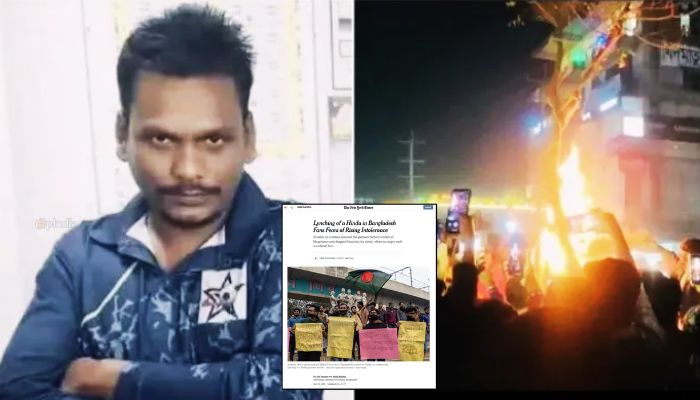

In a horrific incident, Dipu Chandra Das, a Hindu garment factory worker in his thirties, was brutally lynched by an Islamic mob in Mymensingh, Bangladesh. Dipu Das was first beaten to death, then his body was tied to a tree, and set ablaze in full public view by a Muslim mob on 18th December over the allegations of blasphemy. The Western media, ever dextrous in pushing the Muslim victimhood bogey, maintained a deafening silence on Das’s killing. No front-page outrage from CNN, no urgent dispatches from Washington Post, no alarm-raising by The Guardian. Days after ignoring the incident like it never happened, The New York Times finally reported on the brutal lynching of Dipu Chandra Das.
Muslim mob killed Hindu man in a rapidly Islamising Bangladesh, but NYT finds entire South Asia to blame, refuses to name the Islamic mob that killed Dipu Chandra Das
The acknowledgement, however, was not without framing it as an incident of some sort of abstract intolerance and a part of a “broader pattern of intolerance in South Asia.” The headline of the NYT report itself is quite revealing of the newspaper’s agenda of using the Bangladeshi Hindu man’s lynching for making a broader statement that somehow religious intolerance is not a Muslim-exclusive phenomenon, but the entire South Asian region is grappling with it, and Muslims too are victims of it.
Notably, Dipu Chandra Das’s alleged comment that all religions contain superstitions, during a discussion with co-workers about Muslims fixating on Friday (Jummah), somehow enraged the Islamist co-workers who accused him of insulting the Islamic prophet, Muhammad.
In the article headlined “Lynching of a Hindu in Bangladesh Fans Fears of Rising Intolerance”, the NYT reported this atrocity, however, the framing of the horrific incident by reporters Shafi Hasnat and Mujib Mashal, evidently intended to dilute the Hindu man’s brutal killing by Muslims and integrating it within “a wider pattern of religious intolerance in the South Asia region.”

The article tries to claim the entire ‘South Asian region’ as dysfunctional when it comes to religious tolerance, and that all parties, be it Muslims, Hindus or other religious groups, are equally intolerant of each other and brutal lynchings, as that of Dipu Chandra Das, happen with Muslims too in India.
The New York Times article says that “…the brutal nature of the killing, amid a wave of riots and mob violence, has raised alarms about the tense leadership vacuum that has persisted in Bangladesh since its authoritarian prime minister was toppled in student-led protests last year.”
Very shrewdly, the NYT reporters mentioned facts of the brutal lynching of the Bangladeshi Hindu man, to maintain a balance, while blaming everything–leadership vacuum, exploitation of chaos by ‘extremist forces’ for political gains ahead of elections, and rumours of insult to Islam, but not the actual, factual and persistent cause of the Islamist onslaught against Hindus.
Islamists are intolerant of the mere presence of Hindus, their temples and culture; they are intolerant of the fact that a Hindu, a Kafir, reportedly dared to even speak about Islamic superstitions. Political instability, blasphemy rumours and other circumstantial aspects are mere excuses, not causes, of the Islamist persecution of Hindus.
The NYT’s wordplay is a sample of its bias here. A Hindu man got brutally lynched, and the Islamist mob that killed him gleefully chanted Islamic slogans while torching his body and enjoying the spectacle. Buy for NYT, the incident is not the highlight, the perpetrators who did it are not even named, but their priority is that ‘fears of rising intolerance are being fanned’. It almost reads as if the Hindu man got lynched on his own, and the incident just fanned the fears of rising intolerance automatically. The Islamic mob that carried out the brutal act has nothing to do with it.
The New York Times dragged India into its report about the brutal killing of a Bangladeshi Hindu: The insidious monkey balancing
The NYT dragged India into the scene, and claimed, “The threats to Hindus in Bangladesh have drawn widespread concern in India, where Prime Minister Narendra Modi’s government has repeatedly voiced alarm. But they are the latest in a wider pattern of religious intolerance in the South Asia region.”
The NYT claimed that ‘Hindu vigilantes’ target Muslims over accusations of carrying cow meat, or suspected Bangladeshi Muslim infiltrators. The newspaper, however, did not make any mention of the brutal killing of Kanhaiyalal by Islamic jihadis; it does not find the incidents of Sar Tan Se Juda and Allahu Akbar slogan-raising Muslim mobs attacking Hindus on Holi, Diwali, Ram Navami and other festivals or for celebrating cricket match victories, as cases fit for mention under ‘rising religious intolerance’.

Earlier this month, a Muslim man named Sarfaraz and nine other Islamists were found guilty of brutally murdering a Hindu youth named Ram Gopal Mishra last year for removing an Islamic flag and installing a saffron flag. Sarfaraz was sentenced to death, while others were awarded a life sentence. Mishra was dragged by Islamists, shot at close range, his body was riddled with 40 bullet wounds, and his toes were burnt. Still, the NYT did not mention this case or say that Hindus are being attacked for their religious identity only in Bangladesh and Pakistan, but also in India.
The NYT deliberately picked the case of a Hindu man from the “bottom ranks of India’s rigid caste hierarchy”, who was mistaken for a Bangladeshi illegal and assaulted in Kerala. The NYT’s choice of case was interesting as it indicated that in India, Hindus attack anyone they think is Bangladeshi or someone “India’s ruling Hindu nationalist politicians loosely use to describe Muslim migrants”, and upper caste Hindus torment Dalits. The NYT smartly peddled the Muslim-Dalit victimhood narrative without even appearing too obvious.
Apparently, the killing of Dipu Chandra Das was too brutal to ignore, so The New York Times decided to report it, but in a manner where the Islamist-inflicted atrocity is diluted and subsumed in a generic South Asian ‘regional pattern’ of intolerance.
In fact, the whole India mention was an act of monkey balancing, an insidious trick of both-sides-ism. The New York Times reporters quite efficiently used this deflection tactic to soften Muslim atrocities by dragging unrelated and exaggerated parallels from the other side. The NYT basically told the readers that “Look, Muslim co-workers killed a Hindu co-worker in Bangladesh over blasphemy allegations, but it happens in India too, where Muslims are attacked and killed by Hindus for being Muslims, so everyone is equally guilty in South Asia.”
The New York Times reported a Muslim mob’s brutal crime against an innocent and helpless Hindu man, using vague vocabulary
For a change, The New York Times pointed out that while Muhammad Yunus, the Chief Advisor to the Interim Government of Bangladesh, condemned violence as a security challenge, not targeted attacks on “any section of the population” (no specific mention of Hindus), the religiously-motivated killing of Dipu Chandra Das was celebrated by “many”. The NYT, however, did not mention that Muhammad Yunus has been coddling Islamists. He unbanned Jamat-e-Islami, released jailed Islamist fanatics, and has inducted Islamists into his regime. Yunus has also continuously been downplaying Islamist-orchestrated anti-Hindu violence as non-communal ‘disputes’ “exaggerated” by the Indian media.

The New York Times made a hardly three-line mention of how, among the “many” who celebrated the brutal mob lynching of Dipu Chandra Das was Jubayer Ahmad Tasrif, who is set to contest the upcoming elections. The newspaper included this incident of a person who is going to contest elections, rallying support from fellow Hindu-hating Muslims by hailing the killing of a Hindu man, as just additional information. Had a Hindu politician in India celebrated a Muslim man’s lynching, the NYT would have run out of ink analysing how Hindu nationalism is crushing ‘minorities’, the collapse of democracy, and of course, the death of the ‘idea of India’.
It, however, is quite a progress for a publication like the New York Times to even mention the lynching of a Hindu man as a religiously-motivated killing, given that the NYT was among the major Western media outlets which passed off the Islamist pogrom against Hindus as ‘political retribution’ for supporting the Awami League.

However, skipping the specifics like Islamic intolerance-motivated killing of a Hindu man by Muslim mob and using vague vocabulary like ‘religiously-motivated’ killing by factory ‘co-workers’ and ‘angry mobs’, suggests that the Bangladeshi Hindu man’s killing was among the few isolated incidents of religious intolerance and violence, those too, triggered by power vacuum, political gains-related motives and whatnot. The NYT mentioned the religious identity of perpetrators incidentally, only to explain it to the readers that the supposed ‘blasphemy’ was committed against Islam. It is disgraceful that for days, when the Western media finally deigned to cover Das’s killing, it twisted a narrative of a watered-down ‘regional patterns’, to dilute the Islamist motivation behind the savagery the Hindu man was subjected to moments before and after his death.
No propaganda, narrative, rhetoric or framing can change the fact that Dipu Chandra Das’s brutal lynching and setting ablaze of his body in the street, was a targeted attack not by ‘offended Muslim co-workers’ or ‘Muslim vigilante’ or ‘Islamist extremists’ but Muslims on a Hindu man belonging to a religious minority community in Bangladesh, where Hindus have faced systematic persecution for decades.
It is dishonest, morally corrupt and journalistically unethical for the NYT to withhold names of Muslims as aggressors in Dipu Chandra Das’s case, while explicitly characterising Hindus as aggressors otherwise. Apparently, for the Islamo-leftist media, when Hindus happen to be or are accused of being the perpetrators of violence against Muslims, their religion or their Hinduness is the explanation and motivation, but when Muslims commit violence against Hindus, their religion is purely incidental.
Das was killed for by Islamists in a country where the Hindu population has dwindled from 22% at the time of independence to hardly 8% amidst a wave of violence, rape, temple desecration, forced conversions, land grabs, and false implications in blasphemy cases.
The Western media widely covered the political killing of radical Islamist student leader and avowed India-hater, Osman Hadi. In the past few days, it has been seen how the Western governments and organisations, including the US, EU and other missions, have expressed deep sadness over Hadi’s killing, with the UN calling for an impartial probe. The international media lionised Hadi’s Islamist anti-Hasina and ‘revolutionary’ credentials while downplaying his Islamist ideology, glossing it over as fierce activism.
For Dipu Chandra Das, a humble factory worker with no record of any political affiliations or radical ties but only the misfortune of being a Hindu in Bangladesh, there has been no outpour of sadness, anger or demands for strict action against his Muslim killers. The West’s hypocrisy is glaring, where Islamists are romanticised as ‘activists’ and ‘fighters’ while Hindu victims of Muslim intolerance and violence are dismissed as footnotes in a “regional pattern”.