Not just testing, from design to production of space hardware: Read how the Space Manufacturing Park to be set up in Ahmedabad will boost India’s private space sector
The Gujarat Government has announced the setting up of Common Technical Facilities (CTF) for the Space Manufacturing Park being developed at Khoraj GIDC near Ahmedabad. For the development of these facilities, IN-SPACe will contribute up to ₹100 crore for equipment, while the state government will bear the additional cost for construction and operations. This announcement was made during the 10th IN-SPACe Industry Connect event. The proposed Common Technical Facilities will include a Class 100,000 cleanroom, thermo-vacuum chamber, vibration testing system with capacity for payloads up to 12 tonnes, EMI/EMC testing facilities, climate test chamber, mass properties measurement system, magnetic field testing infrastructure, and facilities for calibration of Earth Observation optics. The state government has allocated 50 acres of land at Khoraj, with provisions to expand it up to 100 acres in the future. At first glance, this news may appear like any other announcement of a new industrial park or government project. However, if one tries to understand the broader perspective behind it, it becomes clear that this is not merely the construction of a new facility, but an effort to create the necessary infrastructure for India’s rapidly growing private space sector. In fact, to understand this project, it is first necessary to understand how anything sent into space is prepared on Earth. Not an ordinary industrial park When common people think of satellites, their mind often goes only to the moment of launch. The rocket roars and flies into the sky, and the satellite reaches space. But in reality, there is a process of preparation and testing that goes on for years before the launch. Space is not like Earth’s environment. There is no air, no pressure, extreme temperature variations occur, and one has to face extraordinary vibrations during launch. Therefore, before sending any satellite or other space hardware into space, it undergoes numerous tests. The cleanroom is its simplest example. Even a small particle of dust can affect the cameras, sensors, and other highly sensitive devices installed in a satellite. Therefore, such instruments are assembled not in a normal environment but in a highly controlled and pure environment of a cleanroom. The work of a thermo-vacuum chamber is to simulate space-like conditions. Air is removed to create a vacuum, and extremely hot and extremely cold conditions are created to check whether the satellite will function properly in space or not. Similarly, vibration testing is extremely important. When a rocket is launched, it generates heavy vibrations and mechanical stresses. If the satellite or the devices inside it cannot withstand these vibrations, the entire mission can fail. Therefore, such conditions are artificially created on Earth itself, and testing is done. EMI/EMC testing ensures that various electronic systems can function properly without affecting each other. In simple words, the facilities being built at Khoraj are such that satellites and other space systems will be tested by creating space-like conditions on Earth itself. Why is it important for startups? In the last few years, the number of space startups in India has increased rapidly. Many new companies have emerged in fields ranging from rocket technology to satellite manufacturing, Earth observation, communication, and data analytics. But for most startups, the biggest challenge is infrastructure. Establishing own thermo-vacuum chamber, cleanroom, or vibration testing system is an extremely expensive matter for a startup. In many cases, this cost runs into crores of rupees. As a result, companies have to depend on other organisations for such facilities. Until now, many private companies have been using ISRO’s available facilities. After the government opened the space sector for the private sector post-2020, such access was made available in a more systematic manner through IN-SPACe. However, ISRO’s facilities have been primarily built for ISRO’s own missions. As the number of private space companies in India increases, the demand for such facilities is also constantly rising. In this situation, the purpose of the Common Technical Facilities being developed at Khoraj is that multiple companies can use modern testing infrastructure on a single platform. This will not only reduce costs but also lower the barriers to entry into the space sector for new companies. Although Common Technical Facilities are being discussed the most, the Khoraj project should not be viewed only as a testing centre. The plan of the state government and IN-SPACe is for a space manufacturing ecosystem where companies can not only test their products but also design, develop, assemble, and manufacture satellites, payload systems, and other space hardware. Thus, CTF is an important part of the entire project, but the objective of the overall project is much broader than testing. what changed in India’
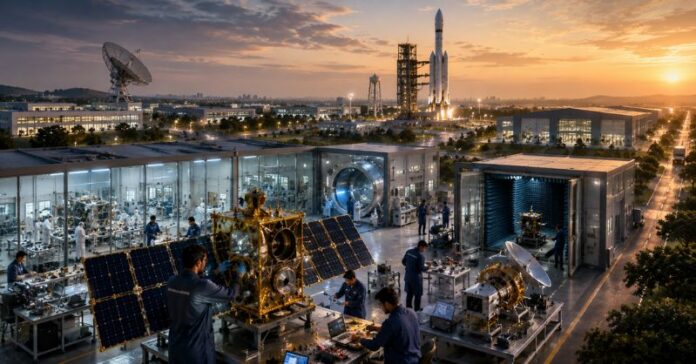
The Gujarat Government has announced the setting up of Common Technical Facilities (CTF) for the Space Manufacturing Park being developed at Khoraj GIDC near Ahmedabad. For the development of these facilities, IN-SPACe will contribute up to ₹100 crore for equipment, while the state government will bear the additional cost for construction and operations. This announcement was made during the 10th IN-SPACe Industry Connect event.
The proposed Common Technical Facilities will include a Class 100,000 cleanroom, thermo-vacuum chamber, vibration testing system with capacity for payloads up to 12 tonnes, EMI/EMC testing facilities, climate test chamber, mass properties measurement system, magnetic field testing infrastructure, and facilities for calibration of Earth Observation optics. The state government has allocated 50 acres of land at Khoraj, with provisions to expand it up to 100 acres in the future.
At first glance, this news may appear like any other announcement of a new industrial park or government project. However, if one tries to understand the broader perspective behind it, it becomes clear that this is not merely the construction of a new facility, but an effort to create the necessary infrastructure for India’s rapidly growing private space sector. In fact, to understand this project, it is first necessary to understand how anything sent into space is prepared on Earth.
Not an ordinary industrial park
When common people think of satellites, their mind often goes only to the moment of launch. The rocket roars and flies into the sky, and the satellite reaches space. But in reality, there is a process of preparation and testing that goes on for years before the launch. Space is not like Earth’s environment. There is no air, no pressure, extreme temperature variations occur, and one has to face extraordinary vibrations during launch. Therefore, before sending any satellite or other space hardware into space, it undergoes numerous tests.
The cleanroom is its simplest example. Even a small particle of dust can affect the cameras, sensors, and other highly sensitive devices installed in a satellite. Therefore, such instruments are assembled not in a normal environment but in a highly controlled and pure environment of a cleanroom. The work of a thermo-vacuum chamber is to simulate space-like conditions. Air is removed to create a vacuum, and extremely hot and extremely cold conditions are created to check whether the satellite will function properly in space or not.
Similarly, vibration testing is extremely important. When a rocket is launched, it generates heavy vibrations and mechanical stresses. If the satellite or the devices inside it cannot withstand these vibrations, the entire mission can fail. Therefore, such conditions are artificially created on Earth itself, and testing is done. EMI/EMC testing ensures that various electronic systems can function properly without affecting each other. In simple words, the facilities being built at Khoraj are such that satellites and other space systems will be tested by creating space-like conditions on Earth itself.
Why is it important for startups?
In the last few years, the number of space startups in India has increased rapidly. Many new companies have emerged in fields ranging from rocket technology to satellite manufacturing, Earth observation, communication, and data analytics. But for most startups, the biggest challenge is infrastructure.
Establishing own thermo-vacuum chamber, cleanroom, or vibration testing system is an extremely expensive matter for a startup. In many cases, this cost runs into crores of rupees. As a result, companies have to depend on other organisations for such facilities. Until now, many private companies have been using ISRO’s available facilities. After the government opened the space sector for the private sector post-2020, such access was made available in a more systematic manner through IN-SPACe.
However, ISRO’s facilities have been primarily built for ISRO’s own missions. As the number of private space companies in India increases, the demand for such facilities is also constantly rising. In this situation, the purpose of the Common Technical Facilities being developed at Khoraj is that multiple companies can use modern testing infrastructure on a single platform. This will not only reduce costs but also lower the barriers to entry into the space sector for new companies.
Although Common Technical Facilities are being discussed the most, the Khoraj project should not be viewed only as a testing centre. The plan of the state government and IN-SPACe is for a space manufacturing ecosystem where companies can not only test their products but also design, develop, assemble, and manufacture satellites, payload systems, and other space hardware. Thus, CTF is an important part of the entire project, but the objective of the overall project is much broader than testing.
what changed in India’s space sector after 2020?
To understand this entire project, it is necessary to understand the space reforms of 2020. For a long time, India’s space sector remained almost entirely ISRO-centric. The country’s space capabilities developed, historic missions like Mangalyaan and Chandrayaan were successful, but private sector participation was limited.
In 2020, the Central Government took an important decision and opened the space sector for the private sector. Along with this, IN-SPACe was established. The role of IN-SPACe is to provide necessary approvals, guidance, and coordination to private companies for entry into the space sector. As a result, today many Indian startups are working on rockets, satellites, and other space technologies.
Giving entry to the private sector in the space sector did not mean only giving opportunities to new companies. It also meant that the country would need new types of infrastructure. The Common Technical Facilities being developed at Khoraj can be seen as a part of this major transformation.
Gujarat is playing an important role
The Space Park being developed at Khoraj is envisioned not just as a testing place but as a complete industrial cluster. In the future, companies can come here that manufacture various components of satellites, develop payload systems, work on space-based applications, and then also test their products in the same ecosystem. In other words, an attempt is being made to create the necessary infrastructure for the entire process from design to flight-ready systems in a single cluster.
The importance of the Khoraj project is not only because it is being built in Gujarat. There are also several strategic reasons behind it. IN-SPACe’s headquarters is located in Ahmedabad. Moreover, Gujarat’s relationship with ISRO is also decades old. The Space Applications Centre located in Ahmedabad has been playing an important role in the country’s space programme.
In the last few years, the Gujarat Government has also focused specially on defence, aerospace, and high-tech manufacturing sectors. Major investments being made in the semiconductor sector in the state are also noteworthy. There is a close relationship between space technology and the semiconductor industry because advanced electronic components are needed for satellites and other space systems. In this view, the Space Manufacturing Park being developed at Khoraj is not a standalone project but a part of the large high-tech ecosystem emerging in Gujarat.
What could be the long-term impact?
The real impact of the Khoraj project will be visible in the coming years. If the proposed infrastructure is successfully developed and widely used by the industry, it can become an important encouragement for India’s space startups. Manufacturing capabilities will increase at the local level, the supply chain will become stronger, and it can also help in reducing dependence on imports.
Another important aspect of this project is also connected with ISRO. With the creation of a separate and dedicated testing ecosystem for the private sector, the burden on ISRO’s facilities can also gradually decrease. As a result, ISRO will be able to focus more on its scientific research, next-generation technologies, human spaceflight programmes, and other advanced missions. Thus, this initiative will not only help the private sector but can also prove to be an important step towards making the entire Indian space ecosystem more efficient.
In the end, the Common Technical Facilities being built at Khoraj should not be seen merely as a new lab or a government project. This is a part of the major transformation taking place in India’s space sector, in which the government, industry, startups, and scientific organisations are collectively trying to create an ecosystem that can give the country a stronger position in the global space economy in the coming decades. Perhaps this is why the Khoraj project holds importance not only for Gujarat but for the entire Indian space sector.
This is an English translation of the original Gujarati article published on OpIndia Gujarati