‘Pakistan Army raises Jihadi groups but calls protesting civilians as terrorists’: JAAC declares in Rawalkot as PoK witnesses widespread protests, all you need to know
As the anti-Pakistan protests in PoJK entered their 24th day, Sardar Aman Khan, the Joint Awami Action Committee (JAAC) leader, said that it was the Pakistan Army that gave Kashmiris guns and now calls them terrorists. The JAAC is a coalition of civil society groups, local traders, and activists, with its central agenda rooted in long-standing economic and governance-related grievances, in addition to political representation. The outfit launched a massive protest against Pakistani authorities on 9th June 2026. On 5th June, PoK’s Pakistani puppet authorities banned the JAAC under the Anti-Terrorism Act 2014, declaring it a proscribed organisation, citing threats to peace and security. Thereafter, internet and mobile services were also suspended in parts of the region. On 8th June, violent clashes erupted in Rawalkot/Rawalakot in Poonch district between local protestors and occupying Pakistani forces, resulting in the killing of several locals. On 9th June, the Jammu and Kashmir Awami Action Committee called a region-wide strike, resulting in closure of markets, transport, and institutions in major cities including Muzaffarabad. Since then, protests and marches have continued and spread to Mirpur, Kotli, Bagh, and other areas with regular organisation of rallies, sit-ins, and marches. It was reported on 10th June that a Pakistani military helicopter on surveillance duty in the region crashed, killing 22 personnel onboard. Pakistan Army harbours Jihadi terror groups, but calls unarmed PoK protestors terrorists: JAAC leader calls out Islamabad’s hypocrisy Addressing a crowd of over 80,000 people in Rawalkot recently, JAAC’s Sardar Aman Khan said, “They say they were terrorists. Look, it was the Pakistan Army that put guns into the hands of Kashmiris. Kashmiris had guns because the Pakistan Army gave them those guns. The entire Pakistan Army did it. And today, they have the audacity to call us terrorists?” JAAC leader in POJK drops truth bomb: "They call us terrorists, but it was the Pakistani army that gave weapons to Kashmiris." Massive rally in Rawalakot exposes army's past role arming locals. pic.twitter.com/N7obnDalwH— Megh Updates (@MeghUpdates) July 2, 2026 Sardar Aman Khan also said that the Pakistan Army facilitated a public event by the Islamic terror outfit Jaish-e-Mohammad earlier this year. The JAAC leader further alleged that the Deputy Commissioner of Rawalakot not only granted permission to Jaish-e-Mohammad, a notorious terrorist group, to organise an event but also provided security cover to the jihadis while cadres carrying assault rifles and swords marched through the city. Kashmir is not Pakistan: PoK residents blast an oppressive Islamabad’s food supplies blockade Last month, while addressing a demonstration at Rawalakot’s Eidgah Ground, JAAC’s Sardar Aman Khan delivered a strong speech declaring that Pakistan-occupied Jammu and Kashmir is not a part of Pakistan and that PoK residents don’t need Pakistan. “POK is not a part of Pakistan. We do not need Pakistan; rather, it is Pakistan that desperately needs POK,” Khan said. New : “Declaration at Rawalakot: ‘PoJK Is Not Part of Pakistan.”Thousands of demonstrators at Rawalakot’s Eidgah Ground reiterated that PoJK is not part of Pakistan, delivering another major challenge to Islamabad’s control over the region.Since 9 June, another group of… pic.twitter.com/DMnNLwgSTp— Shivank Mishra (@shivank_8mishra) June 30, 2026 He also warned Islamabad that if it continues to block supplies of food and other essentials from entering PoK, the local Kashmiris will seek “other roads”. “If the Pakistani establishment continues to block food, let it be known that the remaining borders of PoJK could open up. If that happens, Islamabad will find itself begging the people of PoJK to stay,” Khan said. Khan’s statement has been interpreted by many across both sides of the border as seeking support from India. This came after guns failed to silence the people of PoK; Islamabad resorted to blocking the region’s food, fuel, and healthcare supplies. Pakistan is taking desperate measures to coerce anti-government protestors into submission. PoK residents, including truck drivers and political leaders, said that vehicles carrying essential commodities like food grains, fuel, and medicines are being prevented from entering the illegally occupied territory. Exhibiting its usual shamelessness, Pakistani authorities deny imposition of any deliberate blockade. The Kashmiri protesters, however, remain undeterred and announced they will continue their sit-in and protests until the authorities act on their demands. They have also appealed to the United Nations, Amnesty International, the international media, and Kashmiris living abroad to draw global attention to the situation in the region. Reports say that at least 58 people have died in the ensuing clashes and hundreds wounded. Of these, at least 11-12 wer
As the anti-Pakistan protests in PoJK entered their 24th day, Sardar Aman Khan, the Joint Awami Action Committee (JAAC) leader, said that it was the Pakistan Army that gave Kashmiris guns and now calls them terrorists.
The JAAC is a coalition of civil society groups, local traders, and activists, with its central agenda rooted in long-standing economic and governance-related grievances, in addition to political representation. The outfit launched a massive protest against Pakistani authorities on 9th June 2026.
On 5th June, PoK’s Pakistani puppet authorities banned the JAAC under the Anti-Terrorism Act 2014, declaring it a proscribed organisation, citing threats to peace and security. Thereafter, internet and mobile services were also suspended in parts of the region.
On 8th June, violent clashes erupted in Rawalkot/Rawalakot in Poonch district between local protestors and occupying Pakistani forces, resulting in the killing of several locals.
On 9th June, the Jammu and Kashmir Awami Action Committee called a region-wide strike, resulting in closure of markets, transport, and institutions in major cities including Muzaffarabad.
Since then, protests and marches have continued and spread to Mirpur, Kotli, Bagh, and other areas with regular organisation of rallies, sit-ins, and marches. It was reported on 10th June that a Pakistani military helicopter on surveillance duty in the region crashed, killing 22 personnel onboard.
Pakistan Army harbours Jihadi terror groups, but calls unarmed PoK protestors terrorists: JAAC leader calls out Islamabad’s hypocrisy
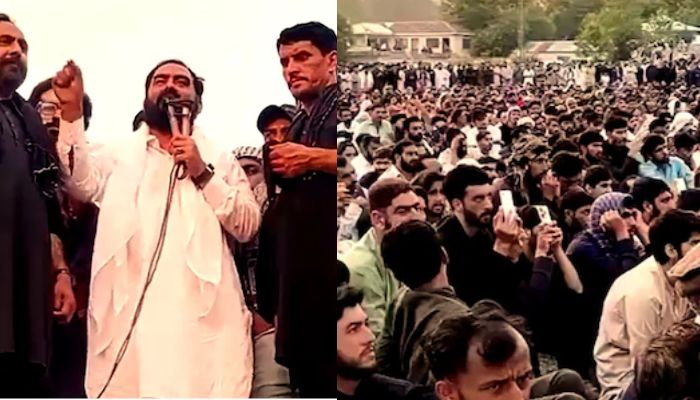
Addressing a crowd of over 80,000 people in Rawalkot recently, JAAC’s Sardar Aman Khan said, “They say they were terrorists. Look, it was the Pakistan Army that put guns into the hands of Kashmiris. Kashmiris had guns because the Pakistan Army gave them those guns. The entire Pakistan Army did it. And today, they have the audacity to call us terrorists?”
JAAC leader in POJK drops truth bomb: "They call us terrorists, but it was the Pakistani army that gave weapons to Kashmiris." Massive rally in Rawalakot exposes army's past role arming locals. pic.twitter.com/N7obnDalwH— Megh Updates (@MeghUpdates) July 2, 2026
Sardar Aman Khan also said that the Pakistan Army facilitated a public event by the Islamic terror outfit Jaish-e-Mohammad earlier this year.
The JAAC leader further alleged that the Deputy Commissioner of Rawalakot not only granted permission to Jaish-e-Mohammad, a notorious terrorist group, to organise an event but also provided security cover to the jihadis while cadres carrying assault rifles and swords marched through the city.
Kashmir is not Pakistan: PoK residents blast an oppressive Islamabad’s food supplies blockade
Last month, while addressing a demonstration at Rawalakot’s Eidgah Ground, JAAC’s Sardar Aman Khan delivered a strong speech declaring that Pakistan-occupied Jammu and Kashmir is not a part of Pakistan and that PoK residents don’t need Pakistan.
“POK is not a part of Pakistan. We do not need Pakistan; rather, it is Pakistan that desperately needs POK,” Khan said.
New : “Declaration at Rawalakot: ‘PoJK Is Not Part of Pakistan.”Thousands of demonstrators at Rawalakot’s Eidgah Ground reiterated that PoJK is not part of Pakistan, delivering another major challenge to Islamabad’s control over the region.Since 9 June, another group of… pic.twitter.com/DMnNLwgSTp— Shivank Mishra (@shivank_8mishra) June 30, 2026
He also warned Islamabad that if it continues to block supplies of food and other essentials from entering PoK, the local Kashmiris will seek “other roads”.
“If the Pakistani establishment continues to block food, let it be known that the remaining borders of PoJK could open up. If that happens, Islamabad will find itself begging the people of PoJK to stay,” Khan said.
Khan’s statement has been interpreted by many across both sides of the border as seeking support from India.
This came after guns failed to silence the people of PoK; Islamabad resorted to blocking the region’s food, fuel, and healthcare supplies. Pakistan is taking desperate measures to coerce anti-government protestors into submission.
PoK residents, including truck drivers and political leaders, said that vehicles carrying essential commodities like food grains, fuel, and medicines are being prevented from entering the illegally occupied territory.
Exhibiting its usual shamelessness, Pakistani authorities deny imposition of any deliberate blockade.
The Kashmiri protesters, however, remain undeterred and announced they will continue their sit-in and protests until the authorities act on their demands. They have also appealed to the United Nations, Amnesty International, the international media, and Kashmiris living abroad to draw global attention to the situation in the region.
Reports say that at least 58 people have died in the ensuing clashes and hundreds wounded. Of these, at least 11-12 were killed during the 8th and 9th June clashes.
Ever since the protests by PoK residents and violent crackdown by occupying Pakistani authorities began, several international human rights bodies have called out Pakistan.
In June, Amnesty International condemned designation of JAAC or JKJAAC as a ‘terrorist organisation’, and said, “The proscription of JKJAAC under anti-terror laws is disproportionate, unlawful and a violation of the right to freedom of association.”
Last month, a British parliamentary group asked the government for clarification on their assessment of the volatile situation in PoK. Bradford East MP Imran Hussain, the chair of the All-Party Parliamentary Group on Kashmir, referenced recent reports from the area of a “communications blackout, as part of a broader lockdown, alongside escalating tensions, and restrictions affecting the ability of people in the region to communicate with the outside world” in a letter to the Foreign Office of the United Kingdom
The movement’s fiercest voice and JAAC leader, Shaukat Nawaz Mir, accused Pakistani authorities of committing a massacre in Rawalakot and even shooting protestors at sight to suppress the protests. On 1st July, Mir was arrested by Pakistani authorities while heading towards a sit-in protest.
The 38-Point Charter and the reserved seats conundrum
The protests in PoK/PoJK are against Pakistan’s repressive policies. Locals claim that unarmed civilians were fired upon and that the bodies of some of those killed were taken away by authorities. During protests, the agitated locals have also raised “Azadi” slogans.
A local Kashmiri said, “Unarmed people are being shot at point-blank range, resulting in martyrdom. They have even taken away the bodies of our youth.”
In September-October 2025, the JAAC presented a comprehensive 38-point charter of demands during a massive protest and strike at that time.
The charter included demands related to accountability for killings of local Kashmiris, educational and heath infrastructure betterment, Rs 10 billion for electricity system upgrades, etc.
The JKAAC also sought reduction of PoK cabinet size to 20 members, limiting administrative secretaries, merging Ehtesab Bureau and Anti-Corruption bodies, aligning laws with federal standards, and curbing elite privileges.
In addition, the Committee demanded lower property transfer taxes, advance tax reductions, and opening merit in education admissions.
The most important demand was the formation of a high-powered committee to review “outside constituencies”, which are the 12 reserved seats for refugees from the Indian side of Jammu and Kashmir who live elsewhere in Pakistan.
While it is reported that most of the demands have been heeded by the Pakistani regime, outside constituencies issues remain unresolved.
The unrest began with a dispute over 12 assembly seats in the 45-seat PoK Legislative Assembly, which are reserved for refugees from Indian Jammu and Kashmir. Local groups allege that Islamabad uses these seats to influence elections and install governments of its choice, essentially diluting local representation.
On 7th June, the PoK Supreme Court ruled that the 12 seats are ‘constitutionally protected’ and cannot be abolished without a constitutional amendment. Since the Pakistani regime uses these 12 reserved seats for installing its puppets in the PoK Assembly to retain strong control over the region, they are reluctant to accept the JKAAC’s demand.
It is ironic that the same Pakistan that calls Indian Kashmir its jugular vein, and wants to ‘liberate’ it from India, is killing Kashmiris in the region under its occupation. Pakistan maintains a tight and exploitative control over PoJK, the region it calls Azad Jammu and Kashmir. While Pakistan cries hoarse for Indian Kashmiris, who enjoy all kinds of facilities and equal access to resources, its Defence Minister Khwaja Asif calls the residents of PoK’s Rawalakot and Mirpur “not proper Kashmiris” just because they demand rights and dignity.