PM Modi to flag off first Vande Bharat sleeper express: Read how the ‘Make in India’ engineering marvel combines technology with comfort
On 17th January (Saturday), Prime Minister Narendra Modi is scheduled to launch the nation’s first Vande Bharat sleeper train from Malda in poll-bound West Bengal. The regular passenger services are going to start between Howrah and Guwahati (Kamakhya) from the next day. Railway Minister Ashwini Vaishnaw recently announced that the trains will offer a new overnight travel option between Howrah in West Bengal and Guwahati in Assam. With the development, Indian Railways is poised to transform overnight travel in India. The new trains promise to improve the experience of nighttime travel since they are designed for high speed, modern comfort and greater security. Image via The Times of India An official statement conveyed, “The Vande Bharat Sleeper train is a shining example of the Make in India initiative, as its three most critical systems – the bogie, propulsion system and vehicle control system – have been entirely designed and developed within the country, making it a fully indigenous train set.” The first Vande Bharat Sleeper train will stop at Bandel, Katwa, New Farakka, Malda Town, New Jalpaiguri, New Coochbehar, New Bongaigaon and Azimganj on its way from Howrah to Guwahati (Kamakhya). A “Make in India” marvel to enhance connectivity and comfort Bharat Earth Movers Limited utilised ICF (Integral Coach Factory, Chennai) technology to develop the trains which have a maximum design speed of 180 kilometres per hour (kmph), the number it touched during the last high-speed test, but will only operate at 130 kmph for safety reasons. The speed fluctuates due to a number of circumstances, such as the track’s geometry, stops along the way, section maintenance, etc. The 16-coach self-propelled train has a first-class air-conditioned (AC) coach, four two-tier AC coaches and eleven three-tier AC coaches. 611 of the 823 berths are set aside for 3AC, 188 for 2AC and 24 for 1AC. The train is equipped with the latest innovations, including automated doors with vestibules, ergonomic sleepers, improved suspension for more comfortable trips and noise-cancelling technology. Image via News18 The Kavach automatic train protection system and an emergency talk-back system are also present to guarantee passenger safety. The aerodynamic appearance and automated external doors significantly improve passenger comfort. The Vande Bharat sleeper train has similarly placed a high priority on sanitation standards. Vaishnaw outlined, “The disinfectant technology will kill 99.9 per cent of germs. The same technology is being used on the Vande Bharat chair-car version.” The train even has better cushions and redesigned ladders along with modular bio vacuum toilets akin to those in aeroplanes, as well as a shower cubicle area for the passengers. There are driver cabins at both ends for shorter turnaround times between trips. A concerted effort has also been made to ensure that the journey is just as enjoyable for the people, particularly for those who take pleasure in food. According to the Ministry of Railways, people will be able to savour regional cuisine as Assamese meals will be provided on trains from Guwahati, while Bengali food will be on trains that commence their respective journeys in Kolkata. Image via News18 The fresh service is anticipated to assist a broad range of travellers and will cover nine districts, Howrah, Hooghly, Purba Bardhaman, Murshidabad, Malda, Jalpaiguri and Cooch Behar in West Bengal, while Kamrup Metropolitan and Bongaigaon in Assam, leading to better rail connectivity between eastern and Northeast parts of the country. These will be overnight travel that starts late at night and ends early in the morning. No RAC, only passengers with confirmed tickets These trains do not have Reservation Against Cancellation (RAC). RAC tickets are frequently granted in the event of non-confirmation, although waitlisted tickets are not accepted and are promptly cancelled in AC class on other express trains. A side lower berth could be shared by two persons under RAC. Every seat will be available starting on the first day of the advance reservation window. Tickets for the Vande Bharat sleeper train would cost a little more than those for current luxury trains like the Rajdhani Express, and travellers will have to pay a minimum rate equal to that of a 400-kilometre trip. A Railway Board circular informed, “Minimum chargeable distance shall be 400 kilometres. Only confirmed tickets shall be issued for this train. Accordingly, there shall be no provision for RAC, waitlisted, or partially confirmed tickets. All available berths will be available from the day of the Advance Reservation Period (ARP).” image via News18 All tickets must be purchased digitally, and refunds will be processed within 24 hours. Other guidelines include the requirement for only fully reimbursable passes to obtain purchase tickets. Tickets acquired through concessions or free gratis passes that are
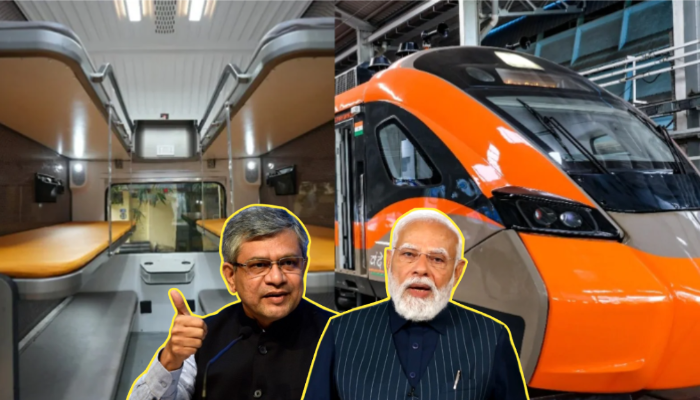

On 17th January (Saturday), Prime Minister Narendra Modi is scheduled to launch the nation’s first Vande Bharat sleeper train from Malda in poll-bound West Bengal. The regular passenger services are going to start between Howrah and Guwahati (Kamakhya) from the next day. Railway Minister Ashwini Vaishnaw recently announced that the trains will offer a new overnight travel option between Howrah in West Bengal and Guwahati in Assam.
With the development, Indian Railways is poised to transform overnight travel in India. The new trains promise to improve the experience of nighttime travel since they are designed for high speed, modern comfort and greater security.

An official statement conveyed, “The Vande Bharat Sleeper train is a shining example of the Make in India initiative, as its three most critical systems – the bogie, propulsion system and vehicle control system – have been entirely designed and developed within the country, making it a fully indigenous train set.”
The first Vande Bharat Sleeper train will stop at Bandel, Katwa, New Farakka, Malda Town, New Jalpaiguri, New Coochbehar, New Bongaigaon and Azimganj on its way from Howrah to Guwahati (Kamakhya).
A “Make in India” marvel to enhance connectivity and comfort
Bharat Earth Movers Limited utilised ICF (Integral Coach Factory, Chennai) technology to develop the trains which have a maximum design speed of 180 kilometres per hour (kmph), the number it touched during the last high-speed test, but will only operate at 130 kmph for safety reasons. The speed fluctuates due to a number of circumstances, such as the track’s geometry, stops along the way, section maintenance, etc.
The 16-coach self-propelled train has a first-class air-conditioned (AC) coach, four two-tier AC coaches and eleven three-tier AC coaches. 611 of the 823 berths are set aside for 3AC, 188 for 2AC and 24 for 1AC. The train is equipped with the latest innovations, including automated doors with vestibules, ergonomic sleepers, improved suspension for more comfortable trips and noise-cancelling technology.

The Kavach automatic train protection system and an emergency talk-back system are also present to guarantee passenger safety. The aerodynamic appearance and automated external doors significantly improve passenger comfort. The Vande Bharat sleeper train has similarly placed a high priority on sanitation standards. Vaishnaw outlined, “The disinfectant technology will kill 99.9 per cent of germs. The same technology is being used on the Vande Bharat chair-car version.”
The train even has better cushions and redesigned ladders along with modular bio vacuum toilets akin to those in aeroplanes, as well as a shower cubicle area for the passengers. There are driver cabins at both ends for shorter turnaround times between trips.
A concerted effort has also been made to ensure that the journey is just as enjoyable for the people, particularly for those who take pleasure in food. According to the Ministry of Railways, people will be able to savour regional cuisine as Assamese meals will be provided on trains from Guwahati, while Bengali food will be on trains that commence their respective journeys in Kolkata.

The fresh service is anticipated to assist a broad range of travellers and will cover nine districts, Howrah, Hooghly, Purba Bardhaman, Murshidabad, Malda, Jalpaiguri and Cooch Behar in West Bengal, while Kamrup Metropolitan and Bongaigaon in Assam, leading to better rail connectivity between eastern and Northeast parts of the country. These will be overnight travel that starts late at night and ends early in the morning.
No RAC, only passengers with confirmed tickets
These trains do not have Reservation Against Cancellation (RAC). RAC tickets are frequently granted in the event of non-confirmation, although waitlisted tickets are not accepted and are promptly cancelled in AC class on other express trains. A side lower berth could be shared by two persons under RAC. Every seat will be available starting on the first day of the advance reservation window.
Tickets for the Vande Bharat sleeper train would cost a little more than those for current luxury trains like the Rajdhani Express, and travellers will have to pay a minimum rate equal to that of a 400-kilometre trip. A Railway Board circular informed, “Minimum chargeable distance shall be 400 kilometres. Only confirmed tickets shall be issued for this train. Accordingly, there shall be no provision for RAC, waitlisted, or partially confirmed tickets. All available berths will be available from the day of the Advance Reservation Period (ARP).”

All tickets must be purchased digitally, and refunds will be processed within 24 hours. Other guidelines include the requirement for only fully reimbursable passes to obtain purchase tickets. Tickets acquired through concessions or free gratis passes that are not compensated will not be accepted. Furthermore, a lower berth would be assigned based on availability for a kid who does not need a separate berth, at standard child fare.
The effect on the wallets of passengers
The pricing has been designed with the financial capacity of the middle class in consideration. Passengers will pay Rs 2.4 per kilometre for 3AC, Rs 3.1 per kilometre for 2AC, and Rs 3.8 per kilometre for first AC. Therefore, the minimum fare for a 400-kilometre Vande Bharat sleeper train is Rs 960 for 3AC, Rs 1,240 for 2AC, and Rs 1,520 for 1AC. These charges include meals, but Goods and Services Tax (GST) will be assessed independently.
The ticket is priced at Rs 2,400 for 3AC, Rs 3,100 for 2AC and Rs 3,800 for 1AC for the 1,000-kilometre journey between Howrah and Guwahati. The costs are Rs 4,800 for 3AC, Rs 6,200 for 2AC, and Rs 7,600 for 3AC over a 2,000-kilometre distance. The rates are increased to Rs 6,720 for 3AC, Rs 8,680 for 2AC and Rs 10,640 for 1AC for travel up to 2,800 kilometres.
People have to shell out Rs 8,400 for 3AC, Rs 10,850 for 2AC and Rs 13,300 for 1AC for a maximum route of 3,500 kilometres. Officials mentioned that fares change gradually on the basis of the distance covered. The Howrah-Guwahati (Kamakhya Junction) route in Saraighat Express has the highest fares of Rs 1,410 for 3AC, Rs 1,985 for 2AC and Rs 3,320 for 1AC.

The train will take nearly 14 hours to travel 1,000 kilometres and will run six days a week, with trains 27575 and 27576 not running on Thursdays and Wednesdays, respectively.
Vande Bharat sleeper, like other trains, will have quotas for women, persons with disabilities (PwD), and senior citizens, in addition to the Duty Pass quota for employees. These trains won’t have any more quotas. According to reports, the reservation system will guarantee that lower berths are assigned to male passengers at 60 years of age and older, alongside female passengers who are 45 years of age and above.
What the future has in store
Indian Railways intends to swiftly grow this service in the future. Vaishnaw highlighted that eight more Vande Bharat sleeper trains would be introduced over the course of the next six months. It will take the total to twelve by the end of the year and greatly strengthen the long-distance rail connection.
He noted, “By this year, 12 trains will be ready. From next year onwards, production will ramp up rapidly as the entire supply chain will be in place by then.” The semi-high speed Vande Bharat sleeper trains are set to establish the standard for lavish, cosy and secure travel. Notably, the fusion of modern comfort with connectivity, expressed through indigenous means, adds even greater importance to it.

The Modi government has proactively worked to bring far-flung and previously neglected regions closer to one another, linking them to the rest of the country through infrastructure and a vast rail network that expands all four corners of India. The Vande Bharat Express has been instrumental in fulfilling this goal and the latest addition represents another crucial extension in the realisation of these efforts.