Regardless of what the US claims, India has continued purchasing Russian oil: Read how ‘wherever we find it cheap’ has been India’s consistent policy
On 6th March (Indian Time), the United States gave a 30-day window to New Delhi to buy crude oil from Russian tankers already in the sea, as the Iran-Israel conflict has disrupted the international supply chains. The official order pertains exclusively to the shipments that are presently at sea. The statement further conveyed that it does not include the permission to obtain any such purchases from the heavily-sanctioned Iran. Breaking News: The US Treasury Dept issues notice, saying it has "allowed" India to purchase Russian oil currently in tankers (even sanctioned tankers) for a period of 30 days, till April 4. pic.twitter.com/LDGaMjVJ6Y— OpIndia.com (@OpIndia_com) March 6, 2026 Treasury Secretary Scott Bessent lauded President Donald Trump for making a significant decision to tackle the impending threat to global energy supply without offering any advantages to Russia. “His energy agenda has resulted in oil and gas production reaching the highest levels ever recorded. To enable oil to keep flowing into the global market, the Treasury Department is issuing a temporary 30-day waiver to allow Indian refiners to purchase Russian oil,” he wrote. President Trump’s energy agenda has resulted in oil and gas production reaching the highest levels ever recorded.To enable oil to keep flowing into the global market, the Treasury Department is issuing a temporary 30-day waiver to allow Indian refiners to purchase Russian oil.…— Treasury Secretary Scott Bessent (@SecScottBessent) March 6, 2026 “Allow” was the most important word in that message. The Trump Administration has insisted that it is “allowing” India a waiver to make essential crude oil purchases from Russian tankers. To add to their boasting, Bessent even presented it as some wise benevolence from his President Donald Trump. Bessent then tacitly told India to acquire oil from America by invoking the close ties between the two nations. He added, “This deliberately short-term measure will not provide significant financial benefit to the Russian government as it only authorises transactions involving oil already stranded at sea. India is an essential partner of the United States, and we fully anticipate that New Delhi will ramp up purchases of US oil. This stop-gap measure will alleviate pressure caused by Iran’s attempt to take global energy hostage.” Nearly 40% of India’s oil imports come from the Gulf with a large amount being shipped through the strategically critical Strait of Hormuz which is currently controlled by Iran. The Modi government earlier announced that the country is in a very comfortable position with regard to energy security and is assessing its energy situation twice a day. The stock position is likewise comfortable with daily replenishments. Furthermore, India is also communicating with other sources to ensure an uninterrupted flow of oil. The USA has no right to “allow” India to do anything. India buys oil wherever it is available cheaply Interestingly, the fresh move from America has transpired following a series of unsuccessful pressure strategies, including an extra 25% tariff raising the total figure to 50% and forcing India to abandon Russian oil in the name of “funding the war in Ukraine.” On the other hand, New Delhi has repeatedly emphasised that its decisions are based on its sovereignty and interests, thereby refusing to succumb to the challenge. The acquisition of oil from Moscow has fluctuated monthly due to various factors, but it was never “stopped” despite the assertions from Washington. In fact, India has been in constant touch with Russian vendors as an alternative to fulfil its energy needs following the shutdown of the Strait of Hormuz. Image via Reuters A recent infographic shared by Reuters even made it quite clear. India’s oil purchase from Russia definitely increased after the start of the Russia-Ukraine war. But it wasn’t because India “wanted to fund a war”. India had nothing to do with that war. India bought Russian oil because Russian oil was offered cheap. And purchasing oil to meet national needs was a greater priority for the government of India than appeasing some NATO leaders and European media. As shown in the Reuters infographic above, India’s Russian oil purchase declined slightly after October 2025, but it never “stopped”, as the USA would like to claim. Therefore, this self-aggrandisement by the US is merely another attempt to claim hollow superiority while pretending to portray itself as a benevolent superpower, which is directly in contrast to reality. Russian oil cargoes return to India even before the US waiver India had already begun sourcing Russian oil from tankers in the sea to compensate for the loss of crude from the Middle East as tensions continue to mount in the region, even before the Trump administration’s so-called “permission” came. A considerable portion of the more than 10 million barrels that have previously been secured was likely
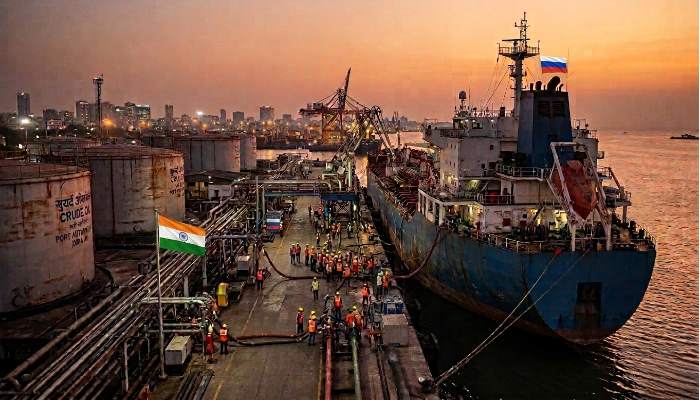
On 6th March (Indian Time), the United States gave a 30-day window to New Delhi to buy crude oil from Russian tankers already in the sea, as the Iran-Israel conflict has disrupted the international supply chains. The official order pertains exclusively to the shipments that are presently at sea. The statement further conveyed that it does not include the permission to obtain any such purchases from the heavily-sanctioned Iran.
Breaking News: The US Treasury Dept issues notice, saying it has "allowed" India to purchase Russian oil currently in tankers (even sanctioned tankers) for a period of 30 days, till April 4. pic.twitter.com/LDGaMjVJ6Y— OpIndia.com (@OpIndia_com) March 6, 2026
Treasury Secretary Scott Bessent lauded President Donald Trump for making a significant decision to tackle the impending threat to global energy supply without offering any advantages to Russia. “His energy agenda has resulted in oil and gas production reaching the highest levels ever recorded. To enable oil to keep flowing into the global market, the Treasury Department is issuing a temporary 30-day waiver to allow Indian refiners to purchase Russian oil,” he wrote.
President Trump’s energy agenda has resulted in oil and gas production reaching the highest levels ever recorded.To enable oil to keep flowing into the global market, the Treasury Department is issuing a temporary 30-day waiver to allow Indian refiners to purchase Russian oil.…— Treasury Secretary Scott Bessent (@SecScottBessent) March 6, 2026
“Allow” was the most important word in that message. The Trump Administration has insisted that it is “allowing” India a waiver to make essential crude oil purchases from Russian tankers. To add to their boasting, Bessent even presented it as some wise benevolence from his President Donald Trump.
Bessent then tacitly told India to acquire oil from America by invoking the close ties between the two nations. He added, “This deliberately short-term measure will not provide significant financial benefit to the Russian government as it only authorises transactions involving oil already stranded at sea. India is an essential partner of the United States, and we fully anticipate that New Delhi will ramp up purchases of US oil. This stop-gap measure will alleviate pressure caused by Iran’s attempt to take global energy hostage.”
Nearly 40% of India’s oil imports come from the Gulf with a large amount being shipped through the strategically critical Strait of Hormuz which is currently controlled by Iran. The Modi government earlier announced that the country is in a very comfortable position with regard to energy security and is assessing its energy situation twice a day. The stock position is likewise comfortable with daily replenishments. Furthermore, India is also communicating with other sources to ensure an uninterrupted flow of oil.
The USA has no right to “allow” India to do anything. India buys oil wherever it is available cheaply
Interestingly, the fresh move from America has transpired following a series of unsuccessful pressure strategies, including an extra 25% tariff raising the total figure to 50% and forcing India to abandon Russian oil in the name of “funding the war in Ukraine.” On the other hand, New Delhi has repeatedly emphasised that its decisions are based on its sovereignty and interests, thereby refusing to succumb to the challenge.
The acquisition of oil from Moscow has fluctuated monthly due to various factors, but it was never “stopped” despite the assertions from Washington. In fact, India has been in constant touch with Russian vendors as an alternative to fulfil its energy needs following the shutdown of the Strait of Hormuz.
Image via Reuters
A recent infographic shared by Reuters even made it quite clear. India’s oil purchase from Russia definitely increased after the start of the Russia-Ukraine war. But it wasn’t because India “wanted to fund a war”. India had nothing to do with that war. India bought Russian oil because Russian oil was offered cheap. And purchasing oil to meet national needs was a greater priority for the government of India than appeasing some NATO leaders and European media.
As shown in the Reuters infographic above, India’s Russian oil purchase declined slightly after October 2025, but it never “stopped”, as the USA would like to claim.
Therefore, this self-aggrandisement by the US is merely another attempt to claim hollow superiority while pretending to portray itself as a benevolent superpower, which is directly in contrast to reality.
Russian oil cargoes return to India even before the US waiver
India had already begun sourcing Russian oil from tankers in the sea to compensate for the loss of crude from the Middle East as tensions continue to mount in the region, even before the Trump administration’s so-called “permission” came. A considerable portion of the more than 10 million barrels that have previously been secured was likely taken before the latest declaration from the US, based on a piece on Bloomberg.
Sources in the Government of India have already stated that Russia was one of the top suppliers of energy to India in February. 1.04 million barrels of crude per day was imported by India in February.
Russia was one of the largest suppliers of energy to India in February. 1.04 million barrels of crude imported a day in February: Govt Sources— Sidhant Sibal (@sidhant) March 6, 2026
The ship-tracking data of Bloomberg revealed that there are approximately 15 million barrels of Russian crude on tankers in the Arabian Sea and the Bay of Bengal while another 7 million are sitting close to Singapore. Within a week, all of them could end up in Indian ports. Furthermore, others are travelling toward the subcontinent via the Suez Canal and the Mediterranean Sea.
Tankers with Russian oil commenced altering their routes to indicate Indian ports even before the “we are allowing” notice came from the White House. According to Kpler, at least 18 vessels holding Urals are demonstrating that they are progressing to India. Sumit Ritolia, an analyst at the company, mentioned that the development could “potentially push volumes back above 2 million barrels a day in the near term.”
According to a source, the Suezmax tanker Odune, which was carrying roughly a million barrels was spotted at the eastern Paradip port on 4th March to deliver it to the state refiner Indian Oil Corporation Limited, reported Reuters.
Additionally, IOC is expected to receive about 700,000 barrels of Russian oil from the Spring Fortune in the port of Vadinar in western India on 7th March (Saturday). An IOC source disclosed that the company is accelerating the procurement from Russia which comprises the containers placed on ships that are cruising around India.
An insider cited by the media house stated that approximately 9.5 million barrels of Russian crude are floating close to Indian waters and might arrive in a matter of weeks. Another Indian refiner has also shown interest in using this oil. Ritolia expressed, “Should Middle Eastern inflows tighten, Indian refiners could pivot back toward Russian grades relatively quickly.”
He observed that there are roughly 30 million barrels of Russian oil available and loaded on ships in the Singapore Strait, the Arabian Sea region and the Indian Ocean, including amounts in floating storage.
An analysis of tracking by Kpler and Vortexa informed that two tankers bringing a combined 1.4 million barrels of Urals crude are going to discharge in Indian ports this week after initially suggesting that they were bound farther east, according to a separate report in Bloomberg.
On 5th March, Matari, an Aframax with almost 700,000 barrels was scheduled to reach Vadinar. With over 730,000 barrels of Urals on board, Indri, another Suezmax in the Arabian Sea which was headed to Singapore, made a sudden detour north into India this week. Last year, the United Kingdom and the European Union slapped sanctions on all three ships.
India shapes policy prioritising its own interests, not ‘permission’ from White House
The aforementioned data has clarified that the US claims of granting a time period to India are nothing more than a desperate effort to give credit where it is undeserved. New Delhi neither sought to be allowed nor expected any such gesture because it was actively pursuing its sovereign energy interests in light of the ongoing tensions.
Moreover, the utter inconsequentiality of these allegations, responses or tactics has been regularly proved as they never impact any decision made by the Modi government. Last month, the centre reaffirmed that it would keep importing crude oil from where it was affordable and of the highest quality.
Indian oil corporations would function, taking into account non-sanctioned sources and the geopolitical environment. This was shared by the senior representatives of the Ministries of Commerce and External Affairs with the Parliamentary Standing Committee on External Affairs, headed by Congress leader and Lok Sabha MP Shashi Tharoor.
A similar episode unfolded when India countered the US assertion that it had agreed to “stop taking oil” from Russia. “National interests will be the guiding factor for us in our choices for energy procurement,” stated Foreign Secretary Vikram Misri on February 9. He pointed out that sufficient availability, reasonable pricing and supply reliability are the main reasons which are behind the country’s buying policy.
According to the foreign secretary, India’s “foremost priority” is to protect Indian the interests of its citizens and guarantee that they get adequate energy at the correct price through dependable and secure outlets.
“Our import policy insofar as energy is concerned is therefore driven entirely by these objectives. We are neither dependent on any single source for this, nor do we intend to be. And it is natural for the mix of sources to vary from time to time, depending on objective market conditions,” the official remarked.
He added, “Our approach is to maintain multiple sources of supply and diversify them as appropriate to ensure stability. Therefore, I would say that the more diversified we are in this area, the more secure we are.” The powerful rebuttal occurred after Trump alleged that India would not acquire Russian oil and slashed the 25% tariff during an announcement of the trade arrangement framework between the two countries.
Govt Sources: Today, we have more energy sources than what is stuck in the Straits of Hormuz. We are in a comfortable position in Crude oil, Oil products and LPG. In terms of our current stock, we are in a comfortable position. We are going to ramp up our supplies from other… pic.twitter.com/plzLEDvl25— ANI (@ANI) March 6, 2026
As if on cue, the Indian government sources have once again asserted that Russian crude will keep flowing to India. “Today, we have more energy sources than what is stuck in the Straits of Hormuz. We are in a comfortable position in Crude oil, Oil products and LPG. In terms of our current stock, we are in a comfortable position. We are going to ramp up our supplies from other parts of the geographies and make up for our supply crunch from the Straits of Hormuz”, GOI has stated.
“We have been buying crude oil from Russia since 2022. In 2022, we were importing 0.2 per cent of total imports from Russia. In February, we imported 20% of our total crude oil imports from Russia. In February, India imported 1.04 mn barrel per day from Russia,” the Indian government has stated.
Trump needs to appease his MAGA fan base, India does not
The Trump administration possesses a peculiar tendency to congratulate or commend itself without reason, leading to self-embarrassment following persistent counters from India.
Meanwhile, New Delhi has continuously worked to protect its own interests, unbothered by these antics which are largely unacknowledged by the Modi government. It has become a routine between the two parties, where Washington introduces an outrageous decree or complaint, only to be ignored or politely rejected by New Delhi.
Likewise, the present White House administration seems to have made “boastful grandstanding” a habit of sorts. Be it “stopping 8 global wars” or controlling the whole world’s economy through their sanctions, Trump’s claims and their actual impact on the ground often don’t align. The multipolar world does not get remote-controlled by sanctions and tariffs.
A sovereign nation’s policy works on sovereign interests. Sanctions or tariffs are just geopolitical hiccups that need occasional recalibration and working through. Be it crude oil, Liquefied Natural Gas (LNG), rare earths or any other commodity, the current global order is an intricate mesh of supply chains and logistical mechanics.
No single nation can control it all by bullying or throwing tantrums. India has navigated this complex grid for decades, and it will continue to do so. Moreover, the claims made by the Trump administration are to please their domestic MAGA fanbase.
The Indian government does not work like that. Through the Russia-Ukraine war, the Gaza-Israel conflict and multiple scenarios over the years, the Ministry of External Affairs in India has kept its communications strictly official and respectful of international laws and national priorities.
Unlike the Trump administration, the Indian MEA (Ministry of External Affairs) does not need to play a social media game to underline its priorities. They know what to do and where to prove their points.