Repeated Islamic invasions, unbroken resolve: How Hindu rulers kept Somnath, the pillar of Sanatan Civilisation alive
Somnath is not merely a temple; it is a symbol of India’s historical memory of a civilisation where faith, valour, and cultural self-respect repeatedly rose in defiance of assaults driven by religious fanaticism. Across centuries, whenever Somnath was attacked, Hindu rulers and warriors responded, sometimes by taking up the sword to block the aggressor’s advance, and at other times by laying brick upon stone to rebuild the temple once again. From Arab to Turkic invasions, religious zealotry repeatedly targeted Somnath, at times through maritime routes and at other times via north-western land corridors. Yet after every act of destruction, history also records that Hindu rulers did not merely survive; they restored both the temple and the civilisation it represented. This article documents that uninterrupted tradition of resistance. This work is dedicated to the memory of those great rulers and warriors who defended Somnath, fought battles, endured struggles, and kept the temple alive. It also traces the journey into modern India, where reconstruction itself became a declaration of national self-respect. Background of Islamic Attacks and Resistance Between the 11th and 14th centuries, Somnath in western India was attacked multiple times. The objective of these assaults was not limited to plundering wealth or demolishing a structure, but to humiliating a civilisational centre. Yet the tradition of Somnath never broke. Political power changed hands, but the spirit of resistance endured, sometimes on the battlefield, sometimes through restoration. Mularaja Solanki: The Political Foundation of Saurashtra’s Defence In the 10th century, Mularaja Solanki (I) founded the Solanki (Chaulukya) dynasty and established Anhilwad Patan as the capital. This was a period marked by Arab maritime raids along the western coast and the gradual advance of Islamic forces from the north-west. While there is no explicit record of Mularaja fighting a direct battle over Somnath, it is historically evident that he established a consolidated Hindu political authority in Gujarat and Saurashtra. This authority later became the shield protecting Somnath. Mularaja’s contribution lay less in the sword and more in political stability, for without a stable state, the defence of any temple is impossible. Bhimdev I: After the Ghaznavid Attack In 1026 CE, Mahmud of Ghazni attacked Somnath, an assault driven not merely by plunder but by the intent to shatter a powerful religious symbol. The aftermath plunged Gujarat into fear and instability. It was during this period that Bhimdev I assumed power. He restored administrative control over Saurashtra and re-established Hindu authority. His historical significance lies in the message he conveyed: an invasion does not mark the end of a state. Under his rule, the Somnath region returned to Hindu control, and the temple was rebuilt. This reconstruction after the devastation of 1026 CE is regarded as the first major political restoration in Somnath’s history, demonstrating how cultural resolve can revive itself despite severe political shocks. Siddharaj Jaysinh: Cultural security through military strength Among the most powerful Solanki rulers was Siddharaj Jaysinh. His reign coincided with the rise of Turkic powers in northern India. He not only defended borders but also established robust political protection over Saurashtra and the Somnath region. During his time, temples were not merely places of worship but symbols of state prestige. An attack on Somnath was viewed as an attack on the state itself, a mindset that helped keep Gujarat secure for a prolonged period. Under Siddharaj Jaysinh, Gujarat and Saurashtra were militarily strengthened. Temples and pilgrimage centres received state protection, and Somnath emerged as a symbol of political security and cultural honour. Construction and restoration works were also undertaken at the temple during his reign. Queen Naiki Devi: Halting the invader at Kayadara In the 12th century, a decisive moment arrived when Queen Naiki Devi defeated Muhammad Ghori at the Battle of Kayadara in 1178 CE. This was not merely a military victory; it spared western India and the Prabhas–Somnath region from large-scale destruction. Contemporary and later historians regard this victory as a decisive defence of Somnath. This was not just a battle, but a defence of Somnath and Gujarat’s civilisational identity. A woman ruler standing firm against a fanatical invasion remains one of the most inspiring chapters of Indian history. Naiki Devi’s valour proves that in battles of faith and self-respect, neither gender nor status is a limitation. When civilisation is under attack, every individual can become a warrior. King Kanhaḍ Dev Between great empires, local rulers also played a decisive role in Somnath’s defence. According to folk history, King Kanhaḍ Dev organised local military forces in Saurashtra. These forces formed the firs
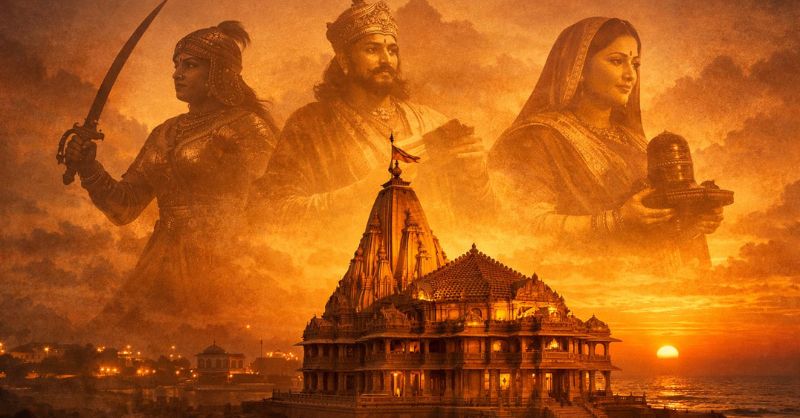

Somnath is not merely a temple; it is a symbol of India’s historical memory of a civilisation where faith, valour, and cultural self-respect repeatedly rose in defiance of assaults driven by religious fanaticism. Across centuries, whenever Somnath was attacked, Hindu rulers and warriors responded, sometimes by taking up the sword to block the aggressor’s advance, and at other times by laying brick upon stone to rebuild the temple once again.
From Arab to Turkic invasions, religious zealotry repeatedly targeted Somnath, at times through maritime routes and at other times via north-western land corridors. Yet after every act of destruction, history also records that Hindu rulers did not merely survive; they restored both the temple and the civilisation it represented. This article documents that uninterrupted tradition of resistance.
This work is dedicated to the memory of those great rulers and warriors who defended Somnath, fought battles, endured struggles, and kept the temple alive. It also traces the journey into modern India, where reconstruction itself became a declaration of national self-respect.
Background of Islamic Attacks and Resistance
Between the 11th and 14th centuries, Somnath in western India was attacked multiple times. The objective of these assaults was not limited to plundering wealth or demolishing a structure, but to humiliating a civilisational centre. Yet the tradition of Somnath never broke. Political power changed hands, but the spirit of resistance endured, sometimes on the battlefield, sometimes through restoration.
Mularaja Solanki: The Political Foundation of Saurashtra’s Defence
In the 10th century, Mularaja Solanki (I) founded the Solanki (Chaulukya) dynasty and established Anhilwad Patan as the capital. This was a period marked by Arab maritime raids along the western coast and the gradual advance of Islamic forces from the north-west. While there is no explicit record of Mularaja fighting a direct battle over Somnath, it is historically evident that he established a consolidated Hindu political authority in Gujarat and Saurashtra. This authority later became the shield protecting Somnath. Mularaja’s contribution lay less in the sword and more in political stability, for without a stable state, the defence of any temple is impossible.
Bhimdev I: After the Ghaznavid Attack
In 1026 CE, Mahmud of Ghazni attacked Somnath, an assault driven not merely by plunder but by the intent to shatter a powerful religious symbol. The aftermath plunged Gujarat into fear and instability. It was during this period that Bhimdev I assumed power. He restored administrative control over Saurashtra and re-established Hindu authority. His historical significance lies in the message he conveyed: an invasion does not mark the end of a state.
Under his rule, the Somnath region returned to Hindu control, and the temple was rebuilt. This reconstruction after the devastation of 1026 CE is regarded as the first major political restoration in Somnath’s history, demonstrating how cultural resolve can revive itself despite severe political shocks.
Siddharaj Jaysinh: Cultural security through military strength
Among the most powerful Solanki rulers was Siddharaj Jaysinh. His reign coincided with the rise of Turkic powers in northern India. He not only defended borders but also established robust political protection over Saurashtra and the Somnath region. During his time, temples were not merely places of worship but symbols of state prestige. An attack on Somnath was viewed as an attack on the state itself, a mindset that helped keep Gujarat secure for a prolonged period.
Under Siddharaj Jaysinh, Gujarat and Saurashtra were militarily strengthened. Temples and pilgrimage centres received state protection, and Somnath emerged as a symbol of political security and cultural honour. Construction and restoration works were also undertaken at the temple during his reign.
Queen Naiki Devi: Halting the invader at Kayadara
In the 12th century, a decisive moment arrived when Queen Naiki Devi defeated Muhammad Ghori at the Battle of Kayadara in 1178 CE. This was not merely a military victory; it spared western India and the Prabhas–Somnath region from large-scale destruction. Contemporary and later historians regard this victory as a decisive defence of Somnath.
This was not just a battle, but a defence of Somnath and Gujarat’s civilisational identity. A woman ruler standing firm against a fanatical invasion remains one of the most inspiring chapters of Indian history. Naiki Devi’s valour proves that in battles of faith and self-respect, neither gender nor status is a limitation. When civilisation is under attack, every individual can become a warrior.
King Kanhaḍ Dev
Between great empires, local rulers also played a decisive role in Somnath’s defence. According to folk history, King Kanhaḍ Dev organised local military forces in Saurashtra. These forces formed the first line of defence against attacks arriving via coastal routes and inland passages. While formal historical texts offer limited detail, Somnath could not have survived without such local resistance.
In the Rajasthan–Gujarat border regions, Kanhaḍ Dev’s campaigns against Turkic and Ghori-aligned forces helped secure routes leading to Somnath. His example illustrates how, even amid major empires, the faith and sword of local rulers kept temples and culture alive, strengthening the foundation for future reconstructions.
King Bhoja Parmar
King Bhoja of the Paramara dynasty contributed more through civilisational revival than battlefield warfare. After Ghaznavid attacks had shaken Hindu society psychologically, Bhoja extended political patronage to Shaiva traditions, temple culture, and classical learning. This was not merely religious support but a political assertion that the Sanatana civilisation cannot be destroyed.
Traditional and literary sources associate King Bhoja and Maharaja Vikramaditya with the restoration of Somnath. In Shaiva tradition and popular memory, Bhoja’s role remains significant, demonstrating that temple protection requires not only military power but also cultural vision and intellectual resurgence.
King Mahipal Dev
Among the Paramara rulers, King Mahipal Dev represented continuity through administration and protection rather than warfare alone. During the 14th–15th centuries, he is said to have repeatedly defeated the forces of Gujarat’s Islamic governor Zafar Khan, safeguarding the Somnath region. Folk tradition holds that he trained local communities in martial skills to ensure the temple’s defence under all circumstances.
Kumarapala
Though a follower of Jainism, Kumarapala extended administrative support for the protection of Hindu pilgrimage sites, including Somnath. This underscores that Somnath’s defence was not a sectarian issue but a civilisational one. While the invaders were religiously motivated, the resistance was rooted in Indian civilisation itself. During the 12th century, Kumarapala supported temple administration and restoration, enabling Somnath’s pilgrimage tradition to regain stability.
The Maratha Empire
In the 18th century, the Maratha Empire displaced Islamic political authority from Saurashtra. This was not a temple-centric war but a struggle for political liberation, without which reconstruction was impossible. Maratha campaigns created conditions of stability, enabling Somnath’s revival and the protection of religious sites across Gujarat.
Queen Ahilyabai Holkar
In 1783, Queen Ahilyabai Holkar reconstructed Somnath. This was more than an architectural act; it was a response to centuries of humiliation. Political constraints led her to build the temple slightly away from the original site, but she consecrated the Shiva linga and revived worship traditions. Before modern reconstruction, this was the most significant effort to keep the flame of faith alive. Tradition holds that Lord Somnath appeared to her in a dream, inspiring this act.
National reawakening in Modern India: From Sardar Patel to PM Modi
After independence, the reconstruction of Somnath became a matter of national self-respect, not merely religious revival. Despite opposition from Nehru, Sardar Vallabhbhai Patel’s resolve led to the construction of the grand temple, marking independent India’s first decisive assertion of its cultural memory.
K.M. Munshi provided ideological and administrative leadership, and in 1951, the temple was inaugurated by President Rajendra Prasad. Under Prime Minister Narendra Modi, Somnath today is presented not as a relic of the past but as a living cultural heritage. The renewed emphasis on its history and preservation signals that Somnath’s story continues to pulse within India’s national consciousness.
The history of Somnath shows that religious fanaticism returned repeatedly, but Hindu rulers and warriors stood firm every time—sometimes in war, sometimes in reconstruction. That is why Somnath still stands today, not merely as a temple, but as a symbol of civilisational resilience. This article is an attempt to remember those who preserved this tradition through the sword, determination, and sustained effort.
References
- R.C. Majumdar – The History and Culture of the Indian People (Volume 5)
- Satish Chandra – Medieval India
- Jadunath Sarkar – History of the Marathas
- Gujarat State Gazetteers (Prabhas/Somnath)
- K.M. Munshi – Pilgrimage to Freedom