Shipbuilding in India: Reclaiming the legacy after a thousand years
When the North-east Monsoon winds gained force in 1025 CE, it wasn’t just the fisher folks and traders who were sailing the seas that year. An armada of Rajendra Chola’s mighty ocean-going deep-water ships called Vankam, sturdier and bigger than the coastal vessels called Odam, had already set sail from the port of Nagapattinam. Their target lay two thousand kilometres away, or, over three weeks of sailing, in the powerful kingdom of Srivijaya in Sumatra, whose influence and dictates were gatekeeping the trade in East Asia and were levying heavy taxes on Chola vessels. The militarised ocean-going ships were built to absorb the blows of the swell thrashing on the hulls. Dark with fish oil and resins, the ships carried troops, war elephants, weapons and supplies to last months. It was age-old engineering that built those vessels. The dark hull was teak planks stitched together with ropes of coconut husk, sealed shut from seawater with tree gum resins and lime. The stitched planks of the hull flexed with the waves, instead of fighting against them. The hull absorbed the pounding of the swells, unlike the iron-bound planking. There was no compass yet, but the navigators read the sun’s angle, the winds, the movement of birds and the position of stars at night. It was wisdom passed down from generations of an ocean-going people who have traded from the Red Sea to Java and Sumatra, spanning the Indian Ocean and wielding the monsoon winds to their advantage. Rajendra Chola was sailing to attack, conquer and subdue the Srivijaya kingdom. He executed his plan with bold strategic manoeuvres. The Chola fleet, instead of taking the northern approach to the Strait of Malacca, crossed the west coast of Sumatra, got resupplied at friendly ports and entered via the Sunda Strait from the South, where Srivijaya never expected. The victory was swift and decisive. Srivijaya ports fell in rapid succession. King Sangrama Vijayottungavarman was captured along with his treasure, elephants and valuables. Palembang, Kadaram, Pannai, Malayiur and many other ports fell to Chola supremacy. Map of Srivijaya kingdom (Source: Wikipedia) But Rajendra Chola wasn’t there to colonise the islands; he wanted trade to go on uninterrupted, Chola traders unhindered. He placed friendly, amiable rulers in the key port cities and ensured that Chola trade went unchallenged, and Srivijaya’s monopoly in the region was shattered. This was a power projection at a scale never witnessed before in India. No Indian empire before the Cholas, and none in the centuries afterwards, had sent a large fleet across the open ocean to strike and dominate a distant kingdom so far from the subcontinent’s shores. The victory was not just of Chola trade, but of seamanship and shipbuilding expertise. From glory to fall and loss of a heritage From that pinnacle of glory, Indian shipbuilding expertise fell. The knowledge was lost, the society retreated from the seas in the centuries that followed and ships remained a matter of just trade, not strategy or sovereignty. The Chola conquest of Srivijaya reads almost mythical today, because the land that made such a conquest possible gradually lost its power over the waves. So much so that the same coasts became the pathways to our long and brutal colonisation in the centuries that followed. For a nation to be any kind of global power, it must first become a maritime power. The condition looms larger for India because we are the natural guardians of the Indian Ocean, ordained by geography, blessed with over 11,000 km of coastline, kissed by the Monsoon winds. But for centuries, we lost our connections to the sea by forgetting the very skills that made us masters of the waves once: shipbuilding. Over the ups and downs of a millennium, we lost the capacity to build large ocean-going vessels at scale. The nation that once influenced the economy of the Roman Empire by the sheer volume of its maritime trade gave up its shipbuilding knowledge and industry and chose to forget that we are a civilisation shaped by the Ocean as much as the Himalayas and its river systems. Shipbuilding is not a single skill or industry. It is a vast, interlocking ecosystem of technologies, industries, and human expertise that has repeatedly determined which nations rise to become global powers. To build a seaworthy ocean-going vessel, be it a Chola Vangam of the 11th century or a modern LNG carrier, demands mastery of naval architecture and design, advanced materials science, precision engineering of propulsion systems, electrical and electronic integration, welding and fabrication at scale, quality control, project management, and a sophisticated network of logistics driven by great vision and risk-taking appetite. Surrounding the core technologies are layer upon layer of supporting industries: steel production, engine and machinery manufacturers, electronics and sensor producers, paint and coating specialists, finan
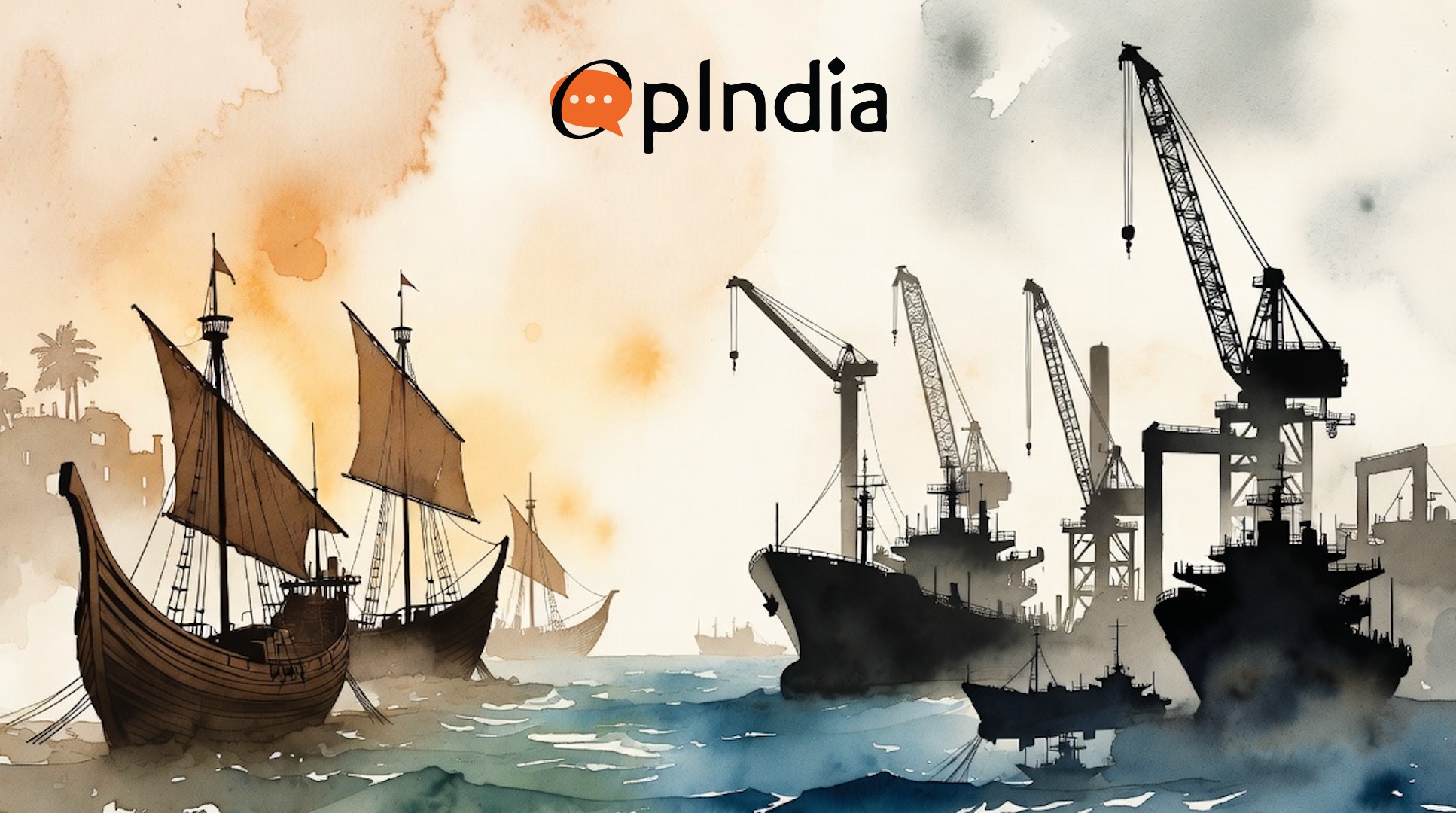
When the North-east Monsoon winds gained force in 1025 CE, it wasn’t just the fisher folks and traders who were sailing the seas that year. An armada of Rajendra Chola’s mighty ocean-going deep-water ships called Vankam, sturdier and bigger than the coastal vessels called Odam, had already set sail from the port of Nagapattinam. Their target lay two thousand kilometres away, or, over three weeks of sailing, in the powerful kingdom of Srivijaya in Sumatra, whose influence and dictates were gatekeeping the trade in East Asia and were levying heavy taxes on Chola vessels.
The militarised ocean-going ships were built to absorb the blows of the swell thrashing on the hulls. Dark with fish oil and resins, the ships carried troops, war elephants, weapons and supplies to last months. It was age-old engineering that built those vessels. The dark hull was teak planks stitched together with ropes of coconut husk, sealed shut from seawater with tree gum resins and lime. The stitched planks of the hull flexed with the waves, instead of fighting against them. The hull absorbed the pounding of the swells, unlike the iron-bound planking.
There was no compass yet, but the navigators read the sun’s angle, the winds, the movement of birds and the position of stars at night. It was wisdom passed down from generations of an ocean-going people who have traded from the Red Sea to Java and Sumatra, spanning the Indian Ocean and wielding the monsoon winds to their advantage.
Rajendra Chola was sailing to attack, conquer and subdue the Srivijaya kingdom. He executed his plan with bold strategic manoeuvres. The Chola fleet, instead of taking the northern approach to the Strait of Malacca, crossed the west coast of Sumatra, got resupplied at friendly ports and entered via the Sunda Strait from the South, where Srivijaya never expected. The victory was swift and decisive. Srivijaya ports fell in rapid succession. King Sangrama Vijayottungavarman was captured along with his treasure, elephants and valuables. Palembang, Kadaram, Pannai, Malayiur and many other ports fell to Chola supremacy.
Map of Srivijaya kingdom (Source: Wikipedia)
But Rajendra Chola wasn’t there to colonise the islands; he wanted trade to go on uninterrupted, Chola traders unhindered. He placed friendly, amiable rulers in the key port cities and ensured that Chola trade went unchallenged, and Srivijaya’s monopoly in the region was shattered.
This was a power projection at a scale never witnessed before in India. No Indian empire before the Cholas, and none in the centuries afterwards, had sent a large fleet across the open ocean to strike and dominate a distant kingdom so far from the subcontinent’s shores. The victory was not just of Chola trade, but of seamanship and shipbuilding expertise.
From glory to fall and loss of a heritage
From that pinnacle of glory, Indian shipbuilding expertise fell. The knowledge was lost, the society retreated from the seas in the centuries that followed and ships remained a matter of just trade, not strategy or sovereignty. The Chola conquest of Srivijaya reads almost mythical today, because the land that made such a conquest possible gradually lost its power over the waves. So much so that the same coasts became the pathways to our long and brutal colonisation in the centuries that followed.
For a nation to be any kind of global power, it must first become a maritime power. The condition looms larger for India because we are the natural guardians of the Indian Ocean, ordained by geography, blessed with over 11,000 km of coastline, kissed by the Monsoon winds. But for centuries, we lost our connections to the sea by forgetting the very skills that made us masters of the waves once: shipbuilding.
Over the ups and downs of a millennium, we lost the capacity to build large ocean-going vessels at scale. The nation that once influenced the economy of the Roman Empire by the sheer volume of its maritime trade gave up its shipbuilding knowledge and industry and chose to forget that we are a civilisation shaped by the Ocean as much as the Himalayas and its river systems.
Shipbuilding is not a single skill or industry. It is a vast, interlocking ecosystem of technologies, industries, and human expertise that has repeatedly determined which nations rise to become global powers. To build a seaworthy ocean-going vessel, be it a Chola Vangam of the 11th century or a modern LNG carrier, demands mastery of naval architecture and design, advanced materials science, precision engineering of propulsion systems, electrical and electronic integration, welding and fabrication at scale, quality control, project management, and a sophisticated network of logistics driven by great vision and risk-taking appetite.
Surrounding the core technologies are layer upon layer of supporting industries: steel production, engine and machinery manufacturers, electronics and sensor producers, paint and coating specialists, finance and insurance institutions, specialised training academies, research laboratories, and the ports and supply chains that feed the shipping yards.
A thousand years after Rajendra Chola’s conquest of Srivijaya, India today ranks near the bottom of the global commercial shipbuilding league, producing a tiny fraction of the world’s tonnage while China, South Korea, and others dominate.
Finally, after nearly a thousand years, that story is beginning to change. In recent years, the government has put shipbuilding firmly back on the agenda of strategic autonomy and national priorities.
Union Govt has started to take shipbuilding seriously
In the Union Budget of 2025–26, a comprehensive package of ₹69,725 crore has been approved to revitalise the sector. The package hopes to revitalise the following major sectors:
The Shipbuilding Financial Assistance Scheme (SBFAS), with an outlay of ₹24,736 crore, is designed to offset the cost disadvantages Indian yards face against heavily subsidised global competitors.
The Maritime Development Fund (MDF), a ₹25,000 crore corpus that includes a Maritime Investment Fund and an Interest Incentivisation Fund to provide long-term, affordable financing. The Union government also cleared a proposal to give ‘infrastructure’ status to large ships.
The Shipbuilding Development Scheme (SbDS), with ₹19,989 crore, aimed at expanding annual output capacity to 4.5 million Gross Tonnage through greenfield shipbuilding clusters and the modernisation of existing yards.
In a written reply to the Lok Sabha, Union Minister Shri Sarbananda Sonowal highlighted the Government’s comprehensive ₹69,725 crore shipbuilding package aimed at strengthening domestic shipbuilding capacity, maritime financing, infrastructure development, and skill creation.… pic.twitter.com/8ZnRC7KxAk— Ministry of Ports, Shipping and Waterways (@shipmin_india) July 27, 2026
Three greenfield clusters, Andhra Pradesh, Gujarat, and Tamil Nadu, have already received in-principle approval. A pipeline of more than 400 vessels is being aggregated to give yards visibility of orders. The stated ambition, aligned with Maritime India Vision 2030 and Maritime Amrit Kaal Vision 2047, is to transform India into a competitive global shipbuilding force and raise the share of Indian-flagged ships in global trade.
The government push is not merely an industrial policy shift. It is an attempt to reconnect with a forgotten competence, driven by the willingness to ride the waves again, and reclaim our relationship with the Ocean that was named after our country.
After the decline of the Chola Empire, political power in India, influenced by social and religious trends, increasingly oriented itself inland. Later dynasties maintained coastal trade, but the active state investment in large-scale naval architecture and blue-water capability dwindled, so did the overall interest and vision. The arrival of European powers in the 16th century further disrupted indigenous shipbuilding. Portuguese, Dutch, and British control of key ports, combined with their own advanced shipyards and naval dominance, pushed the Indian knowledge system for ocean-going vessel building to the fringe. By the British colonial period, India was largely a supplier of timber, labour, and coastal craft rather than a builder of the great ships that carried global trade.
Long miles to cover
After Independence, India did put efforts on defence shipbuilding, and did manage to achieve success in building warships and submarines, through alliances and help from friendly nations. Commercial shipbuilding, however, remained underdeveloped. Global competition intensified, and China and South Korea achieved massive economies of scale. India never closed the gap in design capability, productivity, financing, or order-book volume.
The result was a glaring paradox: the only nation in the world that has an Ocean named after it, boasting a large coastline and the descendant of a flourishing maritime past, is not even among the top 5 shipbuilders of the world.
The reinvigourated government interest seeks to reverse that trajectory. By combining financial incentives, dedicated clusters, and long-term capital investment aided by demand aggregation, the government is trying to create the conditions for scale. How long it will take and whether it succeeds will depend on execution, timely infrastructure, skill development, technology adaptation, private investment, and consistent policy support over many years.
When Rajendra Chola’s ships crossed the open ocean in 1025, they demonstrated that Indian shipbuilding could serve both commerce and strategic reach. A millennium later, India is once again trying to build the capacity to design, construct, and operate the vessels that will carry its trade, energy, and influence across the same seas, and beyond. The awakening has begun. The question is whether the present generation can turn policy and civilisational memory into lasting industrial strength, the kind that once allowed wooden stitched ships from the Coromandel Coast to rewrite the balance of power in the Indian Ocean.
This is the first article in a 3-part series on India’s shipbuilding push.