Somnath Temple: Baan Stambh, an architectural spectacle, symbolises the amalgamation of science and spirituality in ancient Indian civilisation
Adorning the Western coast of India, Somnath Temple stands as a testament to the resilience and grandeur of the ancient Hindu civilisation. One of the twelve Jyotirlingas dedicated to Lord Shiva, the temple accommodates a unique pillar known as the Baan Stambh. Located on the south side of the temple, facing the Arabian Sea, the pillar is decorated with intricate carvings. It remains a centre of curiosity for the visitors. Baan Stambh is not just another ancient architectural spectacle; it symbolises a perfect amalgamation of spirituality and science, which existed in this ancient civilisation. The exact date of construction of the pillar is not known, but its history dates back to the 6th century CE. The pillar finds mention in some scriptures of that period. Screengrab from the book “The Maritime Heritage of India” Mystery and significance of Baan Stambh At the top of the pillar is a globe through which an arrow is passing, which points southward. At the bottom of the pillar, a Sanskrit inscription is carved, which reads, “आसमुद्रान्त दक्षिण ध्रुव पर्यंत अबाधित ज्योतिर्मार्ग”. The Sanskrit inscription translates to ‘from this point of the sea to the South Pole (Antarctica), there is no mountain or landmass’. The inscription states a verified geographical fact. There is no intervening mountain or landmass from the point of the sea to Antarctica, around 10,000 km away. The inscription is proof of the precise navigational skills of the ancient people, who lived at a time when no modern navigational tools existed. It highlights that the ancient people had a deep knowledge of the Earth’s geography and directions. Somnath Swabhiman Parv The Somnath Temple is located in Prabhas Patan of Veraval, in the Gujarati state of Saurashtra, along the coast. The temple is referred to in Chapter 14 of the Shiva Purana. It is known as Triveni Sangam because of the meeting of the Kapila, Hiran and Saraswati rivers. The temple is not only a revered ancient Hindu pilgrimage site but also a symbol of the indestructible spirit of the Sanatan civilisation. January 2026 marks the 1000 years since the first attack on the temple by Mahmud of Ghazni in 1026. The temple subsequently endured multiple attacks and invasions by Islamic invaders and was reduced to ruins. But the temple kept rising from its ruins. The temple was restored to its present glory on May 11, 1951, with the efforts of visionary leaders like Sardar Vallabhbhai Patel, Dr Rajendra Prasad and KM Munshi. Yesterday (5th January), Prime Minister Modi wrote an elaborate post, marking the Somnath Swabiman Parv, and highlighting the temple’s journey through these 1000 years.
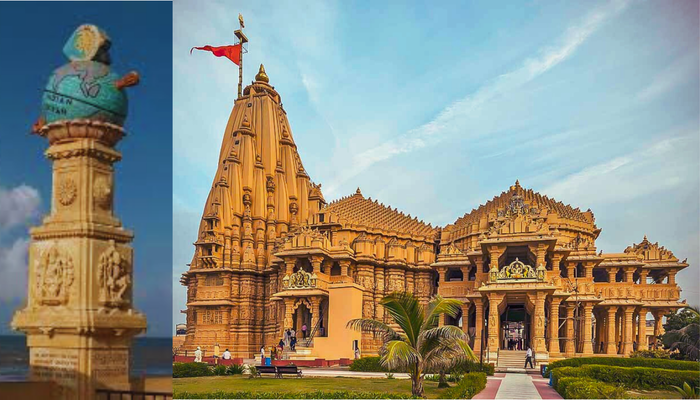

Adorning the Western coast of India, Somnath Temple stands as a testament to the resilience and grandeur of the ancient Hindu civilisation. One of the twelve Jyotirlingas dedicated to Lord Shiva, the temple accommodates a unique pillar known as the Baan Stambh. Located on the south side of the temple, facing the Arabian Sea, the pillar is decorated with intricate carvings. It remains a centre of curiosity for the visitors.
Baan Stambh is not just another ancient architectural spectacle; it symbolises a perfect amalgamation of spirituality and science, which existed in this ancient civilisation. The exact date of construction of the pillar is not known, but its history dates back to the 6th century CE. The pillar finds mention in some scriptures of that period.

Mystery and significance of Baan Stambh
At the top of the pillar is a globe through which an arrow is passing, which points southward. At the bottom of the pillar, a Sanskrit inscription is carved, which reads, “आसमुद्रान्त दक्षिण ध्रुव पर्यंत अबाधित ज्योतिर्मार्ग”. The Sanskrit inscription translates to ‘from this point of the sea to the South Pole (Antarctica), there is no mountain or landmass’. The inscription states a verified geographical fact. There is no intervening mountain or landmass from the point of the sea to Antarctica, around 10,000 km away.
The inscription is proof of the precise navigational skills of the ancient people, who lived at a time when no modern navigational tools existed. It highlights that the ancient people had a deep knowledge of the Earth’s geography and directions.
Somnath Swabhiman Parv
The Somnath Temple is located in Prabhas Patan of Veraval, in the Gujarati state of Saurashtra, along the coast. The temple is referred to in Chapter 14 of the Shiva Purana. It is known as Triveni Sangam because of the meeting of the Kapila, Hiran and Saraswati rivers. The temple is not only a revered ancient Hindu pilgrimage site but also a symbol of the indestructible spirit of the Sanatan civilisation. January 2026 marks the 1000 years since the first attack on the temple by Mahmud of Ghazni in 1026.
The temple subsequently endured multiple attacks and invasions by Islamic invaders and was reduced to ruins. But the temple kept rising from its ruins. The temple was restored to its present glory on May 11, 1951, with the efforts of visionary leaders like Sardar Vallabhbhai Patel, Dr Rajendra Prasad and KM Munshi.
Yesterday (5th January), Prime Minister Modi wrote an elaborate post, marking the Somnath Swabiman Parv, and highlighting the temple’s journey through these 1000 years.