The forgotten glory of Bangladesh’s Dhamrai Rath Yatra: How the Pakistan Army burnt a 500-year-old Jagannath Rath but couldn’t extinguish the spirit of a timeless tradition
Every year, the festival of Rath Yatra fills the air with devotion as Lord Jagannath, along with his elder brother Lord Balabhadra and sister Devi Subhadra, comes out to bless devotees. The grand Rath Yatra in Puri, Odisha, is known across the world, while Ahmedabad hosts the country’s second-largest procession. Similar Rath Yatras are also celebrated in many other cities and towns with great faith and enthusiasm. However, very few people know that one of the most magnificent Rath Yatras was once held in what is now Bangladesh. The Dhamrai Rath Yatra, which has a history of around 500 years, was once considered one of the grandest celebrations in the region. Though the festival continues even today, it has never fully regained the scale and glory it enjoyed before the events of 1971. A five-century-old tradition in Dhamrai Dhamrai is a town located around 40 kilometres from Dhaka in present-day Bangladesh. The Rath Yatra held here on Ashadhi Bij has been celebrated for nearly five centuries. Historical records also mention this Rath Yatra as early as 1672, showing how deeply rooted the tradition is. For generations, the festival attracted thousands of devotees. People travelled from Bengal, Odisha, Assam and even Nepal to take part in the month-long celebrations. Preparations for the festival would begin weeks in advance, and the entire town would come alive with religious events, prayers and cultural programmes. The Rath Yatra started from the famous Jashomadhav Temple and ended at the Gopinagar Temple, located about half a kilometre away. For devotees, pulling the chariot of Lord Jagannath was considered a matter of great faith and good fortune. The giant chariot was taller than Puri’s The biggest attraction of the Dhamrai Rath Yatra was its huge wooden chariot. During the early decades of the 19th century, local zamindars decided to build a new and larger chariot for the festival. Skilled carpenters and craftsmen from nearby areas were called, and after nearly a year of hard work, the massive structure was completed. The chariot stood about 60 feet tall, making it taller than the present-day Jagannath Rath in Puri, which is around 44 feet high. It was built on a 45-by-45-foot base and had 32 large wooden wheels. Two beautifully carved wooden horses were attached to the front, and thick ropes weighing nearly 1,000 kilograms were tied to it so that thousands of devotees could pull the chariot together. The sight of the massive chariot moving through Dhamrai was considered one of the biggest religious events in the region. The festival lasted for nearly a month and attracted pilgrims from different parts of the Indian subcontinent. A new chapter after partition The Partition of India in 1947 changed the political map of the region. Dhamrai became part of East Pakistan, which later became Bangladesh after the Liberation War of 1971. Soon after Partition, the zamindari system was abolished in 1950, leaving the future of the Rath Yatra uncertain. At this stage, industrialist and philanthropist Rai Bahadur Ranada Prasad Saha stepped forward to keep the tradition alive. A resident of Mirzapur in the Tangail district, Saha took responsibility for maintaining the giant chariot and organising the annual Rath Yatra. Ranada Prasad Saha was widely respected for his social work. He established several educational institutions and supported many charitable activities. Under his leadership, the Dhamrai Rath Yatra continued despite changing political circumstances. Operation Searchlight changed everything The situation took a tragic turn in 1971 when the Pakistani Army launched Operation Searchlight in East Pakistan. Beginning in March 1971, the military operation aimed to crush the Bengali nationalist movement. During the violence, Bengali civilians, especially Bengali Hindus, were heavily targeted. Many historical accounts state that around three million people lost their lives during the operation, while more than four lakh women were raped. Around one crore people crossed into India to escape the violence. The operation eventually became one of the darkest chapters in the history of the Bangladesh Liberation War. Ranada Prasad Saha, who had been managing the Dhamrai Rath Yatra, also became a victim during this period. In April 1971, the Pakistani Army took him and his son Bhavani Prasad Saha into custody. They were released briefly in May, but were taken away again the very next day. Neither of them was ever seen again, and it is widely believed that they were killed by the Pakistani Army. The burning of the historic chariot The tragedy did not end with the disappearance of Ranada Prasad Saha. On 10th June, 1971, the historic wooden chariot of Dhamrai was set on fire by the Pakistani Army. Some accounts say the incident happened only a day before the Rath Yatra, while others mention that it took place around two weeks before the festival. The giant wooden st
Every year, the festival of Rath Yatra fills the air with devotion as Lord Jagannath, along with his elder brother Lord Balabhadra and sister Devi Subhadra, comes out to bless devotees. The grand Rath Yatra in Puri, Odisha, is known across the world, while Ahmedabad hosts the country’s second-largest procession. Similar Rath Yatras are also celebrated in many other cities and towns with great faith and enthusiasm.
However, very few people know that one of the most magnificent Rath Yatras was once held in what is now Bangladesh. The Dhamrai Rath Yatra, which has a history of around 500 years, was once considered one of the grandest celebrations in the region. Though the festival continues even today, it has never fully regained the scale and glory it enjoyed before the events of 1971.
A five-century-old tradition in Dhamrai
Dhamrai is a town located around 40 kilometres from Dhaka in present-day Bangladesh. The Rath Yatra held here on Ashadhi Bij has been celebrated for nearly five centuries. Historical records also mention this Rath Yatra as early as 1672, showing how deeply rooted the tradition is.
For generations, the festival attracted thousands of devotees. People travelled from Bengal, Odisha, Assam and even Nepal to take part in the month-long celebrations. Preparations for the festival would begin weeks in advance, and the entire town would come alive with religious events, prayers and cultural programmes.
The Rath Yatra started from the famous Jashomadhav Temple and ended at the Gopinagar Temple, located about half a kilometre away. For devotees, pulling the chariot of Lord Jagannath was considered a matter of great faith and good fortune.
The giant chariot was taller than Puri’s
The biggest attraction of the Dhamrai Rath Yatra was its huge wooden chariot. During the early decades of the 19th century, local zamindars decided to build a new and larger chariot for the festival. Skilled carpenters and craftsmen from nearby areas were called, and after nearly a year of hard work, the massive structure was completed.
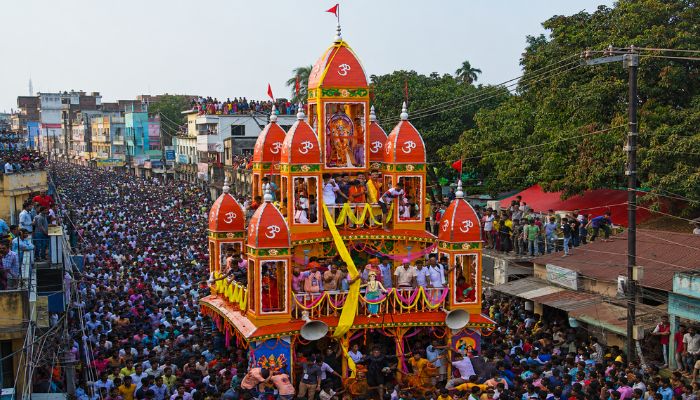
The chariot stood about 60 feet tall, making it taller than the present-day Jagannath Rath in Puri, which is around 44 feet high. It was built on a 45-by-45-foot base and had 32 large wooden wheels. Two beautifully carved wooden horses were attached to the front, and thick ropes weighing nearly 1,000 kilograms were tied to it so that thousands of devotees could pull the chariot together.
The sight of the massive chariot moving through Dhamrai was considered one of the biggest religious events in the region. The festival lasted for nearly a month and attracted pilgrims from different parts of the Indian subcontinent.
A new chapter after partition
The Partition of India in 1947 changed the political map of the region. Dhamrai became part of East Pakistan, which later became Bangladesh after the Liberation War of 1971. Soon after Partition, the zamindari system was abolished in 1950, leaving the future of the Rath Yatra uncertain.
At this stage, industrialist and philanthropist Rai Bahadur Ranada Prasad Saha stepped forward to keep the tradition alive. A resident of Mirzapur in the Tangail district, Saha took responsibility for maintaining the giant chariot and organising the annual Rath Yatra.
Ranada Prasad Saha was widely respected for his social work. He established several educational institutions and supported many charitable activities. Under his leadership, the Dhamrai Rath Yatra continued despite changing political circumstances.
Operation Searchlight changed everything
The situation took a tragic turn in 1971 when the Pakistani Army launched Operation Searchlight in East Pakistan. Beginning in March 1971, the military operation aimed to crush the Bengali nationalist movement. During the violence, Bengali civilians, especially Bengali Hindus, were heavily targeted.
Many historical accounts state that around three million people lost their lives during the operation, while more than four lakh women were raped. Around one crore people crossed into India to escape the violence. The operation eventually became one of the darkest chapters in the history of the Bangladesh Liberation War.
Ranada Prasad Saha, who had been managing the Dhamrai Rath Yatra, also became a victim during this period. In April 1971, the Pakistani Army took him and his son Bhavani Prasad Saha into custody. They were released briefly in May, but were taken away again the very next day. Neither of them was ever seen again, and it is widely believed that they were killed by the Pakistani Army.
The burning of the historic chariot
The tragedy did not end with the disappearance of Ranada Prasad Saha. On 10th June, 1971, the historic wooden chariot of Dhamrai was set on fire by the Pakistani Army. Some accounts say the incident happened only a day before the Rath Yatra, while others mention that it took place around two weeks before the festival.
The giant wooden structure was so massive that it continued burning for nearly a week before turning completely into ashes. Since the chariot had been destroyed, the Rath Yatra could not be organised that year. The festival was also not held in 1972, bringing an end to a centuries-old tradition, even if only for a short period.
For devotees, the loss of the sacred chariot was more than the destruction of a structure. It represented the loss of an important part of their religious and cultural identity.
The festival returned, but the grandeur never did
After a gap of two years, the Rath Yatra resumed in 1973 with a newly built chariot. Over the following years, more chariots were constructed, allowing the festival to continue. However, the celebrations never reached the same scale they once had.
The month-long programmes gradually became shorter, and the large number of pilgrims from different regions stopped coming. The festival survived, but much of its earlier splendour faded with time.
India’s support helped build a new chariot
Nearly four decades later, India extended support to revive the historic tradition. In 2009, the Government of India signed a Memorandum of Understanding (MoU) with the Jashomadhav Temple Committee for the construction of a new Rath.
The work was completed in 2010. The new wooden chariot stands about 40 feet tall, has three levels and moves on 16 wheels. Since then, this chariot has been used every year for the Dhamrai Rath Yatra.
The support helped preserve an important religious tradition that had survived centuries of political changes, Partition and war.
The legacy lives on
Even today, the Dhamrai Rath Yatra continues to be celebrated every year in Bangladesh with faith and devotion. Devotees still gather to pull the chariot of Lord Jagannath, Lord Balabhadra and Devi Subhadra, keeping alive a tradition that has existed for nearly 500 years.
Yet, those familiar with its history remember a different time when the festival lasted for weeks, drew pilgrims from across the region and featured one of the tallest wooden chariots in South Asia. The destruction of the original chariot during the violence of 1971 remains a painful memory.
The story of Dhamrai is not only about a religious festival. It is also a reminder of how traditions can survive even after facing war, violence and loss. Though its old grandeur has faded, the spirit of the Rath Yatra continues to live on through the faith of its devotees and the determination of the local community to preserve their heritage.
This article was published in OpIndia Gujarati in 2023. The original Gujarati article can be read here.