The illusion of 118% rise in caste discrimination complaints: How UGC data is being used to distort the caste discrimination debate
Over the past few days, headlines pushed by The Wire and amplified by left-leaning social media influencers have repeatedly claimed a 118.4% rise in caste-based discrimination complaints in higher education. At first glance, an 118.4% rise in caste-based discrimination complaints sounds concerning, and that is precisely the point. Percentages create shock when stripped out of context. even when the underlying numbers remain small. Statistics presented without institutional scale distort reality and short-circuit reasoned debate. While discrimination must be addressed, reliance on headline percentages without proportional context has produced a misleading narrative now being used to justify sweeping regulatory changes under the UGC’s 2026 framework. What the data really shows Between 2019–20 and 2023–24, reports of caste-based discrimination rose from 173 to 378. This increase is estimated as 118.4%. The University Grants Commission recorded 1,160 complaints in these five years. However, what is almost never highlighted is where these complaints came from and how they are distributed. According to UGC data submitted to Parliament and the Supreme Court, these complaints were reported across 704 universities and 1,553 colleges, totalling over 2,200 higher education institutions nationwide and over 90% of these complaints were marked as ‘resolved’. The statistics appear significantly different when viewed through this perspective: 378 complaints from thousands of institutions, even in the year with the greatest reporting, is fewer than one complaint per institution annually. It is crucial to have this institutional denominator. Indian higher education serves crores of students and employs lakhs of faculty and staff. It spans a vast and diverse academic ecosystem. Yet, the statistical framing used in public discourse rarely reflects this scale. Instead, the focus remains fixed on the percentage increase, detached from proportional reality. Furthermore, the year-wise data shows a gradual rise, but an explosion. The complaints increased marginally from 173 (2019-20) to 182 (2020-2021), 186 (2021-22), and 241 (2022-23), before rising sharply in 2023-24. This pattern suggests not a sudden collapse of campus ethics but a slow build-up followed by increased reporting. At the same time, Pending cases increased from just 18 in 2019–20 to 108 in 2023–24. This rise is rarely highlighted in public discourse. While overall resolution rates are cited to project institutional efficiency, the growing backlog suggests that the system is now facing pressure from increased inflow, raising questions about capacity, timelines, and the quality of resolution rather than its mere completion. Importantly, senior UGC officials themselves have attributed the growth mainly to increased student knowledge of the existence and operation of SC/ST cells. To put it another way, the data shows enhanced reporting and visibility rather than necessarily deteriorating behaviour. None of this is to deny that discrimination exists or that complaints should be taken seriously. But when absolute numbers remain small relative to the system’s size, presenting them exclusively as percentage increases creates a distorted sense of crisis. As there is a famous quote that “The statistics you don’t see are often more important than the ones you do.” The missing context here is not incidental, but it fundamentally alters how the data should be interpreted. When percentages are highlighted without institutional scale, per-campus averages, or outcome breakdowns, statistics stop informing policy objectively. They begin to function as narrative tools, shaping public perception and justifying regulatory overreach rather than enabling proportionate, evidence-based reform. Why the increase is not necessarily alarming Crucially, even UGC officials have admitted that greater awareness and better visibility of SC/ST Cells and Equal Opportunity Cells on campuses are major factors in the increase in complaints received. Institutions have been regularly instructed over the past few years to formalise reporting procedures, conduct sensitisation campaigns, and publicise grievance channels. Higher reporting in these situations does not always translate into a corresponding rise in discriminatory behaviour. More often than not, it indicates increased trust in institutional processes and a readiness to voice complaints that could have gone unreported in the past. Therefore, rather than indicating worsening campus conduct, increased reporting can just as likely indicate better access to remedy. It is dangerous to draw policy conclusions unsupported by the facts if improved reporting is confused with growing prejudice. How numbers are weaponised Despite this nuance, the public discourse has been dominated by a single figure: 118.4%. The Left ecosystem consistently foregrounds this percentage jump while carefully avoiding critical context,
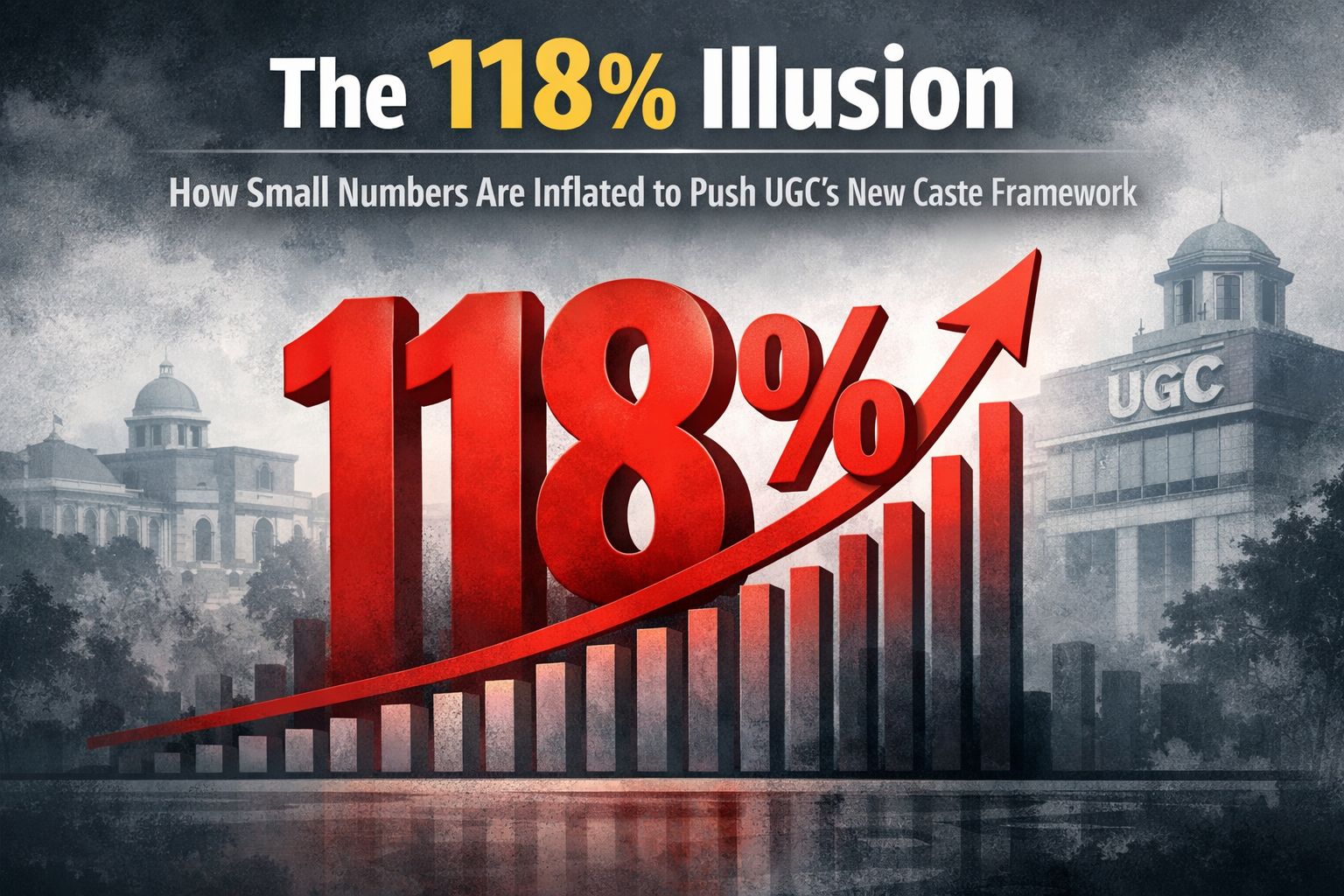

Over the past few days, headlines pushed by The Wire and amplified by left-leaning social media influencers have repeatedly claimed a 118.4% rise in caste-based discrimination complaints in higher education. At first glance, an 118.4% rise in caste-based discrimination complaints sounds concerning, and that is precisely the point. Percentages create shock when stripped out of context. even when the underlying numbers remain small. Statistics presented without institutional scale distort reality and short-circuit reasoned debate. While discrimination must be addressed, reliance on headline percentages without proportional context has produced a misleading narrative now being used to justify sweeping regulatory changes under the UGC’s 2026 framework.
What the data really shows
Between 2019–20 and 2023–24, reports of caste-based discrimination rose from 173 to 378. This increase is estimated as 118.4%. The University Grants Commission recorded 1,160 complaints in these five years. However, what is almost never highlighted is where these complaints came from and how they are distributed.
According to UGC data submitted to Parliament and the Supreme Court, these complaints were reported across 704 universities and 1,553 colleges, totalling over 2,200 higher education institutions nationwide and over 90% of these complaints were marked as ‘resolved’.
The statistics appear significantly different when viewed through this perspective: 378 complaints from thousands of institutions, even in the year with the greatest reporting, is fewer than one complaint per institution annually.
It is crucial to have this institutional denominator. Indian higher education serves crores of students and employs lakhs of faculty and staff. It spans a vast and diverse academic ecosystem. Yet, the statistical framing used in public discourse rarely reflects this scale. Instead, the focus remains fixed on the percentage increase, detached from proportional reality.
Furthermore, the year-wise data shows a gradual rise, but an explosion. The complaints increased marginally from 173 (2019-20) to 182 (2020-2021), 186 (2021-22), and 241 (2022-23), before rising sharply in 2023-24. This pattern suggests not a sudden collapse of campus ethics but a slow build-up followed by increased reporting.
At the same time, Pending cases increased from just 18 in 2019–20 to 108 in 2023–24. This rise is rarely highlighted in public discourse. While overall resolution rates are cited to project institutional efficiency, the growing backlog suggests that the system is now facing pressure from increased inflow, raising questions about capacity, timelines, and the quality of resolution rather than its mere completion.
Importantly, senior UGC officials themselves have attributed the growth mainly to increased student knowledge of the existence and operation of SC/ST cells. To put it another way, the data shows enhanced reporting and visibility rather than necessarily deteriorating behaviour.
None of this is to deny that discrimination exists or that complaints should be taken seriously. But when absolute numbers remain small relative to the system’s size, presenting them exclusively as percentage increases creates a distorted sense of crisis. As there is a famous quote that “The statistics you don’t see are often more important than the ones you do.” The missing context here is not incidental, but it fundamentally alters how the data should be interpreted.
When percentages are highlighted without institutional scale, per-campus averages, or outcome breakdowns, statistics stop informing policy objectively. They begin to function as narrative tools, shaping public perception and justifying regulatory overreach rather than enabling proportionate, evidence-based reform.
Why the increase is not necessarily alarming
Crucially, even UGC officials have admitted that greater awareness and better visibility of SC/ST Cells and Equal Opportunity Cells on campuses are major factors in the increase in complaints received. Institutions have been regularly instructed over the past few years to formalise reporting procedures, conduct sensitisation campaigns, and publicise grievance channels. Higher reporting in these situations does not always translate into a corresponding rise in discriminatory behaviour. More often than not, it indicates increased trust in institutional processes and a readiness to voice complaints that could have gone unreported in the past. Therefore, rather than indicating worsening campus conduct, increased reporting can just as likely indicate better access to remedy. It is dangerous to draw policy conclusions unsupported by the facts if improved reporting is confused with growing prejudice.
How numbers are weaponised
Despite this nuance, the public discourse has been dominated by a single figure: 118.4%. The Left ecosystem consistently foregrounds this percentage jump while carefully avoiding critical context, such as the number of institutions involved, the size of the student population, and the per-campus average. An exaggerated sense of crisis is produced by this selective concentration. Even minor numerical increases can result in significant percentage spikes when the base number is small. When statistics lack scale and balance, they become persuasive rather than educational tools. In this manner, numbers are not used to inform policy but to manufacture urgency and justify sweeping regulatory expansion already ideologically favoured.
Our position: Against UGC 2026, not against justice
It is incorrect to portray opposition to the UGC’s 2026 regulations as a denial of discrimination. Discrimination exists and must be addressed firmly. However, the new framework redefines caste-based discrimination in a way that excludes the General Category by design, while simultaneously removing safeguards against misuse. By narrowing protection to select groups and weakening procedural balance, the regulations risk institutionalising administrative fear rather than justice. Equity cannot be achieved by replacing one form of exclusion with another or by presuming guilt in the name of compliance.
Conclusion
Statistics are meant to illuminate policy choices, not intimidate public debate. The 118% figure, when presented without institutional scale or proportional context, misleads rather than informs. Used this way, numbers stop guiding reform and begin justifying power.
India needs anti-discrimination mechanisms that are firm yet fair, protective yet balanced, and evidence-based rather than ideologically driven. Policies shaped by inflated narratives may appear decisive, but without proportionality and due process, they risk undermining the very justice they claim to uphold.