US boots on ground in Iran imminent? Read how Washington is fortifying its troop presence in the Gulf as the West Asia war drags on
America’s ‘Operation Epic Fury’ against Iran may soon witness its troops launching a ground invasion against the West Asian country as Trump’s war of attrition continues. About a month after the joint Israel-US front launched an offensive against Iran, the conflict has shifted primarily from air and naval strikes to preparations for potential limited ground operations, as Iran continues to impose a selective blockade on the Strait of Hormuz, which has disrupted global oil flows. US military fortifying forward presence in the Gulf to scare Iran and expand its military buildup to expand options beyond airstrikes Amidst stalled talks, the Pentagon is rapidly fortifying its forward presence in the Gulf states, Kuwait, Qatar, Bahrain, UAE, and Saudi Arabia, as staging grounds and logistics hubs for contingencies. This marks America’s largest military buildup in the Middle East, the infamous and cataclysmic 2003 Iraq invasion. The fresh US military surge in the region is a buildup on a pre-existing footprint of about 40,000 to 50,000 troops. A Washington Post report cites US officials privy to the development, to say that the potential US ground Operation against Iran would most likely involve a mixture of Special Operations forces and conventional infantry troops. As per the US Central Command, the USS Tripoli, carrying 3,500 sailors and Marines from the 31st Marine Expeditionary Unit, had arrived in recent weeks. So far, 5,000 United States troops, including 2,500 Marines, have made their way to West Asia, waiting for a go-ahead from the American Commander-in-Chief to launch a ground invasion against Iran. U.S. Sailors and Marines aboard USS Tripoli (LHA 7) arrived in the U.S. Central Command area of responsibility, March 27. The America-class amphibious assault ship serves as the flagship for the Tripoli Amphibious Ready Group / 31st Marine Expeditionary Unit composed of about… pic.twitter.com/JFWiPBbkd2— U.S. Central Command (@CENTCOM) March 28, 2026 A CNN report published last week says that around 2,000 to 4,000 paratroopers from the elite 82nd Airborne Division were being flown in as an “Immediate Response Force” prepared for quick insertion operations, in addition to over 4,000 Marines and sailors onboard USS Tripoli and USS Boxer (2,500 Marines and sailors). Notably, USS Boxer’s deployment is significant, given it serves as a carrier for the F-35B stealth fighter, since America’s most advanced carrier, USS Gerald R Ford, is out of commission. Last Friday (27th March), USS Gerald F Ford docked in Croatia for repairs after the US Navy said that there was a ‘laundry fire’, while Trump said that the carrier was successfully hit around 17 times by Iranian forces. This essentially means that around 4,500 sailors on board USS Gerald R Ford are temporarily out of the US-Iran war. However, Ford’s exit is compensated by USS George HW Bush, which has departed the US Navy headquarters in Norfolk. These reinforcements, which could increase the total ground-force presence to 17,000 if further waves of up to 10,000 troops are approved, would aid the campaign of the American forces to pound Iranian infrastructure in the oil-export hub, particularly in Kharg Island, and sites near the Strait of Hormuz. The rapid military buildup becomes all the more significant for the US since Iran’s IRGC is continuously targeting American bases in the Gulf to weaken their presence in the region, undermine logistics, air support, and missile defence leverage, and dent Trump’s pride. As the conflict drags into its fifth week with Iranian missiles and drones targeting US bases and Gulf shipping lanes, the US would use this as a justification for fortifying its troop presence, describing it as deterrence and a force multiplier. What is driving Trump’s plans to launch a ground invasion against Iran? While Israel attacked Iran, citing what it describes as an “existential threat” the West Asian country would pose to it if its nuclear program achieves success, Trump’s rhetoric suggests that America’s involvement in the war is not just about aiding Israel eliminate this threat but about landing its infamous ‘plane of democracy’ wherever there are oil and other natural resources. Donald Trump has expressed interest in occupying Kharg Island, Iran’s main oil export hub, and has said that seizing control of Iran’s oil as a preferred option. “To be honest with you, my favourite thing is to take the oil in Iran, but some stupid people back in the US say: ‘Why are you doing that?’ But they’re stupid people. Maybe we take Kharg Island, maybe we don’t. We have a lot of options,” the US President said. Covering up the embarrassment Iran has inflicted to the US so far, with false bravado, Trump had said that more strikes on Kharg Island are possible, saying the site has already been damaged but may still be targeted again “just for fun”. However, despite Trump’s claims of destroying Iran’s military power and ‘
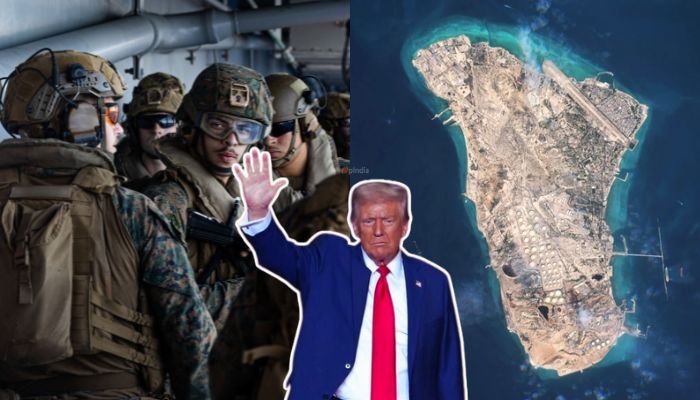
America’s ‘Operation Epic Fury’ against Iran may soon witness its troops launching a ground invasion against the West Asian country as Trump’s war of attrition continues. About a month after the joint Israel-US front launched an offensive against Iran, the conflict has shifted primarily from air and naval strikes to preparations for potential limited ground operations, as Iran continues to impose a selective blockade on the Strait of Hormuz, which has disrupted global oil flows.
US military fortifying forward presence in the Gulf to scare Iran and expand its military buildup to expand options beyond airstrikes
Amidst stalled talks, the Pentagon is rapidly fortifying its forward presence in the Gulf states, Kuwait, Qatar, Bahrain, UAE, and Saudi Arabia, as staging grounds and logistics hubs for contingencies. This marks America’s largest military buildup in the Middle East, the infamous and cataclysmic 2003 Iraq invasion. The fresh US military surge in the region is a buildup on a pre-existing footprint of about 40,000 to 50,000 troops.
A Washington Post report cites US officials privy to the development, to say that the potential US ground Operation against Iran would most likely involve a mixture of Special Operations forces and conventional infantry troops.
As per the US Central Command, the USS Tripoli, carrying 3,500 sailors and Marines from the 31st Marine Expeditionary Unit, had arrived in recent weeks. So far, 5,000 United States troops, including 2,500 Marines, have made their way to West Asia, waiting for a go-ahead from the American Commander-in-Chief to launch a ground invasion against Iran.
U.S. Sailors and Marines aboard USS Tripoli (LHA 7) arrived in the U.S. Central Command area of responsibility, March 27. The America-class amphibious assault ship serves as the flagship for the Tripoli Amphibious Ready Group / 31st Marine Expeditionary Unit composed of about… pic.twitter.com/JFWiPBbkd2— U.S. Central Command (@CENTCOM) March 28, 2026
A CNN report published last week says that around 2,000 to 4,000 paratroopers from the elite 82nd Airborne Division were being flown in as an “Immediate Response Force” prepared for quick insertion operations, in addition to over 4,000 Marines and sailors onboard USS Tripoli and USS Boxer (2,500 Marines and sailors).
Notably, USS Boxer’s deployment is significant, given it serves as a carrier for the F-35B stealth fighter, since America’s most advanced carrier, USS Gerald R Ford, is out of commission. Last Friday (27th March), USS Gerald F Ford docked in Croatia for repairs after the US Navy said that there was a ‘laundry fire’, while Trump said that the carrier was successfully hit around 17 times by Iranian forces. This essentially means that around 4,500 sailors on board USS Gerald R Ford are temporarily out of the US-Iran war.
However, Ford’s exit is compensated by USS George HW Bush, which has departed the US Navy headquarters in Norfolk.
These reinforcements, which could increase the total ground-force presence to 17,000 if further waves of up to 10,000 troops are approved, would aid the campaign of the American forces to pound Iranian infrastructure in the oil-export hub, particularly in Kharg Island, and sites near the Strait of Hormuz.
The rapid military buildup becomes all the more significant for the US since Iran’s IRGC is continuously targeting American bases in the Gulf to weaken their presence in the region, undermine logistics, air support, and missile defence leverage, and dent Trump’s pride. As the conflict drags into its fifth week with Iranian missiles and drones targeting US bases and Gulf shipping lanes, the US would use this as a justification for fortifying its troop presence, describing it as deterrence and a force multiplier.
What is driving Trump’s plans to launch a ground invasion against Iran?
While Israel attacked Iran, citing what it describes as an “existential threat” the West Asian country would pose to it if its nuclear program achieves success, Trump’s rhetoric suggests that America’s involvement in the war is not just about aiding Israel eliminate this threat but about landing its infamous ‘plane of democracy’ wherever there are oil and other natural resources.
Donald Trump has expressed interest in occupying Kharg Island, Iran’s main oil export hub, and has said that seizing control of Iran’s oil as a preferred option. “To be honest with you, my favourite thing is to take the oil in Iran, but some stupid people back in the US say: ‘Why are you doing that?’ But they’re stupid people. Maybe we take Kharg Island, maybe we don’t. We have a lot of options,” the US President said.
Covering up the embarrassment Iran has inflicted to the US so far, with false bravado, Trump had said that more strikes on Kharg Island are possible, saying the site has already been damaged but may still be targeted again “just for fun”. However, despite Trump’s claims of destroying Iran’s military power and ‘having fun’, the regime continues to target Israel and Middle Eastern countries with missiles and drones.
Pertinently, Kharg Island lies about 30 kilometres off Iran’s southern coast and handles nearly 90% of the country’s crude oil exports. The island is located close to the Strait of Hormuz, one of the world’s most important sea routes through which around one-fifth of global oil supply moves. Any long disruption in this region could push energy prices higher and affect supply chains worldwide.
It is, however, possible that the American President, besides the genuine interest in seizing control of Iranian oil after Venezuelan oil, and the imperative of breaking the blockade of the Strait of Hormuz, would deliberately be diverting attention to Kharg Island while the real motive could be to seize control of Iran’s 400kg of enriched uranium, which is sufficient to make nuclear bombs.
The US President has a penchant for aggrandising himself by issuing threats while also posing as a peacemaker. This vacillation is reflected in his decisions in the raging war against Iran. Just a few days back, Trump hinted that America might wind up its offensive against Tehran soon, only to pivot to expressing interest in Kharg Island and Iran’s oil, threatening to “unleash hell”, as well as ensuring that the Pentagon provides the Commander in Chief with “maximum optionality” by expanding troop presence in the region, as described by White House spokesperson, Karoline Leavitt.
While Trump maintains an obvious silence on the specifics of the number of US military troops to be deployed for a potential invasion against the Iranian territory, several legacy media reports, like the one by The Wall Street Journal, say that the Trump administration is considering the deployment of over 10,000 troops in West Asia.
Meanwhile, Iran’s parliament speaker, Mohammad Bagher Ghalibaf, has strongly criticised the reported US preparations. He accused Washington of secretly plotting a ground attack while publicly engaging in diplomatic efforts aimed at ending the conflict. “Iran’s armed forces are fully prepared to confront any land assault by American troops,” Ghalibaf said, warning that any attempt at occupation would be met with a “ruthless” response.
The speaker’s remarks echo earlier statements in which he called for US forces to leave the region entirely, arguing that security in the Middle East should be handled by regional countries without American involvement.
While it remains to be seen whether the US forces go full throttle and launch a ground invasion against Iran, such an adventure could deliver short-term tactical gains in degrading Iran’s nuclear ambitions, giving Israel a reprieve, and oil leverage; however, this would come at a cost of massive American casualties from asymmetric threats like drones and missiles. Moreover, the ballooning expenses that strain budgets would be in direct contrast to Trump’s earlier promises of not dragging America into distant and prolonged wars, fuelling domestic anger over him landing the US in the Iraq and Afghanistan-like quagmires.
For Iran, particularly, the Mullah regime, an American ground incursion could prove to be an unintended unifying factor and fuel nationalist fervour. However, Iran, already facing sanctions and attacks, would further grapple with economic collapse, military attrition, and perhaps weaken its oil leverage, leaving Tehran with fewer cards to play in any eventual peace deal.