When Republic Day turned bloody: How the 1965 anti-Hindi agitation in Tamil Nadu claimed over 70+ lives and changed the state politics forever
26th January, 1965. The entire country was celebrating Republic Day. The parade was underway in Delhi, the tricolour was waving, and people were filled with enthusiasm. But in Madras (present-day Tamil Nadu), the atmosphere was completely different. The morning sky was gloomy, black flags were flying, and the streets were crowded with young students. This day became not a day of celebration, but of mourning. The movement that began to oppose making Hindi the official language became so violent that many young men lost their lives. Many were killed in police firing, and many committed suicide. Official figures put the death toll at around 70, but witnesses and activists say the number was much higher. This was a disaster that unfolded on Republic Day. The sacrifices made by students here decades ago were sacrificed to the politics of language. Today, decades later, we must remember that time to understand how a linguistic issue was turned into a political weapon, putting the lives of young people at stake. This issue isn’t just about supporting or opposing Hindi. It’s about the politics of the DMK, which mobilised youth under the guise of an anti-Hindi movement, and the Congress government mishandled it. The DMK turned it into a North India versus South India issue, while the Congress party tried to retain or regain power by linking its protests to anti-Hindi sentiment. The result: the deaths of innocent students, chaos in the state, and prolonged political change. Anti-Hindi roots in Tamil Nadu go back to before Independence. The movement had ancient roots. Even before independence, in 1937, the Congress government in the Madras Presidency, led by C. Rajagopalachari, made Hindi compulsory in schools. Even then, there was opposition, and the government was forced to back down. Even in the Constituent Assembly, leaders like T.T. Krishnamachari warned that linguistic imperialism could endanger the nation’s unity. Consequently, the Munshi-Ayyangar formula was adopted in the 1950 Constitution, making Hindi the official language, but retaining English as an auxiliary language for 15 years. This period was to end on 26th January, 1965. Leaders in the Hindi belt hailed this as a victory for Hindi. However, in the South, and especially in Tamil Nadu, it was seen as linguistic dominance and a cultural assault. Students feared that civil service exams would be conducted in Hindi, and non-Hindi speakers would be excluded from jobs. DMK did politics by sacrificing students Tensions had been rising since 1964. DMK leader C.N. Annadurai initiated large demonstrations. Student organisations also became active. The DMK declared it a “day of mourning.” Madras’s Congress Chief Minister, Bhaktavatsalam, warned that anyone observing Republic Day as a day of mourning was a traitor. Annadurai and several DMK workers were placed under house arrest. The government thought the movement was limited to one party and would be suppressed. But this was a misconception. The real strength lay with the students. The DMK put students at the forefront and tried to gain political advantage under the guise of the movement. Congress workers resorted to violence to stop the Madurai procession. On 25th January, students in Madurai took out a procession. They carried placards that read, “Hindi never, English always!” They were about to burn copies of the Constitution, which provided for Hindi to be the official language. Clashes broke out with Congress workers. The small clash quickly escalated into a riot. Stones were thrown, buses were burned, and the strong smell of burning rubber spread. News spread throughout the state, and violence erupted. Several protesters were killed in clashes with police, and others committed suicide. On 26th January, black flags were raised in Madras. Students took to the streets. Railway tracks were blocked, and railway property was burned. Transportation came to a standstill. The agitation continued until February. Students formed the Anti-Hindi Agitation Council, which united college students. Violence reached its peak, resulting in several deaths in police firing. Two Union ministers, C. Subramaniam and O.V. Alagesan, resigned. They told Prime Minister Lal Bahadur Shastri that they could not remain in a government that was fighting its own people. English got a permanent place in 1967 Shastri and Home Minister Gulzarilal Nanda were embroiled in legal wrangling in Delhi. Political courage was lacking. Indira Gandhi, then Minister of Information and Broadcasting, broke all protocol and went straight to Madras. She spoke to the protesters and, without consulting the government, acquiesced to their demands, assuring them that English would remain. However, in February, Prime Minister Lal Bahadur Shastri himself assured Parliament that English would remain an associate language indefinitely. This was formalised in the 1967 amendment to the Official Languages Act. English would rema
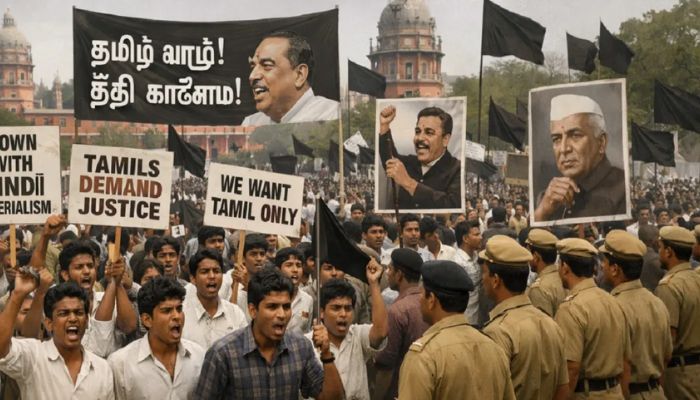

26th January, 1965. The entire country was celebrating Republic Day. The parade was underway in Delhi, the tricolour was waving, and people were filled with enthusiasm. But in Madras (present-day Tamil Nadu), the atmosphere was completely different. The morning sky was gloomy, black flags were flying, and the streets were crowded with young students. This day became not a day of celebration, but of mourning. The movement that began to oppose making Hindi the official language became so violent that many young men lost their lives. Many were killed in police firing, and many committed suicide.
Official figures put the death toll at around 70, but witnesses and activists say the number was much higher. This was a disaster that unfolded on Republic Day. The sacrifices made by students here decades ago were sacrificed to the politics of language. Today, decades later, we must remember that time to understand how a linguistic issue was turned into a political weapon, putting the lives of young people at stake.
This issue isn’t just about supporting or opposing Hindi. It’s about the politics of the DMK, which mobilised youth under the guise of an anti-Hindi movement, and the Congress government mishandled it. The DMK turned it into a North India versus South India issue, while the Congress party tried to retain or regain power by linking its protests to anti-Hindi sentiment. The result: the deaths of innocent students, chaos in the state, and prolonged political change.
Anti-Hindi roots in Tamil Nadu go back to before Independence.
The movement had ancient roots. Even before independence, in 1937, the Congress government in the Madras Presidency, led by C. Rajagopalachari, made Hindi compulsory in schools. Even then, there was opposition, and the government was forced to back down. Even in the Constituent Assembly, leaders like T.T. Krishnamachari warned that linguistic imperialism could endanger the nation’s unity. Consequently, the Munshi-Ayyangar formula was adopted in the 1950 Constitution, making Hindi the official language, but retaining English as an auxiliary language for 15 years.
This period was to end on 26th January, 1965. Leaders in the Hindi belt hailed this as a victory for Hindi. However, in the South, and especially in Tamil Nadu, it was seen as linguistic dominance and a cultural assault. Students feared that civil service exams would be conducted in Hindi, and non-Hindi speakers would be excluded from jobs.
DMK did politics by sacrificing students
Tensions had been rising since 1964. DMK leader C.N. Annadurai initiated large demonstrations. Student organisations also became active. The DMK declared it a “day of mourning.” Madras’s Congress Chief Minister, Bhaktavatsalam, warned that anyone observing Republic Day as a day of mourning was a traitor. Annadurai and several DMK workers were placed under house arrest. The government thought the movement was limited to one party and would be suppressed. But this was a misconception. The real strength lay with the students. The DMK put students at the forefront and tried to gain political advantage under the guise of the movement.
Congress workers resorted to violence to stop the Madurai procession.
On 25th January, students in Madurai took out a procession. They carried placards that read, “Hindi never, English always!” They were about to burn copies of the Constitution, which provided for Hindi to be the official language. Clashes broke out with Congress workers. The small clash quickly escalated into a riot. Stones were thrown, buses were burned, and the strong smell of burning rubber spread. News spread throughout the state, and violence erupted. Several protesters were killed in clashes with police, and others committed suicide.
On 26th January, black flags were raised in Madras. Students took to the streets. Railway tracks were blocked, and railway property was burned. Transportation came to a standstill. The agitation continued until February. Students formed the Anti-Hindi Agitation Council, which united college students. Violence reached its peak, resulting in several deaths in police firing. Two Union ministers, C. Subramaniam and O.V. Alagesan, resigned. They told Prime Minister Lal Bahadur Shastri that they could not remain in a government that was fighting its own people.
English got a permanent place in 1967
Shastri and Home Minister Gulzarilal Nanda were embroiled in legal wrangling in Delhi. Political courage was lacking. Indira Gandhi, then Minister of Information and Broadcasting, broke all protocol and went straight to Madras. She spoke to the protesters and, without consulting the government, acquiesced to their demands, assuring them that English would remain. However, in February, Prime Minister Lal Bahadur Shastri himself assured Parliament that English would remain an associate language indefinitely. This was formalised in the 1967 amendment to the Official Languages Act. English would remain so until all non-Hindi-speaking states agreed, virtually forever.
Congress is out of power forever
This agreement wasn’t a complete victory for anyone, but it recognised India’s pluralism. Hindi would be promoted, but not imposed. But what was the cost? Dozens of young people were killed. The DMK turned this movement into a political weapon, turning opposition to Hindi into a North-South divide. It is capitalised by putting students in the forefront while remaining behind the scenes. The Congress government also made mistakes—first attempting to suppress the protests, then delaying the agreement.
The result? The DMK came to power in 1967. Congress was permanently weakened in Tamil Nadu. To this day, Congress has never won an election on its own. Power rotates between the DMK and the AIADMK, with Congress reduced to a mere tail-ender in one coalition or another.
The enemies of that time have now become permanent friends.
Today, the DMK and Congress are together in Tamil Nadu. They cannot survive without each other. But what did the politics of that time do? Young people were made pawns for sacrifice. Under the guise of opposing Hindi, regional sentiments were incited, and power was gained. We oppose the violent form of the anti-Hindi movement, which resulted in the loss of innocent lives. Imposing Hindi would have been wrong (though it wasn’t), but making the movement so violent, using students as a front, and using deaths as a political stepping stone was also wrong. The Congress mishandled this situation, and the DMK capitalised on it.
DMK still uses anti-Hindi as a political weapon
However, the DMK continues to use this issue as a weapon. On Sunday, January 25, 2026, on “Tamil Language Martyrs’ Day,” Chief Minister MK Stalin reiterated his old rhetoric.
Stalin wrote on social media – “Language War Martyrdom Day: Then and now, there is no place for Hindi here! A state that loved its language more than life itself fought against the imposition of Hindi. Every time it was imposed, it fought with the same zeal. It protected the rights and identity of the different linguistic nationalities in the subcontinent. I pay tribute to those martyrs who sacrificed their lives for Tamil. No more lives will be lost in the language war; our Tamil identity will not die! We will always oppose the imposition of Hindi.”
Stalin also shared an old video of the 1964-65 movement, which features images of protests, self-immolations, and violence. He paid tribute to Annadurai and Karunanidhi. He accused the central government of imposing Hindi through the NEP 2020 and the three-language policy. Stalin claimed that Tamil Nadu’s progress was due to its two-language policy (Tamil and English).
But the question is, is Hindi being imposed today? Union Education Minister Dharmendra Pradhan has repeatedly stated that Hindi is not mandatory in the NEP, but that all Indian languages are promoted. Yet, Stalin calls it an “imposition.” Why? Because the 2026 assembly elections are near. Reviving old movements, stirring emotions, and awakening regional identities… this is the DMK’s old strategy. They came to power in 1965 through the deaths of students, and now they are remembering those deaths and asking for votes.
Republic Day is supposed to be a day of celebration. But in 1965, it became a day of mourning in Tamil Nadu. Let’s remember the students who thought they were saving language and culture but were sacrificed to the machinations of politics. We must remember that linguistic issues should not be used as a weapon for political division.