Why is Leftist media rattled over India-US trade deal: Read how some International media portals are fearmongering, and spreading falsehoods over the interim FTA framework
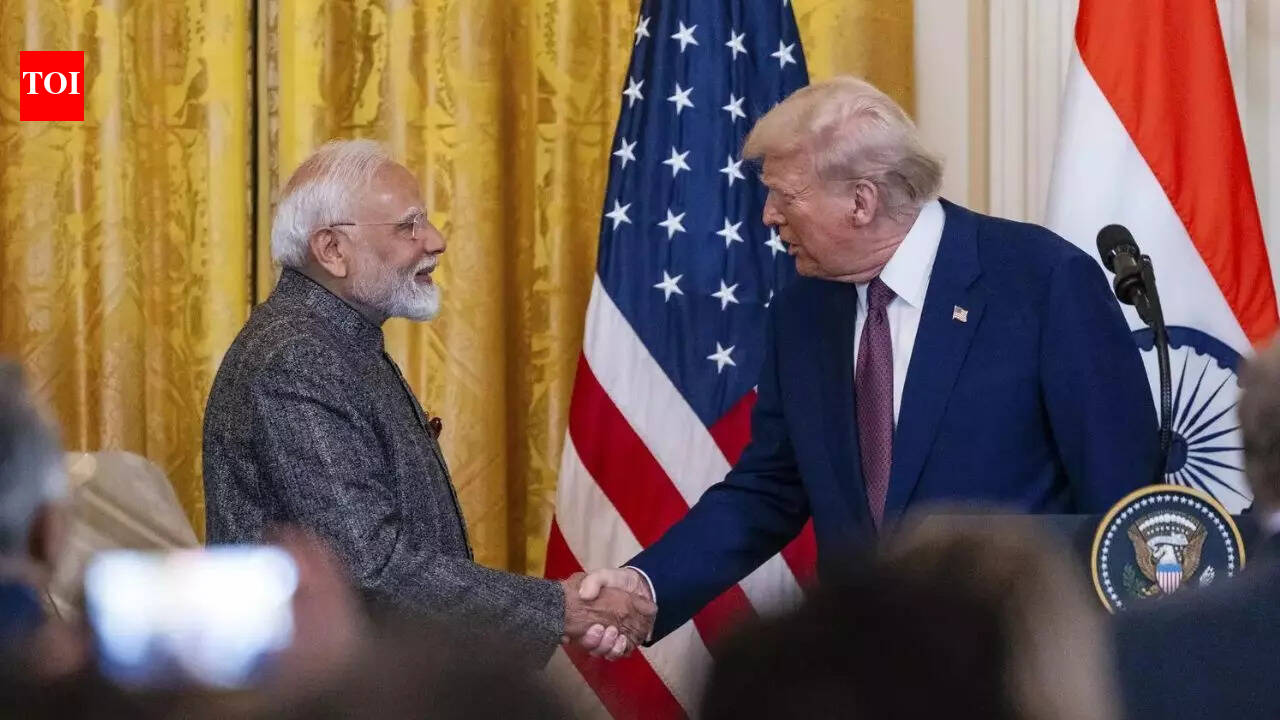
Within hours had passed after India and the United States announced a framework for an interim trade agreement and a familiar pattern started to set in. The Indian Left leaning media ecosystem rushed to declare the trade deal a problematic step by Prime Minister Narendra Modi led government and now international commentators and media have also stepped in. They are portraying a preliminary negotiating outline as a finalised act of national surrender. From Bloomberg to The Hindu to The Wire, the language was not of analysis but of alarm. It is designed less to inform than to provoke political anxiety, particularly among farmers. What is interesting in their cunningly worded narrative is that it is not about disagreement with the government but a deliberate attempt to mischaracterise the announcements that have been made. The joint statement issued on 6th February is not a signed free trade agreement. As OpIndia detailed earlier, it is a framework, an outline meant to guide negotiations. Yet, it has been repeatedly described as a done deal. The narrative of the Left leaning Indian and international media is directed towards making the framework look as if it is completely filled with irreversible concessions, binding commitments and permanent losses to sovereignty. From framework to fiction in a single news cycle The op-ed authored by Andy Mukherjee and published by Bloomberg likened the India-US trade framework to an IMF bailout, complete with metaphors of parole, tourniquets and strategic submissions. The problem with this analogy is not its drama but its factual looseness. IMF bailouts involve legally binding conditionalities tied to the disbursement of funds. What India has agreed to here is neither a bailout nor a binding purchase order. It is a pathway to restore market access lost to punitive tariffs imposed by Donald Trump led US government. Similarly, Prasenjit Bose, who is a Congress leader, in The Hindu declared the framework a blow to India’s strategic autonomy. He asserted that India had already committed to zero tariffs on all American industrial and agricultural goods. The joint statement does not say this. It refers to discussions on tariff rationalisation in areas where India already has import dependencies, not a blanket opening of markets. Pushparaj Deshpande’s piece in The Wire goes a step further and repeatedly cited statements attributed to US officials as proof of Indian capitulation. At the same time, he admitted that no final text or signed agreement exists. This contradiction runs through much of the criticism. Claims are treated as facts, speculation as policy, and a negotiating posture as a settled outcome. Russian oil and the art of selective outrage A major portion of the fearmongering revolves around Russian oil. International media has insisted that India has agreed to abandon discounted Russian crude under American pressure. This claim does not appear in the joint statement issued by India and the US. It appears in a separate executive order issued by the White House, which reflects an American position and not an Indian commitment. As OpIndia pointed out earlier, India has never relied exclusively on Russian oil. Purchases increased after the Russia Ukraine war because of steep discounts. Those discounts are already narrowing, and Russian oil imports have begun falling in the current financial year. To present this as a sudden collapse of energy sovereignty is to ignore both market dynamics and historical precedent. India has previously reduced imports from Iran and Venezuela under sanctions pressure without economic collapse. That reality is inconvenient for those attempting to frame the present moment as unprecedented surrender. Agriculture, GM panic and the return of protest politics Fearmongering has also revolved around the agriculture sector. Farmer unions, led by groups such as the Sanyukt Kisan Morcha and All India Kisan Sabha, have announced nationwide protests on 12th February. They have accused the government of handing Indian agriculture to American multinationals. Effigies of the US President and PM Modi are to be burnt, even though no agricultural free trade agreement exists. The claim that soybean oil imports amount to backdoor entry of genetically modified crops has been repeatedly debunked. As OpIndia noted in its reports, India already imports large quantities of soybean oil because domestic production does not meet demand. Importing oil is not the same as importing the crop itself, let alone permitting its cultivation. Furthermore, the assertion that India does not import farm products and is now being forced to do so is highly misleading. India imported agricultural products worth around 38 billion dollars in 2024 to 25, which included edible oils, pulses, fruits and nuts. These imports plug domestic shortages and support food security. They have not destroyed Indian agriculture so far, nor is there evidence th

Within hours had passed after India and the United States announced a framework for an interim trade agreement and a familiar pattern started to set in. The Indian Left leaning media ecosystem rushed to declare the trade deal a problematic step by Prime Minister Narendra Modi led government and now international commentators and media have also stepped in.
They are portraying a preliminary negotiating outline as a finalised act of national surrender. From Bloomberg to The Hindu to The Wire, the language was not of analysis but of alarm. It is designed less to inform than to provoke political anxiety, particularly among farmers.
What is interesting in their cunningly worded narrative is that it is not about disagreement with the government but a deliberate attempt to mischaracterise the announcements that have been made. The joint statement issued on 6th February is not a signed free trade agreement.
As OpIndia detailed earlier, it is a framework, an outline meant to guide negotiations. Yet, it has been repeatedly described as a done deal. The narrative of the Left leaning Indian and international media is directed towards making the framework look as if it is completely filled with irreversible concessions, binding commitments and permanent losses to sovereignty.
From framework to fiction in a single news cycle
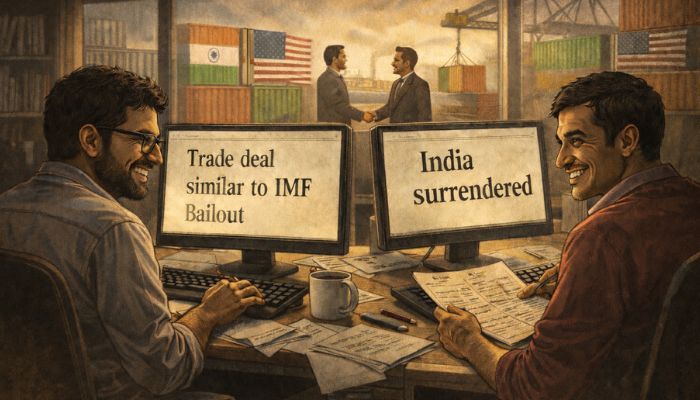
The op-ed authored by Andy Mukherjee and published by Bloomberg likened the India-US trade framework to an IMF bailout, complete with metaphors of parole, tourniquets and strategic submissions. The problem with this analogy is not its drama but its factual looseness. IMF bailouts involve legally binding conditionalities tied to the disbursement of funds. What India has agreed to here is neither a bailout nor a binding purchase order. It is a pathway to restore market access lost to punitive tariffs imposed by Donald Trump led US government.
Similarly, Prasenjit Bose, who is a Congress leader, in The Hindu declared the framework a blow to India’s strategic autonomy. He asserted that India had already committed to zero tariffs on all American industrial and agricultural goods. The joint statement does not say this. It refers to discussions on tariff rationalisation in areas where India already has import dependencies, not a blanket opening of markets.
Pushparaj Deshpande’s piece in The Wire goes a step further and repeatedly cited statements attributed to US officials as proof of Indian capitulation. At the same time, he admitted that no final text or signed agreement exists. This contradiction runs through much of the criticism. Claims are treated as facts, speculation as policy, and a negotiating posture as a settled outcome.
Russian oil and the art of selective outrage
A major portion of the fearmongering revolves around Russian oil. International media has insisted that India has agreed to abandon discounted Russian crude under American pressure. This claim does not appear in the joint statement issued by India and the US. It appears in a separate executive order issued by the White House, which reflects an American position and not an Indian commitment.
As OpIndia pointed out earlier, India has never relied exclusively on Russian oil. Purchases increased after the Russia Ukraine war because of steep discounts. Those discounts are already narrowing, and Russian oil imports have begun falling in the current financial year. To present this as a sudden collapse of energy sovereignty is to ignore both market dynamics and historical precedent.
India has previously reduced imports from Iran and Venezuela under sanctions pressure without economic collapse. That reality is inconvenient for those attempting to frame the present moment as unprecedented surrender.
Agriculture, GM panic and the return of protest politics
Fearmongering has also revolved around the agriculture sector. Farmer unions, led by groups such as the Sanyukt Kisan Morcha and All India Kisan Sabha, have announced nationwide protests on 12th February. They have accused the government of handing Indian agriculture to American multinationals. Effigies of the US President and PM Modi are to be burnt, even though no agricultural free trade agreement exists.
The claim that soybean oil imports amount to backdoor entry of genetically modified crops has been repeatedly debunked. As OpIndia noted in its reports, India already imports large quantities of soybean oil because domestic production does not meet demand. Importing oil is not the same as importing the crop itself, let alone permitting its cultivation.
Furthermore, the assertion that India does not import farm products and is now being forced to do so is highly misleading. India imported agricultural products worth around 38 billion dollars in 2024 to 25, which included edible oils, pulses, fruits and nuts. These imports plug domestic shortages and support food security. They have not destroyed Indian agriculture so far, nor is there evidence that limited tariff adjustments will suddenly do so now.
Opposition narratives and manufactured panic
The issue is that political actors in India have amplified these distortions with remarkable speed. AAP leader Sanjay Singh accused the government of lying to farmers. Similarly, Yogendra Yadav warned of maize and soy flooding Indian markets through the so called back door. None of these claims are supported by the joint statement or any official clarification from either government.
What is being attempted is not scrutiny but mobilisation. By presenting a framework as a finished agreement, the opposition and its media allies create urgency, anger and fear, the essential ingredients of street politics. The aim is not to understand the deal but to delegitimise the government before negotiations even begin.
What the framework actually does and does not do
The interim framework primarily restores tariff relief to Indian exporters who were facing duties as high as 50 percent. It reduces these to 18 percent, easing pressure on labour intensive sectors such as textiles, gems and jewellery. It opens talks on issues like pharmaceuticals, aircraft parts and standards alignment, none of which are resolved yet.
India has not signed away the agriculture sector. The framework does not mandate zero tariffs across the board. It does not commit India to a fixed 500 billion dollar purchase obligation. These are negotiating aspirations, not binding clauses.
To conflate a starting point with an end state is either analytical incompetence or political mischief.
Fear first, facts later
The pace at which international and domestic Left leaning media declared disaster reveals more about their worldview than about the trade framework itself. Any engagement with the US is framed as subjugation, any negotiation as surrender, and any compromise as betrayal. It simply does not fit their script that India might negotiate from a position of interest rather than ideology.
Trade negotiations are messy, incremental and often opaque. They are not decided in op ed columns or protest calls. India has not signed away its future. It has opened talks. Those talks deserve scrutiny, not hysteria. Media houses’ and political actors’ real story is not of a one-sided deal but of a coordinated attempt to convert a framework into a fear campaign. And that, more than any tariff line, should concern anyone serious about public discourse and national interest.