Yogi govt in UP to grant legal land ownership to over 2,500 Bangladeshi Hindu refugee families living in India for decades: Read details
The government led by Yogi Adityanath in Uttar Pradesh has launched a substantial initiative for Hindu refugees who migrated from what was previously referred to as East Pakistan (currently Bangladesh). These efforts transcend the usual governmental rehabilitation procedures and instead, signify a long-overdue act of justice for a prolonged historical injustice faced by Hindu victims. From the 1960s until 1975, a considerable number of Hindu families, escaping religious persecution, riots and instability in East Pakistan, relocated to and settled in various districts of Uttar Pradesh, such as Pilibhit, Lakhimpur Kheri, Bijnor and Rampur. The acceleration of the process to grant legal ownership rights over the land where they have built their homes, farms and resided for many years has now finally taken place. Consequently, major transformations are also being observed within the Hindu demographic landscape. Historical background: The exodus that did not end even after the partition The situation for the Hindu community in East Pakistan remained unfavourable after the partition of 1947. Throughout different periods, their migration continued relentlessly due to communal strife, religious bias, encroachment on property, assaults on temples and systematic persecution at the local level. The period between 1960 and 1975 saw this migration wave affecting several regions in North India, including Uttar Pradesh. Thousands of Bangladeshi Hindu refugee families were moved to various districts by the centre and Uttar Pradesh governments in these years. These families established their homes in various villages in places including Pilibhit, Lakhimpur Kheri, Bijnor and Rampur. They received residential plots and agricultural land. However, they were most often unable to obtain full possession of the land due to the existing legal framework, inconsistencies in official documentation and subsequent administrative modifications. These persecuted Hindu refugees from Bangladesh made India their permanent home, and generations of their descendants spent their lives in the country. Their names are present on all official documents from voter identification cards to ration cards, yet they are either categorised as occupants of “State Government Land” or have incomplete entries in the land records. The decision of the Yogi government: Fulfilment of a moral obligation Chief Minister Yogi Adityanath directed that Hindu refugees from East Pakistan should be granted rights to land ownership at a high-level meeting in July 2025. According to reports, he made it clear that this issue should not be perceived solely as a rehabilitation case, but as a matter of “social justice, humanity, and national responsibility.” His directives prominently featured several specific provisions. Firstly, the land-related cases concerning around 10,000 families who were displaced and settled in Pilibhit, Lakhimpur Kheri, Bijnor and Rampur between 1960 and 1975 are to be examined. Secondly, the land rights of those families who received land for housing and agricultural purposes are to be addressed. These rights are presently unresolved due to legal irregularities and inconsistencies in official documentation. Third, alternative land must be designated in cases where land is not available at a particular site or legal allocation is impractical. Fourth, the legal vacuum that emerged after the old government grants framework (as per the Government Grants Act) is to be resolved through a different mechanism, thus providing these families with their rightful entitlements. CM Yogi clearly directed officials, asserting that “the law is intended to benefit the public, not to cause them distress.” These measures were originally designed specifically for the Pilibhit region. The state government ensured that these resolutions were not merely theoretical and as a result, the process for conferring land ownership rights was commenced for around 2,196 families in the region. Verification reports concerning the Hindu refugee families residing in 25 villages have been submitted to the government and arrangements are being made to deliver the final documentation promptly upon receipt of formal guidelines. Additionally, initiatives are in progress to apply this same model in Lakhimpur Kheri and other districts. The evolving situation in Lakhimpur Kheri: 331 families, 4 villages, 3 tehsils Official data presented a distinct overview of the circumstances in Lakhimpur Kheri. As per official documentation, 331 families who were displaced from East Pakistan (currently Bangladesh) have been relocated within the district. These families have established their residence across three tehsils: Gola, Dhaurahra and Mohammadi. According to the report, 97 families were settled in the village of Sutkuiya located in Dhaurahra Tehsil, 37 families were placed in Village Number 3 of Gola Tehsil. Furthermore, 41 families were settled in the
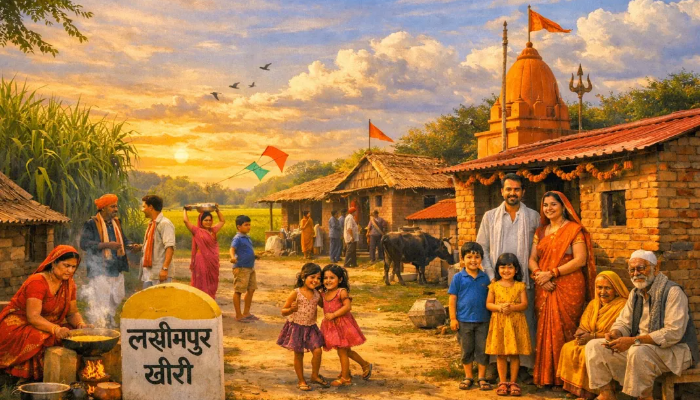
The government led by Yogi Adityanath in Uttar Pradesh has launched a substantial initiative for Hindu refugees who migrated from what was previously referred to as East Pakistan (currently Bangladesh). These efforts transcend the usual governmental rehabilitation procedures and instead, signify a long-overdue act of justice for a prolonged historical injustice faced by Hindu victims.
From the 1960s until 1975, a considerable number of Hindu families, escaping religious persecution, riots and instability in East Pakistan, relocated to and settled in various districts of Uttar Pradesh, such as Pilibhit, Lakhimpur Kheri, Bijnor and Rampur. The acceleration of the process to grant legal ownership rights over the land where they have built their homes, farms and resided for many years has now finally taken place. Consequently, major transformations are also being observed within the Hindu demographic landscape.
Historical background: The exodus that did not end even after the partition
The situation for the Hindu community in East Pakistan remained unfavourable after the partition of 1947. Throughout different periods, their migration continued relentlessly due to communal strife, religious bias, encroachment on property, assaults on temples and systematic persecution at the local level.
The period between 1960 and 1975 saw this migration wave affecting several regions in North India, including Uttar Pradesh. Thousands of Bangladeshi Hindu refugee families were moved to various districts by the centre and Uttar Pradesh governments in these years.
These families established their homes in various villages in places including Pilibhit, Lakhimpur Kheri, Bijnor and Rampur. They received residential plots and agricultural land. However, they were most often unable to obtain full possession of the land due to the existing legal framework, inconsistencies in official documentation and subsequent administrative modifications.
These persecuted Hindu refugees from Bangladesh made India their permanent home, and generations of their descendants spent their lives in the country. Their names are present on all official documents from voter identification cards to ration cards, yet they are either categorised as occupants of “State Government Land” or have incomplete entries in the land records.
The decision of the Yogi government: Fulfilment of a moral obligation
Chief Minister Yogi Adityanath directed that Hindu refugees from East Pakistan should be granted rights to land ownership at a high-level meeting in July 2025. According to reports, he made it clear that this issue should not be perceived solely as a rehabilitation case, but as a matter of “social justice, humanity, and national responsibility.”
His directives prominently featured several specific provisions. Firstly, the land-related cases concerning around 10,000 families who were displaced and settled in Pilibhit, Lakhimpur Kheri, Bijnor and Rampur between 1960 and 1975 are to be examined. Secondly, the land rights of those families who received land for housing and agricultural purposes are to be addressed. These rights are presently unresolved due to legal irregularities and inconsistencies in official documentation.
Third, alternative land must be designated in cases where land is not available at a particular site or legal allocation is impractical. Fourth, the legal vacuum that emerged after the old government grants framework (as per the Government Grants Act) is to be resolved through a different mechanism, thus providing these families with their rightful entitlements.
CM Yogi clearly directed officials, asserting that “the law is intended to benefit the public, not to cause them distress.” These measures were originally designed specifically for the Pilibhit region. The state government ensured that these resolutions were not merely theoretical and as a result, the process for conferring land ownership rights was commenced for around 2,196 families in the region.
Verification reports concerning the Hindu refugee families residing in 25 villages have been submitted to the government and arrangements are being made to deliver the final documentation promptly upon receipt of formal guidelines. Additionally, initiatives are in progress to apply this same model in Lakhimpur Kheri and other districts.
The evolving situation in Lakhimpur Kheri: 331 families, 4 villages, 3 tehsils
Official data presented a distinct overview of the circumstances in Lakhimpur Kheri. As per official documentation, 331 families who were displaced from East Pakistan (currently Bangladesh) have been relocated within the district. These families have established their residence across three tehsils: Gola, Dhaurahra and Mohammadi.
According to the report, 97 families were settled in the village of Sutkuiya located in Dhaurahra Tehsil, 37 families were placed in Village Number 3 of Gola Tehsil. Furthermore, 41 families were settled in the village of Mohanganj (Colony) within Mohammadi Tehsil.
Moreover, the most significant settlement of Bangladeshi Hindu refugees in Lakhimpur Kheri is situated in Fayaznagar which is part of Mohammadi Tehsil where 156 families have been established in this specific area alone. Collectively, these four settlements are united by a common historical memory despite being geographically separated.
Family composition: The story of three generations
The document further presents information about the average family size. This figure illustrates the actual scale of the “population” being examined. The families generally have around 1 to 8 members in Gola Tehsil. The family sizes vary from about 1 to 6 members in Dhaurahra Tehsil, and these can consist of approximately 1 to 10 members in Mohammadi Tehsil.
When viewed in this context, the estimated total population of these 331 families is between 1,500 and 1,800 individuals. This population now includes a combination of second- and third-generation descendants. The first generation was made up of those who crossed the border, the second-generation experienced life in uncertain resettlement and the third generation is currently waiting for their legal rights to that land.
Lakhimpur Kheri microdata related to land holdings
The officially published report includes an in-depth description of the residential and agricultural land owned by each family. An average of 3 bighas of agricultural land has been distributed among 37 families in Gola Tehsil. Approximately 60 families were allocated around 1.620 bighas of agricultural land each in Sutkuiya village, situated in Dhaurahra Tehsil. In Mohammadi Tehsil—particularly in Mohan Ganj (Colony).
Fifteen families were granted three bighas of land each, in the village of Mohanganj (Colony) in Tehsil Mohammadi. Furthermore, nine families were assigned seven bighas of land per family, while an additional seventeen families received five bighas of land each. In addition to these groups, approximately 156 families who settled in Fayyanagar village (Mohammadi Tehsil) were allocated around 4.75 bighas of agricultural land per family for farming purposes.
These statistics clearly indicate that the Hindu refugees from Bangladesh residing in Lakhimpur Kheri are not completely landless nor are they extensive landowners. They are small to medium-scale farmers whose means of subsistence rely on landholdings that vary from 1 to 7 bighas. Hence, the challenge was not their inability to acquire land, but instead, the issue was that they had not, until this point, obtained full legal documentation in their own names despite having cultivated the land for generations.
Pilibhit’s 2,196 families and a 62-year wait
The conditions in Pilibhit reveal yet another crucial facet of this significant choice made by the Uttar Pradesh government. Within the Pilibhit district, roughly 2,196 families, identified as Hindu refugees who moved from East Pakistan, are established across 25 villages.
While they were given land for housing and agricultural purposes in the 1960s, they were never granted legal ownership rights. In official records, the land was at times recorded under the jurisdiction of the Forest Department. In other cases, property mutation (the transfer of title) was not executed and in some situations no clear legal route remained to formalize their titles after the repeal of the old Government Grants Act.
After CM Yogi’s intervention, the District Magistrate of Pilibhit indicated that verification reports for 1,466 of the 2,196 families have already been submitted to the state government. The process of issuing land titles to these families is anticipated to commence as soon as the final guidelines are received. This initiative is not limited to Pilibhit and is being implemented in all districts of Uttar Pradesh where such refugees were resettled.
A significant technical challenge arose from the fact that these lands were originally allocated under the “Government Grants Act.” This act was annulled in 2018, resulting in the absence of a clear or direct legal route to authenticate these earlier land grants. Officials informed CM Yogi that this was the main reason the process of conferring ownership rights, even to legitimate refugee families, had come to a standstill, as there were no specific legal provisions that allowed for the alteration of land titles in their names.
“The law is not intended to trap individuals in distress, but rather to assist them,” he responded. Officials were tasked with identifying and formulating an alternative legal solution to address the issue following this directive. Documents from Lakhimpur Kheri suggest that the state government has not excluded these families from other welfare initiatives. As per reports, these refugee families have consistently received benefits from various government programs, adhering to the relevant rules and eligibility requirements.
These initiatives have included programs such as the Pradhan Mantri Kisan Durghatna Kalyan Yojana, crop insurance schemes, the Pradhan Mantri/Chief Minister Kisan Samman Schemes, pensions for senior citizens, widows and individuals with disabilities, marriage grants (including the Mukhyamantri Samuhik Vivah Yojana), educational support, scholarships and school-related benefits, health and nutrition initiatives, the Pradhan Mantri Awas Yojana (Rural), rations under the National Food Security Act, the Swachh Bharat Mission, rural road projects, rural employment and livelihood schemes, among others.
Due to the initiatives led by CM Yogi and his government, these Hindu families have started to gain the respect and dignity that is granted to citizens. In the past, they were classified as “incomplete refugees” in relation to land ownership. With the current initiatives of the Yogi government, land rights are now being integrated with welfare scheme benefits, with the goal of enhancing their economic stability.
The initiatives undertaken by the Uttar Pradesh government demonstrate that, at the state level, the processes of preparing documentation for refugees and granting them land rights are not mutually exclusive, but rather complementary.
The Uttar Pradesh model: A benchmark for refugee welfare
The Yogi administration in Uttar Pradesh has intensified its initiatives on various fronts concerning the welfare of Bangladeshi Hindu refugees. They have received recognition, and the government has formally acknowledged that these families have lived here for many years. Although they were allocated land previously, they were not granted ownership rights. The Yogi administration has corrected this historical error.
Consequently, they were given a legal resolution. Currently, alternative options are being looked into to address the legal gap that emerged following the repeal of the Government Grants Act. The aim is to validate previous land allocations and, in turn, grant land ownership rights to these families.
Moreover, the administrative implementation has been significantly reinforced. A comprehensive process has been initiated that includes the verification of each family, the accurate measurement of their land holdings and the subsequent preparation of required documentation by requisitioning district-specific reports, identifying, for instance, 2,196 families in Pilibhit and 331 in Lakhimpur Kheri.
Simultaneously, the Yogi government has shown a clear political commitment by forwarding lists of refugees to the central government. It seeks to include them under the provisions of the Citizenship Amendment Act (CAA), ensure their ongoing access to welfare schemes and facilitate their transition from the status of mere “refugees” to that of “settled citizens and farmers.”
Hence, it can be stated that Uttar Pradesh serves as an active and exemplary model in addressing the critical issues of welfare, dignity, and land rights for Bangladeshi Hindu refugees within the current landscape, a model that transcends mere relief measures to adopt a rights-based approach to problem-solving.
To declare that “the Yogi government of Uttar Pradesh is working for the welfare of Bangladeshi Hindu refugees” is not simply a political statement but it is a concrete, historic and legally grounded initiative that is fundamentally connected to the land, homes and identities of thousands of families. Whether it involves the 2,196 settlements in Pilibhit or the small agricultural plots cultivated by the 331 families in Lakhimpur Kheri, all of these factors contribute to this transformative story.