Anti-Indian hate surged on X during US immigration debates, small network amplified racist narratives against Indians: Report
A new report analysing online discourse in the United States has claimed that Anti-Indian rhetoric and anti-Indian attacks against Indians and Indian-origin individuals went up sharply on the social media platform X. Particularly in 2025, during the heated debates in the United States surrounding immigration and the H-1 B visa programme. The Network Contagion Research Institute (NCRI) has put out a research report titled “From Policy Drift to Purity Grift: How a Small Network Hijacked the Immigration Debate.” It has analysed thousands of posts on X to study the rise of anti-Indian narrative. According to the study, anti-Indian posts on X generated more than 300 million views in 2025. Moreover, this content has tripled over the year. The institute’s researchers analysed that 24,674 posts came from 14,000 accounts, which collectively received over 8.5 million likes and around 9 lakh retweets, indicating the massive reach of such hostile narratives. According to the report, these posts frequently portrayed Indians as “invaders”, “job stealers” or demographic “replacers”, particularly in the context of discussions around the H-1 B visa programme and immigration policies in the United States. Indian-Americans’ contribution The report highlights the economic and social contributions of Indian-Americans in the United States. It is important to note that the community plays a significant role in the country’s technology, business, and academic sectors. According to the report, Indian-Americans number around 5.2 million in the US and have the highest median household income among major Asian-origin groups, with 77% holding at least a bachelor’s degree, far higher than the national average. The study also notes that Indian-origin entrepreneurs represent the largest national-origin group among immigrant founders of billion-dollar startups in the US, highlighting the community’s economic contribution even as online hostility against Indians has grown. Report analysed thousands of posts using keyword-based data collection The researchers used a structured query system to collect posts containing explicit racial slurs or those combining Indian identity markers with negative or exclusionary language. Keywords included derogatory terms and markers such as “India,” “Indian,” “Indians,” “Hindu,” and “H-1B,” paired with terms like “deport,” “ban,” “replace,” “invasion,” “fraud,” and “scam.”In the report, the dataset is limited to posts published in 2025 with more than 10 likes, ensuring the analysis focuses on content that achieved some level of engagement. The study also excluded posts originating from India to concentrate on hostility directed at Indians in external discourse. Immigration policy debates triggered online hate campaigns. The report noted that spikes in anti-Indian narrative on social media frequently increased during the debates, mainly on immigration policy developments in the United States in 2025. According to the study, some policy announcements sparked angry online conversations about Indians. These included the US Department of Homeland Security’s new H-1B modernisation rule, visa restrictions on some Indian travel agencies that were thought to be helping people move to the US illegally, and the idea of charging employers $100,000 to file new H-1B visa applications. The report says that after these events, online conversations about immigration moved away from criticising policies and toward more general attacks on Indians as a group. Many posts made Indians look like economic rivals or demographic “replacers.” Some even called for limits on Indian immigration or deportation measures. The study also says that stories about immigration made up most of the dataset. Almost half of the posts were about topics like deportation, immigration restrictions, or “replacement” rhetoric, which together got a lot of engagement. Shift from explicit slurs to policy-framed hostility. One of the shocking trends identified from the report is the shift in the nature of the rhetoric over the years. In early 2025, many of the hateful posts relied on explicit racial slurs targeting Indians. However, from mid-2025, this rhetoric increasingly shifted toward policy-framed narratives related to immigration, labour competition, and alleged abuse of the visa system, which also shows the intensity of hate towards Indians. The researchers suggest that this shift may reflect attempts to avoid content moderation while still promoting hostile narratives, allowing such posts to achieve broader reach on social media. A small network of highly active accounts drove amplification, another finding from the report. A relatively small number of accounts played a disproportionate role in amplifying anti-Indian content. The analysis found that three highly active accounts alone accounted for over 10% of the total likes and nearly 20% of the retweets in the dataset. The accounts are named “NeonWhiteCat”,
A new report analysing online discourse in the United States has claimed that Anti-Indian rhetoric and anti-Indian attacks against Indians and Indian-origin individuals went up sharply on the social media platform X. Particularly in 2025, during the heated debates in the United States surrounding immigration and the H-1 B visa programme.
The Network Contagion Research Institute (NCRI) has put out a research report titled “From Policy Drift to Purity Grift: How a Small Network Hijacked the Immigration Debate.” It has analysed thousands of posts on X to study the rise of anti-Indian narrative.
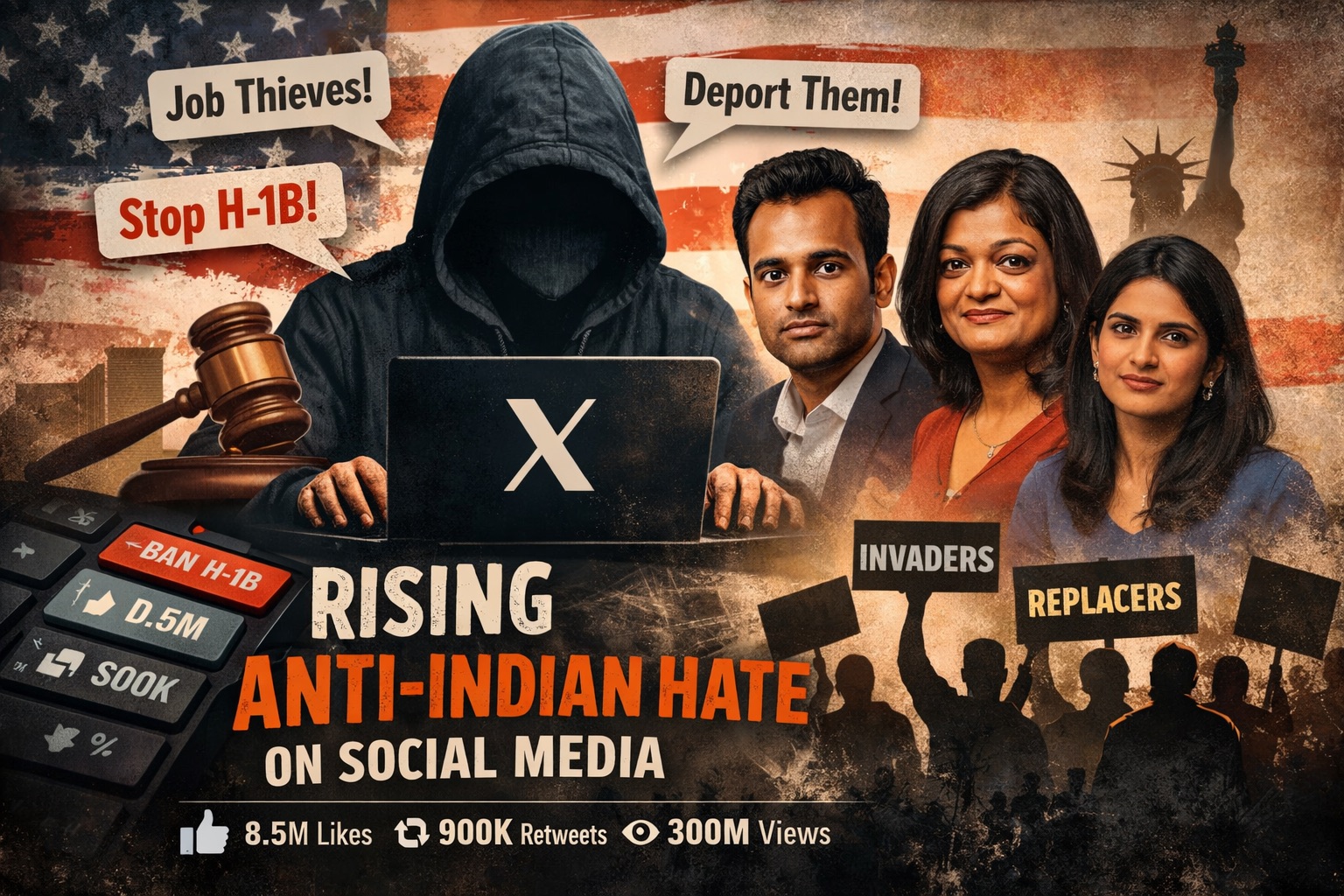
According to the study, anti-Indian posts on X generated more than 300 million views in 2025. Moreover, this content has tripled over the year. The institute’s researchers analysed that 24,674 posts came from 14,000 accounts, which collectively received over 8.5 million likes and around 9 lakh retweets, indicating the massive reach of such hostile narratives. According to the report, these posts frequently portrayed Indians as “invaders”, “job stealers” or demographic “replacers”, particularly in the context of discussions around the H-1 B visa programme and immigration policies in the United States.
Indian-Americans’ contribution
The report highlights the economic and social contributions of Indian-Americans in the United States. It is important to note that the community plays a significant role in the country’s technology, business, and academic sectors. According to the report, Indian-Americans number around 5.2 million in the US and have the highest median household income among major Asian-origin groups, with 77% holding at least a bachelor’s degree, far higher than the national average. The study also notes that Indian-origin entrepreneurs represent the largest national-origin group among immigrant founders of billion-dollar startups in the US, highlighting the community’s economic contribution even as online hostility against Indians has grown.
Report analysed thousands of posts using keyword-based data collection
The researchers used a structured query system to collect posts containing explicit racial slurs or those combining Indian identity markers with negative or exclusionary language. Keywords included derogatory terms and markers such as “India,” “Indian,” “Indians,” “Hindu,” and “H-1B,” paired with terms like “deport,” “ban,” “replace,” “invasion,” “fraud,” and “scam.”In the report, the dataset is limited to posts published in 2025 with more than 10 likes, ensuring the analysis focuses on content that achieved some level of engagement. The study also excluded posts originating from India to concentrate on hostility directed at Indians in external discourse.
Immigration policy debates triggered online hate campaigns.
The report noted that spikes in anti-Indian narrative on social media frequently increased during the debates, mainly on immigration policy developments in the United States in 2025. According to the study, some policy announcements sparked angry online conversations about Indians. These included the US Department of Homeland Security’s new H-1B modernisation rule, visa restrictions on some Indian travel agencies that were thought to be helping people move to the US illegally, and the idea of charging employers $100,000 to file new H-1B visa applications. The report says that after these events, online conversations about immigration moved away from criticising policies and toward more general attacks on Indians as a group. Many posts made Indians look like economic rivals or demographic “replacers.” Some even called for limits on Indian immigration or deportation measures. The study also says that stories about immigration made up most of the dataset. Almost half of the posts were about topics like deportation, immigration restrictions, or “replacement” rhetoric, which together got a lot of engagement.
Shift from explicit slurs to policy-framed hostility.
One of the shocking trends identified from the report is the shift in the nature of the rhetoric over the years. In early 2025, many of the hateful posts relied on explicit racial slurs targeting Indians. However, from mid-2025, this rhetoric increasingly shifted toward policy-framed narratives related to immigration, labour competition, and alleged abuse of the visa system, which also shows the intensity of hate towards Indians. The researchers suggest that this shift may reflect attempts to avoid content moderation while still promoting hostile narratives, allowing such posts to achieve broader reach on social media. A small network of highly active accounts drove amplification, another finding from the report. A relatively small number of accounts played a disproportionate role in amplifying anti-Indian content. The analysis found that three highly active accounts alone accounted for over 10% of the total likes and nearly 20% of the retweets in the dataset. The accounts are named “NeonWhiteCat”, “MattForney”, and “TheBrancaShow”According to the report, this suggests that anti-Indian narratives online were significantly shaped by a concentrated group of users rather than representing purely organic discussion across the platform. The study also notes that some of the accounts amplifying anti-Indian rhetoric were associated with extremist or white nationalist online ecosystems, which have previously been linked to other forms of ethnic hostility.
Indian-origin public figures are frequently targeted
Further, the report notes that several Indian-origin public figures in the United States were repeatedly targeted in hostile posts. Former presidential candidate Vivek Ramaswamy and lawmakers Shri Thanedar and Pramila Jayapal are among the most frequently mentioned and referenced in discussions surrounding immigration policy. According to the researchers, individuals associated with immigration debates often became focal points for broader attacks against Indians as a community. It suggested that posts referencing these figures often moved beyond policy criticism and instead included ethnic generalisations about Indians or Indian-origin professionals in the United States. In several cases, this ecosystem framed their positions on immigration policies as part of a larger narrative portraying Indians as responsible for alleged job displacement or immigration-related issues in the US.
Racist attacks on Usha Vance triggered a major spike in hostility.
It also examines the narrative war surrounding Usha Vance, the Indian-origin wife of US Vice President JD Vance. According to the researchers, it is found that hostile posts about Usha Vance remained relatively limited for most of 2025 but spiked sharply toward the end of the year following racially charged remarks by controversial online influencers such as Nick Fuentes and Sneako. According to the study, these remarks spread widely through reposts and reactions on social media, significantly amplifying racist narratives targeting her and her family.
Report warns against conflating policy debate with ethnic hostility.
While acknowledging that concerns regarding immigration policies and potential misuse of visa programmes constitute legitimate areas of policy debate, the report warns that such discussions often devolve into collective blame directed at Indians. researchers, criticism crosses the line into ethnic hostility when it involves dehumanising stereotypes, sweeping generalisations about Indians, or calls for exclusion based on ethnicity rather than policy considerations. The study concludes that monitoring such online narratives is important, as large surges in ethnic hostility on social media have historically sometimes preceded real-world harassment or discrimination.
Conclusion
The findings of the report highlight how policy debates around immigration in the United States are increasing generalisations and racist stereotypes against Indians and Indian-origin professionals.
It also concludes that the growth of such narratives on social media requires closer monitoring, particularly as online hostility can sometimes translate into real-world targeting of communities. It also calls for greater awareness among platforms and policymakers to distinguish between legitimate policy criticism and narratives that promote ethnic hostility or collective blame against immigrant communities.