As Congress and AAP fight to take credit for developing the ‘education sector’ of Punjab, read how Arvind Kejriwal was accused of passing Sheila Dixit’s work in Delhi as his own
For a few days, social media has been filled with the news of how Punjab achieved the number 1 position in the education sector. But this recent achievement of securing the top position in school education has triggered a political debate over who deserves credit for the success. The Aam Aadmi Party (AAP) government has presented the ranking as evidence of its education reforms, with Arvind Kejriwal stating that Punjab rose from 27th place to the top position under the Bhagwant Mann government. However, former Punjab education minister and Congress MLA Pargat Singh has disputed this claim. He argues that Punjab’s improvement had already begun under the previous Congress government and was visible in major education surveys conducted before AAP came to power in 2022. The disagreement reminds me of the old debate that emerged in Delhi years ago, when Congress leaders accused AAP of taking credit for improvements in education that they said were built on reforms and infrastructure created during Sheila Dikshit’s tenure. The Punjab controversy has once again raised the question of who should get credit for long-term educational progress. What is AAP claiming? The controversy started after the Punjab government highlighted its performance in the latest ranking and claimed that the state had emerged as the top performer in school education. Arvind Kejriwal and Chief Minister Bhagwant Mann, with other AAP leaders, credited this achievement to reforms introduced after the party came to power in 2022. The government pointed to initiatives such as Schools of Eminence, teacher training programmes in countries like Finland and Singapore, teacher and staff recruitment, expansion of smart classrooms, and improvements in school infrastructure. According to AAP, these measures have helped transform Punjab’s government schools and contributed to the state’s rise in education rankings. Kejriwal also highlighted that Punjab was ranked near the bottom in previous years and has now reached the top, presenting this as evidence of the success of the AAP government’s education model. Reality Check: Did Punjab’s Rise Begin Before AAP Came To Power? While AAP has claimed credit for Punjab’s rise in the education sector, the timeline suggests the state’s improvement may have begun before the party came to power in 2022. The AAP government was sworn in in March 2022. But some key surveys or studies have cited the data prior to 2022. It raises the question: Does the AAP government deserve the actual credit, or are they riding on someone else’s work? For example, the National Achievement Survey (NAS) 2021, which measures students’ learning levels nationwide, was conducted several months before the AAP formed the government. Punjab did well in the survey, ranking among the better-performing states. Similarly, Congress leaders have cited earlier Performance Grading Index (PGI) reports to claim that the progress in education in the state was already evident before the change of government. This does not necessarily mean that the current government played no role. Since coming to power, AAP has launched its own initiatives, including Schools of Eminence, teacher training programmes, recruitment drives and infrastructure upgrades. However, education reforms generally take years to produce measurable results, making it difficult to attribute long-term improvements to a single government alone. Therefore, the timeline suggests that Punjab’s educational rise was already underway before AAP assumed office, even as the current government has continued to introduce its own reforms. Another important point that is often missed in the political debate is that Punjab has not been declared India’s overall No. 1 state in education. The ranking quoted by the AAP government concerns school education indicators and learning outcomes. It does not measure the entire education sector, which would include higher education, universities, research output, faculty quality, employability and other parameters. So, Punjab may have done well in school education rankings, but to claim that it is India’s No. 1 state in education is entirely wrong. Advertising these claims will spread misinformation, but the reality cannot be hidden for long. The Delhi Parallel: A Similar Debate Over Educational Credit Taking credit is the old disease from which AAP has been suffering for a long time. So, the debate unfolding in Punjab is not entirely new. A similar argument was made in Delhi after the AAP government began promoting its education model as one of its biggest achievements. Delhi was governed for 15 years by former Chief Minister Sheila Dikshit, before the AAP came to power. During her tenure, the government invested heavily in school infrastructure, built new classrooms, expanded school facilities and increased spending on education. After coming to power, AAP introduced several new initiatives, including teacher training programm
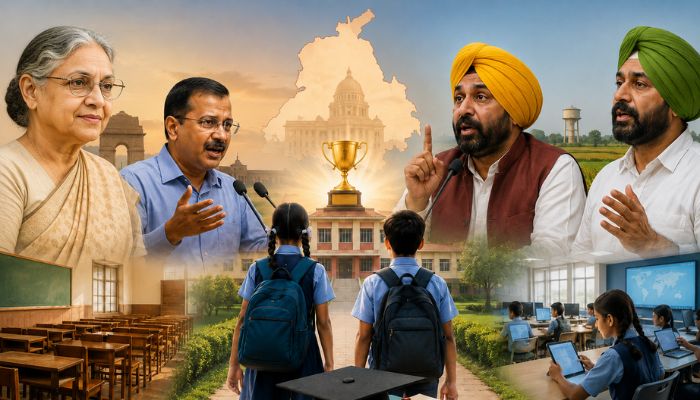
For a few days, social media has been filled with the news of how Punjab achieved the number 1 position in the education sector. But this recent achievement of securing the top position in school education has triggered a political debate over who deserves credit for the success. The Aam Aadmi Party (AAP) government has presented the ranking as evidence of its education reforms, with Arvind Kejriwal stating that Punjab rose from 27th place to the top position under the Bhagwant Mann government. However, former Punjab education minister and Congress MLA Pargat Singh has disputed this claim. He argues that Punjab’s improvement had already begun under the previous Congress government and was visible in major education surveys conducted before AAP came to power in 2022. The disagreement reminds me of the old debate that emerged in Delhi years ago, when Congress leaders accused AAP of taking credit for improvements in education that they said were built on reforms and infrastructure created during Sheila Dikshit’s tenure. The Punjab controversy has once again raised the question of who should get credit for long-term educational progress.
What is AAP claiming?
The controversy started after the Punjab government highlighted its performance in the latest ranking and claimed that the state had emerged as the top performer in school education. Arvind Kejriwal and Chief Minister Bhagwant Mann, with other AAP leaders, credited this achievement to reforms introduced after the party came to power in 2022.
The government pointed to initiatives such as Schools of Eminence, teacher training programmes in countries like Finland and Singapore, teacher and staff recruitment, expansion of smart classrooms, and improvements in school infrastructure. According to AAP, these measures have helped transform Punjab’s government schools and contributed to the state’s rise in education rankings.
Kejriwal also highlighted that Punjab was ranked near the bottom in previous years and has now reached the top, presenting this as evidence of the success of the AAP government’s education model.
Reality Check: Did Punjab’s Rise Begin Before AAP Came To Power?
While AAP has claimed credit for Punjab’s rise in the education sector, the timeline suggests the state’s improvement may have begun before the party came to power in 2022. The AAP government was sworn in in March 2022. But some key surveys or studies have cited the data prior to 2022. It raises the question: Does the AAP government deserve the actual credit, or are they riding on someone else’s work?
For example, the National Achievement Survey (NAS) 2021, which measures students’ learning levels nationwide, was conducted several months before the AAP formed the government. Punjab did well in the survey, ranking among the better-performing states. Similarly, Congress leaders have cited earlier Performance Grading Index (PGI) reports to claim that the progress in education in the state was already evident before the change of government.
This does not necessarily mean that the current government played no role. Since coming to power, AAP has launched its own initiatives, including Schools of Eminence, teacher training programmes, recruitment drives and infrastructure upgrades. However, education reforms generally take years to produce measurable results, making it difficult to attribute long-term improvements to a single government alone.
Therefore, the timeline suggests that Punjab’s educational rise was already underway before AAP assumed office, even as the current government has continued to introduce its own reforms.
Another important point that is often missed in the political debate is that Punjab has not been declared India’s overall No. 1 state in education. The ranking quoted by the AAP government concerns school education indicators and learning outcomes. It does not measure the entire education sector, which would include higher education, universities, research output, faculty quality, employability and other parameters. So, Punjab may have done well in school education rankings, but to claim that it is India’s No. 1 state in education is entirely wrong. Advertising these claims will spread misinformation, but the reality cannot be hidden for long.
The Delhi Parallel: A Similar Debate Over Educational Credit
Taking credit is the old disease from which AAP has been suffering for a long time. So, the debate unfolding in Punjab is not entirely new. A similar argument was made in Delhi after the AAP government began promoting its education model as one of its biggest achievements. Delhi was governed for 15 years by former Chief Minister Sheila Dikshit, before the AAP came to power. During her tenure, the government invested heavily in school infrastructure, built new classrooms, expanded school facilities and increased spending on education. After coming to power, AAP introduced several new initiatives, including teacher training programmes, curriculum reforms and large-scale school modernisation projects.
However, Congress leaders often argued that AAP was taking credit for improvements that were built on foundations laid during the Sheila Dikshit era. According to them, many of the gains showcased by AAP were made possible by investments and reforms undertaken by the previous government.
AAP rejected this criticism, maintaining that it had transformed the education system through its own policies and reforms. The disagreement eventually became a larger political debate over whether educational success should be credited to the government that started the reforms or the one that expanded and publicised them.
Now, with Congress making similar allegations in Punjab, the debate over who deserves credit for long-term educational progress has resurfaced.
Conclusion
Punjab’s recent education ranking has undoubtedly strengthened the AAP government’s claim that its reforms are delivering results. However, the political dispute surrounding the achievement highlights a larger question: who deserves credit for improvements that take years to materialise?
The available timeline suggests that Punjab’s educational progress did not begin overnight after the AAP government took office in 2022. Data from surveys and assessments conducted before the change in government indicate that the state was already showing signs of improvement. At the same time, the current government has introduced several initiatives of its own to further strengthen the education system.
The controversy also mirrors an earlier debate in Delhi, where Congress leaders accused AAP of claiming credit for gains built on foundations laid during the Sheila Dikshit era. Whether one agrees with that comparison or not, both cases underscore that educational reforms are usually the result of efforts spanning multiple governments.
It is also important to note that Punjab’s latest performance pertains primarily to school education indicators and learning outcomes. Therefore, it is wrong to claim that Punjab is now India’s No. 1 state in the entire education sector. Such a claim would require comparisons across higher education institutions, universities, research output, employability, and other educational parameters