As Congress opposes Modi govt over Aravalli Hills mining policy after advocating the same in 2002, here’s a history of the party’s flip-flops on various issues
The Congress party’s cynical game of politics is seeped in blatant hypocrisy. Policies they advocate in power become flawed and even ‘dangerous’ when the BJP implements them. In a fresh extension to this pattern, the Congress party has launched a scathing attack on the Modi government over the revised definition of the Aravalli Hills and mining policy. From Sonia Gandhi’s op-ed to Ashok Gehlot’s fearmongering rhetoric, the party leaders are alleging that somehow the Modi government is hatching a “well-planned conspiracy” to undermine safeguards and allow large-scale mining in the Aravallis. For Congress, the Supreme Court accepting the BJP-proposed ‘100-meter’ criterion-based operational definition of the Aravalli Hills is an approval of the so-called ‘conspiracy’ to hand over the Aravallis to mining mafias. However, OpIndia reported earlier how it was the Congress government in Rajasthan that first proposed and adopted the 100-meter height-based definition in its affidavit filed before the court in 2002. Gehlot and his party are now demanding that the entire Aravallis should be free from mining to protect its ecology; however, in the affidavit filed in 2002, the Gehlot government itself wanted to open the Aravallis for mining. While the Modi government has imposed complete ban on issuing new mining leases until a Management Plan for Sustainable Mining (MPSM) is finalised, back in 2002, Rajasthan’s Congress government vehemently opposed ban on all mining activities in the Aravalli Hills spread across the state’s 14 districts and even highlighted before the Supreme Court that mining generates lakhs of jobs for locals and hundreds of crores of revenue for the state government. Apparently, mining in the Aravallis was good when Congress was in power, but it is dangerous when the BJP government is even considering allowing mining in 0.019% of the area, that, too, in the non-protected zone. When Ashok Gehlot gave mining contracts to his relatives as Rajasthan CM and illegal mining was rampant, the Aravallis were thriving, but when the BJP intends to implement a scientific and stakeholder-approved mining plan, Congress cries “#SaveAravalli”. This, however, is not the first time that Congress’s stance bent to the whims of being out of power. Hanumangarh Ethanol Plant was a job-generating project when Congress approved it, became a ‘corporate-benefitting scheme’ when the BJP implemented it It must be recalled that the ethanol plant in Rajasthan’s Hanumangarh was approved by the Congress government under Ashok Gehlot’s leadership in 2023, but when the BJP came to power and continued its construction, the same Gehlot and the Congress party turned against it. It all began with the Congress government choosing a proposed ethanol plant project of the Punjab-based firm Dune Ethanol Private Limited for funding to the tune of ₹450 crores in 2023. Everything was going hunky dory till the elections happened, and Congress was voted out of power. For Congress, the very project which would have generated jobs and boosted the state’s economy, became ‘BJP’s scheme of favouring corporates’. Congress opposes 60-day annual work pause in BJP’s VB G RAM G Bill, UPA-II era Agriculture Minister wanted to implement the same It is not unexpected that a politically and ideologically opposed Congress would support a BJP government-proposed legislation without any criticism. However, it is peculiar that the party opposes the very policy or rule it once wanted to implement, just because its political adversary in power is proposing it. Recently, the Viksit Bharat Guarantee for Rozgar and Ajeevika Mission (Gramin) or VB G-RAM-G Bill was passed in the Parliament. The legislation replaced the Mahatma Gandhi National Rural Employment Guarantee Act (MGNREGA). While the Congress party opposed to almost all of VB G-RAM-G’s provisions, even its name for removing MK Gandhi’s name, their opposition to the 60-day work pause provision during peak sowing and harvesting seasons particularly stood out. This work pause would allow workers to shift to higher-paying farm labour without losing the employment guarantee scheme benefits. This would potentially help stabilise rural wages and food production. In addition, the 60-day aggregated pause would help prevent labour shortages during critical farm operations and avoid labour being diverted away to guaranteed-wage worksites. The Congress party and the extended anti-BJP ecosystem alleged that this pause during peak agricultural seasons is “labour control” and “state-managed labour supply”, arguing that the pause strips workers of their choice, wages and even dignity. However, back in the UPA-II era, Sharad Pawar, then Agriculture Minister, wanted to implement a similar annual MNREGA work pause for the very reasons cited in the VB-G RAM G legislation. The Congress also has a problem with the new legislation’s 60:40 Centre-State fund sharing arrangement, saying
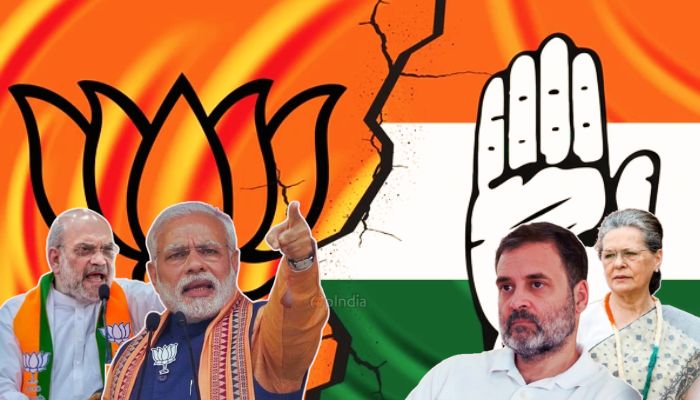

The Congress party’s cynical game of politics is seeped in blatant hypocrisy. Policies they advocate in power become flawed and even ‘dangerous’ when the BJP implements them. In a fresh extension to this pattern, the Congress party has launched a scathing attack on the Modi government over the revised definition of the Aravalli Hills and mining policy.
From Sonia Gandhi’s op-ed to Ashok Gehlot’s fearmongering rhetoric, the party leaders are alleging that somehow the Modi government is hatching a “well-planned conspiracy” to undermine safeguards and allow large-scale mining in the Aravallis. For Congress, the Supreme Court accepting the BJP-proposed ‘100-meter’ criterion-based operational definition of the Aravalli Hills is an approval of the so-called ‘conspiracy’ to hand over the Aravallis to mining mafias.
However, OpIndia reported earlier how it was the Congress government in Rajasthan that first proposed and adopted the 100-meter height-based definition in its affidavit filed before the court in 2002. Gehlot and his party are now demanding that the entire Aravallis should be free from mining to protect its ecology; however, in the affidavit filed in 2002, the Gehlot government itself wanted to open the Aravallis for mining.

While the Modi government has imposed complete ban on issuing new mining leases until a Management Plan for Sustainable Mining (MPSM) is finalised, back in 2002, Rajasthan’s Congress government vehemently opposed ban on all mining activities in the Aravalli Hills spread across the state’s 14 districts and even highlighted before the Supreme Court that mining generates lakhs of jobs for locals and hundreds of crores of revenue for the state government.
Apparently, mining in the Aravallis was good when Congress was in power, but it is dangerous when the BJP government is even considering allowing mining in 0.019% of the area, that, too, in the non-protected zone. When Ashok Gehlot gave mining contracts to his relatives as Rajasthan CM and illegal mining was rampant, the Aravallis were thriving, but when the BJP intends to implement a scientific and stakeholder-approved mining plan, Congress cries “#SaveAravalli”.
This, however, is not the first time that Congress’s stance bent to the whims of being out of power.
Hanumangarh Ethanol Plant was a job-generating project when Congress approved it, became a ‘corporate-benefitting scheme’ when the BJP implemented it
It must be recalled that the ethanol plant in Rajasthan’s Hanumangarh was approved by the Congress government under Ashok Gehlot’s leadership in 2023, but when the BJP came to power and continued its construction, the same Gehlot and the Congress party turned against it.
It all began with the Congress government choosing a proposed ethanol plant project of the Punjab-based firm Dune Ethanol Private Limited for funding to the tune of ₹450 crores in 2023. Everything was going hunky dory till the elections happened, and Congress was voted out of power. For Congress, the very project which would have generated jobs and boosted the state’s economy, became ‘BJP’s scheme of favouring corporates’.
Congress opposes 60-day annual work pause in BJP’s VB G RAM G Bill, UPA-II era Agriculture Minister wanted to implement the same
It is not unexpected that a politically and ideologically opposed Congress would support a BJP government-proposed legislation without any criticism. However, it is peculiar that the party opposes the very policy or rule it once wanted to implement, just because its political adversary in power is proposing it.
Recently, the Viksit Bharat Guarantee for Rozgar and Ajeevika Mission (Gramin) or VB G-RAM-G Bill was passed in the Parliament. The legislation replaced the Mahatma Gandhi National Rural Employment Guarantee Act (MGNREGA). While the Congress party opposed to almost all of VB G-RAM-G’s provisions, even its name for removing MK Gandhi’s name, their opposition to the 60-day work pause provision during peak sowing and harvesting seasons particularly stood out.
This work pause would allow workers to shift to higher-paying farm labour without losing the employment guarantee scheme benefits. This would potentially help stabilise rural wages and food production. In addition, the 60-day aggregated pause would help prevent labour shortages during critical farm operations and avoid labour being diverted away to guaranteed-wage worksites.
The Congress party and the extended anti-BJP ecosystem alleged that this pause during peak agricultural seasons is “labour control” and “state-managed labour supply”, arguing that the pause strips workers of their choice, wages and even dignity.
However, back in the UPA-II era, Sharad Pawar, then Agriculture Minister, wanted to implement a similar annual MNREGA work pause for the very reasons cited in the VB-G RAM G legislation.
The Congress also has a problem with the new legislation’s 60:40 Centre-State fund sharing arrangement, saying that this will put a financial strain on State governments. However, in the UPA-II era, the Rural Development Ministry and the Finance Ministry were often at loggerheads over the latter cutting fund allocations to the scheme.
In fact, P Chidambaram, who was Finance Minister in UPA-I, was of the view that a portion of the MNREGA’s cost should be borne by state governments, although he faced intra-party opposition.
GST was Good and Services Tax when Congress wanted to bring a unified tax system, became ‘Gabbar Singh Tax’ when the BJP implemented it
Although the Goods and Services Tax (GST) was first proposed by the Kelkar Task Force on Indirect Taxes in 2000, with the concept endorsed and initiated by the Prime Minister Atal Bihari Vajpayee-led NDA government, the subsequent UPA government was also keen to implement it.
Pranab Mukherjee, Finance Minister in the UPA era, pushed for GST as a unified tax reform. However, when the BJP-led NDA government finally implemented the GST in 2017, Congress was opposed to it. In fact, Rahul Gandhi maligned the GST as ‘Gabbar Singh Tax’, criticised its structure while his own party’s government sat on the idea for years and did nothing.
Congress opposed the Modi government’s agriculture reform laws, even as it promised the same in its election manifesto
Back in 2020, when the Modi government proposed three agriculture reform laws, the Congress party, especially Rahul Gandhi, opposed it, labelling them “black laws” (Kaale Kanoon). It was claimed by the Congress party that the Modi government introduced those laws to economically exploit peasants and agricultural labourers.
Congress claimed that the three bills, which aimed to reform agricultural marketing in the country, were nothing but a new form of ‘Zamindari’ and some friends of Prime Minister Modi would be the ‘Zamindars’ of New India.
However, this entire outrage coming from Congress was quite hypocritical. The same Congress party which opposed the Modi government’s three farm bills had once been the proponents of the same reforms.
In fact, in its 2019 Lok Sabha poll manifesto, Congress had announced the very same reforms the Modi government introduced in 2020.
In the run-up to the 2019 Lok Sabha elections, the Congress party had released an election manifesto, in which it was clearly stated that the Congress party, if ever it comes to power, would repeal the Agricultural Produce Market Committees Act and make the trading in agricultural produce, including exports and inter-state trade, free from all restrictions.

While the Congress party wanted to repeal the APMC Act altogether, the Modi government only intended to deregulate trade outside Mandis, making it easier for the farmers to sell their farm produce. And yet, the Congress, just to polish its politics, opposed the reforms.
Similarly, Congress promised to repeal the Essential Commodities Act, 1955, but when the Modi government brought a law that would replace the ECA and empower the Centre to control the production, supply, distribution, trade, and commerce in certain commodities, Congress rose in opposition.

Congress introduced Aadhaar, but when the BJP expanded it, the grand old party cried hoarse
It is known that Aadhaar was introduced by the Congress-led government in 2009 to provide a unique identification number for every legal Indian resident. The idea was to streamline access to services via a unique 12-digit number-based identification card, cutting dependency on multiple documents. However, when the BJP-led NDA government proceeded to expand the system with mandatory linkages for services and banking, Congress cried hoarse and challenged it in the Supreme Court, alleging ‘political plagiarism’.
Despite originating the idea, Congress alleged that mandatory Aadhaar linking would violate privacy and could be used as a surveillance tool. Clearly, political convenience takes precedence over effective policy implementation, no matter which party does it.
In a similar episode where Congress demonstrated its contradictory stance on Aadhaar, back in 2021, the party opposed the Modi government’s bid to link voter ID with Aadhaar card. Congress had argued that Aadhaar is not proof of citizenship but only proves residency. However, when the Election Commission conducted Special Intensive Revision (SIR) in Bihar, the same Congress party urged the ECI to accept Aadhaar as proof of citizenship.
Triple Talaq Bill: From supporting the legislation in principle to opposing it for Muslim appeasement
In an effort not to appear a supporter of regressive and misogynistic practices, the Congress party offered conditional support to the Modi government when the latter introduced the Muslim Women (Protection of Rights on Marriage) Bill, 2018, commonly known as the Triple Talaq Bill. However, the Congress party backtracked as Muslim men rose in opposition to the proposed legislation over the provision of 3 years’ jail.
Driven by its Shah Bano Case era Muslim appeasement syndrome, Congress went from supporting the Triple Talaq Bill in principle to vehemently opposing and even vowing to scrap it if ever returned to power.
Ex-PM Manmohan Singh wanted to give citizenship to persecuted minorities, Congress opposed the Modi govt’s CAA
In 2019, the Modi government proposed the Citizenship Amendment Act (CAA) to grant citizenship to persecuted Hindu, Christian, Sikh, Buddhist and other non-Muslim minorities from neighbouring Muslim-majority countries–Pakistan, Bangladesh, and Afghanistan. The Congress party toed the Indian Islamist line to claim that excluding Muslims from it was discriminatory, even though it was illogical to claim that Muslims were persecuted in Islamic nations for being Muslims.
While Congress opposed the BJP-introduced Citizenship Amendment Act in 2019, even as Islamists ran riots in New Delhi against Hindus in the name of anti-CAA protests, back in 2003, Congress leader Dr Manmohan Singh advocated for granting citizenship to persecuted minorities from neighbouring Muslim-majority nations.
As leader of opposition in Rajya Sabha, Dr. Singh addressed the house on 18th December 2003 on this issue and said, “While I am on this subject, I would like to say something, about the treatment of refugees. After the partition of our country, the minorities in countries like Bangladesh have faced persecution, and it is our moral obligation that if circumstances force people, these unfortunate people, to seek refuge in our country, our approach to granting citizenship to these unfortunate persons should be more liberal. I sincerely hope that the hon. Deputy Prime Minister will bear this in mind in charting out the future course of action with regard to the Citizenship Act.”

Nehru advocated for Uniform Civil Code, but now Congress is opposed to even the thought of the Modi government implementing UCC
While the Indian Constitution lists the Uniform Civil Code (UCC) under Article 44, as a part of the Direct Principle of State Policy (DPSP), and even former Prime Minister Jawaharlal Nehru advocated for its implementation, the Congress party stands opposed to it now. Although Nehru did not deem the immediate post-partition time ripe for UCC’s implementation, he opined that the Code was an eventual necessity for national unity.
The Modi government has hinted at its intentions of implementing the Uniform Civil Code on many occasions; however, Congress stands against it. It was seen in 2019, how Congress opposed CAA, UCC and NRC, with Sonia Gandhi declaring an “Aar ya Paar ki Ladaai” (do or die), all due to the party’s Muslim appeasement politics.
Conclusion
From UCC, Aadhaar, Triple Talaq, to VB-G RAM G and Aravalli Hills mining policy, Congress changes its stance based on political convenience. What was right when Congress was in power becomes automatically wrong when the BJP does it. For the grand old party, partisan spite, appeasement, convenience and power are more important than necessary policy implementation and national progress.