Babu Jagjivan Ram: The Dalit leader Congress and the Left never truly embraced because he refused to abandon Hinduism
Every year on July 6, the nation remembers Babu Jagjivan Ram on his death anniversary, one of the tallest Dalit leaders. Politicians cutting across party lines pay tributes to him, recall speeches he made during India’s freedom struggle and his contribution to the country in the following decades. Then, almost as quickly as the commemorations begin, they end. Unlike Dr BR Ambedkar, Jagjivan Ram seldom becomes the subject of serious intellectual debate or editorial commentary. He is remembered as an efficient administrator, a long-serving Union minister, the Defence Minister who oversaw India’s victory in the 1971 Bangladesh Liberation War, or the Deputy Prime Minister in the Janata government. Rarely is he remembered as a political thinker who articulated an entirely different roadmap for Dalit emancipation. This neglect is curious. Jagjivan Ram was among the longest-serving members of independent India’s political establishment. He entered Jawaharlal Nehru’s Interim Government in September 1946, before Independence itself, and remained a Union minister almost continuously until 1977. He handled Labour, Railways, Communications, Agriculture, Food and Defence, each among the most consequential portfolios in government. He was Congress President during the tumultuous split of 1969. Twice, he came close to becoming the President of India. In 1979, after the fall of the Morarji Desai government, he also came within touching distance of becoming India’s first Dalit Prime Minister. Few leaders have occupied so much executive power for so long. Yet Jagjivan Ram’s intellectual legacy remains strangely underexplored. Perhaps one reason lies in the fact that Jagjivan Ram refused to fit neatly into any ideological framework that dominated Indian political discourse in the decades following India’s independence, where Marxist ‘historians’, backed by successive Congress-led governments, wrote and edited history to their liking. Ram fought caste discrimination uncompromisingly, yet refused to reject Hinduism. He remained deeply rooted in the Sant Ravidas tradition and believed that Hindu society had to be transformed from within rather than abandoned altogether. While Ambedkar eventually concluded that caste was inseparable from the Hindu social order and embraced Buddhism, Jagjivan Ram insisted that Dalits were equal inheritors of Hindu civilisation and should claim it as their own. This was perhaps one of the most significant reasons Marxist ‘historians’ that shared Congress’ ideological moorings did not celebrate Ram as much as he should have been. History has largely remembered one vision. The other deserves renewed attention. A Dalit who reached the highest offices, but never the highest honour Born on 5 April 1908 in Chandwa village of Bihar’s Shahabad district, Jagjivan Ram experienced untouchability from childhood. One famous episode from his school days illustrates both the discrimination he endured and the temperament that would define his public life. Separate earthen pots were kept for Hindu, Muslim and “untouchable” students. Jagjivan Ram repeatedly broke the pot reserved for Dalits until the school administration finally abandoned the discriminatory practice altogether. The episode was symbolic. Throughout his political life, Jagjivan Ram preferred dismantling discriminatory institutions rather than merely protesting against them. After graduating from Calcutta University in 1931, he emerged as one of the most articulate voices for the Depressed Classes. He organised Ravidas Sabhas, mobilised Dalit youth, founded the All India Depressed Classes League and soon entered the national movement under Mahatma Gandhi’s influence. His rise thereafter was extraordinary. At the age of just thirty-eight, he joined the Interim Government headed by Jawaharlal Nehru. He remained among independent India’s most trusted administrators for three decades. As Labour Minister, he helped lay the foundations of India’s labour welfare architecture. As Communications Minister, he expanded public infrastructure. As Agriculture Minister, he navigated India through food shortages and played a pivotal role during the Green Revolution. As Defence Minister, he oversaw India’s armed forces during the Bangladesh Liberation War. Yet administrative excellence alone does not explain why Jagjivan Ram matters. His true importance lies elsewhere, in the distinctive political philosophy that guided these achievements. The forgotten letter that changes the story Contemporary political narratives often portray Jagjivan Ram and Dr B.R. Ambedkar as if they stood permanently on opposite sides of Indian politics. The historical record is considerably more nuanced. One of the least discussed documents relating to Jagjivan Ram is a confidential letter he wrote to Dr Ambedkar on 8 March 1937. Preserved in the Government of Maharashtra’s published collection of Dr Babasa
Every year on July 6, the nation remembers Babu Jagjivan Ram on his death anniversary, one of the tallest Dalit leaders. Politicians cutting across party lines pay tributes to him, recall speeches he made during India’s freedom struggle and his contribution to the country in the following decades.
Then, almost as quickly as the commemorations begin, they end.
Unlike Dr BR Ambedkar, Jagjivan Ram seldom becomes the subject of serious intellectual debate or editorial commentary. He is remembered as an efficient administrator, a long-serving Union minister, the Defence Minister who oversaw India’s victory in the 1971 Bangladesh Liberation War, or the Deputy Prime Minister in the Janata government. Rarely is he remembered as a political thinker who articulated an entirely different roadmap for Dalit emancipation.
This neglect is curious.
Jagjivan Ram was among the longest-serving members of independent India’s political establishment. He entered Jawaharlal Nehru’s Interim Government in September 1946, before Independence itself, and remained a Union minister almost continuously until 1977. He handled Labour, Railways, Communications, Agriculture, Food and Defence, each among the most consequential portfolios in government. He was Congress President during the tumultuous split of 1969.
Twice, he came close to becoming the President of India. In 1979, after the fall of the Morarji Desai government, he also came within touching distance of becoming India’s first Dalit Prime Minister.
Few leaders have occupied so much executive power for so long.
Yet Jagjivan Ram’s intellectual legacy remains strangely underexplored.
Perhaps one reason lies in the fact that Jagjivan Ram refused to fit neatly into any ideological framework that dominated Indian political discourse in the decades following India’s independence, where Marxist ‘historians’, backed by successive Congress-led governments, wrote and edited history to their liking.
Ram fought caste discrimination uncompromisingly, yet refused to reject Hinduism. He remained deeply rooted in the Sant Ravidas tradition and believed that Hindu society had to be transformed from within rather than abandoned altogether. While Ambedkar eventually concluded that caste was inseparable from the Hindu social order and embraced Buddhism, Jagjivan Ram insisted that Dalits were equal inheritors of Hindu civilisation and should claim it as their own.
This was perhaps one of the most significant reasons Marxist ‘historians’ that shared Congress’ ideological moorings did not celebrate Ram as much as he should have been.
History has largely remembered one vision.
The other deserves renewed attention.
A Dalit who reached the highest offices, but never the highest honour
Born on 5 April 1908 in Chandwa village of Bihar’s Shahabad district, Jagjivan Ram experienced untouchability from childhood. One famous episode from his school days illustrates both the discrimination he endured and the temperament that would define his public life.
Separate earthen pots were kept for Hindu, Muslim and “untouchable” students. Jagjivan Ram repeatedly broke the pot reserved for Dalits until the school administration finally abandoned the discriminatory practice altogether.
The episode was symbolic.
Throughout his political life, Jagjivan Ram preferred dismantling discriminatory institutions rather than merely protesting against them.
After graduating from Calcutta University in 1931, he emerged as one of the most articulate voices for the Depressed Classes. He organised Ravidas Sabhas, mobilised Dalit youth, founded the All India Depressed Classes League and soon entered the national movement under Mahatma Gandhi’s influence.
His rise thereafter was extraordinary.
At the age of just thirty-eight, he joined the Interim Government headed by Jawaharlal Nehru. He remained among independent India’s most trusted administrators for three decades.
As Labour Minister, he helped lay the foundations of India’s labour welfare architecture. As Communications Minister, he expanded public infrastructure. As Agriculture Minister, he navigated India through food shortages and played a pivotal role during the Green Revolution. As Defence Minister, he oversaw India’s armed forces during the Bangladesh Liberation War.
Yet administrative excellence alone does not explain why Jagjivan Ram matters.
His true importance lies elsewhere, in the distinctive political philosophy that guided these achievements.
The forgotten letter that changes the story
Contemporary political narratives often portray Jagjivan Ram and Dr B.R. Ambedkar as if they stood permanently on opposite sides of Indian politics.
The historical record is considerably more nuanced.
One of the least discussed documents relating to Jagjivan Ram is a confidential letter he wrote to Dr Ambedkar on 8 March 1937. Preserved in the Government of Maharashtra’s published collection of Dr Babasaheb Ambedkar: Writings and Speeches, the letter offers a fascinating glimpse into a relationship that was initially marked not by hostility but by cooperation.
Jagjivan Ram had recently led the Depressed Classes League to a respectable electoral performance in the provincial elections. Writing to Ambedkar, he updated him on developments in Bihar, responded to an earlier communication from Ambedkar, and invited him to attend the Provincial Conference of the Depressed Classes League in Patna.
The tone is striking.
It is not that of a rival writing to another rival. Nor is it a formal exchange between two distant politicians.
Instead, Jagjivan Ram appears almost like a younger activist reporting developments to a senior leader whose opinion mattered.
The letter also reveals another important historical fact.
It shows Ambedkar actively reaching out to regional Dalit organisations beyond his own political movement. Before their ideological paths diverged, both leaders recognised the necessity of building broader platforms for the uplift of the Depressed Classes.
This forgotten correspondence reminds us that history did not begin with disagreement.
It began with dialogue.
Where Jagjivan Ram and Ambedkar parted ways
The divergence between Ambedkar and Jagjivan Ram was neither personal nor rooted in different objectives. Both devoted their lives to ending untouchability. Both sought dignity, equality and political empowerment for Dalits.
Where they differed was in diagnosing the nature of the problem and prescribing the remedy.
Ambedkar increasingly came to believe that caste was not simply a social distortion but an organising principle of Hindu society itself. The annihilation of caste therefore required structural rupture, with inherited social arrangements, with orthodox Hindu authority, and eventually with Hinduism itself. His politics consequently emphasised constitutional safeguards, independent Dalit political organisation and, ultimately, conversion to Buddhism.
Jagjivan Ram accepted neither this diagnosis nor this prescription. He agreed that untouchability was a civilisational disgrace. He agreed that Hindu society required radical transformation. He even agreed that cosmetic reforms would never suffice.
Where he differed was in believing that Hindu civilisation itself remained worth reclaiming.
Jagjivan Ram’s religious convictions were not incidental to his politics but foundational to them. His lifelong devotion to Sant Ravidas and broader Sant traditions shaped a worldview that rejected caste hierarchy while simultaneously affirming a Dalit identity within Hindu civilisation. Rather than seeking liberation through religious rupture, Jagjivan Ram envisaged liberation through moral, political and institutional transformation.
In that sense, Jagjivan Ram was no less radical than Ambedkar. His radicalism simply operated in a different direction. Ambedkar sought to dismantle caste by rejecting the social order that sustained it. Jagjivan Ram sought to dismantle caste by forcing that very social order to reform itself.
This distinction becomes evident in one of his earliest speeches.
Addressing a gathering in Patna in 1931, Jagjivan Ram criticised upper-caste reformers who merely advised Dalits to give up meat, alcohol or supposedly impure habits. Such sermons, he declared, were no longer sufficient. Dalits demanded equality, not lectures.
It was a remarkably modern intervention.
He rejected paternalism while simultaneously rejecting separatism. His politics sought dignity without disengagement. That philosophy would soon bring him into one of the most consequential intellectual disagreements in modern Indian history.
The Hindu who refused to leave, the reformer who refused to compromise
If the correspondence between Jagjivan Ram and Dr B.R. Ambedkar in 1937 demonstrates that the two leaders once shared a common platform, the years that followed also mark the point where their political philosophies decisively diverged.
By the mid-1930s, Ambedkar had reached a conclusion that would permanently alter the trajectory of Dalit politics. At the historic Yeola Conference in 1935, he declared that though he had been born a Hindu, he would not die one. For Ambedkar, caste was not merely a social practice but a structural feature of Hindu society. Consequently, the liberation of the Depressed Classes demanded not only constitutional safeguards and political assertion but eventually an exit from the religious framework that sustained caste hierarchy.
Jagjivan Ram could not agree.
Not because he underestimated caste oppression. His own life was testimony to it, but because he diagnosed the problem differently. He believed untouchability was a moral degeneration of Hindu society rather than the essence of Hindu civilisation. Therefore, the solution was not civilisational rupture but civilisational reform.
It was perhaps the most fundamental ideological disagreement in twentieth-century Dalit politics.
“We are born Hindus, we shall die Hindus”
Long before Ambedkar embraced Buddhism in 1956, Jagjivan Ram had publicly articulated his opposition to religious conversion.
Speaking at a convention of the Untouchability Society in Patna in 1931 in the presence of Rajendra Prasad, Jagjivan Ram delivered a speech that deserves to be remembered alongside the landmark speeches of the era.
He rejected the patronising attitude of caste Hindus who advised Dalits to improve themselves by abandoning meat, alcohol or supposedly “impure” habits.
“Dalits no longer want sermons,” he declared. “They demand to be treated properly.”
He then made a statement that would define his political philosophy for the rest of his life:
“We are untouchable Hindus. We are born Hindus, will remain Hindus and die Hindus. We created the nation; we were not created by the nation.”
In the same speech, he opposed all forms of religious conversion while simultaneously demanding the complete abolition of untouchability and calling upon every caste and religion to unite in India’s freedom struggle.
The chronology matters.
This was 1931, years before Ambedkar’s conversion to Buddhism.
Jagjivan Ram’s opposition to conversion was therefore not merely an anti-Ambedkar position. It was an independently evolved philosophical conviction rooted in his own understanding of religion, society and nationhood.
Years later, when debates over conversion intensified, Jagjivan Ram expressed himself even more forcefully.
An Indian Express report carried the striking headline: “Only cowards will leave Hinduism.”
Addressing a conference of the Depressed Classes League, Jagjivan Ram declared:
“We are Hindus and those of us who want to get out of the Hindu religion are cowards.”
He insisted religion was “a matter of faith and not an instrument for bargaining for political rights.” While acknowledging that differences of opinion existed between him and Dr Ambedkar, he refused to personalise the disagreement, observing that “time alone will tell who is on the right path” and adding that “we are not among those who abuse and throw mud on others.”
Equally significant was the other half of his message.
Having appealed to Dalits to remain within the Hindu fold, he turned towards caste Hindus and warned that they had an equal responsibility to treat the Depressed Classes on the same footing as every other Hindu.
This dual appeal captures Jagjivan Ram’s politics perfectly.
His message to Dalits was: do not abandon Hindu society. His message to caste Hindus was: transform Hindu society. Both demands were inseparable.
Radical, but in a different direction
It would be a mistake to describe Jagjivan Ram as a moderate reformer.
His methods were often remarkably radical.
The difference lay not in the intensity of his objectives but in the instruments he employed.
Ambedkar’s strategy centred upon constitutional restructuring, autonomous Dalit politics and ultimately religious conversion.
Jagjivan Ram sought equally transformative outcomes through institutional intervention, administrative reform and social integration.
Perhaps no episode illustrates this better than one of his least remembered innovations as Railway Minister.
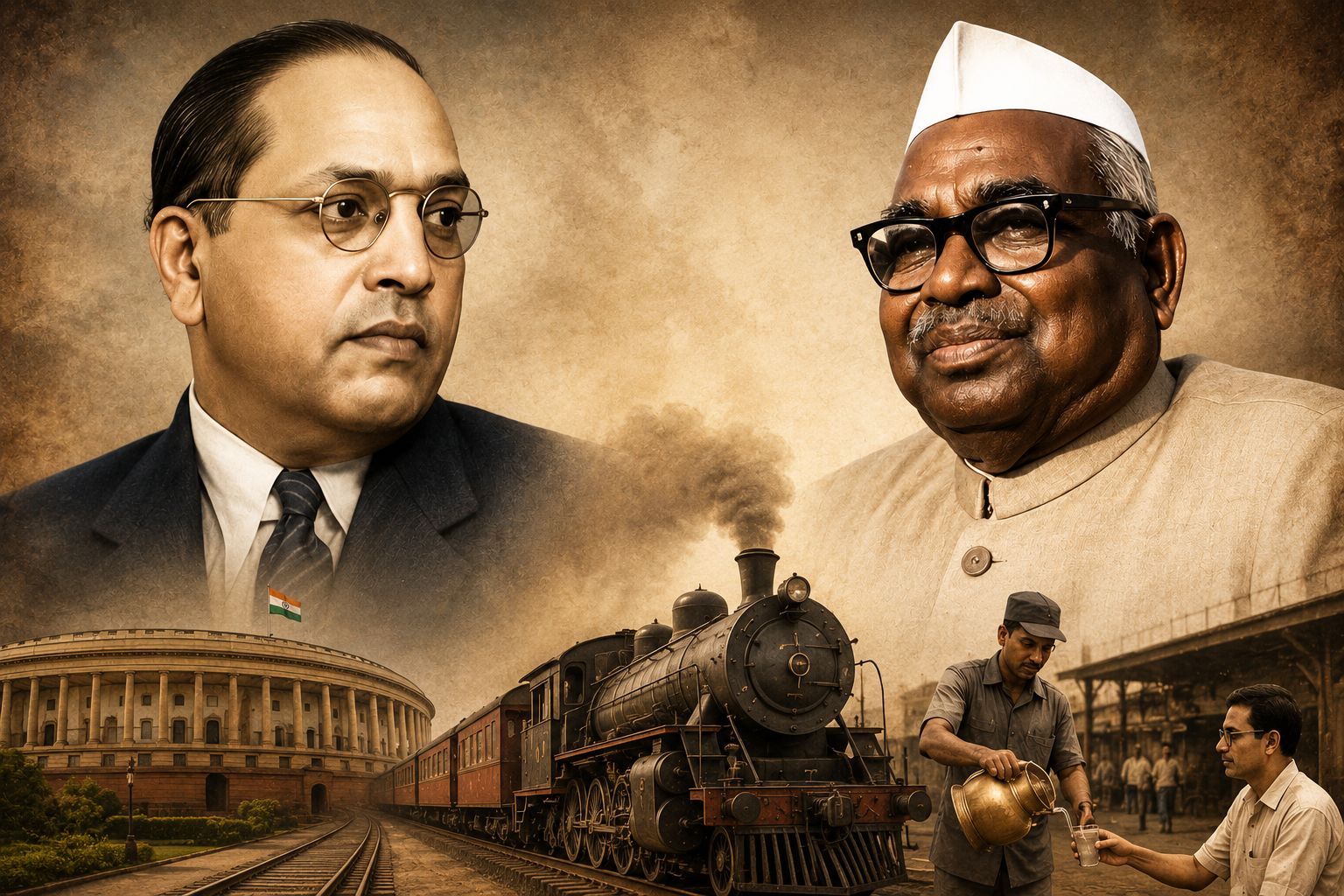
During his tenure, the Railways created the post popularly known as “Paani Pandey”, employees responsible for distributing drinking water to passengers on railway platforms. Preference for these positions was deliberately given to Scheduled Castes.
At first glance, this appears to be an ordinary employment measure. It was anything but ordinary.
Jagjivan Ram understood that untouchability was sustained not merely by laws but by everyday habits. On a scorching Indian afternoon, when a thirsty traveller arrived at a railway platform, caste prejudice collided with human necessity.
The traveller now had two choices: Drink water served by a Dalit employee or refuse water altogether. Jagjivan Ram had effectively forced Indian society to confront its own hypocrisy.
This was reservation employed not merely for economic uplift but for social transformation. Instead of reserving only elite bureaucratic positions, he reserved an everyday human interaction.
The message was unmistakable.
If one believed touching a Dalit was polluting, one would have to deny oneself water in the Indian summer. Few administrative decisions have challenged untouchability so directly.
Integration, not assimilation
Academic literature has often misunderstood Jagjivan Ram because it has tended to evaluate him through an Ambedkarite framework.
Peter Friedlander’s reassessment of Jagjivan Ram argues that his politics cannot be understood without appreciating his grounding in the Sant Ravidas tradition and the broader Shiv Narayani movement into which he was born. These traditions rejected caste discrimination while remaining firmly situated within a Hindu devotional universe. They emphasised equality, spiritual dignity and social reform without demanding that believers abandon Hindu civilisation.
This religious inheritance profoundly influenced Jagjivan Ram’s political philosophy.
Unlike many Congress politicians, religion was not merely a private matter for him.
Nor was it an obstacle to social justice. Rather, it became the moral foundation upon which he built his politics.
He organised Ravidas Sabhas across eastern India, promoted Ravidas Jayanti celebrations as platforms for Dalit mobilisation and worked for temple entry movements across the country. An Indian Express article published in 2016 noted that his efforts contributed to opening major temples, including Kashi Vishwanath, Meenakshi Temple and Jagannath Temple, to Dalits.
His vision therefore was neither assimilation nor separatism. It was integration with dignity.
Dalits would neither remain permanently subordinate nor withdraw from Hindu society.
They would reshape it.
Congress’s indispensable man but never its first choice
For nearly three decades, Jagjivan Ram remained indispensable to successive Congress governments. Few ministers matched his administrative versatility.
Yet when the highest constitutional offices became available, he repeatedly found himself overlooked.
In 1969, Indira Gandhi reportedly wanted Jagjivan Ram to become President of India. Internal opposition within the Congress Parliamentary Board prevented that outcome.
A decade later, after the collapse of the Morarji Desai government, Jagjivan Ram again appeared poised to create history by becoming India’s first Dalit Prime Minister.
Jagjivan Ram himself reportedly remarked with deep bitterness that in India, “a chamar can never become Prime Minister.”
The remark reflected the disappointment of a man who had devoted almost his entire adult life to public service.
Why Jagjivan Ram never became an ideological icon
Today, Ambedkar occupies a central place in India’s constitutional imagination. Jagjivan Ram does not. Part of the reason lies in their respective legacies.
Ambedkar left behind a corpus of constitutional, economic and philosophical writings that naturally became the foundation of an intellectual movement. But more importantly, he urged his supporters to walk away from Hinduism citing the caste system. That became a philosophical anchor for Marxist historians to wield as a weapon against Hinduism and poison impressionable minds with their propaganda.
On the other hand, Jagjivan Ram’s legacy was expressed primarily through governance. Yet there is another reason. Jagjivan Ram is difficult to appropriate. On top of that, Ram was unapologetic about his Hindu roots.
Congress remembers him as a loyal administrator but seldom foregrounds his unapologetic Hindu convictions or his categorical opposition to conversion.
The Left celebrates Ambedkar’s critique ofthe Hindu social order but finds little room for a Dalit icon who believed Hindu society could reform itself from within.
Ironically, Jagjivan Ram falls between two dominant narratives. To reduce him merely to a Congress loyalist is historically inaccurate. To dismiss him because he remained Hindu is intellectually impoverishing.
His politics represented a distinct school of Dalit thought, one that combined fierce opposition to untouchability with an equally fierce refusal to surrender Hindu civilisational inheritance.
Remembering Jagjivan Ram in full
History does not require us to choose between Ambedkar and Jagjivan Ram. Both worked towards social justice, expanded opportunities for millions of historically oppressed Indians. Both redefined social equality.
But where they differed was in their vision of how liberation could be achieved.
Ambedkar concluded that caste could not be annihilated without breaking decisively from the Hindu social order.
Jagjivan Ram believed that the battle had to be fought within that order until it yielded equality.
One sought transformation through rupture. The other sought transformation through reclamation.
On every July 6, therefore, India should remember Babu Jagjivan Ram not merely as its longest-serving Union Minister or the Deputy Prime Minister who almost became Prime Minister. He should also be remembered as the architect of an alternative intellectual tradition in Dalit politics, a tradition that insisted one could be uncompromising in the struggle against caste while remaining uncompromisingly Hindu.