Bharuch’s Jama Masjid was built after demolishing Hindu-Jain temples: What do historical records say? All you need to know
The Jama Masjid of Bharuch city has once again landed in controversy. Two days ago, saints from the Akhil Bharatiya Sant Samiti staged a protest, alleging that despite the mosque being protected by the Archaeological Survey of India (ASI), illegal construction had been carried out there in violation of archaeological regulations. Eventually, the police administration intervened and sought two months, assuring action. Trusting the police, the saints called off their protest. The matter now rests with the police. While more details about the protest and the saints’ demands are available separately, this episode has revived an old debate: was the Jama Masjid in Bharuch built after demolishing a temple? Did Hindu-Jain temples exist there in the past? What does history say, and what do contemporary records and books written at the time reveal? One of the most recent references appears in the book “Hindu Temples: What Happened to Them,” authored by Sitaram Goel. Although the book primarily focuses on the Ram Janmabhoomi dispute, it also contains a separate section listing places across India where temples were demolished, and mosques or other religious structures were built in their place. These lists are organised state-wise and district-wise. In the Gujarat section, when one looks at Bharuch, the very first entry is the Jama Masjid. It notes that the mosque was constructed in 1321 and that materials from Hindu-Jain temples were used in its construction. The second volume of “Hindu Temples: What Happened to Them”, titled “The Islamic Evidence”, also mentions this mosque. Citing Mughal-era documents, it states that pillars from Hindu-Jain temples were used in the Jama Masjid of Bharuch. Courtesy: Burgess’ book Several historical records agree that the Bharuch Jama Masjid was built during the reign of Alauddin Khilji. Khilji was an invader who attacked Hindu religious sites in India and destroyed numerous temples, including Somnath. Amir Khusrau writes that around 1300, Khilji targeted temples in Gujarat and sent Ulugh Khan for this purpose. Ulugh Khan first reached Somnath, where the temple was demolished and plundered, and then proceeded towards Khambhat. From there, he looted and destroyed temples in several coastal cities, Bharuch being one of them. British archaeologist James Burgess, born in the UK in 1832, conducted extensive archaeological work in India. He served as the Director General of the Archaeological Survey of India from 1886 to 1889 and earlier as Director of the Archaeological Survey, Western India. He documented what he observed during his travels across western India, later publishing several books. In his work “On the Muhammadan Architecture of Bharoch (Bharuch), Cambay, Dholka, Champaner and Mahmudabad in Gujarat”, Burgess mentions the Bharuch Jama Masjid. While describing the site, he writes that invasions began in Bharuch around 1297 on Khilji’s orders. During these attacks, Hindu temples were targeted and demolished, and, as seen elsewhere, materials from destroyed Hindu and Jain temples were used to construct the Jama Masjid. Courtesy: Burgess’ book Burgess provides detailed plans and photographs of the mosque, offering further clarity. He notes that the spacing between the pillars is uneven, 8 feet in some places, 10 feet in others, and even 13 feet elsewhere, resulting in irregularities in the domes above. According to Burgess, this inconsistency exists because materials from Hindu temples were reused in construction. Parts of the roof were taken from smaller domes of older Jain and Hindu temples, and some pillars feature animal carvings, indicating their temple origin. Burgess also points out that the mihrab (a semicircular niche in the wall) at the rear of the mosque is unlike typical mosques found in Gujarat, and its three mihrabs differ somewhat in architectural style. Regarding the courtyard, he writes that the marble gateway at its entrance is clearly from a Jain temple, with Jain figures still visible, though many have been defaced. A document titled “Bharuch District Directory Report” records that the ancient city was attacked during the Khilji’s time, and a Jain derasara (temple) was seized and converted into a mosque. The same report mentions another Jain shrine called Shamaliya Vihar, which was also later demolished and turned into a mosque under Muslim rule. The official website of the Bharuch District Collector likewise notes that the Jama Masjid was built using remnants of ancient Jain temples, largely from temple materials. It explicitly states that stones were taken from temples and that Hindu temple markers are visible in the mihrab. Importantly, there are no contradictions across these documents; all accounts corroborate one another. Even official government records affirm these details. References:– History of India as Told by Its Own Historians, H. M. Elliot– Hindu Temples: What Happened to Them, Volumes 1–2, Sita

The Jama Masjid of Bharuch city has once again landed in controversy. Two days ago, saints from the Akhil Bharatiya Sant Samiti staged a protest, alleging that despite the mosque being protected by the Archaeological Survey of India (ASI), illegal construction had been carried out there in violation of archaeological regulations. Eventually, the police administration intervened and sought two months, assuring action. Trusting the police, the saints called off their protest. The matter now rests with the police.
While more details about the protest and the saints’ demands are available separately, this episode has revived an old debate: was the Jama Masjid in Bharuch built after demolishing a temple? Did Hindu-Jain temples exist there in the past? What does history say, and what do contemporary records and books written at the time reveal?
One of the most recent references appears in the book “Hindu Temples: What Happened to Them,” authored by Sitaram Goel. Although the book primarily focuses on the Ram Janmabhoomi dispute, it also contains a separate section listing places across India where temples were demolished, and mosques or other religious structures were built in their place. These lists are organised state-wise and district-wise.
In the Gujarat section, when one looks at Bharuch, the very first entry is the Jama Masjid. It notes that the mosque was constructed in 1321 and that materials from Hindu-Jain temples were used in its construction.
The second volume of “Hindu Temples: What Happened to Them”, titled “The Islamic Evidence”, also mentions this mosque. Citing Mughal-era documents, it states that pillars from Hindu-Jain temples were used in the Jama Masjid of Bharuch.

Several historical records agree that the Bharuch Jama Masjid was built during the reign of Alauddin Khilji. Khilji was an invader who attacked Hindu religious sites in India and destroyed numerous temples, including Somnath.
Amir Khusrau writes that around 1300, Khilji targeted temples in Gujarat and sent Ulugh Khan for this purpose. Ulugh Khan first reached Somnath, where the temple was demolished and plundered, and then proceeded towards Khambhat. From there, he looted and destroyed temples in several coastal cities, Bharuch being one of them.
British archaeologist James Burgess, born in the UK in 1832, conducted extensive archaeological work in India. He served as the Director General of the Archaeological Survey of India from 1886 to 1889 and earlier as Director of the Archaeological Survey, Western India. He documented what he observed during his travels across western India, later publishing several books.
In his work “On the Muhammadan Architecture of Bharoch (Bharuch), Cambay, Dholka, Champaner and Mahmudabad in Gujarat”, Burgess mentions the Bharuch Jama Masjid. While describing the site, he writes that invasions began in Bharuch around 1297 on Khilji’s orders. During these attacks, Hindu temples were targeted and demolished, and, as seen elsewhere, materials from destroyed Hindu and Jain temples were used to construct the Jama Masjid.

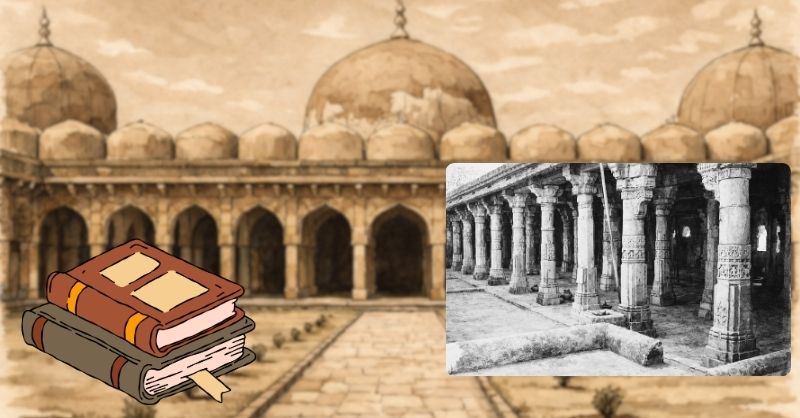
Burgess provides detailed plans and photographs of the mosque, offering further clarity. He notes that the spacing between the pillars is uneven, 8 feet in some places, 10 feet in others, and even 13 feet elsewhere, resulting in irregularities in the domes above. According to Burgess, this inconsistency exists because materials from Hindu temples were reused in construction. Parts of the roof were taken from smaller domes of older Jain and Hindu temples, and some pillars feature animal carvings, indicating their temple origin.
Burgess also points out that the mihrab (a semicircular niche in the wall) at the rear of the mosque is unlike typical mosques found in Gujarat, and its three mihrabs differ somewhat in architectural style. Regarding the courtyard, he writes that the marble gateway at its entrance is clearly from a Jain temple, with Jain figures still visible, though many have been defaced.

A document titled “Bharuch District Directory Report” records that the ancient city was attacked during the Khilji’s time, and a Jain derasara (temple) was seized and converted into a mosque. The same report mentions another Jain shrine called Shamaliya Vihar, which was also later demolished and turned into a mosque under Muslim rule.
The official website of the Bharuch District Collector likewise notes that the Jama Masjid was built using remnants of ancient Jain temples, largely from temple materials. It explicitly states that stones were taken from temples and that Hindu temple markers are visible in the mihrab.
Importantly, there are no contradictions across these documents; all accounts corroborate one another. Even official government records affirm these details.
References:
– History of India as Told by Its Own Historians, H. M. Elliot
– Hindu Temples: What Happened to Them, Volumes 1–2, Sitaram Goel
– On the Muhammadan Architecture of Bharoch (Bharuch), Cambay, Dholka, Champaner and Mahmudabad in Gujarat, James Burgess