Labour’s Islamophobia push and the price of appeasement: Hindus and Sikhs in the UK push back against a definition that risks turning criticism of Islam into a punishable offence
In the United Kingdom, a massive row has erupted over the new Islamophobia definition that the Labour government is set to propose. The leaders of the British Hindu and Sikh communities have raised concerns that the new definition of what it calls “anti-Muslim hatred” will have a “significant chilling effect” on freedom of speech. The proposed Islamophobia definition that has sparked debate in the UK In December 2025, the BBC reported on the draft definition of anti-Muslim hatred or ‘Islamophobia’. The BBC reported that the Working Group on Anti-Muslim Hatred/Islamophobia has submitted its draft for adoption. While the draft excluded the term ‘Islamophobia’, the definition itself came under fire for leaving a window for its weaponisation. The Working Group formed in February 2025 submitted its draft in October. The Group is chaired by Dominic Grieve KC, Professor Javed Khan, Baroness Shaista Gohir, Akeela Ahmed, and Asha Affi. In a statement issued on 15th December 2025, Shaista Gohir confirmed that the new Islamophobia definition BBC reported is the same as the one submitted by the Working Group to the government in October. Gohir also urged the Labour government to adopt the definition “if it cares about the safety of Muslims.” My statement on the Islamophobia definition which is not called Islamophobia – I urge the govt to adopt it if it cares about the safety of Muslims. pic.twitter.com/0AeiWQjrun— Baroness Gohir OBE (@ShaistaGohir) December 15, 2025 The Group states that the definition will be non-statutory, meaning that it will not be legally binding but will provide guidance to government and other bodies about what actions constitute Islamophobia or anti-Muslim hatred. The draft definition reads, “Anti-Muslim hostility is engaging in or encouraging criminal acts, including acts of violence, vandalism of property, and harassment and intimidation, whether physical, verbal, written or electronically communicated, which is directed at Muslims or those perceived to be Muslims because of their religion, ethnicity or appearance.” It adds, “It is also the prejudicial stereotyping and racialisation of Muslims, as part of a collective group with set characteristics, to stir up hatred against them, irrespective of their actual opinions, beliefs or actions as individuals.” “It is engaging in prohibited discrimination where the relevant conduct – including the creation or use of practices and biases within institutions – is intended to disadvantage Muslims in public and economic life,” the definition further includes. Hindu Council UK calls out the many problematic aspects of the new Islamophobia definition On 29th December, the Hindu Council UK wrote a letter to Communities Secretary Steve Reed, cautioning that the draft definition of Islamophobia is deeply flawed and will have serious consequences if it ends up being adopted officially. In the letter signed by Dipen Rajyaguru, Director of Equality and Inclusion, the Hindu Council UK said, “…having carefully reviewed the proposed definition, and drawing on concerns raised by our community Hindu Council UK, other organisations and commentators as well as extensive criticism of the earlier APPG definition of Islamophobia we believe the current proposal is deeply flawed and risks serious unintended consequences.” In a pointwise fashion, the Council detailed why it believes the draft Islamophobia definition is problematic. Under the first point, “Lack of Clarity and Overly Broad Language”, the Hindu Council said that the new definition introduces vague and undefined concepts like “prejudicial stereotyping”, racialisation of Muslims”, “collective group with set characteristics”, “stir up hatred”, “practices and biases within institutions”. Asserting that these terms lack clear legal meaning, the Council said, “From a Hindu perspective, this ambiguity is dangerous. It leaves interpretation open to subjective perception rather than objective legal standards, making the definition vulnerable to inconsistent application and politicisation.” Under the second point, “Conflation of People with Beliefs and Ideas,” the Hindu Council stresses a concern shared by not only Hindu but Sikh, Christian, secular, and free-speech organisations that the new definition “fails to clearly distinguish between hostility towards Muslims as people and criticism of Islam as a belief system.” The Council pointed out that by referring to “racialisation” and “collective characteristics”, the definition “risks treating a religion and its associated ideas, doctrines, and practices as if they were immune from critique.” The Council said that Hindu intellectuals often indulge in discussions of theological differences between dharmic traditions and Islam, historical events involving Islamic rule in South Asia, contemporary issues such as extremism, apostasy laws, or treatment of minorities and Women in Muslim-majority societies like Bangla
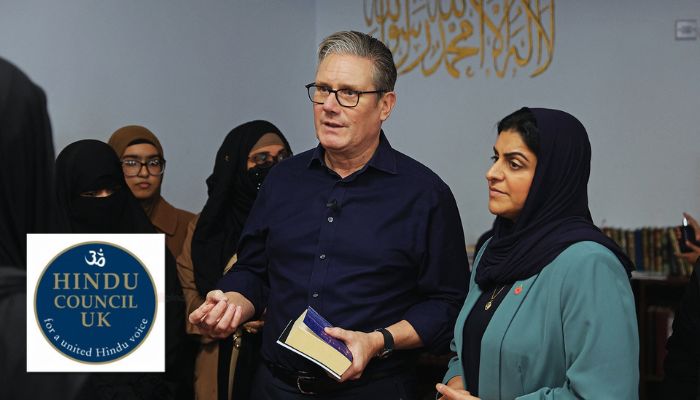

In the United Kingdom, a massive row has erupted over the new Islamophobia definition that the Labour government is set to propose. The leaders of the British Hindu and Sikh communities have raised concerns that the new definition of what it calls “anti-Muslim hatred” will have a “significant chilling effect” on freedom of speech.
The proposed Islamophobia definition that has sparked debate in the UK
In December 2025, the BBC reported on the draft definition of anti-Muslim hatred or ‘Islamophobia’. The BBC reported that the Working Group on Anti-Muslim Hatred/Islamophobia has submitted its draft for adoption. While the draft excluded the term ‘Islamophobia’, the definition itself came under fire for leaving a window for its weaponisation.
The Working Group formed in February 2025 submitted its draft in October. The Group is chaired by Dominic Grieve KC, Professor Javed Khan, Baroness Shaista Gohir, Akeela Ahmed, and Asha Affi.

In a statement issued on 15th December 2025, Shaista Gohir confirmed that the new Islamophobia definition BBC reported is the same as the one submitted by the Working Group to the government in October. Gohir also urged the Labour government to adopt the definition “if it cares about the safety of Muslims.”
My statement on the Islamophobia definition which is not called Islamophobia – I urge the govt to adopt it if it cares about the safety of Muslims. pic.twitter.com/0AeiWQjrun
— Baroness Gohir OBE (@ShaistaGohir) December 15, 2025
The Group states that the definition will be non-statutory, meaning that it will not be legally binding but will provide guidance to government and other bodies about what actions constitute Islamophobia or anti-Muslim hatred.

The draft definition reads, “Anti-Muslim hostility is engaging in or encouraging criminal acts, including acts of violence, vandalism of property, and harassment and intimidation, whether physical, verbal, written or electronically communicated, which is directed at Muslims or those perceived to be Muslims because of their religion, ethnicity or appearance.”
It adds, “It is also the prejudicial stereotyping and racialisation of Muslims, as part of a collective group with set characteristics, to stir up hatred against them, irrespective of their actual opinions, beliefs or actions as individuals.”
“It is engaging in prohibited discrimination where the relevant conduct – including the creation or use of practices and biases within institutions – is intended to disadvantage Muslims in public and economic life,” the definition further includes.
Hindu Council UK calls out the many problematic aspects of the new Islamophobia definition
On 29th December, the Hindu Council UK wrote a letter to Communities Secretary Steve Reed, cautioning that the draft definition of Islamophobia is deeply flawed and will have serious consequences if it ends up being adopted officially.
In the letter signed by Dipen Rajyaguru, Director of Equality and Inclusion, the Hindu Council UK said, “…having carefully reviewed the proposed definition, and drawing on concerns raised by our community Hindu Council UK, other organisations and commentators as well as extensive criticism of the earlier APPG definition of Islamophobia we believe the current proposal is deeply flawed and risks serious unintended consequences.”
In a pointwise fashion, the Council detailed why it believes the draft Islamophobia definition is problematic. Under the first point, “Lack of Clarity and Overly Broad Language”, the Hindu Council said that the new definition introduces vague and undefined concepts like “prejudicial stereotyping”, racialisation of Muslims”, “collective group with set characteristics”, “stir up hatred”, “practices and biases within institutions”.
Asserting that these terms lack clear legal meaning, the Council said, “From a Hindu perspective, this ambiguity is dangerous. It leaves interpretation open to subjective perception rather than objective legal standards, making the definition vulnerable to inconsistent application and politicisation.”
Under the second point, “Conflation of People with Beliefs and Ideas,” the Hindu Council stresses a concern shared by not only Hindu but Sikh, Christian, secular, and free-speech organisations that the new definition “fails to clearly distinguish between hostility towards Muslims as people and criticism of Islam as a belief system.”
The Council pointed out that by referring to “racialisation” and “collective characteristics”, the definition “risks treating a religion and its associated ideas, doctrines, and practices as if they were immune from critique.”
The Council said that Hindu intellectuals often indulge in discussions of theological differences between dharmic traditions and Islam, historical events involving Islamic rule in South Asia, contemporary issues such as extremism, apostasy laws, or treatment of minorities and Women in Muslim-majority societies like Bangladesh.
However, the proposed definition, the Hindu Council asserted, risks such discussions getting characterised as “prejudicial stereotyping” or “stirring up hatred”, regardless of factual basis or intent.
Under the third point, the Council raised concern that the new Islamophobia definition could result in infringement of freedom of expression.
The Council expressed apprehension that, despite claiming that the definition targets hostility rather than debate, “its breadth creates a significant chilling effect on free speech.”
“For minority communities such as Hindus and other Dharmic Traditions, this presents a serious risk. Narratives about historical persecution under Islamic empires, or discussion of contemporary Islamist ideology, could be suppressed out of fear of breaching a poorly defined standard of “anti-Muslim hostility.”
Another important concern raised by the Hindu Council is the de facto reintroduction of blasphemy laws. The Council stated that the new definition risks “operating as a de facto blasphemy framework, even if this is not the Government’s intention.”
The Council said that the introduction of terms like “racialisation” and “collective stereotyping” in the new Islamophobia definition risks shielding Islamic beliefs and practices from scrutiny, “in practice, if not in law.”
“In summary, the Muslims we know who we estimate to be the 99% majority would not have inserted words like ‘hostility for hatred’ and the last paragraph, which attempts to protect any criticism of Islamist radicalisation, just as the old definition attempted to protect the Grooming Gangs with their Muslimness,” the Hindu Council stated.
Furthermore, the Hindu Council UK stated the new definition could result in the weaponisation of complaints, institutional overreach, two-tier protection of religions, and the embedding of the initially “non-statutory” wording into public policies eventually.

Labour Party’s adoption of an outrageously biased ‘Islamophobia’ definition
This is not the first time that the Labour Party has resorted to blatant Muslim appeasement. While the Keir Starmer-led Labour government is now proceeding towards adopting an anti-Muslim hatred definition, years back, the Labour Party adopted a document that ‘broadened’ the definition of Islamophobia.
In 2019, the Labour Party adopted the All-Party Parliamentary Group on British Muslims (APPG) definition of Islamophobia. Back in 2018, the All-Party Parliamentary Group on British Muslims proposed that there should be a ‘legally binding’ definition of Islamophobia. While there already are laws covering religion-based hate crimes and discrimination, the definition sought to expand the scope of what was deemed criminal under the existing legal framework, particularly in the context of criticism directed towards Muslims.

“Islamophobia is rooted in racism and is a type of racism that targets expressions of Muslimness or perceived Muslimness,” the definition proposed by the APPG on British Muslims, co-chaired by Anna Soubry and Wes Streeting, reads.
In their Foreword to the APPG report, Wes Streeting and Anna Soubry advocated for the definition of Islamophobia to be adopted by the government, statutory agencies, and civil society organisations. This would allow them to challenge Islamophobia through various channels such as politics, policymaking, media, society, and education.
The APPG’s reasoning behind expanding the scope of Islamophobia was highly outrageous and was steeped in pro-Muslim bias. The APPG asserted that criticising Islam amounts to anti-Muslim racism. It said that terms like ‘Asian grooming gangs’ or ‘Bin Laden’ (notice the inverted commas used by the APPG) are a modern-day iteration of “anti-Islam tropes”
Terms like “racialisation” found in the new draft definition of Islamophobia can be traced to the 2018 report of the APPG on Muslims.
“From the numerous victim forms we were able to collect, we found several themes that served to reinforce the evidence presented to us by academic experts and community activists. We found that the racialisation of Muslims has palpable consequences, with both Asian, Black and white convert Muslims being targeted for abuse on grounds of their Muslimness. We also found that age-old stereotypes and tropes about Islam, such as sexual profligacy and paedophilia or Islam and violence, and their modern-day iteration in the ‘Asian grooming gangs’ or ‘Bin Laden’ labels re-emerge in discourses and dispositions which heighten vulnerability of Muslims to hate crimes,” the propaganda report by APPG on British Muslims read.
The APPG, in its desperation to make Muslims and Islam sacrosanct to criticism of any form, deemed even accusing Muslims of exaggerating or inventing Islamophobia, genocide of Muslims, as an example of Islamophobia. In simple words, even Muslims play false victimhood, which they do in most cases, if not all, exaggerating isolated incidents of criticism or violence against a Muslim person or group as a targeted attack on the entire community. Others cannot call them out because if they do, they will be declared ‘Islamophobic’ and may face legal consequences.

.Interestingly, the APPG on British Muslims also asserted that “denying Muslim populations the right to self -determination e.g., by claiming that the existence of an independent Palestine or Kashmir is a terrorist endeavour,” would also be Islamophobic.
The APPG on Muslims did not attempt to accommodate Islamic sentiments or protect the community against unwarranted criticism; rather, the UK’s parliamentary body ceded freedom of expression and common sense to legalise the weaponisation of Islamophobia.
Since the Labour Party adopted this deeply flawed definition of Islamophobia, the Labour government later also attempted to formally adopt this definition. In August 2024, it was reported that the Labour government was considering adopting the APPG for British Muslims’ definition of Islamophobia.
The new draft Islamophobia definition proposed by the Working Group on Anti-Muslim Hatred/Islamophobia Definition is evidently the old APPG product in a new packaging.
This is alarming. It must not be forgotten how the Labour government tried to suppress criticism of Pakistani-Muslim grooming gangs. It was seen how the fears of appearing Islamophobic and racially insensitive prevented UK authorities from effectively acting against Pakistani Muslim groomers/rapists for years, and now the Labour Party, which has adopted the flawed Islamophobia definition, is dismissing those criticising Muslim grooming gangs as “far-right” in an apparent attempt to make the Muslim community sacrosanct to criticism.
Prime Minister Keir Starmer earlier rejected a national inquiry into the Pakistani-Muslim grooming gangs, apparently, inspired by the Islamophobia definition his party adopted, to avoid coming across as an Islamophobe.
OpIndia reported earlier how, in many cases involving Pakistani-Muslim grooming/rape gangs, instead of arresting the rapists, the police ended up arresting the victims and their families. This was commonly due to a failure to probe the grooming part, in most cases a deliberate cover-up to avoid appearing Islamophobic, culturally insensitive and racially prejudiced, with young victims being treated as offenders for small violations while still in contact with their abusers.
For years, the fear of being labelled Islamophobic or indulging in ‘racial profiling’ prevented the police from taking decisive action against Muslim rape gangs in the UK. The Labour Party’s political perversion further worsened the situation.
It must be recalled how Sarah Champion, a Labour Party MP, had to apologise for an article published in The Sun in 2017 wherein she wrote that “Britain has a problem with British Pakistani men raping and exploiting white girls”.
In 2012, Keith Vaz, a Labour Party leader and Chair of the Home Affairs Select Committee, downplayed the grooming jihad crimes, calling them not racially motivated and emphasising that the entire community should not be ‘stigmatised’. His overemphasis on not singling out the identity of the grooming gang members reflected the Labour Party’s appeasement politics and downplayed the crimes of the grooming gangs involving men of Pakistani origin.
In 2011, former Home Secretary Jack Straw attributed the cultural practices of Pakistani men to their crimes against white girls. He said that Pakistani men see white girls as “easy meat.”
A Nottingham Crown Court judge who convicted two Pakistani men who groomed and raped several minor white girls downplayed the identity of the perpetrators by asserting that the race of both the victims and the abusers was ‘coincidental’.
The collective failure of the British governments and law enforcement authorities in bringing Muslim grooming/rape gangs, which targeted thousands of non-Muslim minor and adult girls for over two decades, stems from the idea of avoiding being ‘Islamophobic’. It must also not be forgotten that even the British media, for a long period of time, refrained from calling the Muslim rape gangs what they are, but chose the broader and rather vague term, “South Asian grooming gangs.” Such terminology is fundamentally flawed and dishonest, as grooming Jihad or rape jihad is not a racial crime committed by South Asians against other races but an Islamist crime against non-Muslims.
Islamophobia is used as an excuse to suppress dissent, and legitimising it is suicidal
Islamist takeover of the UK is ongoing in full swing, through demographic shifts and other means. Yes, instead of cracking down on Islamists, Labour is coddling them and legitimising the ‘Islamophobia’ shield Islamists use to silence the victims of Islamic terrorism and extremism of other forms, gaslight critical voices, and weaponise it against other religious groups, allowing Islamists to assert religious dominance.
It must not be forgotten how the 2022 anti-Hindu Leicester violence carried out by Muslim mobs was dubbed a ‘Hindutva’ inspired riot. And, how deliberately floated and amplified rumours of Hindus attacking Muslims and doing blasphemy against Islam triggered Muslims to attack Hindus. The government adopting any definition of Islamophobia which enables Muslims to arbitrarily accuse members of other religious communities of Islamophobia, would expose the latter to threats, stigma and villainisation.
If a formal definition that essentially makes Muslims and Islam sacrosanct from criticism, and leaves a window for Muslims to bring up false Islamophobia complaints against non-Muslims, then, despite its non-binding nature, the definition will influence policies in such a manner that non-Muslim communities will be relegated to the status of second-class citizens in the UK.