Can the Centre really withdraw FIRs against hooligans who indulged in violence during CJP protest? Here is what the law says
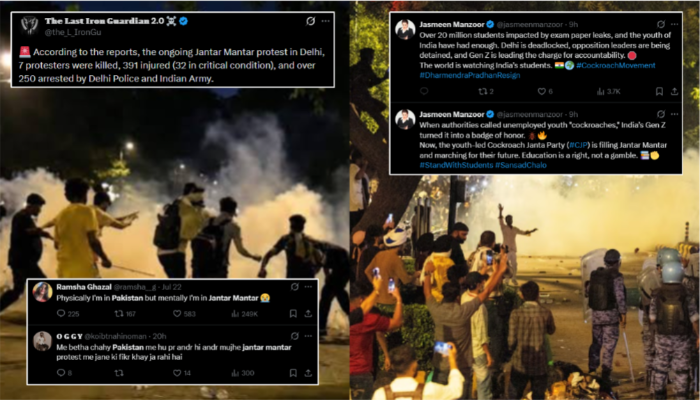
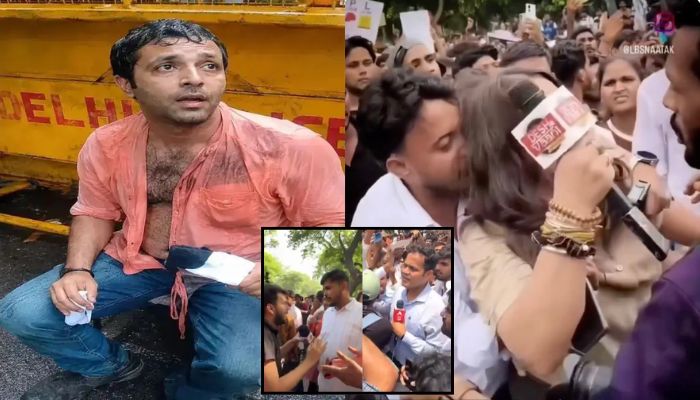
The recent Cockroach Janta Party (CJP) protests triggered by the NEET paper leak ended after the Centre promised to fulfil all their demands, including the resignation of the Education Minister Dharmendra Pradhan. The protests took a dangerous turn on Monday, July 20, when the CJP decided to march to Parliament, where the Monsoon Session was about to start, through a high-security area, beyond the Jantar Mantar site. It is notable here that the permission for protest was only for the Jantar Mantar site, not beyond that. The protestors continued to hold up at Jantar Mantar until 20th July, when, during an unauthorised march to the Parliament, incidents of stone pelting and clashes with security personnel happened. The CJP leaders continued to press their demands as the ‘protesters’ held the state to ransom by creating a ruckus on the streets of the national capital. Are the CJP and its ‘protesters’ above the law? One of the demands put forward by the CJP leaders was a promise from the government not to take any coercive action against any of the ‘protestors’, including those who attacked police personnel, created a ruckus, and vandalised public property during the protests, and to withdraw the FIRs already filed against such ‘protestors’. Clearly, the party was trying to shield the hooligans who helped it build pressure on the government through violence, triggering the use of force by the security personnel. A scrutiny carried out by the Delhi Police of people present at and around the Cockroach Janta Party’s (CJP) protest at Jantar Mantar has found that a large number of those in the crowd had previous criminal records. Surprisingly, and to the disappointment of ordinary, law-abiding citizens of the country, the central government conceded to this demand as well. The decision of the government leaves the ordinary citizens of the country with many questions, such as: Can the government be blackmailed into surrendering to anti-social elements and watching vandals, who damaged not just material things but the social fabric itself, walk free? Or, in legal terms, can the executive/government really stop the course of law already set in motion? Or is the government legally empowered to withdraw FIRs filed against individuals who held the state to ransom? Let’s take a look at the law to find answers to these questions. A crime is a wrong against the state Criminal jurisprudence treats an offence as a wrong against the entire society and not just against an individual. This is the reason that whenever a crime is committed, the state steps in to prosecute the offender. This rule acts as a legal safeguard intended to protect the rights of vulnerable victims and maintain peace and order in society. An extension of this legal safeguard is the rule that once the legal machinery is kicked into motion, it cannot be stopped without the permission of the court. One of the ways to kick the legal machinery into motion is by filing an FIR regarding a crime that has been committed. Once an FIR is registered regarding the commission of a crime, it cannot be cancelled or withdrawn without the court’s approval. The rationale behind the unwritten rule is to protect the victim from being pressured into not taking legal action against an influential or powerful offender. In the present scenario, even though the government promised to withdraw all the FIRs registered against violent protesters, it cannot directly do so. However, there are certain legal provisions that allow for the withdrawal of an FIR or the stopping of legal proceedings. Let’s take a look at them. An out-of-court settlement There is a legal provision in the Bharatiya Nagarik Suraksha Sanhita, 2023, that allows parties in a criminal trial to ‘settle’ the case out of court or without undergoing a full trial. However, this is only allowed in certain minor offences, usually affecting private interests, which have been categorised as compoundable offences under the BNSS. Compoundable offences are listed under and governed by Section 359 of the BNSS. Some examples of compoundable offences are simple hurt, cheating, house-trespass, some cases of wrongful restraint, and theft. Serious offences like rape, murder, rioting, and dacoity are not compoundable. While some compoundable offences can be settled without the court’s permission, others require the court’s approval. The government will not be able to make use of this provision as the acts of violence committed during the CJP protests, such as attacking security personnel, stone pelting, and damaging police vehicles and public property, certainly do not fall within the category of compoundable offences. Cancellation or withdrawal of an FIR Well, thankfully, it is beyond the power of the executive to withdraw a case or an FIR once it is filed. Once an FIR is registered, the judiciary takes over the matter. The executive cannot order the concerned police station to withdraw an
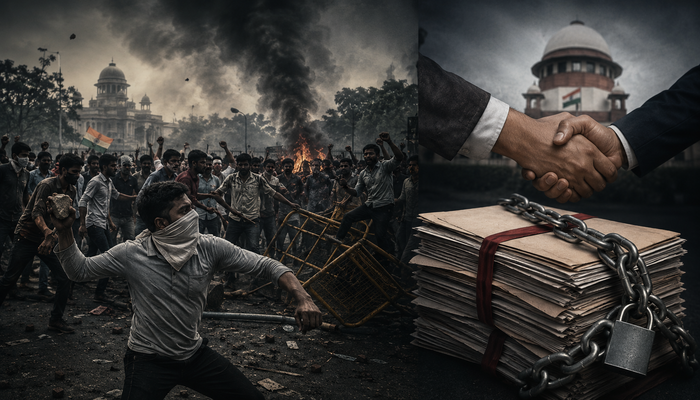
The recent Cockroach Janta Party (CJP) protests triggered by the NEET paper leak ended after the Centre promised to fulfil all their demands, including the resignation of the Education Minister Dharmendra Pradhan. The protests took a dangerous turn on Monday, July 20, when the CJP decided to march to Parliament, where the Monsoon Session was about to start, through a high-security area, beyond the Jantar Mantar site. It is notable here that the permission for protest was only for the Jantar Mantar site, not beyond that.
The protestors continued to hold up at Jantar Mantar until 20th July, when, during an unauthorised march to the Parliament, incidents of stone pelting and clashes with security personnel happened. The CJP leaders continued to press their demands as the ‘protesters’ held the state to ransom by creating a ruckus on the streets of the national capital.
Are the CJP and its ‘protesters’ above the law?
One of the demands put forward by the CJP leaders was a promise from the government not to take any coercive action against any of the ‘protestors’, including those who attacked police personnel, created a ruckus, and vandalised public property during the protests, and to withdraw the FIRs already filed against such ‘protestors’.
Clearly, the party was trying to shield the hooligans who helped it build pressure on the government through violence, triggering the use of force by the security personnel. A scrutiny carried out by the Delhi Police of people present at and around the Cockroach Janta Party’s (CJP) protest at Jantar Mantar has found that a large number of those in the crowd had previous criminal records.
Surprisingly, and to the disappointment of ordinary, law-abiding citizens of the country, the central government conceded to this demand as well. The decision of the government leaves the ordinary citizens of the country with many questions, such as: Can the government be blackmailed into surrendering to anti-social elements and watching vandals, who damaged not just material things but the social fabric itself, walk free? Or, in legal terms, can the executive/government really stop the course of law already set in motion? Or is the government legally empowered to withdraw FIRs filed against individuals who held the state to ransom? Let’s take a look at the law to find answers to these questions.
A crime is a wrong against the state
Criminal jurisprudence treats an offence as a wrong against the entire society and not just against an individual. This is the reason that whenever a crime is committed, the state steps in to prosecute the offender. This rule acts as a legal safeguard intended to protect the rights of vulnerable victims and maintain peace and order in society. An extension of this legal safeguard is the rule that once the legal machinery is kicked into motion, it cannot be stopped without the permission of the court.
One of the ways to kick the legal machinery into motion is by filing an FIR regarding a crime that has been committed. Once an FIR is registered regarding the commission of a crime, it cannot be cancelled or withdrawn without the court’s approval. The rationale behind the unwritten rule is to protect the victim from being pressured into not taking legal action against an influential or powerful offender.
In the present scenario, even though the government promised to withdraw all the FIRs registered against violent protesters, it cannot directly do so. However, there are certain legal provisions that allow for the withdrawal of an FIR or the stopping of legal proceedings. Let’s take a look at them.
An out-of-court settlement
There is a legal provision in the Bharatiya Nagarik Suraksha Sanhita, 2023, that allows parties in a criminal trial to ‘settle’ the case out of court or without undergoing a full trial. However, this is only allowed in certain minor offences, usually affecting private interests, which have been categorised as compoundable offences under the BNSS.
Compoundable offences are listed under and governed by Section 359 of the BNSS. Some examples of compoundable offences are simple hurt, cheating, house-trespass, some cases of wrongful restraint, and theft. Serious offences like rape, murder, rioting, and dacoity are not compoundable. While some compoundable offences can be settled without the court’s permission, others require the court’s approval.
The government will not be able to make use of this provision as the acts of violence committed during the CJP protests, such as attacking security personnel, stone pelting, and damaging police vehicles and public property, certainly do not fall within the category of compoundable offences.
Cancellation or withdrawal of an FIR
Well, thankfully, it is beyond the power of the executive to withdraw a case or an FIR once it is filed. Once an FIR is registered, the judiciary takes over the matter. The executive cannot order the concerned police station to withdraw an FIR or command the concerned court/magistrate not to proceed based on the FIR. This protects a victim and even a weak state from surrendering to brute force.
This makes one wonder, if the law does not confer the executive with the power to cancel or withdraw an FIR, why did the government promise to withdraw all FIRs filed against violent protestors? Well, there is another way the accused can still be discharged or acquitted, or the case can be closed, which is a closure report by the police.
A closure report
A closure report or final report is filed by the police under Section 193 of the BNSS after completing the investigation. The report is filed in cases where the police fail to find any evidence prima facie indicating the commission of the crime disclosed in the FIR, fail to trace the accused, or find that the complaint was false.
That’s not it. Filing a closure report does not itself close the case; it depends on the court’s satisfaction whether it will accept the closure report or order further investigation. If the court is satisfied with the police’s investigation, it can accept the closure report and close the case. In that case, the FIR remains on record, but the case is closed. But if the court is not satisfied with the police’s findings, it can order further investigation.
So in the present situation, the police may, on tacit direction of the government, try this route and file closure reports in all the FIRs registered against violent protestors. But considering that the entire country, including the courts, witnessed the CJP protests turn violent, and the acts of perpetrators being recorded on phone cameras and CCTV, using this route would be challenging for the government. Besides, the final decision to close the case would depend on the discretion of the court.
Withdrawal of prosecution
Another way in which the Indian criminal law allows for stopping legal proceedings after the filing of an FIR is through the public prosecutor. Under Section 360 of the BNSS, the public prosecutor may seek permission from the court for the withdrawal of an FIR. But in this situation as well, the final decision rests with the court.
While making such a request, the public prosecutor needs to first show the court that he/she had the Central government’s permission to make the request for withdrawal. The court then examines the request to ensure that it was made in good faith, in the interest of justice, not under political influence, and not to protect influential people. If the court is satisfied that the withdrawal of the prosecution serves the interest of justice, it may allow it.
However, here too, where both the vandalism and the subsequent promise of the Centre not to take coercive action against the miscreants were so public, it would be challenging for the public prosecutor to convince the court that the withdrawal would serve the interests of justice.
Besides, the provision bars the public prosecutor from seeking permission for withdrawal in cases involving damage to public property belonging to the central government. Therefore, the FIRs disclosing that the protestors openly damaged public and government property cannot be withdrawn using this provision.
Quashing of FIRs
The Supreme Court and the High Court can use their inherent powers to quash an FIR if this is needed to prevent the abuse of the process of law and secure the ends of justice. The power is exercised rarely but certainly when the Supreme Court or a High Court is satisfied that this is required for doing complete justice in a case. However, the current scenario does not seem to fit the case. Quashing FIRs filed against ‘protestors’ who publicly indulged in acts of vandalism and violence would definitely not serve the ends of justice.
The Supreme Court mulls an independent investigation
Meanwhile, the Supreme Court has adopted a stern approach and clearly stated that whoever took the law into their own hands during the CJP protests must face the law. The court passed an interim order allowing authorities to continue the investigation into the FIR already registered.
Chief Justice of India Surya Kant said that an independent probe must investigate the allegations both against the police and protestors. The top court, however, directed the states, where similar protests were held, to release protestors with no criminal past.
The Apex Court’s stance did not sit right with the CJP leadership, who behave as if they and their hooligans are above the law. The CJP wanted to secure immunity for the goondas, who caused havoc during the protests, and help them evade the law using the government’s word. It goes without saying that the CJP’s demand to allow hoodlums to get away with their illegal acts has neither a legal nor a moral basis.
People living in civilised societies governed by law cannot be allowed to evade the law by mutual agreements. For a functional democracy governed by the rule of law, it is imperative that those who violate the law, be they protestors or ordinary citizens, face the consequences of their actions. If anti-social elements are allowed to scot free after brazenly committing violence, it would lead to complete chaos and a state of anarchy, which the CJP claims to fight.