Crying ‘hate speech’ ahead of Eid after Islamists lynched a Hindu man on Holi: How Harsh Mander-linked APCR’s PIL seeks to shift focus from Tarun’s murder to Muslim victimhood
In the aftermath of the brutal killing of 26-year-old Tarun Kumar in Delhi’s Uttam Nagar during Holi, a familiar pattern has begun to emerge in India’s activist-legal ecosystem. The Association for Protection of Civil Rights (APCR) has approached the Delhi High Court with a Public Interest Litigation (PIL), seeking urgent intervention to curb alleged hate speech against Muslims ahead of Eid. The petition invokes fears of communal unrest, citing inflammatory slogans, social media mobilisation, and apprehensions of violence around the festival period. At a superficial level, the plea positions itself as a constitutional intervention aimed at preserving communal harmony. However, when examined against the factual matrix of the Uttam Nagar incident and the institutional history of APCR, the move appears less like a neutral rights-based intervention and more like a calibrated attempt at narrative management, one that shifts focus away from the triggering act of violence and toward a selectively constructed discourse of victimhood. The Uttam Nagar killing: A triggering event reframed The facts of the Uttam Nagar incident are neither ambiguous nor disputed in their broad contours. During Holi celebrations, an 11-year-old girl from Tarun Kumar’s family threw a water balloon from her terrace, intending to hit her father. The balloon missed its intended target and splashed water on a woman from a neighbouring Muslim family. What followed initially was a verbal altercation, which, according to both police accounts and family statements, was resolved after an apology from the Hindu family. Ordinarily, such an incident would have ended there, a minor dispute during a festive celebration. However, the situation took a violent turn later in the evening. As Tarun was returning home after celebrating Holi, he was intercepted by a group of 15 to 20 people from the neighbouring community. He was brutally assaulted with iron rods, bricks, and stones. When his family members rushed to save him, they too were attacked. Several people were injured in the clash, including Tarun’s father and uncle. Tarun himself sustained severe injuries and succumbed to them the following day. The absence of prior enmity between the families underscores the disproportionate nature of the violence. This was not a long-standing feud spiralling out of control; it was a targeted act of retaliation following an accidental and already-resolved incident. The brutality of the assault and the scale of mobilisation involved indicate premeditation rather than spontaneity. Yet, in APCR’s petition, this sequence is subtly but significantly reinterpreted. The killing is framed as a “local incident” that was later “communalised” through protests and public discourse. By doing so, the petition shifts analytical attention away from the act of violence itself and toward the reactions that followed it. This reframing is not incidental; it is foundational to how the narrative is constructed. From violence to “Hate Speech”: The strategic pivot The core of APCR’s petition does not dwell on the killing of Tarun Kumar. Instead, it foregrounds allegations of hate speech, inflammatory slogans, and the mobilisation of protests such as “Akrosh Sabhas.” The petition claims that these developments have created an atmosphere of fear among Muslims, particularly in the run-up to Eid. It refers to slogans allegedly advocating violence, economic boycotts, and even the disruption of Eid celebrations. In doing so, the petition executes a strategic pivot: it transforms the discourse from one centred on a mob killing to one centred on alleged majoritarian aggression. The causal chain is effectively inverted. The initial act of violence becomes a background detail, while the subsequent reaction is elevated as the primary concern. This inversion has significant implications. In legal terms, it seeks to reframe the issue before the court, from one of criminal accountability for a killing to one of preventive policing against potential hate speech. In political terms, it repositions the community associated with the perpetrators as the one under threat. And in narrative terms, it aligns the incident with a broader template of minority victimhood that has become a recurring motif in activist discourse. Litigation as narrative: The use of PILs Public Interest Litigation in India has historically served as a powerful tool for expanding rights and ensuring accountability. However, it has also increasingly been used as an instrument of what can be termed “narrative litigation,” where the objective extends beyond legal relief to shaping public discourse and institutional perception. APCR’s petition fits squarely within this framework. By invoking phrases such as “coordinated dissemination of inflammatory content,” “economic boycott,” and “imminent threat,” the plea constructs a sense of urgency and scale that demands judicial attention. The reliefs sought,
In the aftermath of the brutal killing of 26-year-old Tarun Kumar in Delhi’s Uttam Nagar during Holi, a familiar pattern has begun to emerge in India’s activist-legal ecosystem. The Association for Protection of Civil Rights (APCR) has approached the Delhi High Court with a Public Interest Litigation (PIL), seeking urgent intervention to curb alleged hate speech against Muslims ahead of Eid. The petition invokes fears of communal unrest, citing inflammatory slogans, social media mobilisation, and apprehensions of violence around the festival period.
At a superficial level, the plea positions itself as a constitutional intervention aimed at preserving communal harmony. However, when examined against the factual matrix of the Uttam Nagar incident and the institutional history of APCR, the move appears less like a neutral rights-based intervention and more like a calibrated attempt at narrative management, one that shifts focus away from the triggering act of violence and toward a selectively constructed discourse of victimhood.
The Uttam Nagar killing: A triggering event reframed
The facts of the Uttam Nagar incident are neither ambiguous nor disputed in their broad contours. During Holi celebrations, an 11-year-old girl from Tarun Kumar’s family threw a water balloon from her terrace, intending to hit her father. The balloon missed its intended target and splashed water on a woman from a neighbouring Muslim family. What followed initially was a verbal altercation, which, according to both police accounts and family statements, was resolved after an apology from the Hindu family.
Ordinarily, such an incident would have ended there, a minor dispute during a festive celebration. However, the situation took a violent turn later in the evening. As Tarun was returning home after celebrating Holi, he was intercepted by a group of 15 to 20 people from the neighbouring community. He was brutally assaulted with iron rods, bricks, and stones. When his family members rushed to save him, they too were attacked. Several people were injured in the clash, including Tarun’s father and uncle. Tarun himself sustained severe injuries and succumbed to them the following day.
The absence of prior enmity between the families underscores the disproportionate nature of the violence. This was not a long-standing feud spiralling out of control; it was a targeted act of retaliation following an accidental and already-resolved incident. The brutality of the assault and the scale of mobilisation involved indicate premeditation rather than spontaneity.
Yet, in APCR’s petition, this sequence is subtly but significantly reinterpreted. The killing is framed as a “local incident” that was later “communalised” through protests and public discourse. By doing so, the petition shifts analytical attention away from the act of violence itself and toward the reactions that followed it. This reframing is not incidental; it is foundational to how the narrative is constructed.
From violence to “Hate Speech”: The strategic pivot
The core of APCR’s petition does not dwell on the killing of Tarun Kumar. Instead, it foregrounds allegations of hate speech, inflammatory slogans, and the mobilisation of protests such as “Akrosh Sabhas.” The petition claims that these developments have created an atmosphere of fear among Muslims, particularly in the run-up to Eid. It refers to slogans allegedly advocating violence, economic boycotts, and even the disruption of Eid celebrations.
In doing so, the petition executes a strategic pivot: it transforms the discourse from one centred on a mob killing to one centred on alleged majoritarian aggression. The causal chain is effectively inverted. The initial act of violence becomes a background detail, while the subsequent reaction is elevated as the primary concern.
This inversion has significant implications. In legal terms, it seeks to reframe the issue before the court, from one of criminal accountability for a killing to one of preventive policing against potential hate speech. In political terms, it repositions the community associated with the perpetrators as the one under threat. And in narrative terms, it aligns the incident with a broader template of minority victimhood that has become a recurring motif in activist discourse.
Litigation as narrative: The use of PILs
Public Interest Litigation in India has historically served as a powerful tool for expanding rights and ensuring accountability. However, it has also increasingly been used as an instrument of what can be termed “narrative litigation,” where the objective extends beyond legal relief to shaping public discourse and institutional perception.
APCR’s petition fits squarely within this framework. By invoking phrases such as “coordinated dissemination of inflammatory content,” “economic boycott,” and “imminent threat,” the plea constructs a sense of urgency and scale that demands judicial attention. The reliefs sought, registration of FIRs, enhanced security, and preventive action, are framed as necessary responses to this constructed threat landscape.
What is noteworthy, however, is the asymmetry in emphasis. While the petition meticulously documents alleged hate speech and apprehensions of violence against Muslims, it does not accord comparable centrality to the killing that triggered the entire chain of events. This selective emphasis suggests that the litigation is not merely about addressing a situation on the ground but about embedding a particular narrative within judicial proceedings.
A track record of selective representation
To understand whether this is an isolated instance or part of a broader pattern, one must examine APCR’s past interventions. The organisation’s report following the 2024 Lok Sabha election results is instructive in this regard. The report claimed a surge in anti-Muslim violence across India and was widely circulated across media platforms. However, several cases cited in the report were later found to have been misrepresented or stripped of critical context.
For instance, the death of Aurangzeb alias Farid in Aligarh was presented as a lynching by a Hindu mob. Subsequent reports, however, indicated that he was caught during a robbery attempt and assaulted in that context. Similarly, a death in Gujarat during a cricket match was framed as communal violence driven by religious tensions, even though police investigations confirmed that the altercation arose from a dispute over bike parking. Other cases, including incidents in Jharkhand and Uttar Pradesh, were portrayed as targeted killings despite official findings indicating accidents or non-communal causes.
These examples point to a consistent pattern: incidents are curated and presented in a manner that foregrounds religious identity while omitting contextual details that might complicate the narrative. This is not merely a matter of interpretive difference; it reflects a methodological approach that prioritises narrative coherence over factual completeness.
The Sambhal report: Testimony versus forensics
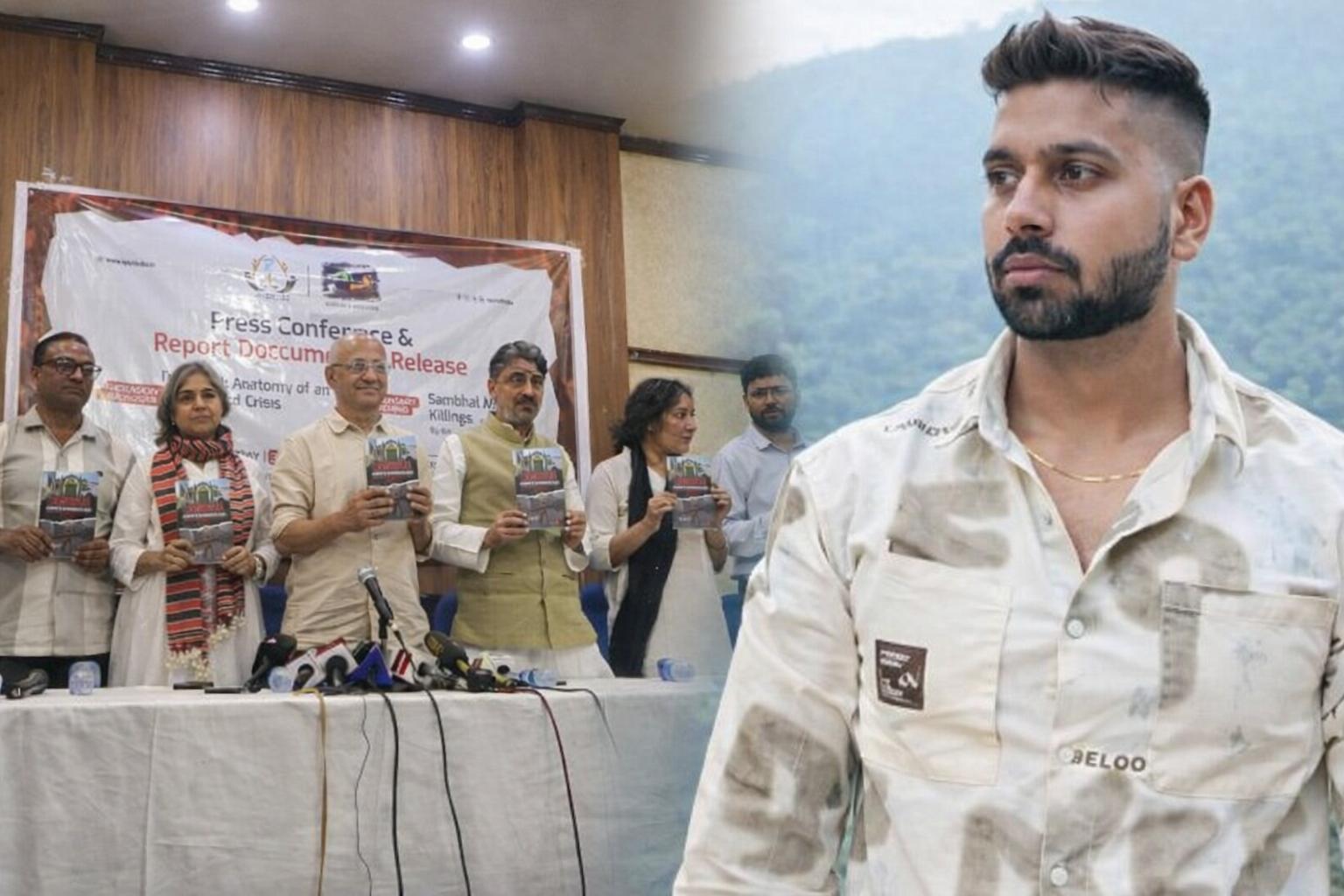
APCR’s collaboration with activist Harsh Mander’s Karwan-e-Mohabbat in producing the report “Sambhal: Anatomy of an Engineered Crisis” further illustrates this pattern. The report, accompanied by a documentary, misrepresented the Sambhal violence as a case of systemic oppression and state overreach against Muslims.
Notably, it downplayed the recovery of foreign-made cartridges from the site of the violence, including ammunition linked to the Pakistan Ordnance Factory. It also did not adequately engage with police findings, indicating that rioters had opened fire on law enforcement personnel and that some deaths occurred due to firing by rioters themselves.
By privileging selective testimonial evidence while marginalising forensic data, the report constructs a narrative that is compelling but incomplete. It reinforces a predetermined conclusion, that of unilateral victimhood, while excluding elements that suggest Islamist mobs were responsible for the waves of violence that followed the court-ordered survey of the Sambhal mosque.
The Ideological ecosystem: Activism, academia, and amplification
APCR’s work does not exist in isolation; it is part of a broader ecosystem comprising activists, academics, and media platforms that collectively shape and amplify specific narratives. Harsh Mander, a central figure in this ecosystem, has long been associated with whitewashing Islamist hate crimes and blaming the majority for violence spurred by Islamic extremists. His organisation, Karwan-e-Mohabbat, has produced multiple reports that advance Muslim victimhood and paper over unpleasant facts about the involvement of Muslim mobs in causing these instances of violence.
Complementing this ‘activist’ dimension is the ‘academic’ engagement of figures such as Delhi University professor Apoorvanand, whose writings and public interventions often frame communal incidents within a broader critique of majoritarian politics and state institutions. Known for his frequent commentary in left-leaning publications, Apoorvanand has repeatedly positioned himself within debates on communalism by critiquing state institutions and framing incidents through the lens of majoritarianism. However, he has often attracted criticism for what appears to be a pattern of selective outrage and rhetorical deflection.
A telling example of this emerged in his remarks concerning Pakistani terrorist Ajmal Kasab. Apoorvanand attempted to cast aspersions on public prosecutor Ujjwal Nikam by suggesting that remarks made during Kasab’s trial were intended to “create animosity” against the terrorist. When faced with backlash, instead of clarifying his position, he doubled down by shifting the focus away from the terrorist’s crimes and toward an abstract critique of “society” and political narratives. In doing so, he effectively reframed justified public outrage against a mass murderer as a product of manipulative discourse, thereby trivialising the gravity of the terror attack itself.
This is a classic example of how Islamists, including terrorists like Ajmal Kasab, get a free pass from those who claim to be ‘activists’ and ‘academia’ while their non-Muslim victims get branded as provocateurs and instigators. Together, these actors create a layered discourse in which activist reports are legitimised through academic commentary and then amplified through legal interventions and pliant media coverage.
This ecosystem operates with a degree of coordination, even if informal. Reports generate narratives, academics provide intellectual validation, and litigation seeks institutional endorsement. The result is a self-reinforcing cycle that shapes public perception and policy responses.
The question of asymmetry
One of the most persistent criticisms of this ecosystem is its apparent asymmetry in evaluating communal incidents. Violence involving Muslim perpetrators is often contextualised as reactive, situational, or provoked, while violence involving Hindu actors is framed as systemic, ideological, and indicative of broader societal trends.
In the Uttam Nagar case, this asymmetry is evident in the way the incident is framed. The killing of Tarun Kumar, despite its brutality, is treated as a localised dispute. In contrast, the protests and alleged slogans that followed are elevated as evidence of widespread communal hostility and potential violence against Muslims. This inversion of emphasis effectively shifts the locus of concern from the act of violence to the reaction it provoked.
Such asymmetry has broader implications. It influences not only public discourse but also institutional responses, including policing priorities and judicial interventions. When narratives are constructed in a manner that consistently privileges one perspective over another, it risks undermining the principle of equal justice.
Victimhood as narrative capital
At a structural level, the approach reflected in APCR’s petition can be understood as part of a politics of victimhood. In this framework, the construction and amplification of victimhood narratives become a means of mobilising support, shaping discourse, and influencing institutions.
This process typically involves the selective curation of incidents, the omission of inconvenient details, and the strategic use of legal and media platforms to amplify the narrative. Over time, a feedback loop is created in which reports justify petitions, petitions validate reports, and both are used to reinforce a particular worldview. While advocacy for vulnerable communities is an essential aspect of a democratic society, it must be grounded in a commitment to factual accuracy and consistency. When advocacy becomes selective or instrumentalised, it risks eroding its own credibility.
How APCR exploits media, academia, and litigation to whitewash Islamism
The APCR’s petition before the Delhi High Court is emblematic of a larger contest over narrative control in communal incidents in India. It raises important questions about the role of civil society organisations, the exploitation of litigation as a tool of narrative construction, and the responsibilities of institutions in navigating competing claims.
Ensuring law and order, preventing hate speech, and protecting all communities are legitimate and necessary objectives. However, these goals must be pursued through a balanced and evidence-based approach that does not obscure the origins of violence or privilege one narrative over another. Instead, groups created for vested interests that masquerade as ‘justice-seeking organisations’ use judiciary to advance their personal agendas, often which reverses the roles of aggressors and the victims, and project the Hindu majority as a vindictive community seeking ‘retribution’ from the ‘peaceful’ minorities.
The killing of Tarun Kumar demands accountability on its own terms. It cannot be reduced to a footnote in a broader narrative that shifts focus away from the act itself. If institutions are to retain public trust, they must anchor their responses in facts, fairness, and the rule of law, resisting attempts to turn tragedies into instruments of narrative contestation.