Did you know it’s illegal to die in some places? 7 bizarre laws from around the world and the surprising reasons behind them
Laws across the world are formed and shaped to cater to the requirements of the societies in which they exist. While some laws, such as those relating to crimes like theft or murder, usually exist universally, there may be laws or local rules to address a peculiar problem. While such rules or laws may make perfect sense to the local people, outsiders, unaware of the social, historical or cultural context of such laws, may find them absurd. Here are seven rules and laws from across the world that may look unusual and common-sense-defying to others, but are followed by the people of the countries where they exist. The chewing gum ban in Singapore The harmless sticky candy once became a menace across Singapore after miscreants started sticking it in places like the sensors of subway doors, inside lock cylinders, mailboxes, inside keyholes, on lift buttons and on elevator buttons. This resulted in added maintenance and cleaning costs. In 1987, the Mass Rapid Transit (MRT) local railway system, which was Singapore’s largest public project, started running. But the chewing gum menace reached the MRT as well. Miscreants started pasting chewing gum on the door sensors of MRT trains, which prevented doors from functioning properly and caused disruption to train services. The Singaporean government at the time was committed to making Singapore a global trading hub and was paying particular attention to cleanliness and public hygiene. The government came up with a legal solution to the problem and passed a law in 1992 banning the import, sale and distribution of chewing gum. As per the law, chewing gum is not illehgal is not illegal in the country, but selling, importing or distributing chewing gum is. Therefore, a person travelling to Singapore can bring a small amount of chewing gum into the country for personal use, but it is illegal to spit the gum in an inappropriate place. In 2004, the Singapore government made an exception under the law for therapeutic, dental, and nicotine chewing gum, which can be bought from a doctor or registered pharmacist. Dying is Illegal in these parts of the world.d As absurd as it may sound, there are places in the world where dying is prohibited. Death is generally a dreaded and unwelcome phenomenon everywhere, but some regions have gone to the extent of making rules to stop death from visiting them. There is not one, two or three, but as many as six countries having places that have rules against dying. Longyearbyen, Norway: Longyearbyen is located on the archipelago of Svalbard in extreme cold temperatures and permafrost conditions (permanently frozen ground), which prevent the dead bodies from decomposing. To prevent the risk of diseases or infections spreading, the governor of Svalbard made a policy decision to ban dying in the city. As per the policy, people who have died or are suffering from terminal diseases have to fly to mainland Norway for burial or treatment. However, if one dies in the town, it is possible to cremate them there, but it requires a license and lots of paperwork that could take months. It was proved in 1998 that the fear of the spread of infections from dead bodies was not unfounded when scientists unearthed the bodies of seven men buried in the ice 80 years ago. All seven people had died after the Spanish flu in the big pandemic of 1918. Surprisingly, the scientists were able to extract live samples of the virus from all seven dead bodies. This confirmed that deadly diseases could survive in dead bodies buried in permafrost. Lanjaron, Spain: The mayor of Lanjaron, Jose Rubio, imposed a ban on dying in the town in 1999. The reason behind the ban was that the local cemetery had reached its capacity limit. Le Lavandou, Sarpourenx and Cugnaux, France: A similar ban was imposed in three towns of Le Lavandou, Sarpourenx and Cugnaux in southern France. In 2000, the Mayor of Le Lavandou outlawed death due to a lack of space for burials in the local cemetery. The towns of Sarpourenx and Cugnaux also followed suit in 2007 and 2008, respectively, for similar reasons. Sellia, Italy: The mayor of the medieval village of Sellia in Italy passed a decree in 2015 that officially made it illegal to get sick or die in the village as a measure to save its ageing population. Mayor Davide Zicchinella signed a decree stating that residents were forbidden from getting sick, and they should put their health first. The extreme measure was adopted after the village’s population dropped to 537 in 2015 from 1300 in 1960. Besides, 60% of the surviving population was over 65. Biritiba Mirim, Brazil: In 2005, the mayor of Biritiba Mirim town in Brazil filed a public bill, making it illegal for the residents to die in the town as the local cemetery was full. The bill did not provide any punishments, but the Mayor aimed to target relatives of people who die with fines and even jail, if necessary, to get more space for tombstones. Itsukushima,
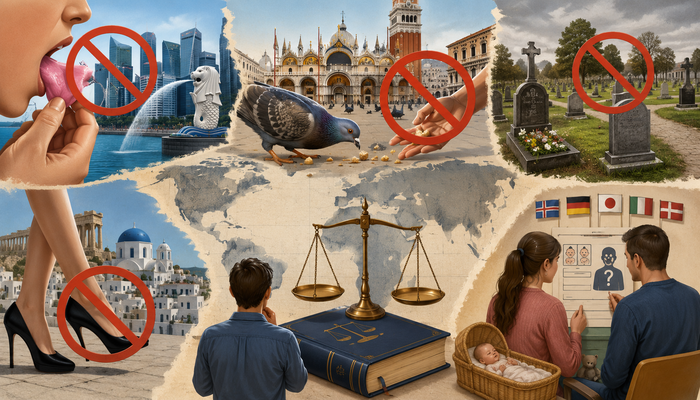
Laws across the world are formed and shaped to cater to the requirements of the societies in which they exist. While some laws, such as those relating to crimes like theft or murder, usually exist universally, there may be laws or local rules to address a peculiar problem. While such rules or laws may make perfect sense to the local people, outsiders, unaware of the social, historical or cultural context of such laws, may find them absurd.
Here are seven rules and laws from across the world that may look unusual and common-sense-defying to others, but are followed by the people of the countries where they exist.
The chewing gum ban in Singapore
The harmless sticky candy once became a menace across Singapore after miscreants started sticking it in places like the sensors of subway doors, inside lock cylinders, mailboxes, inside keyholes, on lift buttons and on elevator buttons. This resulted in added maintenance and cleaning costs. In 1987, the Mass Rapid Transit (MRT) local railway system, which was Singapore’s largest public project, started running. But the chewing gum menace reached the MRT as well. Miscreants started pasting chewing gum on the door sensors of MRT trains, which prevented doors from functioning properly and caused disruption to train services.
The Singaporean government at the time was committed to making Singapore a global trading hub and was paying particular attention to cleanliness and public hygiene. The government came up with a legal solution to the problem and passed a law in 1992 banning the import, sale and distribution of chewing gum. As per the law, chewing gum is not illehgal is not illegal in the country, but selling, importing or distributing chewing gum is.
Therefore, a person travelling to Singapore can bring a small amount of chewing gum into the country for personal use, but it is illegal to spit the gum in an inappropriate place. In 2004, the Singapore government made an exception under the law for therapeutic, dental, and nicotine chewing gum, which can be bought from a doctor or registered pharmacist.
Dying is Illegal in these parts of the world.d
As absurd as it may sound, there are places in the world where dying is prohibited. Death is generally a dreaded and unwelcome phenomenon everywhere, but some regions have gone to the extent of making rules to stop death from visiting them. There is not one, two or three, but as many as six countries having places that have rules against dying.
Longyearbyen, Norway: Longyearbyen is located on the archipelago of Svalbard in extreme cold temperatures and permafrost conditions (permanently frozen ground), which prevent the dead bodies from decomposing. To prevent the risk of diseases or infections spreading, the governor of Svalbard made a policy decision to ban dying in the city. As per the policy, people who have died or are suffering from terminal diseases have to fly to mainland Norway for burial or treatment. However, if one dies in the town, it is possible to cremate them there, but it requires a license and lots of paperwork that could take months.
It was proved in 1998 that the fear of the spread of infections from dead bodies was not unfounded when scientists unearthed the bodies of seven men buried in the ice 80 years ago. All seven people had died after the Spanish flu in the big pandemic of 1918. Surprisingly, the scientists were able to extract live samples of the virus from all seven dead bodies. This confirmed that deadly diseases could survive in dead bodies buried in permafrost.
Lanjaron, Spain: The mayor of Lanjaron, Jose Rubio, imposed a ban on dying in the town in 1999. The reason behind the ban was that the local cemetery had reached its capacity limit.
Le Lavandou, Sarpourenx and Cugnaux, France: A similar ban was imposed in three towns of Le Lavandou, Sarpourenx and Cugnaux in southern France. In 2000, the Mayor of Le Lavandou outlawed death due to a lack of space for burials in the local cemetery. The towns of Sarpourenx and Cugnaux also followed suit in 2007 and 2008, respectively, for similar reasons.
Sellia, Italy: The mayor of the medieval village of Sellia in Italy passed a decree in 2015 that officially made it illegal to get sick or die in the village as a measure to save its ageing population. Mayor Davide Zicchinella signed a decree stating that residents were forbidden from getting sick, and they should put their health first. The extreme measure was adopted after the village’s population dropped to 537 in 2015 from 1300 in 1960. Besides, 60% of the surviving population was over 65.
Biritiba Mirim, Brazil: In 2005, the mayor of Biritiba Mirim town in Brazil filed a public bill, making it illegal for the residents to die in the town as the local cemetery was full. The bill did not provide any punishments, but the Mayor aimed to target relatives of people who die with fines and even jail, if necessary, to get more space for tombstones.
Itsukushima, Japan: The Itsukushima town, also known as Miyajima, of Japan, is considered a sacred place as it houses several shrines and temples. To maintain the sanctity of the place, a ban on childbirth and death was imposed in the late 19th century. There are no cemeteries or hospitals on the island.
Not voting is criminal in Australia
While voting is considered a right of the citizens in several democracies, Australia went a step ahead and made not voting a crime punishable. In other words, voting is not just a right in Australia but a legal obligation, whose violation can attract a monetary penalty of as much as A$20 ($13; £10) and can also be prosecuted. This was done by way of an amendment in the Electoral Act in 1924.
As a result of the law, the country is among the countries with the highest voter turnouts. Even though it may sound punitive, the law has popular support. A variety of measures have been adopted by the authorities to facilitate people in casting their votes. For example, the elections in the country are held on Saturdays, when most of the people are not working. Besides, employers are required to provide workers paid leave on election day to ensure that people have enough time to go vote.
Government approves children’s names in these countries
Several countries across the world have some rules and regulations relating to the naming of children. While some have approval systems for children’s names, others have laws that allow rejection of certain names. In some countries, there is a ban on certain specified names. Here are some of the countries that regulate how children are named.
Iceland: The European country has a National Register of Persons established under the National Name Act (1971, amended 2019). As per the law, the names of children must conform to Icelandic grammatical traditions under legislative mandate.
New Zealand: In this country, certain names which are offensive, embarrassing, or unreasonably long are explicitly prohibited under the Births, Deaths, Marriages and Relationships Registration Act 1995.
Denmark: In Denmark, the Personal Names Act (Navneloven, 2003) puts restrictions on name choices to approximately 7,000 approved names under formal legislation.
Germany: Germany’s Civil Status Act (Personenstandsgesetz) and name approval regulations under the Standesamt constitute binding statutory law requiring official approval. Names of children in Germany must be approved by the office of vital statistics in the area (the Standesamt) where the baby is born. The name must indicate the child’s gender, and the name cannot be one used traditionally as a surname.
Finland: All Finnish citizens and residents are required to have at least one and at most four first names as per the Names Act of 1985. Those not having a first name are obligated to adopt one when they are entered into the Finnish national population database. Besides, the law requires the parents of newborn children to name their children and inform the population registry within two months of their birth.
In this aspect, India gives absolute freedom to parents to name their children in whatever way they like. A law putting restrictions on children’s names would sound absolutely absurd and unimaginable to Indians, who name their children after Gods, places, good qualities and even fruits and sweets.
Ban on feeding pigeons
Growing populations of pigeons in any area can be a real problem, and Venice has found a solution for that. The city council of the floating town of Italy passed a municipal regulation prohibiting feeding pigeons to stop their populations from rising rapidly. Initially, the ban was effective in areas with historical monuments, but in 2008, it was extended to the entire city. Until the ban, feeding pigeons at St. Mark’s Square used to be a classic tourist activity.
The reason behind the ban was that pigeon droppings damaged the marble of monuments and caused cleanliness and public health challenges. The regulation is enforced by the local authorities, and its violation attracts hefty fines.
A similar ban was imposed in Mumbai, Maharashtra, by the Brihanmumbai Municipal Corporation (BMC) following a High Court order. The decision led to the shutdown of the century-old Dadar Kabutarkhana, which was a prominent pigeon feeding site in Mumbai. The Bombay High Court had flagged serious risks to public health and sanitation in its order.
No high heels when in Greece
For travellers who love wearing and posing in high heels with attractive monuments or ancient archaeological sites in the background, Greece, with all its architectural grandeur, is not the place to go. One might wonder what high heels have to do with the historical sites of Greece. Well, the answer lies in a local regulation that imposes a ban on wearing high heels at historical sites.
In 2009, the Greek government issued a public directive prohibiting visitors from visiting historical sites wearing footwear that can damage the ancient marble. The ban was imposed after experts stated that footwear with sharp and narrow heels, such as stilettos, can damage the floors of historical sites, which cannot be restored easily. The rule prescribed hefty fines of up to €900 for visitors who flouted the rule.
No camouflage clothing for civilians in these nations
While wearing clothes with camouflage prints is perfectly normal in most parts of the world, certain countries in the Caribbean region, Africa, Asia and the Middle East expressly ban wearing camouflage prints for civilians. There are over two dozen countries, most of which are conflict-ridden, across the world that impose such restrictions. Countries like Antigua and Barbuda, Barbados, Bahamas, Dominica, Grenada, Saudi Arabia, Ghana, Nigeria, and the Philippines have formal laws that impose a ban on camouflage clothing for civilians.
Wearing camouflage clothing is illegal for civilians in these nations, as the cloth pattern is reserved exclusively for military and law enforcement. Violating these laws can result in the confiscation of the items, heavy fines, or even arrest.