Economic Times targets Suryakumar Yadav over handshake, forgets Pakistan’s terror record and its own Aman ki Asha nostalgia
On 17th February, Economic Times chose to lecture Indian cricketers on “respect” because Suryakumar Yadav did not indulge in a choreographed handshake with his Pakistani counterpart after winning T20 World Cup match on Sunday. One would imagine that, in 2026, Indian media would have moved beyond the lazy trope that sporting courtesy must exist in a vacuum, untouched by geopolitics, terrorism and state complicity. Apparently, that is not the case. The suggestion that “history may judge India harshly” over a handshake is not just melodramatic. It is divorced from the realities of the relationship between India and Pakistan. History, if it judges anyone harshly, will do so on far weightier matters than whether two captains shook hands for the cameras. Cricket does not exist in a vacuum One thing that everyone needs to be clear on is that nothing exists in a vacuum. The very notion of a vacuum is nothingness. India’s reluctance to normalise gestures with Pakistan is not petulance. It is policy rooted in decades of cross-border terrorism and Pakistan’s continued patronage of anti-India terror networks. The demand that Indian players must behave as if nothing is amiss is to demand selective amnesia. It is to insist that the burden of “maturity” lies solely with the victim, never the aggressor. It is a fact that sporting rivalry is built on respect. However, respect is not a one-way street. It cannot be ritualistic theatre while the underlying reality remains hostile. If the Board has decided that bilateral warmth is inappropriate in the current context, that is a sovereign choice. The players are representatives of a nation, not freelance diplomats freelancing niceties. The ‘Aman ki Asha’ amnesia It is particularly ironic that this sermon emerged from a publication within the Times Group ecosystem. The same group that once championed the “Aman ki Asha” campaign with great fanfare, projecting cultural bonhomie as a bridge over very real fault lines. What did that optimism lead to? Did terror infrastructure disappear? Did masterminds of terrorist attacks against India face credible justice? Did cross-border infiltration cease? The problem with performative peace initiatives is that they are heavy on optics and light on accountability. Handshakes make for good photographs. They do not dismantle terror networks. If “Aman ki Asha” could not alter ground realities, perhaps it is time to stop pretending that a televised handshake will. In fact, when India, during Operation Sindoor, destroyed terror infrastructure within Pakistan and Pakistan Occupied Jammu and Kashmir, the hostile neighbour reacted and tried to attack India. It is now actively funding terror outfits to help rebuild the infrastructure where terrorists train for attacks against India. The rivalry that is not a rivalry There is another curious contradiction in the criticism. Suryakumar Yadav himself downplayed the so-called “India Pakistan rivalry” back in September 2025 as Pakistan’s SKY Network trolled its own team during a press conference. He insisted that it is just another cricket match. He has categorically said that “it is not a rivalry anymore”, citing the fact that the majority of matches between India and Pakistan, especially during international tournaments like the World Cup, have been won by India. Now, when the same team refuses to indulge in overt warmth, it is accused of politicising sport. Which is it? If it is “just another match”, then the absence of a handshake should not carry civilisational weight. If it is a high voltage political spectacle, then perhaps it is naive to pretend that gestures are devoid of meaning. The truth is simpler. India is the dominant cricketing and financial power. Pakistan’s cricket board needs these fixtures far more desperately. The asymmetry is real. India does not need to perform symbolic reconciliation to validate its sporting stature. Respect is not submission The op-ed written by Anand Vasu for ET framed the handshake as a litmus test of maturity. That is a dangerously simplistic metric. Respect in sport is demonstrated through adherence to rules, the absence of sledging that crosses lines, and fairness in play. By all accounts, the match in Colombo proceeded without incident. No on-field ugliness. No acrimony. Just cricket. What was missing was a carefully staged gesture. To equate that absence with moral diminishment is to trivialise far more substantive issues. Indian players are not obliged to project warmth towards representatives of a state that continues to be hostile to their own country. Financial morality lectures ring hollow Interestingly, the op-ed acknowledged that India versus Pakistan is the financial heart of global cricket. Broadcasters, sponsors and boards depend on it. Yet it chastised India for not performing sportsmanship to enhance the spectacle. If commerce is comfortable monetising the rivalry, it should also be comforta
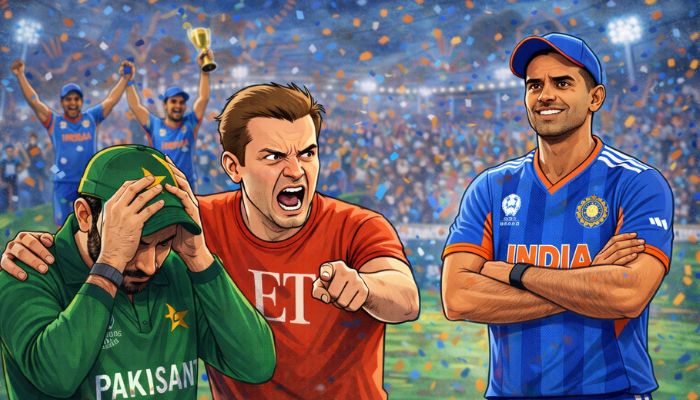

On 17th February, Economic Times chose to lecture Indian cricketers on “respect” because Suryakumar Yadav did not indulge in a choreographed handshake with his Pakistani counterpart after winning T20 World Cup match on Sunday. One would imagine that, in 2026, Indian media would have moved beyond the lazy trope that sporting courtesy must exist in a vacuum, untouched by geopolitics, terrorism and state complicity. Apparently, that is not the case.
The suggestion that “history may judge India harshly” over a handshake is not just melodramatic. It is divorced from the realities of the relationship between India and Pakistan. History, if it judges anyone harshly, will do so on far weightier matters than whether two captains shook hands for the cameras.
Cricket does not exist in a vacuum
One thing that everyone needs to be clear on is that nothing exists in a vacuum. The very notion of a vacuum is nothingness. India’s reluctance to normalise gestures with Pakistan is not petulance. It is policy rooted in decades of cross-border terrorism and Pakistan’s continued patronage of anti-India terror networks.
The demand that Indian players must behave as if nothing is amiss is to demand selective amnesia. It is to insist that the burden of “maturity” lies solely with the victim, never the aggressor.
It is a fact that sporting rivalry is built on respect. However, respect is not a one-way street. It cannot be ritualistic theatre while the underlying reality remains hostile. If the Board has decided that bilateral warmth is inappropriate in the current context, that is a sovereign choice. The players are representatives of a nation, not freelance diplomats freelancing niceties.
The ‘Aman ki Asha’ amnesia
It is particularly ironic that this sermon emerged from a publication within the Times Group ecosystem. The same group that once championed the “Aman ki Asha” campaign with great fanfare, projecting cultural bonhomie as a bridge over very real fault lines. What did that optimism lead to? Did terror infrastructure disappear? Did masterminds of terrorist attacks against India face credible justice? Did cross-border infiltration cease?
The problem with performative peace initiatives is that they are heavy on optics and light on accountability. Handshakes make for good photographs. They do not dismantle terror networks. If “Aman ki Asha” could not alter ground realities, perhaps it is time to stop pretending that a televised handshake will.
In fact, when India, during Operation Sindoor, destroyed terror infrastructure within Pakistan and Pakistan Occupied Jammu and Kashmir, the hostile neighbour reacted and tried to attack India. It is now actively funding terror outfits to help rebuild the infrastructure where terrorists train for attacks against India.
The rivalry that is not a rivalry
There is another curious contradiction in the criticism. Suryakumar Yadav himself downplayed the so-called “India Pakistan rivalry” back in September 2025 as Pakistan’s SKY Network trolled its own team during a press conference. He insisted that it is just another cricket match. He has categorically said that “it is not a rivalry anymore”, citing the fact that the majority of matches between India and Pakistan, especially during international tournaments like the World Cup, have been won by India. Now, when the same team refuses to indulge in overt warmth, it is accused of politicising sport.
Which is it? If it is “just another match”, then the absence of a handshake should not carry civilisational weight. If it is a high voltage political spectacle, then perhaps it is naive to pretend that gestures are devoid of meaning.
The truth is simpler. India is the dominant cricketing and financial power. Pakistan’s cricket board needs these fixtures far more desperately. The asymmetry is real. India does not need to perform symbolic reconciliation to validate its sporting stature.
Respect is not submission
The op-ed written by Anand Vasu for ET framed the handshake as a litmus test of maturity. That is a dangerously simplistic metric. Respect in sport is demonstrated through adherence to rules, the absence of sledging that crosses lines, and fairness in play. By all accounts, the match in Colombo proceeded without incident. No on-field ugliness. No acrimony. Just cricket.
What was missing was a carefully staged gesture. To equate that absence with moral diminishment is to trivialise far more substantive issues. Indian players are not obliged to project warmth towards representatives of a state that continues to be hostile to their own country.
Financial morality lectures ring hollow
Interestingly, the op-ed acknowledged that India versus Pakistan is the financial heart of global cricket. Broadcasters, sponsors and boards depend on it. Yet it chastised India for not performing sportsmanship to enhance the spectacle. If commerce is comfortable monetising the rivalry, it should also be comfortable accepting the political realities that underpin it. One cannot harvest the drama and then recoil at its consequences.
To suggest that Indian cricket’s “legacy” will be defined by a handshake rather than by performance, professionalism and results shows how “hurt” the author was by the defeat Pakistan faced.
The thing is, India did not refuse to play. It did not boycott the match. It did not engage in theatrics. It competed, won, and moved on. It is those who are suffering from “Aman Ki Asha” amnesia who are hurt by the lack of a simple handshake.