EGI, Press Club outrage after police summon ‘journalists’ who spread propaganda against terror financing linked to mosques and madrasas? Here’s what we know so far
A fresh political and media storm has erupted in Jammu and Kashmir after the police summoned several journalists for reports that questioned a security-driven exercise to collect information on mosques and madrasas in the Valley. While media bodies and regional political actors have portrayed the move as an assault on press freedom, the episode has once again revealed how influential institutions are quick to delegitimise counter-terror measures and transparency seeking efforts in one of India’s most volatile regions, often at the cost of obscuring long-established terror financing networks and shielding frameworks that have been at the forefront of terror-related incidents in Kashmir. Jammu and Kashmir shares a highly sensitive boundary with Pakistan, a country repeatedly flagged by global watchdogs, including the Financial Action Task Force (FATF), for sponsoring terrorism. Against this backdrop, India’s security establishment has increasingly focused on choking terror funding, widely acknowledged as the lifeline of militancy in the Valley. Police drive aligned with the Centre’s focus on terror finance The current police exercise, described by some reports as “profiling” of mosques, cannot be viewed in isolation to the broader framework of the Modi government’s policy to strike at the root cause of terrorism: financing. Security agencies have consistently maintained that while mosques and madrasas are legitimate religious institutions, a fraction of them have historically been misused as conduits for raising and laundering funds for extremist organisations, often under the garb of charity, donations, or religious collections. Back in 1990s, it was reported that mosque speakers were used by terrorists to threaten Kashmiri Pandits to abandon their homes and leave the valley. With this precedent, seeking basic information such as contact details, sect affiliation, and financial records of clerics is standard counter-terror financing practice, especially in regions vulnerable to radicalisation and foreign-backed militancy, especially one that shares a long Line of Actual control with an enemy nation that routinely sends terrorists across to destabilise India. The Jammu and Kashmir Police’s drive is not an isolated action but a continuation of a strategy that has already demonstrated tangible results. Lessons from the past: choking funds, ending street violence One of the most visible successes of India’s crackdown on terror financing came after agencies such as the National Investigation Agency (NIA) began systematically targeting hawala networks, separatist funding channels, and Pakistan-linked handlers operating through NGOs and religious fronts. This financial squeeze led to a dramatic reduction in stone-pelting incidents across the Valley, once a near-daily occurrence that paralysed civilian life and served as a pressure tactic for terror groups. Investigations revealed that many of these protests were not spontaneous but were funded through organised channels, with money distributed to youths for orchestrated violence. Once the funding dried up, the so-called claims of seeking ‘azaadi’ collapsed. High-profile terror financing convictions The Modi government’s resolve to dismantle terror ecosystems was further underlined by decisive action against prominent separatist leaders. Asiya Andrabi, head of the banned Dukhtaran-e-Millat, was arrested and convicted in terror financing cases for raising funds to fuel separatism and violence in Kashmir. More significantly, Yasin Malik, the chief of the Jammu Kashmir Liberation Front (JKLF) and long projected by sympathetic sections of the media as a “peaceful separatist,” was arrested by the NIA and later convicted in a major terror financing case. In 2022, a special court sentenced Malik to life imprisonment for illegally raising funds, criminal conspiracy, and maintaining links with terrorist organisations under the Unlawful Activities (Prevention) Act (UAPA). The case decisively punctured the myth that separatist violence in Kashmir was organic or leaderless, instead exposing a structured funding apparatus backed by Pakistan and its proxies. Journalists summoned after narratives questioned police intent It was after reports framed the current police exercise as “surveillance” or “profiling” that journalists from national newspapers were summoned for questioning. The Indian Express confirmed that its Assistant Editor in Kashmir, Basharat Masood, was asked to sign a bond stating that he would not engage in activities that could “disturb the peace.” Other reporters were also called to Srinagar’s Cyber Police Station regarding their coverage. While the police have yet to issue a public statement, reports indicate that the questioning related to how the exercise was portrayed, especially when ‘journalists’ in Kashmir are notorious for peddling narratives that could inflame tensions or misrepresent counter-terror m

A fresh political and media storm has erupted in Jammu and Kashmir after the police summoned several journalists for reports that questioned a security-driven exercise to collect information on mosques and madrasas in the Valley. While media bodies and regional political actors have portrayed the move as an assault on press freedom, the episode has once again revealed how influential institutions are quick to delegitimise counter-terror measures and transparency seeking efforts in one of India’s most volatile regions, often at the cost of obscuring long-established terror financing networks and shielding frameworks that have been at the forefront of terror-related incidents in Kashmir.
Jammu and Kashmir shares a highly sensitive boundary with Pakistan, a country repeatedly flagged by global watchdogs, including the Financial Action Task Force (FATF), for sponsoring terrorism. Against this backdrop, India’s security establishment has increasingly focused on choking terror funding, widely acknowledged as the lifeline of militancy in the Valley.
Police drive aligned with the Centre’s focus on terror finance
The current police exercise, described by some reports as “profiling” of mosques, cannot be viewed in isolation to the broader framework of the Modi government’s policy to strike at the root cause of terrorism: financing.
Security agencies have consistently maintained that while mosques and madrasas are legitimate religious institutions, a fraction of them have historically been misused as conduits for raising and laundering funds for extremist organisations, often under the garb of charity, donations, or religious collections. Back in 1990s, it was reported that mosque speakers were used by terrorists to threaten Kashmiri Pandits to abandon their homes and leave the valley.
With this precedent, seeking basic information such as contact details, sect affiliation, and financial records of clerics is standard counter-terror financing practice, especially in regions vulnerable to radicalisation and foreign-backed militancy, especially one that shares a long Line of Actual control with an enemy nation that routinely sends terrorists across to destabilise India.
The Jammu and Kashmir Police’s drive is not an isolated action but a continuation of a strategy that has already demonstrated tangible results.
Lessons from the past: choking funds, ending street violence
One of the most visible successes of India’s crackdown on terror financing came after agencies such as the National Investigation Agency (NIA) began systematically targeting hawala networks, separatist funding channels, and Pakistan-linked handlers operating through NGOs and religious fronts.
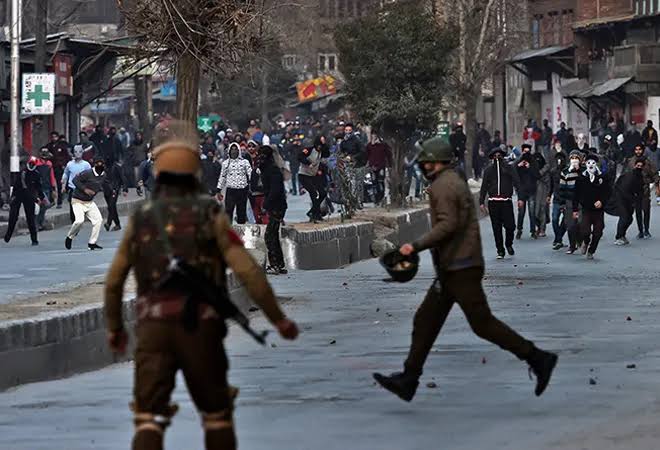
This financial squeeze led to a dramatic reduction in stone-pelting incidents across the Valley, once a near-daily occurrence that paralysed civilian life and served as a pressure tactic for terror groups. Investigations revealed that many of these protests were not spontaneous but were funded through organised channels, with money distributed to youths for orchestrated violence.
Once the funding dried up, the so-called claims of seeking ‘azaadi’ collapsed.
High-profile terror financing convictions
The Modi government’s resolve to dismantle terror ecosystems was further underlined by decisive action against prominent separatist leaders.
Asiya Andrabi, head of the banned Dukhtaran-e-Millat, was arrested and convicted in terror financing cases for raising funds to fuel separatism and violence in Kashmir.
More significantly, Yasin Malik, the chief of the Jammu Kashmir Liberation Front (JKLF) and long projected by sympathetic sections of the media as a “peaceful separatist,” was arrested by the NIA and later convicted in a major terror financing case. In 2022, a special court sentenced Malik to life imprisonment for illegally raising funds, criminal conspiracy, and maintaining links with terrorist organisations under the Unlawful Activities (Prevention) Act (UAPA).
The case decisively punctured the myth that separatist violence in Kashmir was organic or leaderless, instead exposing a structured funding apparatus backed by Pakistan and its proxies.
Journalists summoned after narratives questioned police intent
It was after reports framed the current police exercise as “surveillance” or “profiling” that journalists from national newspapers were summoned for questioning. The Indian Express confirmed that its Assistant Editor in Kashmir, Basharat Masood, was asked to sign a bond stating that he would not engage in activities that could “disturb the peace.”
Other reporters were also called to Srinagar’s Cyber Police Station regarding their coverage. While the police have yet to issue a public statement, reports indicate that the questioning related to how the exercise was portrayed, especially when ‘journalists’ in Kashmir are notorious for peddling narratives that could inflame tensions or misrepresent counter-terror measures as communal targeting.
Media bodies protest, sidestep terror finance reality
The Editors Guild of India (EGI) and the Press Club of India (PCI) swiftly accused the police of intimidation and coercion, warning of an atmosphere of fear. International advocacy groups such as the Committee to Protect Journalists (CPJ) and Digipub News India Foundation followed suit.
What these statements conspicuously avoid addressing is the core security concern: terror financing through religious and charitable fronts is not a hypothetical threat but a documented reality in Kashmir. Global counter-terror frameworks, from FATF to UN resolutions, explicitly mandate financial scrutiny of institutions vulnerable to misuse.
By framing any inquiry into mosque finances as repression, these bodies and those questioning the police drive not only pressurise the police officials serving their duty but also risk insulating precisely those spaces that extremist networks have historically exploited.
Political outrage and selective silence
Regional political leaders, including Mehbooba Mufti, objected to mosques being “singled out,” arguing that other religious institutions should also be scrutinised. However, past terror investigations have overwhelmingly linked militant funding in Kashmir to Islamist networks, not Hindu or other religious bodies.
The ruling National Conference condemned the summoning of journalists but shifted responsibility to Lieutenant Governor Manoj Sinha, while also distancing itself from the police action. Congress leaders echoed concerns about shrinking press freedom, largely ignoring how terror financing methods have evolved since the 1990s and early 2000s.
The uncomfortable truth
At its core, the outrage over police summons diverts attention from a fundamental question: should security agencies hesitate to follow financial trails in a terror-affected region simply because religious institutions are involved?
The Modi government’s approach, targeting money flows, dismantling hawala networks, prosecuting high-profile terror financiers, and enforcing transparency, has already delivered measurable security gains in Jammu and Kashmir. The current police drive fits squarely within that framework.
By casting aspersions on such efforts and reframing them as authoritarian overreach, the media bodies and politicians with vested interests may be unintentionally, or deliberately, shielding the very mechanisms that sustain terrorism in the Valley.
In a region scarred by decades of Pakistan-sponsored violence, the choice before the Jammu and Kashmir police is stark: be weighed down by the fake moral outrage of media bodies and opportunist politicians or perform their duty conscientiously and confront the financial lifelines of terror head-on.