‘First they offer namaz in a temple, then claim it was a mosque’: From Bulandshahr to Bhojshala, examining the Islamist pattern of encroaching Hindu sacred sites and the Left’s defence of it
In India, the pattern of some elements within the Muslim community offering namaz at Hindu religious, historical, and cultural sites and then gradually seizing possession of those places is a deeply concerning trend. It always begins in a seemingly very ordinary and insignificant way. Sometimes they step into the temple premises to escape a light drizzle, and sometimes under the pretext of resting from fatigue. Once inside, they quietly perform namaz or ibadat there. As soon as these acts surface on social media or local Hindus raise objections, a particular section of the country, which we call “liberal Hindus”, immediately begins beating its chest. These liberals loudly lament: “If someone offered namaz and prayed to Allah inside the house of God, what’s the big deal? God is one, after all.” But history and present-day events scream the truth: this is not innocent worship at all, but a meticulously planned chronology. It is precisely the fallacious arguments of these liberal Hindus that give the greatest strength to such extremist thinking. Soon the matter goes far beyond mere namaz. Within a few years, the entire site gets entangled in disputes like the Kans Fort in Malihabad or the Bhojshala in Dhar. In the end, Hindus are forced to fight decades-long legal battles for their own ancient places. The greatest irony is that throughout this entire process, the very Hindus who speak of their constitutional and religious rights are the ones showered with abuse. The liberal social fabric never questions those who quietly or forcibly occupied the place. Bulandshahr: Namaz inside Hanuman Temple To understand the entire controversy, we must first look at the latest incident in Bulandshahr, Uttar Pradesh. Here, an ancient Hanuman temple complex was brazenly turned into a namaz site through conspiracy. On 31 May, during house construction work, the intention of Muslim mason Asar Mohammad and his companions suddenly changed. As soon as the opportunity arose in the afternoon, they entered straight into the Hanuman temple. They used the excuse of drizzling rain. They staged a drama of helplessness. Taking full advantage of the situation, Asar Mohammad offered namaz inside the sacred temple premises. His companion Nazar Mohammad stood guard as a security shield throughout this audacious act. This was clearly a stab in the back of Hindu religious tolerance and the aggressive beginning of an attempt to capture a centre of faith. As soon as the video went viral, seeing the seriousness of the situation, the police administration immediately deployed heavy forces on the spot. The police swiftly acted after sensing the conspiracy. An FIR was registered under serious sections against the main extremists Asar Mohammad, Nazar Mohammad, and the house owner Rajkumar who supported them. The main accused, Asar Mohammad, was promptly challaned and sent behind bars. The suicidal logic of liberal Hindus: The mindset that supplies oxygen to extremism Whenever incidents like Bulandshahr occur in any corner of the country, the secular and liberal brigade becomes active on social media. Their arguments are so hollow and self-destructive that they directly numb the cultural consciousness of the majority community. Let us understand the main arguments of these liberals. “God and Allah are no different”: This is the very first and favourite argument of liberal Hindus. They say that a temple is also the house of God, so if someone remembers their Allah with a sincere heart there, the temple does not become impure. They present it as the most beautiful example of “Ganga-Jamuni tehzeeb” (syncretic culture). “The excuse of lack of space or compulsion”: In the Bulandshahr case too, the same argument was given — it was raining outside, so the Muslim labourers went inside the temple. Liberals emotionally write, “Is it a crime to give a thirsty person water or two yards of space to a person offering namaz?” They completely frame it as a humanitarian issue and divert attention from the real danger. Labelling opposing Hindus as “extremists”: Any Hindu who opposes such unauthorised namaz and seeks legal recourse is immediately branded by these liberals as “hateful Chintu”, “communal” or “fanatic”. According to them, it is the people protesting who are spoiling the atmosphere of the country, not those who are violating the sanctity of the temple. It is precisely because of these suicidal and cowardly arguments that the confidence of the occupying forces grows sky-high. They realise that a large section of Hindu society itself will stand up to defend their encroachment. Our protest is not baseless: Why Hindu society has now become alert and aggressive The protest by Hindu society is not based on hatred or unfounded fear. Behind it lies hundreds of years of bitter experience and the continuous deceptions surfacing in the present. Hindu society has now clearly understood that every such “innocent beginning” end
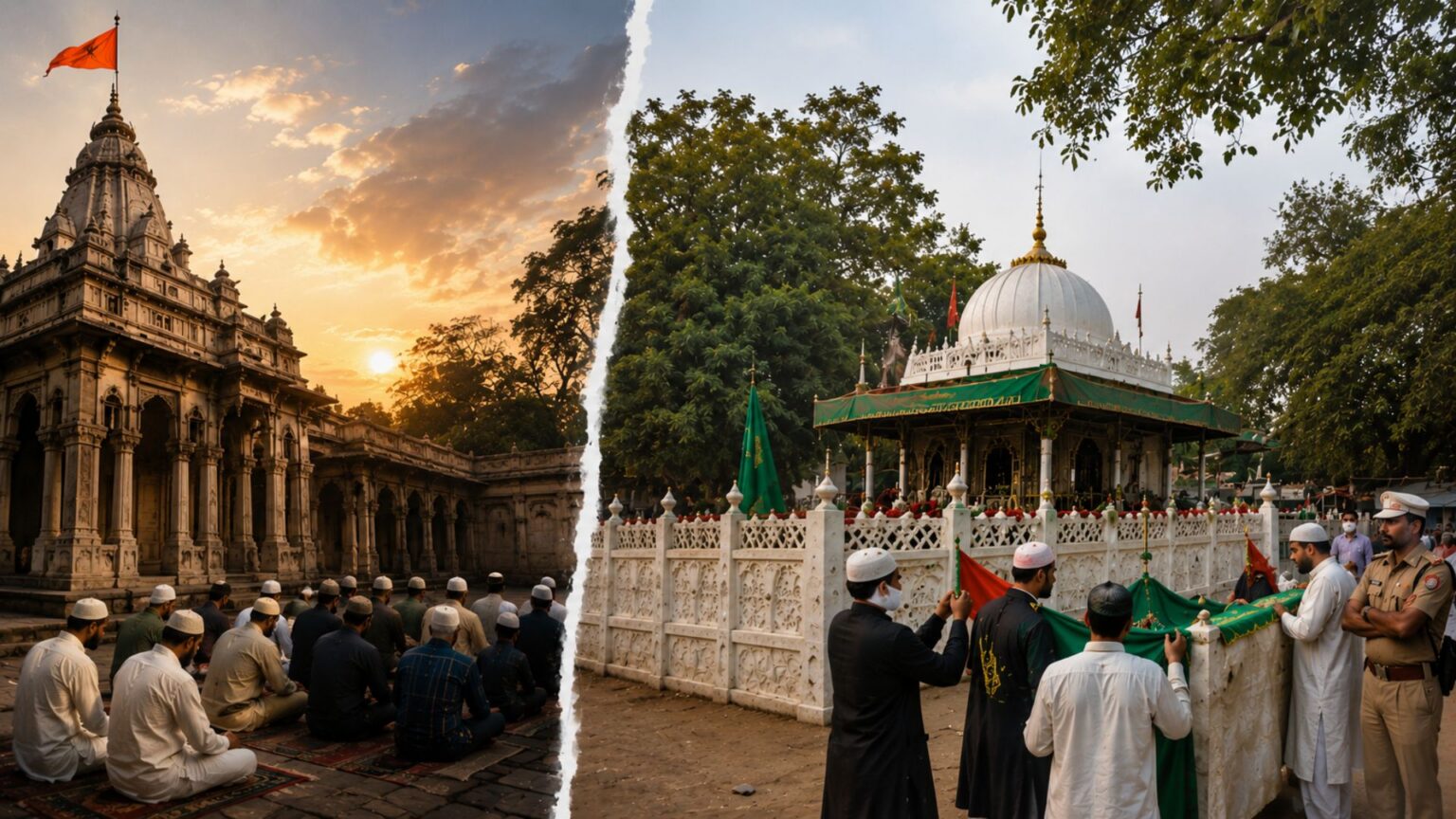
In India, the pattern of some elements within the Muslim community offering namaz at Hindu religious, historical, and cultural sites and then gradually seizing possession of those places is a deeply concerning trend. It always begins in a seemingly very ordinary and insignificant way. Sometimes they step into the temple premises to escape a light drizzle, and sometimes under the pretext of resting from fatigue. Once inside, they quietly perform namaz or ibadat there.
As soon as these acts surface on social media or local Hindus raise objections, a particular section of the country, which we call “liberal Hindus”, immediately begins beating its chest. These liberals loudly lament: “If someone offered namaz and prayed to Allah inside the house of God, what’s the big deal? God is one, after all.”
But history and present-day events scream the truth: this is not innocent worship at all, but a meticulously planned chronology. It is precisely the fallacious arguments of these liberal Hindus that give the greatest strength to such extremist thinking. Soon the matter goes far beyond mere namaz. Within a few years, the entire site gets entangled in disputes like the Kans Fort in Malihabad or the Bhojshala in Dhar. In the end, Hindus are forced to fight decades-long legal battles for their own ancient places.
The greatest irony is that throughout this entire process, the very Hindus who speak of their constitutional and religious rights are the ones showered with abuse. The liberal social fabric never questions those who quietly or forcibly occupied the place.
Bulandshahr: Namaz inside Hanuman Temple
To understand the entire controversy, we must first look at the latest incident in Bulandshahr, Uttar Pradesh. Here, an ancient Hanuman temple complex was brazenly turned into a namaz site through conspiracy. On 31 May, during house construction work, the intention of Muslim mason Asar Mohammad and his companions suddenly changed. As soon as the opportunity arose in the afternoon, they entered straight into the Hanuman temple.
They used the excuse of drizzling rain. They staged a drama of helplessness. Taking full advantage of the situation, Asar Mohammad offered namaz inside the sacred temple premises. His companion Nazar Mohammad stood guard as a security shield throughout this audacious act. This was clearly a stab in the back of Hindu religious tolerance and the aggressive beginning of an attempt to capture a centre of faith.
As soon as the video went viral, seeing the seriousness of the situation, the police administration immediately deployed heavy forces on the spot. The police swiftly acted after sensing the conspiracy. An FIR was registered under serious sections against the main extremists Asar Mohammad, Nazar Mohammad, and the house owner Rajkumar who supported them. The main accused, Asar Mohammad, was promptly challaned and sent behind bars.
The suicidal logic of liberal Hindus: The mindset that supplies oxygen to extremism
Whenever incidents like Bulandshahr occur in any corner of the country, the secular and liberal brigade becomes active on social media. Their arguments are so hollow and self-destructive that they directly numb the cultural consciousness of the majority community. Let us understand the main arguments of these liberals.
“God and Allah are no different”: This is the very first and favourite argument of liberal Hindus. They say that a temple is also the house of God, so if someone remembers their Allah with a sincere heart there, the temple does not become impure. They present it as the most beautiful example of “Ganga-Jamuni tehzeeb” (syncretic culture).
“The excuse of lack of space or compulsion”: In the Bulandshahr case too, the same argument was given — it was raining outside, so the Muslim labourers went inside the temple. Liberals emotionally write, “Is it a crime to give a thirsty person water or two yards of space to a person offering namaz?” They completely frame it as a humanitarian issue and divert attention from the real danger.
Labelling opposing Hindus as “extremists”: Any Hindu who opposes such unauthorised namaz and seeks legal recourse is immediately branded by these liberals as “hateful Chintu”, “communal” or “fanatic”. According to them, it is the people protesting who are spoiling the atmosphere of the country, not those who are violating the sanctity of the temple.
It is precisely because of these suicidal and cowardly arguments that the confidence of the occupying forces grows sky-high. They realise that a large section of Hindu society itself will stand up to defend their encroachment.
Our protest is not baseless: Why Hindu society has now become alert and aggressive
The protest by Hindu society is not based on hatred or unfounded fear. Behind it lies hundreds of years of bitter experience and the continuous deceptions surfacing in the present. Hindu society has now clearly understood that every such “innocent beginning” ends in a massive dispute and the eventual loss of their sacred sites.
When the same kind of deception has been repeated throughout history, it is natural for future generations to become vigilant. Hindus have seen how their straightforwardness and generosity have been shamelessly exploited. Today’s Hindu society knows full well that if they remain silent today over namaz being offered inside the Hanuman temple in Bulandshahr, tomorrow the other side will stake a claim on the sanctum sanctorum itself. This fear is not imaginary; behind it stand dozens of living and simmering examples like Malihabad and Dhar.
Malihabad’s Kans Fort dispute: How three years of “ibadat” snatched the rights of the Pasi community
The most accurate example of this entire strategy is in Malihabad, Lucknow, Uttar Pradesh. The historic “Raj Pasi King Kans Ka Kila” (Kans Fort) is located in the Kansmandi area here. This fort is a symbol of the glorious history of the Pasi community and is an extremely sacred centre of faith for them. But what happened here is eye-opening.
About three years ago, a person named Maulana Jameel Ahmed from Bahraich district came here and started living in one part of this historic fort. In the beginning, he very normally sought permission to clean the fort premises. After that, he quietly began offering namaz there. Local Hindus, showing generosity, did not protest at the time. But gradually, Maulana Jameel turned this historic heritage into a complete centre of Muslim activities.
On 28 March 2026, the dispute fully erupted when an organisation called “Lakhan Army” filed a formal complaint at Malihabad police station. The complaint revealed shocking details. Maulana Jameel Ahmed had illegally occupied King Kans’s fort and started running an illegal madrasa named “Sulemania School” there. Around 20 Hindu children from Nabipnah village were being brought to this madrasa. Under the guise of education, they were being brainwashed and a major centre for religious conversion was being developed. Lakhan Army demanded that the police immediately remove this illegal occupation.
After this, the situation worsened further. On 26 May 2026, tension over the so-called disputed structure at the Kansmandi Kala site became so intense that the administration had to deploy heavy police force. The Pasi community had announced a Sundarkand recitation in the Kans Fort premises on the occasion of Bada Mangal. But the administration, citing law and order, did not permit Hindus to recite Sundarkand. The president of the Pasi community was placed under house arrest, and other supporters were not even allowed near the fort.
Even namaz on Bakrid had to be stopped. The police issued notices to 15 senior leaders of the Pasi community and warned of strict action. Now the situation is such that the very Pasi community to whom the fort belonged is being stopped from going there — and all this happened because of a “innocent namaz” that began just three years ago.
Dhar’s Bhojshala dispute: From the invasions of Khilji and Dilawar to today’s legal battle
A similar historic and painful example is the “Bhojshala” in Dhar district, Madhya Pradesh. Bhojshala was originally a grand and sacred temple of Vagdevi (Goddess Saraswati) built by Raja Bhoj in the 11th century, along with a great Sanskrit university. It is a supremely revered and cultural heritage symbol for followers of Sanatan Dharma.
But cruel Muslim invaders like Alauddin Khilji and Dilawar Khan mercilessly trampled this sacred complex. They made every effort to destroy the temple’s grandeur, but they could not completely erase its Sanatan religious marks. Later, the Muslim side staked its claim on the entire premises and began calling it “Kamal Maulana Masjid”.
This dispute has remained an open wound for Hindus even in modern India. On 21 May 2022, the Madhya Pradesh High Court admitted an important petition filed by “Hindu Front for Justice”. This petition challenged the controversial order issued by the Archaeological Survey of India (ASI) on 7 April 2003, under which ASI had permitted Muslims to offer namaz inside this ancient temple complex every Friday.
Hindu organisations strongly opposed it and presented solid historical evidence before the court. Hindus demanded that the original idol of Goddess Saraswati be reinstalled in the Bhojshala premises. They also demanded modern videography of the entire complex and radio-carbon dating of the ancient artefacts and idols found there by the central government so that truth could be separated from falsehood. The Madhya Pradesh High Court eventually ruled that Bhojshala is a Vagdevi temple and granted Hindus the right to worship, but only after a long legal battle.
Sitaram Goel’s historic document: Over 1,800 mosques built by destroying temples
The argument that “Muslim rulers or fanatics never occupied temples” is completely false and anti-historical. In 1990, renowned historian Sitaram Goel, along with scholars like Arun Shourie, Harsh Narain, Jay Dubashi and Ram Swarup, published a highly authentic and research-based book titled Hindu Temples: What Happened To Them.
In its two sections, the complete raw account of the historical atrocities committed by Muslim invaders and rulers was laid bare. Sitaram Goel identified more than 1,800 specific sites, mosques, dargahs and disputed structures across the country that were either built by directly demolishing Hindu, Jain and Buddhist temples or constructed using the debris, pillars and artefacts from those destroyed temples.
In the second part of the book, The Islamic Evidence, irrefutable proof is given by citing contemporary Muslim historians and official Mughal-era documents showing how centres of Hindu faith were erased and Islamic victory symbols were erected in their place. The state-wise list provided in this book is enough to awaken today’s Hindus.
The statistics from Sitaram Goel’s book narrate a bitter story from different states of India. First, Uttar Pradesh: there are 299 such places where temples were damaged. The Gyanvapi mosque in Varanasi is a major example, it was built by demolishing the ancient Vishweshwar temple. The Teele Wali Masjid in Lucknow was previously the Lakshman Teela temple. The Jami Masjid in Meerut was built on a Buddhist vihara. The Ram temple dispute in Ayodhya was also part of this.
Major statements have also emerged on these disputes in Uttar Pradesh. On 31 July 2023, Chief Minister Yogi Adityanath clearly stated that calling Gyanvapi a mosque is wrong; a trishul and Hindu religious symbols still exist inside it. The ASI survey also found a Shivling there. On the other hand, on 6 August 2020, just a day after the Ram temple bhoomi pujan, All India Imam Association president Sajid Rashidi gave a controversial statement. He threatened that the temple would be demolished again and a Babri Masjid built in its place, citing the example of Hagia Sophia in Turkey.
Now let’s talk about the states of South and West India. Karnataka has 192 such places. Its ancient Hindu cities of Bidar and Bijapur were completely turned into Muslim capitals. The Sola Khamba Masjid and Jami Masjid there were entirely built from the debris of Hindu temples. Tamil Nadu has 175 such places. The Nathar Shah Vali Dargah in Tiruchirappalli was built by demolishing a Shiva temple. The sacred Shivling of the temple was used as a base for placing lamps in the dargah.
The same happened in Gujarat and Rajasthan. Gujarat has 170 such places. Ancient temples were destroyed to give Ahmedabad a Muslim character. The Jami Masjid of Ahmed Shah is a direct example. Many mosques in Dwarka and Somnath were also built on temple sites. Rajasthan too has 170 such places. Ajmer was destroyed and the “Adhai Din Ka Jhonpra” and the dargah of Moinuddin Chishti were built there in 1199. The Topkhana Masjid in Jalore uses stones and material from the Parshvanath Jain temple.
The situation in Central India and other states is no different. Madhya Pradesh has 151 such places. The Jami Masjid in Bhopal was built on the site of an ancient Sabha Mandap temple. Maharashtra has 143 places. The famous Mena Hajjam ki Mazar in Mumbai was built by demolishing the Mahalaxmi temple. Andhra Pradesh has 142 places. Its Jami Masjid was built by destroying the Venugopalaswami temple. West Bengal has 102 places where Hindu capitals were destroyed and Muslim cities established.
Even in states with smaller numbers, the same method was followed. Bihar has 77 places where Jain and Hindu temples were turned into mazaars. Haryana also has 77. Hisar was built by Firoz Shah Tughlaq using debris from the temples of the ancient Agroha city. Delhi has 72 such places. The Qutub Minar complex and Quwwatul Islam Masjid were built by demolishing 27 grand Hindu and Jain temples. Odisha has 12 and Punjab has 14 such places where mosques were built on temple sites. Assam, Kerala and Lakshadweep have 2 each. Lakshadweep’s situation is that its population is now almost 100% Muslim. Diu and Himachal Pradesh also have one historic example each where material from ancient temples was used to build mosques or gates.
Bharuch’s Jama Masjid dispute: The truth emerging from the pages of history
Sitaram Goel’s same book records the case of the “Jama Masjid” in Bharuch district, Gujarat. On 7 January 2026, this historic Jama Masjid in Bharuch city once again came into controversy. Saints from the “Akhil Bharatiya Sant Samiti” alleged that despite being under the protection of the Archaeological Survey of India (ASI), illegal construction was being carried out rampantly here and the strict rules of the archaeology department were being openly flouted.
The saints staged a major protest outside the masjid along with these serious allegations. The situation became so tense that the police and district administration had to intervene. The administration sought two months’ time, assuring the saints of appropriate action, after which the saints ended their protest.
After this dharna, the relevant portion of historian Sitaram Goel’s book again came into discussion. It clearly states that the construction of Bharuch’s Jama Masjid in 1321 was done by demolishing extremely ancient Hindu and Jain temples located there. The pillars and columns still standing inside the masjid loudly testify to their Jain and Hindu origins.
Was the intention really only praying? The bitter truth of attacks on idols and temples
Those liberal and secular intellectuals who argue that “Muslims’ intention is only ibadat and they respect Hindu places of worship equally”… must answer for the attacks and desecration of idols that have occurred in various parts of the country in recent years.
Attack by Muslim mob on Pirana temple in Ahmedabad (8 May 2024) — A violent Muslim mob suddenly attacked the historic “Prerna Peeth Nishkalanki Temple” in Pirana, Ahmedabad. Vishva Hindu Parishad released a video of the attack. In the video, hundreds of Muslims wearing latticed caps are seen entering the temple premises armed with wooden sticks and iron rods.
The fanatical mob vandalised the site. Then the Muslim side claimed that a dargah existed there earlier, even though a Hindu temple had always stood there. Rumours were also spread that the temple administration had removed some ancient graves. After this, a mob of local Muslims gathered and unleashed violence. In the attack, many sacred idols of Hindu deities installed in the sanctum sanctorum were smashed.
Kicking the Devi idol with feet in Moradabad (23 September 2023) — A hateful incident occurred in Moradabad, Uttar Pradesh. Suresh Kumar, a resident of the village, was working as a labourer at a new Devi temple under construction on 21 September. In the evening, Saddam, son of Gafur, arrived with two companions Niyazi and Abrar. Saddam started an argument by asking about the temple gate and pipes. When Suresh objected, Saddam began hurling filthy abuses at Hindus.
He then entered the under-construction temple and kicked the sacred Devi idol that was to be installed there with his feet. He threatened, “Pick up this idol and take it to your Hindu neighbourhood, otherwise your fate will be very bad.” Later the police arrested Saddam.
Stone-pelting on Durga temple in Darbhanga, Bihar (23 July 2023) — A dispute arose between two communities in Darbhanga, Bihar, over installing a Muharram flag. A mob of fanatics deliberately planted a religious Muharram flag right in front of an ancient Maa Durga temple. When Hindu devotees present in the temple peacefully protested, some people from the Muslim side began raising religious slogans. Soon, an Islamic fanatic mob began pelting stones targeting the Durga temple. The Maa Durga temple was completely damaged in the stone-pelting and several devotees were injured. The police had to carry out a heavy lathi-charge to bring the situation under control.
Stone-pelting from mosque on Kanwariyas in Bareilly (23 July 2023) — On the same day, in Bareilly district, a group of Kanwariya pilgrims on their sacred Sawan journey was suddenly attacked. According to “Hindu Jagran Manch”, when the Kanwariyas were passing near the Balkhandi Nath temple, stones were pelted at them from inside a large mosque located there. Large stones were thrown from the mosque’s roof, injuring many Kanwariyas badly. The attackers deliberately targeted the Kanwar yatra from inside the mosque.
Vandalism and arson inside temple in Chandni Chowk, Delhi (2 July 2019) — In Delhi’s Chandni Chowk area, late at night, after a minor dispute, a mob of hundreds of Islamic fanatics turned violent. The Islamic mob broke the door of an ancient Hindu temple in Chandni Chowk and entered inside. The fanatics completely destroyed the sacred idols of God installed inside the temple.
The temple curtains and religious materials were set on fire. The thick glass shields installed for the protection of the idols were smashed with bricks. Shoes, slippers and bricks were scattered all over the temple premises. The attackers continuously raised religious slogans of “Nara-e-Takbeer, Allah-hu-Akbar”. When police intervened, the Islamic mob also pelted stones at the policemen.
The conspiracy of occupation hidden under the guise of offering namaz
Looking at all these incidents, one thing becomes clear: offering namaz at Hindus’ sacred places is not a mistake, but part of a well-thought-out conspiracy. If their only intention had been to worship Allah, they would not have occupied Hindu temples. It is obvious that their real aim is to erase the symbols of another religion. They want to stamp their faith on these sacred places. Our country’s liberal Hindus see this as great generosity. But fanatics see it as the weakness and cowardice of Hindus.
History is witness that any society that does not remain vigilant loses its existence. In the Bulandshahr incident, today’s Hindu society is taking immediate action. They want to get an FIR registered with the police and end the matter quickly. Even a slight carelessness today can give birth to a major dispute tomorrow. In past cases, we have seen endless legal battles like those in Malihabad and Bhojshala, in which generations of Hindus kept running to courts to prove their rights on their own land. Therefore, instead of trusting such cases now, it is better to understand their intention immediately and crush the conspiracy.