From industrial powerhouse to debt trap: Read how West Bengal’s economy has seen a massive decline under the TMC government since 2011
As West Bengal moves toward the 2026 Assembly elections, the atmosphere is thick with political tension. From the tea gardens of Darjeeling to the industrial belts of Hooghly and the coastal villages of the South, every corner of the state is bracing for a decisive moment. Beyond the slogans of “Ma, Mati, Manush” by TMC, a study shows how a state that once stood among India’s foremost economic powerhouses has gradually slid into a cycle of debt and decline. First under the decades-long rule of the Left Front and now under fifteen years of the All India Trinamool Congress (TMC) government led by Mamata Banerjee. A structural decline since 2011 According to the financial report [pdf] published by Finskeptics, there was a sense of hope that the “new dawn” would finally break the chains of industrial inertia. However, the data shows that the structural weaknesses of the economy haven’t just remained; they’ve actually deepened. While the state government has been very successful at building a massive network of welfare schemes, which provide immediate relief to the poor, the “engine” of the economy is sputtering. We are seeing a model where the government is spending more and more on redistribution while the productive sectors, like heavy industry and IT, are struggling to keep up. The consequences are visible in broader indicators: West Bengal’s share in national GDP has declined, per capita income remains below the national average, and thousands of companies have moved out of the state. The investment climate has also suffered. Informal costs such as rent-seeking networks, combined with political interference in labour relations, have reduced investor confidence. Infrastructure gaps and factory closures have further weakened the industrial ecosystem. The long fall of an Industrial giant Historically, West Bengal was the nerve centre of Indian industry. Shortly after Independence, it contributed nearly 10% to the national GDP. It was the land of engineering giants, jute mills, and the undisputed commercial capital of the East. But over the last seven decades, a combination of bad luck and even worse policy has eroded that foundation. From the shocks of Partition to the “freight equalisation policy” that stripped Bengal of its competitive edge in minerals, and the later years of militant labour movements under the Left, the decline was steady. The “Bengal Curse” is a poignant way to describe this: in 1960, West Bengal was the 3rd richest state in India. By 2024, it had tumbled to the 24th spot. Graph via Finskeptics According to a major working paper by the Economic Advisory Council to the Prime Minister (EAC-PM), the state’s share of national GDP dropped from 10.5% in 1960–61 to just 5.6% in 2023–24. This is the sharpest drop recorded for any major state in the country. Even more heartbreaking is that the relative per capita income, which used to be 127.5% of the national average, has crashed to 83.7%. States like Odisha, which were once considered far behind Bengal, are now racing ahead while Bengal struggles to find its footing. Graph via Finskeptics This long-term decline, often described as the “Bengal Curse,” reflects cumulative policy failures across regimes. While the Left Front years entrenched deindustrialisation, the post-2011 period has not delivered the expected turnaround. The current financial mess: Welfare at the cost of growth Under the TMC government, the financial situation has become increasingly fragile. The state is currently trapped in a cycle of borrowing to pay for day-to-day expenses rather than building assets that could generate future income. The debt has skyrocketed, and because the state isn’t bringing in enough of its own tax revenue, it has become heavily dependent on the Centre. The state’s debt has surged to over ₹7.7 lakh crore, while fiscal deficits remain high. Welfare expenditure has expanded significantly, often around election cycles, but capital investment continues to lag. While the government celebrates its “populist” image, the math behind it is worrying. Most of the money coming in is immediately swallowed up by interest payments on old loans, salaries, and pensions. This leaves very little room for building new roads, bridges, or power plants, the very things that attract businesses and create jobs. Key indicators highlight the imbalance. Own tax revenue growth remains weak, the credit-deposit ratio is low, and foreign investment inflows are modest. Industrial closures and company relocations further indicate a weakening economic base. The MSME sector, though large in numbers, is dominated by micro enterprises with limited capacity for scale or job creation. Fiscal and debt trends: The growing mountain of loss The numbers regarding Bengal’s debt are staggering. When the TMC took office in 2011, the state’s debt was about ₹1.92 lakh crore. By the end of the 2025–26 fiscal year, that figure is projected
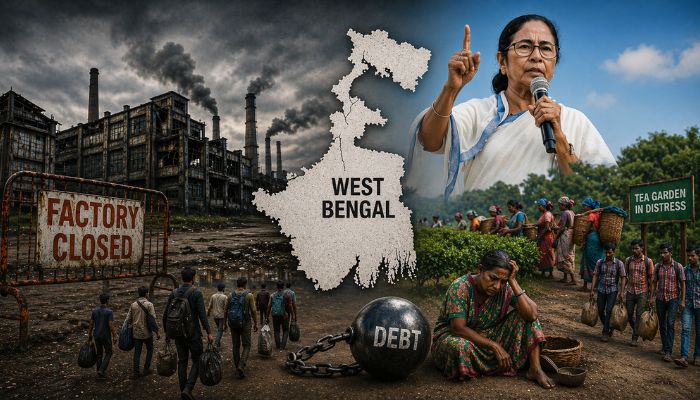
As West Bengal moves toward the 2026 Assembly elections, the atmosphere is thick with political tension. From the tea gardens of Darjeeling to the industrial belts of Hooghly and the coastal villages of the South, every corner of the state is bracing for a decisive moment.
Beyond the slogans of “Ma, Mati, Manush” by TMC, a study shows how a state that once stood among India’s foremost economic powerhouses has gradually slid into a cycle of debt and decline. First under the decades-long rule of the Left Front and now under fifteen years of the All India Trinamool Congress (TMC) government led by Mamata Banerjee.
A structural decline since 2011
According to the financial report [pdf] published by Finskeptics, there was a sense of hope that the “new dawn” would finally break the chains of industrial inertia. However, the data shows that the structural weaknesses of the economy haven’t just remained; they’ve actually deepened.
While the state government has been very successful at building a massive network of welfare schemes, which provide immediate relief to the poor, the “engine” of the economy is sputtering. We are seeing a model where the government is spending more and more on redistribution while the productive sectors, like heavy industry and IT, are struggling to keep up.
The consequences are visible in broader indicators: West Bengal’s share in national GDP has declined, per capita income remains below the national average, and thousands of companies have moved out of the state.
The investment climate has also suffered. Informal costs such as rent-seeking networks, combined with political interference in labour relations, have reduced investor confidence. Infrastructure gaps and factory closures have further weakened the industrial ecosystem.
The long fall of an Industrial giant
Historically, West Bengal was the nerve centre of Indian industry. Shortly after Independence, it contributed nearly 10% to the national GDP. It was the land of engineering giants, jute mills, and the undisputed commercial capital of the East. But over the last seven decades, a combination of bad luck and even worse policy has eroded that foundation. From the shocks of Partition to the “freight equalisation policy” that stripped Bengal of its competitive edge in minerals, and the later years of militant labour movements under the Left, the decline was steady.
The “Bengal Curse” is a poignant way to describe this: in 1960, West Bengal was the 3rd richest state in India. By 2024, it had tumbled to the 24th spot.
Graph via Finskeptics
According to a major working paper by the Economic Advisory Council to the Prime Minister (EAC-PM), the state’s share of national GDP dropped from 10.5% in 1960–61 to just 5.6% in 2023–24. This is the sharpest drop recorded for any major state in the country. Even more heartbreaking is that the relative per capita income, which used to be 127.5% of the national average, has crashed to 83.7%. States like Odisha, which were once considered far behind Bengal, are now racing ahead while Bengal struggles to find its footing.
Graph via Finskeptics
This long-term decline, often described as the “Bengal Curse,” reflects cumulative policy failures across regimes. While the Left Front years entrenched deindustrialisation, the post-2011 period has not delivered the expected turnaround.
The current financial mess: Welfare at the cost of growth
Under the TMC government, the financial situation has become increasingly fragile. The state is currently trapped in a cycle of borrowing to pay for day-to-day expenses rather than building assets that could generate future income. The debt has skyrocketed, and because the state isn’t bringing in enough of its own tax revenue, it has become heavily dependent on the Centre.
The state’s debt has surged to over ₹7.7 lakh crore, while fiscal deficits remain high. Welfare expenditure has expanded significantly, often around election cycles, but capital investment continues to lag.
While the government celebrates its “populist” image, the math behind it is worrying. Most of the money coming in is immediately swallowed up by interest payments on old loans, salaries, and pensions. This leaves very little room for building new roads, bridges, or power plants, the very things that attract businesses and create jobs.
Key indicators highlight the imbalance. Own tax revenue growth remains weak, the credit-deposit ratio is low, and foreign investment inflows are modest. Industrial closures and company relocations further indicate a weakening economic base. The MSME sector, though large in numbers, is dominated by micro enterprises with limited capacity for scale or job creation.
Fiscal and debt trends: The growing mountain of loss
The numbers regarding Bengal’s debt are staggering. When the TMC took office in 2011, the state’s debt was about ₹1.92 lakh crore. By the end of the 2025–26 fiscal year, that figure is projected to hit a massive ₹7.7 lakh crore. That is a fourfold increase in just 15 years.
Every single citizen in West Bengal now carries a “debt burden” of roughly ₹70,653. While the government argues that this is manageable, the real danger is the interest. West Bengal spends about 20% to 28% of all the money it earns just on paying back interest. In comparison, most other big states only spend between 5% and 15%. This means Bengal is losing its “fiscal breathing room.”
Even more concerning is the “Revenue Deficit.” In simple terms, the state is borrowing money to pay for things like subsidies and administrative costs rather than building infrastructure. In FY 2024-25, the fiscal deficit reached 4.02% of the GSDP, which is well above the safe limit of 3% recommended by experts.
Graph via Finskeptics
Between 2020 and 2025, the state accumulated a revenue deficit of ₹1.49 lakh crore. To sustain this, the government has been borrowing heavily, with loans making up 80% of its capital receipts. This is like a household taking out a high-interest credit card loan just to pay the grocery bill; it’s a short-term fix that leads to long-term disaster.
Industrial exodus: Why the factories are leaving
One of the most visible signs of economic stress in West Bengal is the steady exit of industries. Since 2011, over 6,600 companies, including 110 listed firms, have moved their registered offices out of West Bengal. This isn’t just a temporary dip; it’s a structural flight of capital.
Table via Finskeptics
Businesses are leaving for states like Maharashtra, Gujarat, and Uttar Pradesh because they no longer feel confident in Bengal’s business environment. While the state holds grand “Bengal Global Business Summits” and announces massive investment figures, the reality on the ground is that only about 4% of those proposals ever actually happen.
A major reason for this is the “Syndicate System.” In Bengal, the term “syndicate” refers to politically backed groups that control everything from construction materials to labour supply. If a company wants to build a factory, they often have to deal with these informal networks that demand “cut money”, essentially a bribe or a parallel tax.
This adds a huge hidden cost to doing business. On top of this, the old “Gherao” culture, where workers surround managers to demand changes, has made a comeback under new names, leading to 177 factory closures during the TMC’s tenure compared to 83 under the previous government.
This environment has scared away big investors, leaving the state’s industrial output to shrink from 13.5% in the 70s to a measly 3.9% today.
Labour and sectoral distress: The Human cost of decline
The economic imbalance is not just visible in data; it is reflected in the lives of people. One of the clearest indicators is the rise in labour migration. Because there are no new factories and the old ones are closing, West Bengal has become one of India’s biggest exporters of labour. As of 2025, an estimated 22.4 lakh workers from Bengal are working in other states like Kerala, Karnataka, and Maharashtra.
These are people who have left their families behind to do menial jobs elsewhere because they can’t find a living wage at home. This massive out-migration is a “silent referendum” on the state’s governance. If things were going well, why would over two million people flee their homes to work in distant lands?
The distress is particularly visible in the tea gardens of North Bengal. Once the pride of the state, the tea industry is now in a “humanitarian emergency.” Production in 2025 dropped by 50-60%, and 80% of the organised gardens are running at a loss.
But the real tragedy is the workers. While a tea worker in Sikkim earns ₹500 a day, a worker in West Bengal gets only ₹250. This wage gap has led to horrific levels of malnutrition.
Studies in the Alipurduar district show that over 36% of tea workers are clinically undernourished, and nearly 88% suffer from anaemia. In some abandoned gardens, people are literally dying of hunger-related complications. Instead of reviving the industry, the state has allowed land to be diverted for “tea tourism” and real estate, effectively liquidating the assets while the workers starve.
Macroeconomic underperformance: Falling behind the rest of India
At the macro level, West Bengal’s economic performance continues to lag behind comparable states. Its share of national GDP has fallen from 10.5% in 1960–61 to just 5.6% in 2023–24. Per capita income remains below the national average at around 83.7%. The nominal GSDP growth of the state in FY25 was just 9.91%, the lowest among all comparable major states.
The Credit-Deposit (CD) ratio, which measures how much banks are lending locally, is stuck between 46% and 52%. This is 30 points below the national average! It means that the money people in Bengal save in banks is being sent by those banks to other states to fund projects there, because there aren’t enough viable projects to fund in Bengal.
The MSME (Micro, Small, and Medium Enterprises) sector, which the government often brags about, is also in trouble. While there are millions of registrations, 99.9% of them are “Micro” units, often just one person working from home.
These aren’t the kind of businesses that can scale up and provide thousands of jobs. In fact, over 2,200 MSMEs closed down between 2019 and 2024. The state’s ability to generate its own tax revenue is among the lowest in India, and its spending on infrastructure has dropped from 5.3% to a tiny 3%.
Conclusion
What emerges from all these numbers is a clear and worrying pattern. West Bengal is transforming from a state of production to a state of dependency. It is moving from industrial employment to a reliance on money sent home by migrants. Its share of the national pie is shrinking, its factories are closing, and its debt is piling up.
West Bengal’s economic challenges today are not the result of a temporary slowdown; they reflect a deeper structural imbalance. The shift toward welfare-heavy spending without corresponding growth in production, investment, and industry has created a fragile economic model.
High debt, low capital investment, industrial flight, and rising migration are all interconnected symptoms of this imbalance.