From piggybacking on Congress, Left and TMC to supporting radical Islamic parties: How decades of appeasement and demographic shift in West Bengal are changing voting patterns of Muslims
The West Bengal Vidhan Sabha election is just a month away. The ruling Mamata Banerjee-led Trinamool Congress government is in a state of crisis. It is not just due to the formidable resistance put forth by the Opposition BJP but also the emergence of ‘Muslim parties’ in the State, steadily chipping away at her core vote bank. As per estimates [pdf], the Muslim population in West Bengal in 1951 was 19.46%. And their go-to party in the State had been the Indian National Congress. Due to its early appeasement politics and the farce of being ‘secular’, Congress held onto the Muslim vote bank for a long time, and they still do it to some extent. The paradigm shift came in Bengal in the late 1970s, with the Communist Party of India (Marxist) arriving at the power corridors of the State. Over the next 3 decades, the Left party gained significant support from Muslims for fulfilling their demands while posing as ‘atheists’ and opponents of Hindu nationalism. But nothing could have prepared the CPIM for what was to come – The rise of ‘Banglar Meye‘ Mamata Banerjee (who holds a master’s degree in Islamic history). She took Muslim appeasement to new heights and doubled down on exclusionist policies to benefit one community. As the Muslim population grew to an estimated 30-33% of the population in West Bengal (2025), we saw increased cases of religious violence, riots, and targeted attacks with active complicity of the State. A bolstered community, which saw preferential treatment for over 7 decades, is now looking to grab more power and privilege with both hands. This change in communal attitude has seen the mushrooming of ‘Muslim parties’ in Bengal, with a characteristic religious identity and even more radical outlook. We saw the rise of the Indian Secular Front (ISF) ahead of the 2021 Vidhan Sabha election, the growing presence of All India Majlis-e-Ittehadul Muslimeen (AIMIM) and the emergence of the Aam Janata Unnayan Party (AJUP). Muslims of West Bengal, who were once piggybacking on ‘secular’ mainstream parties, are now increasingly siding with open and brazenly communal Islamic parties in the State. This trend highlights how a change in demographics, increasing street veto and access to power can drive identity politics in a State. Appeasement politics in West Bengal Following the partition of India under the supervision of the Congress, Muslims who remained behind found solace in the politics of the party. While the Hindu marriage law was codified, the Congress stayed away from touching the Muhammedan law. The grand old party also used the Waqf Board to appoint loyalists and appease influential Muslim clerics. Not to forget, Congress increased funding for madrasas, opposed uniformity in the civil code and gave disproportionate seats to Muslim candidates. “Election results of 1952 show that a large number of Bengali Muslims did support the Congress. Candidates with Congress ticket won in most constituencies having large number of Muslims,” writes Tawseef Ahmad Malik in ‘Electoral Preferences of Muslims in West Bengal: An Analysis of Lok Sabha Elections’ However, by the late 1970s, Muslims began distancing themselves from Congress and accepting the Left Front as their new ‘messiah’. The Communist Party of India (Marxist) won in areas with high Muslim concentrations that were previously Congress strongholds. “The political victory of the Left Front in 1977 and 1982, and various programmes undertaken by them for theminorities made it a suitable alternative to the Congress,” notes Tawseef Ahmad Malik. Redistribution of surplus lands in the garb of ‘land reforms’ by the Left helped Muslims extensively. As such, the community looked up to CPIM as the ‘protector’ of their political and economic interests. In 1989, the West Bengal government issued a circular and recommended the deletion of discussions about the medieval period because it was “too controversial.” The circular explicitly read “Muslim rule should never attract any criticism. Destruction of temples by Muslim rulers and invaders should not be mentioned.” It maintained its pro-Muslim image by forcing critics of radical Islam, such as Bangladeshi poet Taslima Nasreen, out of West Bengal. CPIM also doctored the Other Backward Classes quota to illegally include Muslims – a move that was struck down by the Calcutta High Court in May 2024. The party declared 66 classes as OBCs between 1994 and 2009. About 12 of the classes belonged to the Muslim community. The CPIM government issued 7 executive orders between 5th March and 10th September 2010 to declare 42 new classes as OBCs. 41 of them belonged to the Muslim community. These new groups thus became eligible for reservation and representation in jobs provided by the West Bengal government. To further appease their Muslim vote bank, the CPIM additionally announced a 10% reservation for Muslims in government jobs in February 2010. Muslim vote sha
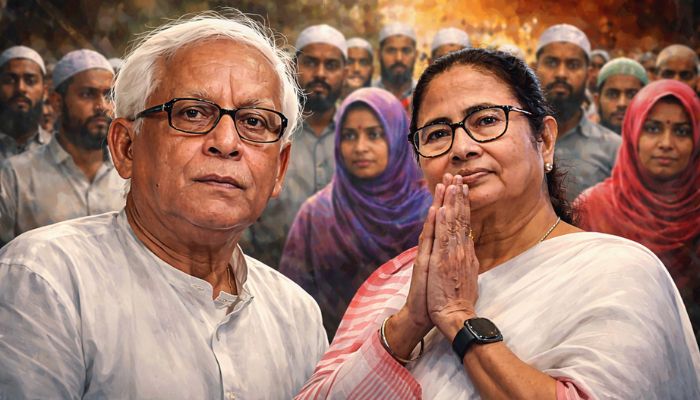
The West Bengal Vidhan Sabha election is just a month away. The ruling Mamata Banerjee-led Trinamool Congress government is in a state of crisis. It is not just due to the formidable resistance put forth by the Opposition BJP but also the emergence of ‘Muslim parties’ in the State, steadily chipping away at her core vote bank.
As per estimates [pdf], the Muslim population in West Bengal in 1951 was 19.46%. And their go-to party in the State had been the Indian National Congress. Due to its early appeasement politics and the farce of being ‘secular’, Congress held onto the Muslim vote bank for a long time, and they still do it to some extent.
The paradigm shift came in Bengal in the late 1970s, with the Communist Party of India (Marxist) arriving at the power corridors of the State. Over the next 3 decades, the Left party gained significant support from Muslims for fulfilling their demands while posing as ‘atheists’ and opponents of Hindu nationalism.
But nothing could have prepared the CPIM for what was to come – The rise of ‘Banglar Meye‘ Mamata Banerjee (who holds a master’s degree in Islamic history). She took Muslim appeasement to new heights and doubled down on exclusionist policies to benefit one community.
As the Muslim population grew to an estimated 30-33% of the population in West Bengal (2025), we saw increased cases of religious violence, riots, and targeted attacks with active complicity of the State. A bolstered community, which saw preferential treatment for over 7 decades, is now looking to grab more power and privilege with both hands.
This change in communal attitude has seen the mushrooming of ‘Muslim parties’ in Bengal, with a characteristic religious identity and even more radical outlook. We saw the rise of the Indian Secular Front (ISF) ahead of the 2021 Vidhan Sabha election, the growing presence of All India Majlis-e-Ittehadul Muslimeen (AIMIM) and the emergence of the Aam Janata Unnayan Party (AJUP).
Muslims of West Bengal, who were once piggybacking on ‘secular’ mainstream parties, are now increasingly siding with open and brazenly communal Islamic parties in the State. This trend highlights how a change in demographics, increasing street veto and access to power can drive identity politics in a State.
Appeasement politics in West Bengal
Following the partition of India under the supervision of the Congress, Muslims who remained behind found solace in the politics of the party. While the Hindu marriage law was codified, the Congress stayed away from touching the Muhammedan law.
The grand old party also used the Waqf Board to appoint loyalists and appease influential Muslim clerics. Not to forget, Congress increased funding for madrasas, opposed uniformity in the civil code and gave disproportionate seats to Muslim candidates.
“Election results of 1952 show that a large number of Bengali Muslims did support the Congress. Candidates with Congress ticket won in most constituencies having large number of Muslims,” writes Tawseef Ahmad Malik in ‘Electoral Preferences of Muslims in West Bengal: An Analysis of Lok Sabha Elections’
However, by the late 1970s, Muslims began distancing themselves from Congress and accepting the Left Front as their new ‘messiah’. The Communist Party of India (Marxist) won in areas with high Muslim concentrations that were previously Congress strongholds.
“The political victory of the Left Front in 1977 and 1982, and various programmes undertaken by them for theminorities made it a suitable alternative to the Congress,” notes Tawseef Ahmad Malik.
Redistribution of surplus lands in the garb of ‘land reforms’ by the Left helped Muslims extensively. As such, the community looked up to CPIM as the ‘protector’ of their political and economic interests.
In 1989, the West Bengal government issued a circular and recommended the deletion of discussions about the medieval period because it was “too controversial.”
The circular explicitly read “Muslim rule should never attract any criticism. Destruction of temples by Muslim rulers and invaders should not be mentioned.”
It maintained its pro-Muslim image by forcing critics of radical Islam, such as Bangladeshi poet Taslima Nasreen, out of West Bengal.
CPIM also doctored the Other Backward Classes quota to illegally include Muslims – a move that was struck down by the Calcutta High Court in May 2024.
The party declared 66 classes as OBCs between 1994 and 2009. About 12 of the classes belonged to the Muslim community. The CPIM government issued 7 executive orders between 5th March and 10th September 2010 to declare 42 new classes as OBCs. 41 of them belonged to the Muslim community.
These new groups thus became eligible for reservation and representation in jobs provided by the West Bengal government. To further appease their Muslim vote bank, the CPIM additionally announced a 10% reservation for Muslims in government jobs in February 2010.
Muslim vote share in West Bengal across 3 Lok Sabha elections
The shift of Muslim voters in West Bengal from the Left Front (CPIM) to the Trinamool Congress (TMC) was a gradual process that accelerated significantly between 2006 and 2011.
Mamata Banerjee capitalised on the Nandigram movement, where the Left had taken over land belonging to Muslim farmers for industrialisation.
After coming to power, the TMC government declared 35 new classes as OBCs. As expected, 34 of those classes belonged to the Muslim community.
In February 2012, Mamata Banerjee made Urdu the second language in areas of the State where Urdu speakers were equal to or more than 10% of the population.
She also introduced a scheme of honorarium for Muslim clerics and muezzins, which is called ‘Imam Bhata’.
Over the years, the TMC government has failed to provide security to Hindus during religious festivals, postponed the Visarjan of Durga Puja to make way for Muharram, demonised Jai Shri Ram, opposed NRC, CAA, the Waqf Amendment Act and even the Special Intensive Revision of electoral rolls in the State.
Mamata Banerjee has downplayed Islamic terror attacks in India, increased funding for madrasas, given scholarships exclusively to Muslims and more. As such, the Muslim vote bank had been her greatest support in electoral politics.
In May 2019, the West Bengal CM had described Muslims as ‘milk-providing cows’. She had infamously said, “Je goru dudh dei, tar lathio khete hoi” (If a cow gives milk, one has to be prepared for its kicks also)”
The rise of radical Islamic parties
Since 2021, West Bengal has been witnessing a new trend. It appears as if Mamata’s open favouritism, preferential treatment and brazen appeasement have fallen short to placate the radical ideas of the Muslim community. As such, there is a growing interest in new and emerging parties whose ideology is ‘political Islam.’
You may recall the case of ‘Indian Secular Front’, which was established in 2021.
The party was founded by an Islamic hate preacher named Abbas Siddiqui, who prayed to Allah to kill 50 crore Indians with the Coronavirus. ISF managed to clinch the Bhangar Vidhan Sabha seat.
At that time, AIMIM of Asaduddin Owaisi contested independently and cut through some of the Muslim vote bank of Mamata Banerjee.
Ahead of the 2026 Vidhan Sabha election, a radical Trinamool Congress MLA named Humayun Kabir threatened to lay the foundation of the controversial ‘Babri Masjid’ in Muslim-dominated Murshidabad.
Kabir, who conceded to making hate speeches against Hindus at the behest of Mamata Banerjee, even floated his own party named Aam Janata Unnayan Party (AJUP).
Since he had weaponised the polarising issue of rebuilding Babri, Kabir has received extensive support from local Muslims. AJUP now hopes to capitalise on this growing Islamist ideology to make inroads in West Bengal politics.
Unlike the past, where Muslims had to choose one mainstream party or another, they now have an option to side with ISF, AJUP and AIMIM.
It gives out a clear message – Muslims are now looking forward to political parties who are ‘for the Muslims, by the Muslims and of the Muslims.’
Years of appeasement, followed by rapid population growth and demographic shift, have made it clear to them that they can grab more political power in West Bengal in the coming years.
As such, all parties that Muslims piggybacked on all these years are now appearing as the ones who did ‘injustice’ to them.
Interestingly, this is what Asaduddin Owaisi claimed on Sunday (22nd March) while announcing AIMIM’s pre-poll alliance with AJUP.
Chances of electoral success
The West Bengal Vidhan Sabha has a total of 294 seats. The Muslim vote bank is likely to play a decisive role in 85 Muslim-majority seats. These constituencies are in the districts of Murshidabad (66%), Malda (51%), North Dinajpur (50%), Birbhum (37%), and South 24 Parganas (35%).
If we include areas with 25-30% Muslim votes, the number of seats can reach 110-120. In the 2021 elections, the TMC won 75 of these 85 Muslim-majority seats (out of a total of 213).
However, with the emergence of the AJUP-AIMIM alliance, the TMC’s vote bank is clearly at risk. If the alliance performs strongly in even 40-50 seats, the TMC could lose 50-70 seats.