From Tiruppur to the EU and the US: How the new trade deals could transform India’s textile hubs and double Tamil Nadu’s garment exports
India’s textile and apparel industry is set for a great boost with the finalisation of the first phase of the India-US trade agreement. The framework for the recently announced agreement is centred on reducing import taxes on various goods to enhance trade between the two nations. India-US Trade Agreement, major boost for Textile IndustryRead more: https://t.co/pbrZErlVs8@PIB_India @TexMinIndia pic.twitter.com/uQvKqgG5NK— PIB Textiles (@PIBTextiles) February 7, 2026 Currently, the USA is the largest export market for Indian textiles and textile products, with exports valued at $10.5-11 billion annually. Close to 28% of total textile and textile product exports from India in FY25 were meant for exports to the USA alone. Now, with the USA agreeing to reduce customs duty on Indian textile products to merely 18%, Indian textile exports are expected to gain a strong edge over other competing countries such as Bangladesh (20%), Vietnam (20%), Pakistan (19%), and China (30%). On Saturday, 7th February, the Union Ministry of Textiles has said that the agreement opens up access to a massive $118 billion US import market for textiles, apparel and made-ups. This means Indian exporters will now find it easier and more cost-effective to sell their products in the US. The ministry believes that this deal will play a key role in helping India reach its ambitious target of $100 billion in textile and apparel exports by 2030, up from $37.7 billion in FY25. A big opportunity for the textile hub of Tiruppur, Tamil Nadu Tamil Nadu, especially Tiruppur, which is a hub for the textile industry, is likely to gain significantly from the India-US agreement. Tiruppur is a city situated about 450 km from Chennai and is also referred to as India’s knitwear capital. It has over 1,100 exporters across the city under the Tiruppur Exporters’ Association (TEA). According to TEA president K M Subramanian, currently, the export of garments from Tamil Nadu to the US has been valued at ₹15,000 crore. This figure, he mentioned, is expected to double to ₹30,000 crore within the next three years following this new agreement. The agreement, says Subramanian, has great significance; the city will gain tremendous growth momentum within the next five years. The employment impact could be equally impressive. At present, around 10 lakh people work in the textile and knitwear sector in Tiruppur and nearby areas. With increased exports and fresh orders from the US, another five lakh jobs could be created over the next three to five years. For a labour-intensive industry like textiles, this could bring major social and economic benefits to the region. Entrepreneurs in Tiruppur are already optimistic. M Rathinasamy, founder of Starrlight Exporters, said that earlier, many US orders were shifting to countries like Bangladesh. Now, with the improved tariff position, more orders are expected to come back to India. Exporters believe that within the next three months, the impact of the deal will begin to show in higher shipment volumes. This renewed growth is particularly important because Tiruppur had reportedly suffered losses of nearly ₹15,000 crore in 2025 due to tariff disadvantages in the US market. The new agreement could help factories run at full capacity again and restore confidence among exporters. The EU deal: “Mother of all deals” If the US agreement is a big step forward, the India–EU free trade agreement is being described as even bigger. This deal has been described as the “mother of all deals” for the subcontinent. India and the European Union have signed a wide-ranging agreement after nearly two decades of negotiations, which enables duty concessions on almost all goods and services traded between India and the European Union. The European Union is a very large market in the world. The European Union imports goods worth $6.5 trillion every year. Commerce and Industry Minister Piyush Goyal described this agreement as a ‘game-changer’ for India’s textile industry, as it removes the initial imposition of customs duty of 9 to 12% on Indian textiles and apparel. Under the new agreement, there will be zero customs duty on 90% of Indian imports immediately, and the remaining 7% will be raised to 93% in seven years. For a long time, Indian exporters complained about a large differential in the EU market with Bangladesh, which benefited from the duty-free market under the “Everything But Arms” facility. Bangladesh ships nearly $30 billion worth of textiles to the EU duty-free, while India’s $7 billion exports faced tariffs of up to 12%. With the new FTA, India will finally compete on equal footing. India can now ramp up textile exports to compete with Bangladesh in Europe"India can boost textile exports to Europe from $7 billion to $30-40 billion quickly. We were always asked how Bangladesh exports so much to Europe. They had zero duties and captured a $30 billion share" pic.twitter.com/HK6HtrJvTX— Shashank
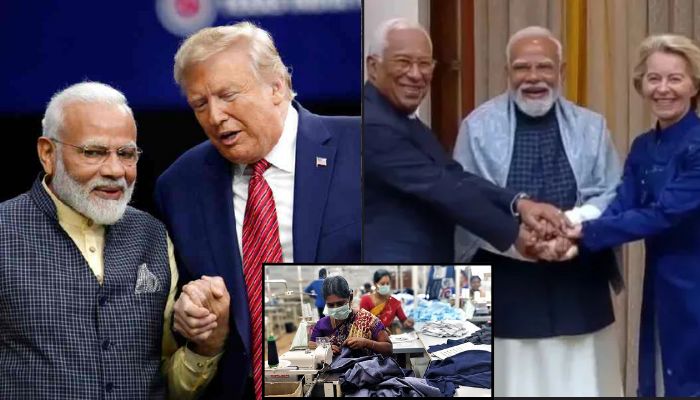

India’s textile and apparel industry is set for a great boost with the finalisation of the first phase of the India-US trade agreement. The framework for the recently announced agreement is centred on reducing import taxes on various goods to enhance trade between the two nations.
India-US Trade Agreement, major boost for Textile Industry
— PIB Textiles (@PIBTextiles) February 7, 2026
Read more: https://t.co/pbrZErlVs8@PIB_India @TexMinIndia pic.twitter.com/uQvKqgG5NK
Currently, the USA is the largest export market for Indian textiles and textile products, with exports valued at $10.5-11 billion annually. Close to 28% of total textile and textile product exports from India in FY25 were meant for exports to the USA alone. Now, with the USA agreeing to reduce customs duty on Indian textile products to merely 18%, Indian textile exports are expected to gain a strong edge over other competing countries such as Bangladesh (20%), Vietnam (20%), Pakistan (19%), and China (30%).
On Saturday, 7th February, the Union Ministry of Textiles has said that the agreement opens up access to a massive $118 billion US import market for textiles, apparel and made-ups. This means Indian exporters will now find it easier and more cost-effective to sell their products in the US. The ministry believes that this deal will play a key role in helping India reach its ambitious target of $100 billion in textile and apparel exports by 2030, up from $37.7 billion in FY25.
A big opportunity for the textile hub of Tiruppur, Tamil Nadu
Tamil Nadu, especially Tiruppur, which is a hub for the textile industry, is likely to gain significantly from the India-US agreement. Tiruppur is a city situated about 450 km from Chennai and is also referred to as India’s knitwear capital. It has over 1,100 exporters across the city under the Tiruppur Exporters’ Association (TEA).
According to TEA president K M Subramanian, currently, the export of garments from Tamil Nadu to the US has been valued at ₹15,000 crore. This figure, he mentioned, is expected to double to ₹30,000 crore within the next three years following this new agreement. The agreement, says Subramanian, has great significance; the city will gain tremendous growth momentum within the next five years.
The employment impact could be equally impressive. At present, around 10 lakh people work in the textile and knitwear sector in Tiruppur and nearby areas. With increased exports and fresh orders from the US, another five lakh jobs could be created over the next three to five years. For a labour-intensive industry like textiles, this could bring major social and economic benefits to the region.
Entrepreneurs in Tiruppur are already optimistic. M Rathinasamy, founder of Starrlight Exporters, said that earlier, many US orders were shifting to countries like Bangladesh. Now, with the improved tariff position, more orders are expected to come back to India. Exporters believe that within the next three months, the impact of the deal will begin to show in higher shipment volumes.
This renewed growth is particularly important because Tiruppur had reportedly suffered losses of nearly ₹15,000 crore in 2025 due to tariff disadvantages in the US market. The new agreement could help factories run at full capacity again and restore confidence among exporters.
The EU deal: “Mother of all deals”
If the US agreement is a big step forward, the India–EU free trade agreement is being described as even bigger. This deal has been described as the “mother of all deals” for the subcontinent. India and the European Union have signed a wide-ranging agreement after nearly two decades of negotiations, which enables duty concessions on almost all goods and services traded between India and the European Union.
The European Union is a very large market in the world. The European Union imports goods worth $6.5 trillion every year. Commerce and Industry Minister Piyush Goyal described this agreement as a ‘game-changer’ for India’s textile industry, as it removes the initial imposition of customs duty of 9 to 12% on Indian textiles and apparel. Under the new agreement, there will be zero customs duty on 90% of Indian imports immediately, and the remaining 7% will be raised to 93% in seven years.
For a long time, Indian exporters complained about a large differential in the EU market with Bangladesh, which benefited from the duty-free market under the “Everything But Arms” facility. Bangladesh ships nearly $30 billion worth of textiles to the EU duty-free, while India’s $7 billion exports faced tariffs of up to 12%. With the new FTA, India will finally compete on equal footing.
India can now ramp up textile exports to compete with Bangladesh in Europe
— Shashank Mattoo (@MattooShashank) January 27, 2026
"India can boost textile exports to Europe from $7 billion to $30-40 billion quickly. We were always asked how Bangladesh exports so much to Europe. They had zero duties and captured a $30 billion share" pic.twitter.com/HK6HtrJvTX
Industry experts believe India’s share in the EU textile market, currently about $5.5 billion or 6%, could double to over $11 billion in the next five years. Given that textiles are India’s second-largest employer after agriculture, employing around 40 million people, the job potential is huge. Estimates suggest that better access to the EU market could generate 6 to 7 million additional jobs in the coming years.
India already has a strong presence in home textiles such as bed linen, towels and curtains. With zero-duty access, European buyers are expected to increase sourcing from India. This means better pricing stability for retailers and long-term business security for Indian manufacturers.
Bangladesh faces growing pressure
While these deals are positive news for India, they present serious challenges for Bangladesh. The EU-India FTA significantly reduces the tariff advantage Bangladesh has long enjoyed as a Least Developed Country (LDC).
Bangladesh’s economy is heavily dependent on textiles and apparel, which account for nearly 94% of its exports to the EU. The EU absorbs about 44% of Bangladesh’s total exports. With India now enjoying zero tariffs, Bangladesh risks losing market share, especially in basic, price-sensitive apparel segments.
Bangladesh is set to graduate from least-developed country (LDC) status in 2026. Its duty-free access under the EU’s EBA scheme will effectively expire by November 2029. After that, unless it secures special GSP+ benefits, it could face tariffs of around 12% on apparel exports. If India continues to enjoy zero-duty access while Bangladesh faces double-digit tariffs, the competitive gap could widen sharply.
This situation could lead to trade diversion. European brands, looking to diversify supply chains under the “China+1” strategy, may prefer India because of tariff advantages, better regulatory predictability, and a strong cotton-to-garment supply chain.
For Bangladesh, this is a wake-up call. It will need to focus on compliance with international labour and environmental standards to secure future trade benefits. But for now, India’s improved tariff position gives it a strong edge in both the US and EU markets.
A turning point for India’s textile ambitions
Taken together, the India-US and India-EU trade deals mark a turning point for the country’s textile and apparel industry. They not only reduce tariff barriers but also improve India’s image as a reliable sourcing destination.
The deal also comes at a crucial time. In November 2025, US imports of textiles and apparel from India had dropped sharply by over 31% compared to the previous year. The new tariff structure is expected to reverse this decline and restore India’s competitiveness in the American market.
With access to two of the world’s largest consumer markets on better terms, Indian exporters could expect to benefit from more orders, expanded factories, and employment generation. States such as Tamil Nadu, Gujarat, Maharashtra, and Punjab could also see fresh investments and employment generation.
But if the momentum continues and the reforms in the domestic market are favourable to these industries, India’s dream of accomplishing $100 billion in textile exports by the year 2030 doesn’t seem to be a distant dream after all. For the industry, these trade deals promise to greenlight the coming decade.