How Khalistani terrorists targeted buses, trains and markets to identify and massacre Hindus
It was the night of 6th July 1987. A Haryana Roadways bus had left Chandigarh and was moving towards Rishikesh. The passengers were mainly pilgrims, labourers, women, children and men who expected nothing worse than a late arrival. When the bus was about to cross Lalru, a car cut across its path. Armed men climbed aboard, drove the bus off the main road, taunted the passengers, looted them, and opened fire from both ends of the vehicle. 38 people were killed that night, including five women and four children. This was not crossfire. There was no confusion. The victims were selected and marked for death because they were Hindus travelling through a landscape in which Khalistani terror had learnt how to weaponise the ordinary journey. This was not an isolated incident. The scene was repeated, with variations, across Punjab during the insurgency. A bus was stopped. A train was halted using the emergency chain. Identities were checked by beard, turban, name, accent or the answers demanded at gunpoint. Sikh passengers were told to step aside. Women and children were sometimes waved away, sometimes not. Hindu men were lined up, ordered off the bus, or trapped inside a compartment and shot at close range. When the killings moved off the roads, they entered markets, brick kilns, morning shakhas and factory floors. When such incidents are taken together, they describe not just accidental civilian loss but a recurring method of communal terrorism. Before Blue Star, the pattern was already visible One of the most common illusions about the Punjab insurgency is that the organised killing of Hindu civilians began only after Operation Blue Star in June 1984. The chronology does not support this theory. Lala Jagat Narain, the founder of the Hind Samachar Group and an outspoken critic of separatist militancy, was assassinated on 9th September 1981. Within weeks, Dal Khalsa hijackers seized Indian Airlines Flight 423 and demanded the release of Khalistani terrorist Jarnail Singh Bhindranwale. Lala Jagat Narain was murdered during the early stage of a campaign against opponents of militant separatism, well before June 1984. By early October 1983, the violence had acquired a new and more chilling grammar. In the Dhilwan bus killings of 5th and 6th October 1983, six Hindu passengers were taken from a bus travelling from Dhilwan towards Jalandhar. They were shot dead after the attackers asked the passengers to identify their religion. Media reports suggest that it was among the first notorious bus massacres in which Hindus were selected and shot during the insurgency. President’s Rule followed immediately in Punjab. But President’s Rule did not stop the killings. On 18th November 1983, another bus in Kapurthala district was intercepted and four Hindu passengers were killed. Notably, in both the Dhilwan and Kapurthala episodes, the hijacked buses ended up abandoned in the same border belt near Amritsar. These were not yet the highest-casualty attacks of the insurgency, but they showed that public transport had become a practical theatre for communal selection and execution. The pre-Blue Star record grew bloodier in February 1984. On 23rd February, a cluster of attacks took place, leading to the deaths of 11 Hindus, while over two dozen people were wounded. Both trains and buses were attacked. While this was not a single-location massacre and involved multiple incidents, the murders happened on a single day. Months before the Army entered the Golden Temple complex, Khalistani terrorists were pulling civilians from transport networks and turning buses and trains into tools of communal terror. Government and newspaper tallies for the first five months of 1984 recorded hundreds of violent incidents and around 300 deaths before Operation Blue Star began. The bus route near Moga added one more pre-June marker. On 21st May, six Khalistani terrorists hijacked a bus near Moga and killed four Hindu passengers. Ten others were injured. Why Hindus were being singled out Reports from that time were unusually direct about why Hindus were being targeted during these attacks. In July 1986, after the Muktsar massacre, the Los Angeles Times wrote that the attack strongly suggested an intensified separatist campaign to polarise Sikh and Hindu communities. It described a broader campaign aimed at driving Hindus out of Punjab. Following the Hoshiarpur massacre in November 1986, the LA Times reported that the killings appeared designed to create divisions between Sikh and Hindu populations. Police officials were quoted as saying that the terrorists wanted Sikhs outside Punjab to move in and Hindus inside Punjab to move out. The Washington Post made a similar point after the Lalru massacre in July 1987, suggesting that terrorists had adopted tactics meant to force Hindus out of the state and create wider tensions elsewhere in the country. Several statements from the authorities reinforced that interp
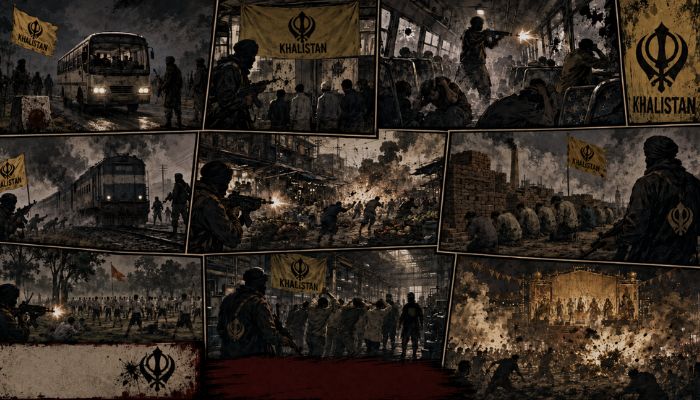
It was the night of 6th July 1987. A Haryana Roadways bus had left Chandigarh and was moving towards Rishikesh. The passengers were mainly pilgrims, labourers, women, children and men who expected nothing worse than a late arrival. When the bus was about to cross Lalru, a car cut across its path. Armed men climbed aboard, drove the bus off the main road, taunted the passengers, looted them, and opened fire from both ends of the vehicle.
38 people were killed that night, including five women and four children. This was not crossfire. There was no confusion. The victims were selected and marked for death because they were Hindus travelling through a landscape in which Khalistani terror had learnt how to weaponise the ordinary journey.
This was not an isolated incident. The scene was repeated, with variations, across Punjab during the insurgency. A bus was stopped. A train was halted using the emergency chain. Identities were checked by beard, turban, name, accent or the answers demanded at gunpoint. Sikh passengers were told to step aside. Women and children were sometimes waved away, sometimes not.
Hindu men were lined up, ordered off the bus, or trapped inside a compartment and shot at close range. When the killings moved off the roads, they entered markets, brick kilns, morning shakhas and factory floors. When such incidents are taken together, they describe not just accidental civilian loss but a recurring method of communal terrorism.
Before Blue Star, the pattern was already visible
One of the most common illusions about the Punjab insurgency is that the organised killing of Hindu civilians began only after Operation Blue Star in June 1984. The chronology does not support this theory. Lala Jagat Narain, the founder of the Hind Samachar Group and an outspoken critic of separatist militancy, was assassinated on 9th September 1981.
Within weeks, Dal Khalsa hijackers seized Indian Airlines Flight 423 and demanded the release of Khalistani terrorist Jarnail Singh Bhindranwale. Lala Jagat Narain was murdered during the early stage of a campaign against opponents of militant separatism, well before June 1984.
By early October 1983, the violence had acquired a new and more chilling grammar. In the Dhilwan bus killings of 5th and 6th October 1983, six Hindu passengers were taken from a bus travelling from Dhilwan towards Jalandhar. They were shot dead after the attackers asked the passengers to identify their religion.
Media reports suggest that it was among the first notorious bus massacres in which Hindus were selected and shot during the insurgency. President’s Rule followed immediately in Punjab.
But President’s Rule did not stop the killings. On 18th November 1983, another bus in Kapurthala district was intercepted and four Hindu passengers were killed. Notably, in both the Dhilwan and Kapurthala episodes, the hijacked buses ended up abandoned in the same border belt near Amritsar. These were not yet the highest-casualty attacks of the insurgency, but they showed that public transport had become a practical theatre for communal selection and execution.
The pre-Blue Star record grew bloodier in February 1984. On 23rd February, a cluster of attacks took place, leading to the deaths of 11 Hindus, while over two dozen people were wounded. Both trains and buses were attacked. While this was not a single-location massacre and involved multiple incidents, the murders happened on a single day.
Months before the Army entered the Golden Temple complex, Khalistani terrorists were pulling civilians from transport networks and turning buses and trains into tools of communal terror. Government and newspaper tallies for the first five months of 1984 recorded hundreds of violent incidents and around 300 deaths before Operation Blue Star began.
The bus route near Moga added one more pre-June marker. On 21st May, six Khalistani terrorists hijacked a bus near Moga and killed four Hindu passengers. Ten others were injured.
Why Hindus were being singled out
Reports from that time were unusually direct about why Hindus were being targeted during these attacks. In July 1986, after the Muktsar massacre, the Los Angeles Times wrote that the attack strongly suggested an intensified separatist campaign to polarise Sikh and Hindu communities. It described a broader campaign aimed at driving Hindus out of Punjab.
Following the Hoshiarpur massacre in November 1986, the LA Times reported that the killings appeared designed to create divisions between Sikh and Hindu populations. Police officials were quoted as saying that the terrorists wanted Sikhs outside Punjab to move in and Hindus inside Punjab to move out.
The Washington Post made a similar point after the Lalru massacre in July 1987, suggesting that terrorists had adopted tactics meant to force Hindus out of the state and create wider tensions elsewhere in the country.
Several statements from the authorities reinforced that interpretation. After the Muktsar massacre, Barnala authorities appealed to people not to fall into the trap of forces seeking “fratricidal bloodshed”. After the Hoshiarpur massacre, Congress leader Rajiv Gandhi called it a “grave provocation” to secularism and brotherhood. After the Moga massacre in 1989, then Home Minister Buta Singh explicitly described the attack as an attempt by terrorists to whip up communal tensions.
These were not retrospective ideological readings imposed decades later. They were the language used by the state at the time in response to the pattern it believed was unfolding. The strategic objective of the terrorists was brutally simple. If Hindus could be made to feel unsafe in Punjab, and if retaliatory anti-Sikh violence could be provoked elsewhere, everyday coexistence could be broken.
Punjab could then be made to appear, falsely but usefully for militants, as a territory where non-Sikhs could not live securely. That is why so many of the chosen targets were buses, trains, market squares and workplaces, the places where ordinary, mixed, unguarded daily life was still functioning. Terror on that terrain was meant to convert coexistence into suspicion.
There is another necessary point that needs to be discussed. This was a strategy of Khalistani terrorists, and the whole Sikh community cannot be said to have had a similar aim. Sikhs were themselves killed by terrorists, including moderates, politicians, policemen and dissenters.
Harchand Singh Longowal, who signed the Rajiv-Longowal Accord in July 1985, was assassinated in August by terrorists opposed to that peace effort. The existence of anti-Hindu massacres is historically undeniable. Similarly, it is also a fact that the terrorists targeted Sikhs who stood against them. Any honest account must hold both truths together.
Buses and trains became killing fields
Dhilwan, October 1983. Dhilwan matters not only because it was early, but because it fixed the basic image that would recur for years. A bus was stopped, identities were demanded, and Hindu passengers were separated and shot. The public memory it created was decisive. It established that transport corridors could be turned into sites of communal sorting and death.
Kapurthala, November 1983. The November killings in Kapurthala district showed that Dhilwan was not a one-off horror. Four Hindu passengers were murdered after another bus was intercepted. In the public mind, repetition gave the method its meaning: what had looked like a singular outrage in October now appeared to be a developing tactic.
Muktsar, 25th July 1986. By the time the attackers struck near Muktsar, the method had become terrifyingly refined. According to the Los Angeles Times, Khalistani terrorists boarded the bus and ordered women, children and Sikh passengers, identifiable by their turbans and unshorn beards, to get down. They then opened fire on those left behind. The paper reported that at least 14 of the dead were believed to be Hindus and that one clean-shaven Sikh may have been killed because he was mistaken for a Hindu. In one small detail, the whole communal logic of the attack was exposed. Visible religious identity determined survival.
Hoshiarpur or Khudda, 30th November 1986. Four months later came one of the most explicit bus massacres of the insurgency. Near Khuda in Hoshiarpur district, Khalistani terrorists ordered Hindu passengers off a public bus and opened fire on them as they descended. Twenty-four people were killed and seven were wounded, according to police accounts carried by the Los Angeles Times. The report called it the worst single terrorist incident in Punjab that year and linked it directly to the earlier Muktsar attack, noting that both appeared intended to divide Sikhs and Hindus.
Lalru, 6th July 1987. Lalru became infamous because of its scale and cruelty. The bus was not merely stopped and sprayed with bullets. According to the Washington Post and later reconstructions based on survivor testimony, the terrorists followed the vehicle, commandeered it, drove it off the highway, looted the passengers, mocked police chief Julio Ribeiro, and then fired for about five minutes from both ends of the bus. The dead included women and children. A note reportedly left behind threatened the killing of a hundred Hindus for every Sikh youth allegedly killed by the state. The massacre was therefore not only communal; it was demonstrative, theatrical, and meant to travel as a rumour and a warning.
Fatehabad, 7th July 1987. A day later, the violence crossed into Haryana but remained inseparable from the Punjab insurgency. Two buses were attacked near Fatehabad; 34 Hindu passengers were killed and 18 were wounded. Later reporting tied the methods closely to Lalru, citing a second vehicle used to stop the bus, looting, Chinese automatic rifles, and a likely escape route back towards the Punjab border. What Lalru and Fatehabad showed together was the wave pattern of terror, with one massacre not ending but rolling into another before the first shock had settled.
Ludhiana district, 15th June 1991. The attacks on two passenger trains in Ludhiana district pushed the logic of transport terror to an even larger scale. Sources differ on the precise toll, with contemporary reporting putting the death toll at at least 80 and some later tallies rising well above 100. What is not in doubt is that militants halted the trains by pulling the emergency cords and then opened fire inside the compartments on an election day already darkened by violence. Not every person killed in the June 1991 attacks was necessarily singled out in the same way, which is why the communal component must be described with care. But the massacre plainly belongs in the history of how rail travel in Punjab was converted into a space of civilian slaughter.
Sohian, 26th December 1991. The December massacre near Sohian was more explicitly selective. Terrorists boarded a local train from Ludhiana to Ferozepur, pulled the emergency chain near Sohian, and then shot 50+ passengers who appeared to be Hindu.
Markets, kilns and factory floors were not spared
Public transport was the most recognisable stage for these killings, but it was never the only one. On 29th March 1986, terrorists killed around 20 labourers at Mallian near Jalandhar.
The Moga massacre of 25th June 1989 showed that the target could also be a stationary Hindu gathering. Terrorists opened fire from a van on an RSS morning assembly at Nehru Park. Initial reporting in The Washington Post said that at least 24 people were killed; later counts and the Moga district memorial page place the death toll at 25 or 26, with more deaths occurring in bomb blasts after the shooting. Buta Singh called it a grave attempt to inflame communal passions. The official memorial at Shahidi Park still preserves the event in local memory, but as with so many such massacres, the wider national memory has shrunk the dead into a number.
Abohar, on 7th March 1990, brought this terror into the commercial heart of a town. Gunmen opened fire in a crowded market and killed 22 Hindus. A market full of civilians was chosen because such a place magnified fear. A bazaar is the opposite of a battlefield; that is precisely why terrorists chose it. OpIndia’s detailed report on the incident can be accessed here.
The violence also travelled outside Punjab. In Rudrapur, Uttar Pradesh,, during Ram Lila celebrations on 17th October 1991, two bombs exploded, the first at the performance ground and the second near the hospital where the injured were being taken. More than 40 people were reported killed and around 140 were injured. Later accounts say that Khalistani groups claimed responsibility. Rudrapur matters in this history because it shows that the same insurgent ecosystem could target Hindu civilians beyond Punjab’s borders while still working within the logic of communal intimidation.
Then came Harkishanpura on 11th March 1992. Reports suggest that 16 Hindu workers were killed by militants. The victims were factory employees, and the terrorists may have been disguised as police, while some accounts link the attack to defiance of a militant shutdown order. Men at work were executed in a factory setting because they belonged to the targeted civilian pool the insurgency had repeatedly marked out.
The victims were commuters, workers and families
The dead in these massacres were not only “passengers” or “civilians” in the abstract. They were women carrying children on buses, men going to shrines, labourers at kilns, RSS volunteers at morning exercises, market-goers, factory hands, migrants, and office-bound commuters. Lalru alone killed women and children; Muktsar spared some women and children while killing the remaining men, which in its own way reveals how carefully the terrorists calibrated terror for symbolic effect. The selection was meant to be seen, remembered and retold by survivors.
Many attacks also show how crude visible markers became instruments of life and death. In Muktsar, Sikh passengers identifiable by their turbans and beards were ordered off the bus, while a clean-shaven Sikh appears to have died because he was taken for a Hindu. In Sohian, passengers were reportedly shot because they “appeared” to be Hindu. The violence therefore did not just target bodies; it targeted the social recognisability of religious identity in a mixed society. The attacker’s question was not who had done what, but who looked like whom.
This is also why these massacres cannot be brushed aside as unfortunate collateral damage in a wider conflict between terrorists and the state. The recurring method points in the opposite direction. Vehicles were intercepted. Passengers were questioned. Religious identity was checked. Some were released and others were shot. Bombs were sometimes added to magnify panic or kill rescuers, as in Moga and Rudrapur. The closer one stays to the documented mechanics, the harder it becomes to deny the communal design.
The rupture did not fully succeed, but the memory faded
The militants wanted something larger than murder. They wanted rupture: a Punjab in which Hindu and Sikh everyday life could no longer look normal, and an India in which every atrocity might trigger an answering atrocity somewhere else. There were moments when they came frighteningly close. The Muktsar killings were followed by Hindu-Sikh rioting in west Delhi, and the Hoshiarpur massacre triggered fears of fresh reprisals. But the project never fully succeeded. Many Sikhs rejected the separatist campaign, and many paid with their lives. Longowal’s murder remains the most famous example, but he was not the only one.
To say that Khalistani terrorists organised massacres of Hindu civilians is not to indict Sikhs but to name the perpetrators correctly. In fact, the historical record itself demands that distinction, because the insurgency also killed Sikh politicians, Sikh policemen, Sikh dissenters and Sikh civilians deemed insufficiently obedient. The men who stopped buses and trains were trying to manufacture a civilisational divide that Punjab’s social life had long resisted.
What has happened since is a quieter injustice. Some incidents, like Moga, still have a memorial site. Most survive in public recall as place-names and casualty figures. The names of many victims are harder to recover than the biographies of the militants who killed them. Even where documentation survives, it is often fragmented. A newspaper clipping here, a district memorial there, a later chronology elsewhere. The result is that the dead remain present in numbers but strangely absent in personality.
So one returns to the bus at Lalru, the bus at Muktsar, the bus near Hoshiarpur, the halted trains in Ludhiana district, the market at Abohar, and the gathering in Moga. The people there were not combatants. They were not soldiers in uniform, nor men storming a police station, nor armed rivals in a factional feud. They were travelling, working, shopping, exercising, and going home. In those moments, their Hindu identity was made the whole case against them. No honest history of the Punjab insurgency can leave that out.