‘If I find three people like Deendayal, I will change politics’ – Read how Dr Mukherjee found Atal and the story of three beacons of nationalism standing tall at the Rashtra Prerna Sthal
Today, on 25th December, is Good Governance Day. It is also the 101st birth anniversary of Bharat Ratna former Prime Minister Atal Bihari Vajpayee. On this occasion, Prime Minister Narendra Modi will dedicate the Rashtra Prerna Sthal in Lucknow, Uttar Pradesh, to the nation. Statues of three luminaries of nationalism, Dr. Shyama Prasad Mukherjee, Pandit Deendayal Upadhyaya, and Atal Bihari Vajpayee have been installed at this site. Know about Rashtriya Prerna Sthal The Rashtriya Prerna Sthal, located on the banks of the Gomti River in Lucknow, is spread across 65 acres. It was built at a cost of approximately ₹230 crore. Sixty-five-foot-tall bronze statues of the three nationalist leaders have been installed on its premises. The statues weigh about 42 tons each and are surrounded by water bodies. The complex houses a state-of-the-art museum designed in the shape of a lotus flower. It spans approximately 98,000 square feet. It features five galleries and 12 interpretation walls depicting the lives, struggles, and ideologies of the three leaders. Remembering former Prime Minister Atal Bihari Vajpayee on the eve of Good Governance Day, Uttar Pradesh Chief Minister Yogi Adityanath described him as the undisputed leader of Indian politics. He said that the former Prime Minister took Indian politics to new heights in six decades. He connected it with values and ideals. CM Yogi Adityanath commented on the inauguration program of Rashtriya Prerna Sthal in a post on X. He said that Rashtriya Prerna Sthal is not just a tribute to the thoughts, ideals and the lives of Bharat Ratna Atal Bihari Vajpayee, Dr. Shyama Prasad Mukherjee and Pandit Deendayal Upadhyay; it symbolises the eternal values of inspirational leadership and patriotism crucial for building a ‘New India’. पूर्व प्रधानमंत्री, 'भारत रत्न' श्रद्धेय अटल बिहारी वाजपेयी जी की 101वीं जयंती के पावन अवसर पर भारत की लोकतांत्रिक चेतना, सुशासन और राष्ट्रसेवा के मूल्यों को नई ऊर्जा प्रदान करते 'राष्ट्र प्रेरणा स्थल' का उद्घाटन विश्व के सर्वाधिक लोकप्रिय राजनेता आदरणीय प्रधानमंत्री श्री…— Yogi Adityanath (@myogiadityanath) December 24, 2025 The contributions of Dr Shyama Prasad Mukherjee, Pandit Deendayal Upadhyaya, and Atal Bihari Vajpayee to Indian politics need no introduction. The Bharatiya Janata Party we see today has its ideological roots in the Bharatiya Jana Sangh, founded by Dr Shyama Prasad Mukherjee in 1951. Dr Shyama Prasad Mukherjee wanted three Deendayals and got one Atal Among the key members who shaped the organisation and ideology during its initial period, Pandit Deendayal Upadhyaya’s name figures prominently. Shyama Prasad Mukherjee used to say that if he could find three people like Deendayal Upadhyaya, he could change the face of the country’s politics. Although Shyama Prasad Mukherjee didn’t get three people like Deendayal Upadhyaya, he did find a similar figure in Atal Bihari Vajpayee, whose ideological clarity and organisational ability strengthened the Jan Sangh and later the BJP. ‘This story is mentioned on page 28 of Kingshuk Nag’s book ‘Atal Bihari Vajpayee: A Man for All Seasons.‘ It was during this ideological journey that Atal Bihari Vajpayee emerged as a national leader. In the 1950s, Atal ji served as editor of magazines like “Panchjanya” and “Rashtradharma.” Pandit Deendayal Upadhyaya closely observed his writing and ideological maturity. Just as a jeweler recognizes a diamond, Deendayal Upadhyaya recognised a gem like Atal Bihari Vajpayee and introduced him to Dr Shyama Prasad Mukherjee. Subsequently, Atal ji served as Shyama Prasad Mukherjee’s assistant for a long time, especially on a sensitive subject like Kashmir. This is the reason that when Atal Bihari Vajpayee became Prime Minister, the Kashmir issue remained an important and sensitive issue during his tenure. His approach towards the Kashmir issue, based on dialogue and resolution, not confrontation, was a result of his ideological upbringing and political experience. Atal ji was also deeply influenced by Pandit Deendayal Upadhyaya’s philosophy of “Integral Humanism.” Whether it was connecting rural India to the mainstream, the Pradhan Mantri Gram Sadak Yojana, or the Sarva Shiksha Abhiyan, Atal Bihari Vajpayee’s vision of bringing development to the last person in society clearly reflected the influence of Deendayal Upadhyaya’s ideas on him. Dr Shyama Prasad Mukherjee, Deendayal Upadhyaya, and Atal Bihari Vajpayee, all three of them dedicated their lives to creating an India they dreamed of. Today’s ‘New India’ not only carries forward their ideals but also realises their unfulfilled dreams. The bold step of abolishing Article 370 and clearly declaring Kashmir as an integral part of India by PM Narendra Modi is proof that the seeds of national consciousness sown by Dr Shyama Prasad Mukherjee during his lifetime have sprouted.
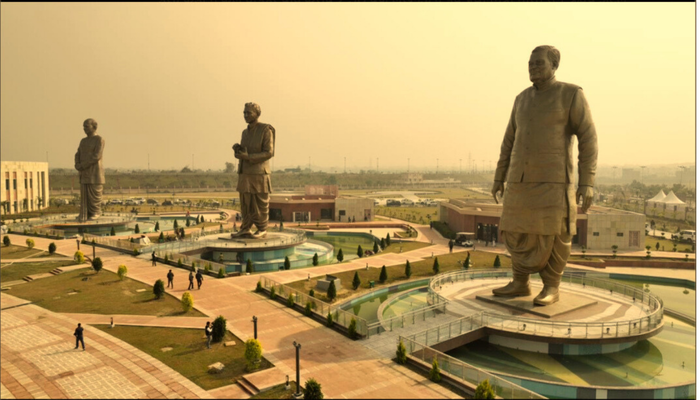

Today, on 25th December, is Good Governance Day. It is also the 101st birth anniversary of Bharat Ratna former Prime Minister Atal Bihari Vajpayee. On this occasion, Prime Minister Narendra Modi will dedicate the Rashtra Prerna Sthal in Lucknow, Uttar Pradesh, to the nation. Statues of three luminaries of nationalism, Dr. Shyama Prasad Mukherjee, Pandit Deendayal Upadhyaya, and Atal Bihari Vajpayee have been installed at this site.
Know about Rashtriya Prerna Sthal
The Rashtriya Prerna Sthal, located on the banks of the Gomti River in Lucknow, is spread across 65 acres. It was built at a cost of approximately ₹230 crore. Sixty-five-foot-tall bronze statues of the three nationalist leaders have been installed on its premises. The statues weigh about 42 tons each and are surrounded by water bodies. The complex houses a state-of-the-art museum designed in the shape of a lotus flower. It spans approximately 98,000 square feet. It features five galleries and 12 interpretation walls depicting the lives, struggles, and ideologies of the three leaders.
Remembering former Prime Minister Atal Bihari Vajpayee on the eve of Good Governance Day, Uttar Pradesh Chief Minister Yogi Adityanath described him as the undisputed leader of Indian politics. He said that the former Prime Minister took Indian politics to new heights in six decades. He connected it with values and ideals. CM Yogi Adityanath commented on the inauguration program of Rashtriya Prerna Sthal in a post on X. He said that Rashtriya Prerna Sthal is not just a tribute to the thoughts, ideals and the lives of Bharat Ratna Atal Bihari Vajpayee, Dr. Shyama Prasad Mukherjee and Pandit Deendayal Upadhyay; it symbolises the eternal values of inspirational leadership and patriotism crucial for building a ‘New India’.
पूर्व प्रधानमंत्री, 'भारत रत्न' श्रद्धेय अटल बिहारी वाजपेयी जी की 101वीं जयंती के पावन अवसर पर भारत की लोकतांत्रिक चेतना, सुशासन और राष्ट्रसेवा के मूल्यों को नई ऊर्जा प्रदान करते 'राष्ट्र प्रेरणा स्थल' का उद्घाटन विश्व के सर्वाधिक लोकप्रिय राजनेता आदरणीय प्रधानमंत्री श्री…
— Yogi Adityanath (@myogiadityanath) December 24, 2025
The contributions of Dr Shyama Prasad Mukherjee, Pandit Deendayal Upadhyaya, and Atal Bihari Vajpayee to Indian politics need no introduction. The Bharatiya Janata Party we see today has its ideological roots in the Bharatiya Jana Sangh, founded by Dr Shyama Prasad Mukherjee in 1951.
Dr Shyama Prasad Mukherjee wanted three Deendayals and got one Atal
Among the key members who shaped the organisation and ideology during its initial period, Pandit Deendayal Upadhyaya’s name figures prominently. Shyama Prasad Mukherjee used to say that if he could find three people like Deendayal Upadhyaya, he could change the face of the country’s politics. Although Shyama Prasad Mukherjee didn’t get three people like Deendayal Upadhyaya, he did find a similar figure in Atal Bihari Vajpayee, whose ideological clarity and organisational ability strengthened the Jan Sangh and later the BJP.

It was during this ideological journey that Atal Bihari Vajpayee emerged as a national leader. In the 1950s, Atal ji served as editor of magazines like “Panchjanya” and “Rashtradharma.” Pandit Deendayal Upadhyaya closely observed his writing and ideological maturity. Just as a jeweler recognizes a diamond, Deendayal Upadhyaya recognised a gem like Atal Bihari Vajpayee and introduced him to Dr Shyama Prasad Mukherjee. Subsequently, Atal ji served as Shyama Prasad Mukherjee’s assistant for a long time, especially on a sensitive subject like Kashmir.

This is the reason that when Atal Bihari Vajpayee became Prime Minister, the Kashmir issue remained an important and sensitive issue during his tenure. His approach towards the Kashmir issue, based on dialogue and resolution, not confrontation, was a result of his ideological upbringing and political experience.
Atal ji was also deeply influenced by Pandit Deendayal Upadhyaya’s philosophy of “Integral Humanism.” Whether it was connecting rural India to the mainstream, the Pradhan Mantri Gram Sadak Yojana, or the Sarva Shiksha Abhiyan, Atal Bihari Vajpayee’s vision of bringing development to the last person in society clearly reflected the influence of Deendayal Upadhyaya’s ideas on him.
Dr Shyama Prasad Mukherjee, Deendayal Upadhyaya, and Atal Bihari Vajpayee, all three of them dedicated their lives to creating an India they dreamed of. Today’s ‘New India’ not only carries forward their ideals but also realises their unfulfilled dreams. The bold step of abolishing Article 370 and clearly declaring Kashmir as an integral part of India by PM Narendra Modi is proof that the seeds of national consciousness sown by Dr Shyama Prasad Mukherjee during his lifetime have sprouted.