Major boost for ‘Make in India’: Apple planning to shift its iPhone chip assembly and packaging to India
In a major boost for the ‘Make in India’ initiative, Apple Inc. is exploring a massive expansion of its supply chain in India by holding discussions with Indian semiconductor firms to assemble and package certain iPhone components domestically. With this decision, Apple has again defied Trump’s threat to stop manufacturing in India. Reports say the talks between Indian semiconductor companies and Apple particularly centre on outsourced semiconductor assembly and test (OAST) processes, the backend steps of assembling dies into finished chips and packaging them, rather than full chip fabrication. The CG Semi, a unit of the Murugappa Group, is the primary partner in the exploratory talks. CG Semi is building a major OSAT facility in Gujarat’s Sanand. The initial focus could be on display driver integrated circuits (DDICs) used in OLED panels of the iPhone. Currently, South Korea, Taiwan and China provide chip fabrication and packaging facilities to Apple. Notably, Apple sources its iPhone display panels from the world’s top OLED manufacturers: Samsung Display, LG Display, and BOE. The DDICs used with these panels are supplied by Samsung, Novatek, Himax, and LX Semicon. While the discussions remain in the initial stage, Apple’s reported move builds on the US-based tech giant’s rapid scaling of iPhone production in India. It was reported earlier that iPhone assembly in India reached $22 billion in value by March 2025, marking a 60 per cent year-on-year increase. Tata Electronics, Foxconn, and Pegatron handle iPhone’s full device assembly in India. India is becoming Apple’s ‘apple of the eye’ as diversification away from China becomes a necessity Apple has consistently been expanding its manufacturing footprint in India as the company is intensifying diversification away from China. What drives this strategy is India’s vast potential, US-China trade risks and ever-looming threat of more and more Trump tariffs. Apple is aiming to produce most iPhones sold in the US at Indian factories by the end of the year 2026. Interestingly, Apple’s reported plans of shifting assembly and packaging to India reflect a step up the value chain from just device assembly. Even though advanced processors like A-series and M-series chips continue to be fabricated by Taiwan’s TSMC, localising backend processes shortens supply chains, slashes transportation costs and import duties while also improving resilience against disruptions. Besides, Apple will also benefit from India’s skilled labour pool and rapidly growing precision engineering ecosystem. Regarding this, Prabhu Ram, vice president, industry research group, CyberMedia Research, told TOI, “As India evolves into a crucial component of the global electronics supply chain, Apple could gain from increased stability and variety by potentially collaborating with an Indian chip manufacturer.” If everything goes right, this development could give a massive impetus to India’s nascent but emerging semiconductor industry, especially in the OSAT segment, which, although is less capital-intensive than front-end fabrication, is significant for scaling production. The CG Semi facility alone will create high-skilled jobs, in testing, assembly and packaging, if the Apple-CG Semi talks materialise. In addition, with a broader ecosystem growth, thousands of jobs in ancillary roles. Besides, local packaging in India would curb reliance on East Asian hubs and attract suppliers for material and equipment, etc, creating a thriving ecosystem akin to those in Vietnam or Taiwan. This would encourage other global players to invest in India and expand partnerships. Needless to say that Apple’s investment in India’s capabilities will signal confidence and serve as a catalyst for other global tech giants to pour investment into the sector. Not to forget, Intel has partnered up with India’s Tata Electronics recently for “collaboration focused on consumer and enterprise hardware enablement, and semiconductor and systems manufacturing.” With this, Tata Electronics’ upcoming Fab in Assam and OSAT facility in Assam will manufacture and package Intel products for local markets, in addition to advanced packaging. India’s domestic firms and startups in semiconductor could also benefit from a partnership with Apple, as such collaborations involve knowledge sharing in quality standards, processes and testing. As the Indian government is offering subsidies for OSAT facilities, Apple’s plans to shift assembly and packaging to India could elevate the country from low-value assembly to higher-value semiconductor backend work and open doors for further progress, aligning with India’s Semiconductor Mission. Notably, the Modi government provides a financial support of 30% of the Capital Expenditure to the eligible applicants for setting up of Compound Semiconductors / Silicon Photonics (SiPh) / Sensors (including MEMS) Fab and Semiconductor ATMP / OSAT facilities in In
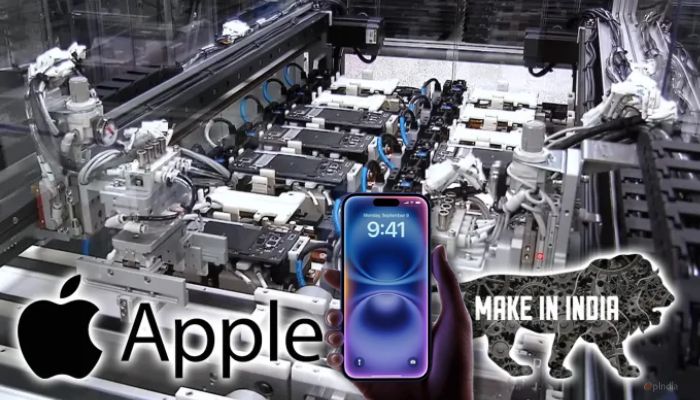

In a major boost for the ‘Make in India’ initiative, Apple Inc. is exploring a massive expansion of its supply chain in India by holding discussions with Indian semiconductor firms to assemble and package certain iPhone components domestically. With this decision, Apple has again defied Trump’s threat to stop manufacturing in India.
Reports say the talks between Indian semiconductor companies and Apple particularly centre on outsourced semiconductor assembly and test (OAST) processes, the backend steps of assembling dies into finished chips and packaging them, rather than full chip fabrication.
The CG Semi, a unit of the Murugappa Group, is the primary partner in the exploratory talks. CG Semi is building a major OSAT facility in Gujarat’s Sanand.
The initial focus could be on display driver integrated circuits (DDICs) used in OLED panels of the iPhone. Currently, South Korea, Taiwan and China provide chip fabrication and packaging facilities to Apple.
Notably, Apple sources its iPhone display panels from the world’s top OLED manufacturers: Samsung Display, LG Display, and BOE. The DDICs used with these panels are supplied by Samsung, Novatek, Himax, and LX Semicon.
While the discussions remain in the initial stage, Apple’s reported move builds on the US-based tech giant’s rapid scaling of iPhone production in India. It was reported earlier that iPhone assembly in India reached $22 billion in value by March 2025, marking a 60 per cent year-on-year increase. Tata Electronics, Foxconn, and Pegatron handle iPhone’s full device assembly in India.
India is becoming Apple’s ‘apple of the eye’ as diversification away from China becomes a necessity
Apple has consistently been expanding its manufacturing footprint in India as the company is intensifying diversification away from China. What drives this strategy is India’s vast potential, US-China trade risks and ever-looming threat of more and more Trump tariffs. Apple is aiming to produce most iPhones sold in the US at Indian factories by the end of the year 2026.
Interestingly, Apple’s reported plans of shifting assembly and packaging to India reflect a step up the value chain from just device assembly. Even though advanced processors like A-series and M-series chips continue to be fabricated by Taiwan’s TSMC, localising backend processes shortens supply chains, slashes transportation costs and import duties while also improving resilience against disruptions. Besides, Apple will also benefit from India’s skilled labour pool and rapidly growing precision engineering ecosystem.
Regarding this, Prabhu Ram, vice president, industry research group, CyberMedia Research, told TOI, “As India evolves into a crucial component of the global electronics supply chain, Apple could gain from increased stability and variety by potentially collaborating with an Indian chip manufacturer.”
If everything goes right, this development could give a massive impetus to India’s nascent but emerging semiconductor industry, especially in the OSAT segment, which, although is less capital-intensive than front-end fabrication, is significant for scaling production.
The CG Semi facility alone will create high-skilled jobs, in testing, assembly and packaging, if the Apple-CG Semi talks materialise. In addition, with a broader ecosystem growth, thousands of jobs in ancillary roles.
Besides, local packaging in India would curb reliance on East Asian hubs and attract suppliers for material and equipment, etc, creating a thriving ecosystem akin to those in Vietnam or Taiwan. This would encourage other global players to invest in India and expand partnerships. Needless to say that Apple’s investment in India’s capabilities will signal confidence and serve as a catalyst for other global tech giants to pour investment into the sector.
Not to forget, Intel has partnered up with India’s Tata Electronics recently for “collaboration focused on consumer and enterprise hardware enablement, and semiconductor and systems manufacturing.” With this, Tata Electronics’ upcoming Fab in Assam and OSAT facility in Assam will manufacture and package Intel products for local markets, in addition to advanced packaging.
India’s domestic firms and startups in semiconductor could also benefit from a partnership with Apple, as such collaborations involve knowledge sharing in quality standards, processes and testing.
As the Indian government is offering subsidies for OSAT facilities, Apple’s plans to shift assembly and packaging to India could elevate the country from low-value assembly to higher-value semiconductor backend work and open doors for further progress, aligning with India’s Semiconductor Mission.
Notably, the Modi government provides a financial support of 30% of the Capital Expenditure to the eligible applicants for setting up of Compound Semiconductors / Silicon Photonics (SiPh) / Sensors (including MEMS) Fab and Semiconductor ATMP / OSAT facilities in India.
In addition, the government also provides financial incentives, designs infrastructure support across various stages of development and deployment of semiconductor design for Integrated Circuits (ICs), Chipsets, System on Chips (SoCs), Systems & IP Cores and semiconductor-linked design.
The government scheme also offers “Product Design Linked Incentive” of up to 50% of the eligible expenditure, subject to a ceiling of ₹15 Crore per application, and “Deployment Linked Incentive” of 6% to 4% of net sales turnover over 5 years, subject to a ceiling of ₹30 Crore per application.
The success of Apple’s partnership with Indian semiconductor companies could also accelerate progress towards much-needed self-reliance in the electronics sector.
Moreover, this partnership could reinforce appeal as a reliable and efficient alternative to China. The Modi government’s Production Linked Incentives (PLI) schemes are already luring foreign companies to expand investment in India.
For Apple, diversifying chip packaging away to India curbs vulnerability to Taiwan Strait tensions, which are on the rise currently, and other disruptions in the region. For India, this partnership could create massive job opportunities, enhance the semiconductor industry and contribute significantly to economic growth. Although the road is not without challenges, however, this could pave the way for more sophisticated components or even front-end fabs; however, it is a long game.
It must be recalled that in September this year, despite repeated threats from U.S. President Donald Trump to stop manufacturing in India, Apple Inc. announced plans not only for expanding iPhone assembly lines in India, but also increasing the localisation of the production of specialised machinery critical to the process.
It was reported that Apple Inc. is pivoting beyond component sourcing to manufacture the very capital equipment and tools used in iPhone production.